
Just-in-time (JIT) inventory keeps stock to a minimum by scheduling materials to arrive only as production needs them. For decades, that lean approach has helped businesses cut costs and reduce waste. But today's less predictable supply chains have made a purely lean approach riskier than it once was. Businesses that understand how JIT works, where it fits, and what it demands can better decide whether it's right for their business.
This article will cover:
- A diagram of the JIT process and steps
- Pros and cons of JIT inventory management
- Questions to help determine whether it’s time to adopt JIT inventory management
What Is Just-in-Time (JIT) in Inventory Management?
JIT is a form of inventory management that requires working closely with suppliers so that raw materials arrive as production is scheduled to begin, but no sooner. The goal is to have the minimum amount of inventory on hand to meet demand.
Key Takeaways
- There are more advantages than disadvantages to practicing JIT if you have a proven, reliable supply chain and accurate demand planning.
- JIT has potential risks if you don’t have accurate and frequently updated sales forecasts.
- Before implementing JIT, make sure your inventory system works with JIT inventory management.
Video: What Is JIT Inventory Management?
Just-in-Time (JIT) Inventory Management Explained
JIT inventory maintains enough stock to produce only what you need, when you need it. The goal is to achieve high-volume production with minimal inventory on hand and to eliminate waste. JIT emerged as part of the broader lean manufacturing movement, and the two still work hand in hand: Lean shapes how work flows, while JIT governs when materials arrive to support it. That tight coordination is what makes JIT so effective at freeing up cash and cutting storage costs, though it also leaves little room for error if supply is disrupted.
Why Use JIT Inventory Management?
Companies often adopt JIT inventory management as a cost-cutting strategy. When implemented correctly, JIT can create more value than traditional methods that require more extensive inventories.
How Does Just-in-Time Inventory Management Improve Businesses?
Just-in-time inventory management reduces waste, improves cash flow, increases flexibility, optimizes human resources, and encourages team empowerment.
Companies that are successful at JIT inventory management maximize profits by keeping investment in stock as low as possible. They use data to manage inventory. They use an ERP system to gather information on shipping, customer satisfaction, loss prevention, warehousing, purchases, reorders, goods in storage, receiving, stock turnover, and more.
How Does Just-in-Time Inventory Management Work?
JIT inventory management times stock to arrive as it is needed for production or to meet consumer demand, but no sooner. Since the main objective is often quality and not the lowest price, JIT requires long-term contracts with reliable suppliers and a steady production flow.
But reliability depends on more than supplier agreements. It works best when both operations move in sync. In JIT, all parts of any production or service system, particularly people, are interconnected. They inform each other and are mutually dependent on generating successful outcomes. This practice’s origin comes from Kaizen, a Japanese term meaning “change for the better.” Originating in Japan, the business philosophy looks to continuously improve operations and involve all employees, from assembly line workers to the CEO. Like JIT, the goal is to reduce waste and improve quality.
The JIT Process
Organizations may vary in how they implement JIT in their environments, but the general steps are the same. This diagram shows how the cycle of continuous improvement works in JIT inventory management.
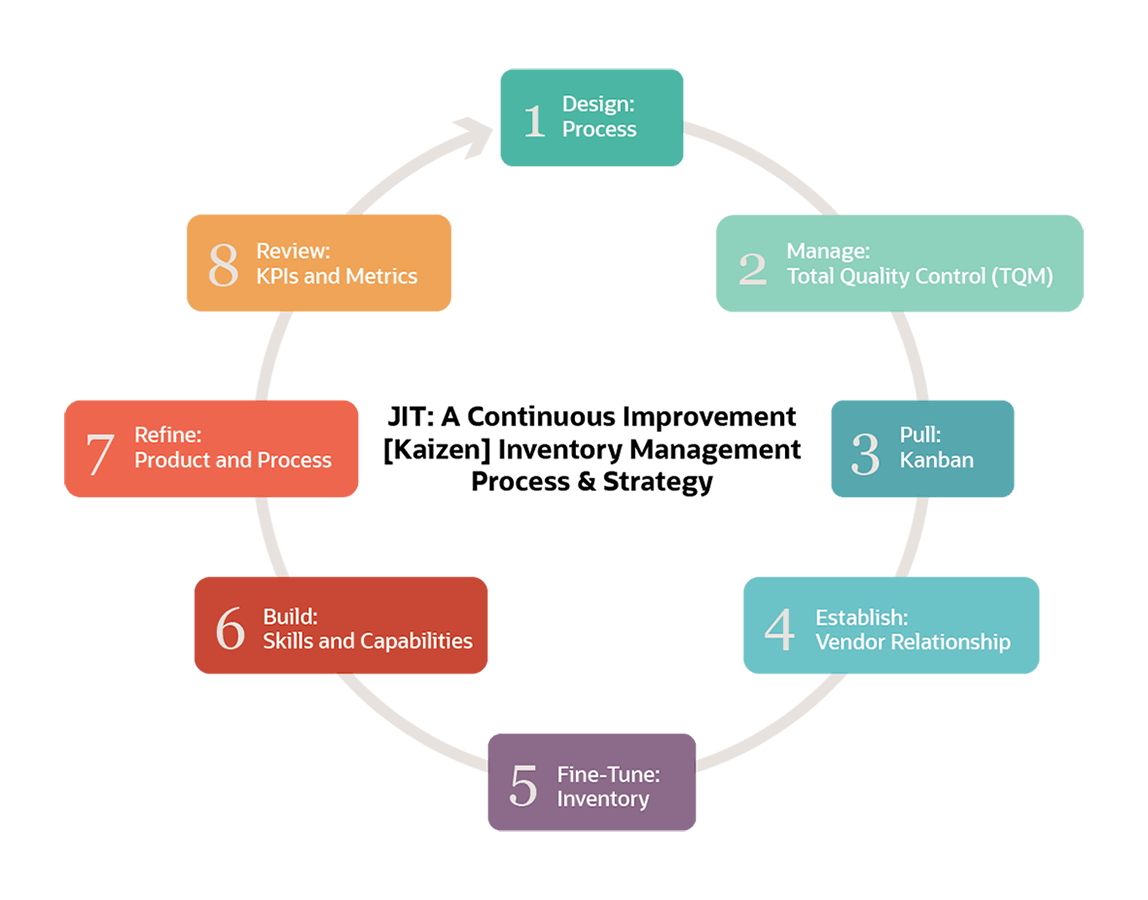
8 Steps in the Cycle of Continuous Improvement for JIT Inventory Management
- Design: The JIT process begins with a review of the essential manufacturing building blocks: product design, process design, personnel, and manufacturing planning. Then plans are put into place to eliminate disruption, minimize waste, and build a flexible system.
- Manage: A total quality management (TQM) review maintains continuous improvement throughout the process. A management review defines workers’ roles and responsibilities, defines and measures statistical quality control, stabilizes schedules, and checks out load and capacity schedules and levels.
- Pull: Educate the team on production and withdrawal methods using signaling methods like Kanban. Review lot size policies and reduce lot sizes.
- Establish: Vendor relationships are vital to the success of JIT. Review vendor lists. Settle on preferred suppliers, negotiate contracts, discuss lead times, delivery expectations, and usage metrics and measures. Learn how to make the most of them in the supply chain.
- Fine-tune: Determine inventory needs, policies, and controls, and reduce inventory movements.
- Build: Inform your team about the skills and capabilities it needs to complete its work and conduct team education and empowerment sessions to educate them.
- Refine: Reduce the number of parts and steps in production by refining, standardizing, and reviewing the entire process.
- Review: Define and implement quality measures and metrics and conduct a root cause analysis of any problems. Emphasize improvements and track trends to improve every aspect of JIT.
Pros and Cons of JIT Inventory Management
JIT inventory management has its pros and cons: Less inventory saves money but relies on strong coordination between workers and suppliers. Also, strict protocols and forecasting requirements produce value, but various factors can disrupt it.
Pros and Cons of JIT Inventory Management
| Pros | Cons |
|---|---|
| Waste Reduction | Lack of Preparedness |
| Reduced Obsolete Inventory | Supply Chain Disruption Risks |
| Fewer Defective Products | Missed Opportunities |
| Improved Efficiency | Unexpected Price Changes |
| Higher Inventory Turnover Ratios | Challenges Brought By Sudden Change |
| Less Excess Stock | Order Issues |
| Reduced Space Requirements | Local Sourcing Costs |
| Smaller Delivery Quantities | Forecasting Flaws |
| Local Sourcing | Time Pressure |
| Greater Productivity | Undisciplined Staff |
| Faster Product Turnaround | Supplier Dependence |
| Reduced Rework | Greater Disruption Threats from Natural Disasters |
| Shorter Production Runs | |
| Easier Change Orders | |
| Better Supplier Relationships | |
| Smoother Production Flow | |
| Shorter Production Cycles | |
| Reduced Process Problems | |
| Fewer Production Runs | |
| Functional Production Cells | |
| Better Equipment Utilization | |
| Compressed Operations | |
| Lower Costs | |
| Reduced Working Capital | |
| Lower Holding Costs | |
| Lower Cash Investment | |
| Fewer Large Raw Material Spends | |
| Reduced Direct and Indirect Labor Costs | |
| Improve Cash Flow | |
| Reduced Defective Product Loss | |
| Improved Quality | |
| Improved Customer Service |
Benefits of JIT Inventory Management
JIT inventory management boosts a company’s ROI by reducing inventory carrying costs, increasing efficiency, and decreasing waste. And because JIT touches nearly every stage of production, those gains are only the starting point. The benefits below show how a well-run system can drive value across cost, cash flow, productivity, and product quality.
- Waste reduction: The JIT inventory management model eliminates
overordering and excess of all kinds.
- Reduce obsolete inventory and dead stock: Low inventory levels significantly reduce the risk of inventory going unsold and sitting in the warehouse obsolete.
- Reduce defective product loss: Defective inventory items are easier to identify and fix when production levels are low, which reduces scrap costs.
- Improved efficiency: JIT eliminates the costs that come with extra
raw materials, unneeded inventory, and product storage.
- Raise inventory turnover ratios: Greater efficiency brings higher inventory turnover.
- Minimal inventory obsolescence: The high inventory turnover rate keeps items from sitting in your facility for too long and becoming obsolete.
- Minimize raw materials on hand: Receiving deliveries in the smallest possible quantities (sometimes multiple times a day) virtually eliminates raw material inventories.
- Local sourcing: When suppliers are located near a company’s production facility, the shortened distances contribute to timely deliveries. On-time, reliable delivery of goods reduces the need for safety stock.
- Greater productivity: JIT enhances productivity by reducing the
time and resources involved in manufacturing processes.
- Faster product turnaround: Manufacturers can more quickly produce products.
- Shorter production runs: With JIT, manufacturers can deliver new products more quickly and easily.
- Simplify change orders: Having less raw material stock to draw down before product changes makes it easier to implement engineering change orders to existing products.
- Smoother production flow: JIT can eliminate bottlenecks and delays
across the entire production process.
- Shorter production cycles: JIT shortens manufacturing time, which decreases lead times for customers.
- Reduce product defects: Production mistakes can be spotted faster and corrected, which results in fewer defective products.
- Shorter production runs: Fast equipment setup times reduce production runs, lowering investment in finished goods.
- More functional production cells: Employees walk individual parts through the processing steps in a work cell, which reduces scrap levels. Cell models also eliminate work-in-process queues that build up at more specialized workstations.
- Compressed operations: Arranging production work cells near each other limits the amount of work-in-process inventory moving between cells.
- Lower costs: Receiving goods on an as-needed basis reduces
inventory costs.
- Reduce working capital: The low inventory levels that come with JIT limit the amount of working capital needed.
- Lower holding costs: Inventory holding costs (like those for warehousing) are minimal because less space is used.
- Lower cash investment: Companies invest less cash in inventory because JIT doesn’t require having a lot of stock on hand.
- Reduce large raw material spends: In JIT, businesses order raw material when needed, so cash is available for other uses that could be more valuable to the company.
- Reduce labor costs: Labor expenses are lower since the number of person-hours required to fulfill orders is usually fewer than full-time production.
- Improve quality: A flexible workforce can focus on making quality
products with lower defect rates. Better outcomes increase customer satisfaction and
reduce the cash outlay for production.
- Reduce work-in-progress goods: Fewer items moving on the shop floor allows teams to focus on building high-quality products.
- Less damage: Since minimal inventory is on hand, storage-related accidents decline.
- Certified quality: Suppliers guarantee quality in advance. So, deliveries go straight to production areas instead of being held in receiving to await inspection.
To support these goals, you can invest in new technology or update existing solutions that will link your system with your suppliers to coordinate the delivery of parts and materials.
Drawbacks of Just-in-Time Inventory
JIT inventory management relies heavily on precise forecasting and strong relationships with key suppliers. When something goes wrong with either of those, that’s a problem because there are no backup options in place. For example, a single supplier that can’t deliver for any period of time can disrupt the entire supply chain and halt your operations. In addition, companies practicing strict JIT inventory management probably won’t have extra stock to satisfy unexpected orders. If an organization’s forecasting can’t account for a surge in demand, it won’t have the stock to fill those orders. That could mean lost revenue and, potentially, lost customers.
Potential Risks of Just-in-Time Inventory
The primary risk of JIT comes from its philosophy. JIT inventory management requires everyone in an ecosystem and supply chain to commit and work cohesively. If any part of that arrangement breaks down, it risks the entire infrastructure:
- Lack of preparedness: The business’s entire workflow needs to convert to a lean framework. These actions affect the organization and the supply chain, which may need to change its procedures and practices.
- Missed opportunities: With few or no finished goods on hand, a company may not be able to meet massive and unexpected orders immediately.
- Unexpected price changes: In JIT, the cost for parts is constant. When costs rise, profit margins drop.
- Overreliance on forecasts: Adapting to sudden surges or declines is difficult because of the reliance on forecasting.
- Order issues: Shortages and stock-outs can disrupt inventory systems.
- Local sourcing costs: JIT relies on local sourcing, which can cost more for a number of different reasons. This dependency can also affect profitability in the pursuit of reliability.
- Time pressure: Scheduling may increase the cost of goods sold (COGS) because there’s no guarantee a company will always have the best price for raw materials from a supplier.
- Undisciplined staff: Team members that are not on board with JIT can affect productivity, quality, and other issues.
- Supplier dependence: A supplier who does not deliver goods on time and in the right amounts can disrupt the entire production process.
- Acts of nature: A natural disaster that interferes with a vendor’s flow of goods can halt production.
JIT Inventory Management and Supply Chain Disruptions
A JIT system is only as strong as the supply chain behind it. These days, trade shifts, regional conflicts, and climate disruptions are recurring pressures—indeed, among the Association for Supply Chain Management’s top 10 supply chain trends for 2026—and a lean operation has little buffer to absorb them. In response, many companies apply JIT selectively, holding “just-in-case” inventory—also known as safety stock—for critical items. They also diversify their supplier base, often through dual sourcing, and employ systems with AI-powered forecasting that can pinpoint risks early enough for adjustments to be made before a problem becomes a shutdown.
JIT Inventory Methodology
The JIT inventory methodology uses a variety of techniques to smooth operations. The lean method focuses on optimizing organization, paying attention to detail, having small lot sizes, increasing transparency, fostering cell manufacturing, and using a pull (rather than push) approach. The following components are central to JIT inventory methodology:
- Order: Maintain a high level of physical and organizational discipline.
- Better quality: Eliminate defects through attention to detail and continuous improvements.
- Reduced setup time: Create flexible changeover approaches when setups need to adjust to meet customer demand.
- Small lot size: In JIT, one is the ideal lot size. The small size reduces in-process inventory, carrying costs, and storage space, and makes for easier inspection and rework.
- Load uniformity: Leveling is a control mechanism that achieves a stable, level daily schedule.
- Flow balance: Flow scheduling organizes throughput for even distribution of energy and labor.
- Diversified skills: Cross-trained workers can be deployed to different areas to keep production moving.
- Visibility for control: Using communication tools, like those found in Kanban, keeps the entire team informed of inventory levels.
- Ongoing maintenance: Ongoing oversight and focus on detail, including the machinery and tools the business uses every day, helps maintain a low defect, low problem environment.
- Use fitness: JIT spaces designed to fit each process speed up production. One workstation pulls output from the one before it, as needed, based on a master schedule or customer demand.
- Logical plant layout: Product-oriented design makes assembly easier and more efficient.
- Strong supplier network: Strong relationships with vendors make JIT inventory most effective.
- Worker immersion: Every team member should be dedicated to the process and colleagues to achieve JIT goals.
- Cell manufacturing: Create an environment where groups can work as quickly as possible to make as many products as they can and limit the waste they create.
- Pull system: The process of only replacing products once they’ve been used in production.
Why Is Kanban a Critical Element for the JIT Inventory System?
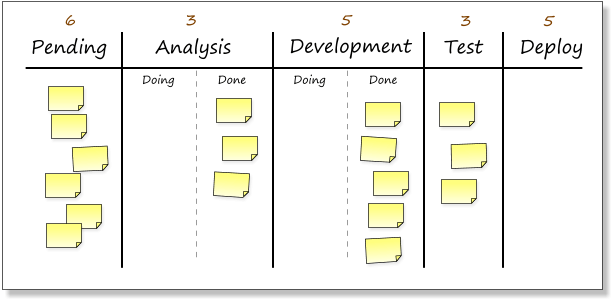
Kanban is the “nervous system” of lean JIT production, controlling work-in-progress production and inventory movement. Kanban is crucial when it comes to eliminating manufacturing waste due to overproduction.
More traditional mass production methods use push inventory strategies based on the estimated number of expected sales. Kanban’s pull system creates more flexibility on the production floor because a company only produces goods based on actual orders. Kanban uses cards (paper or digital) to track the progress of production on a factory floor. As inventory moves through the manufacturing process, Kanban cards reflect that progress and can signal when it’s time to order more stock.
Who Uses Just-in-Time Inventory Management?
JIT inventory management is typically applied in four main ways: to cut waste in perishable or fast-changing goods, to manage the cost and complexity of high-value production, to match supply with demand that is seasonal or hard to predict, and to produce items only when their orders are placed. Although commonly associated with manufacturing, JIT is used across many other sectors, from automakers to healthcare:
- Apparel: JIT is an ideal way to lower the high cost of inventory in the clothing business. Stocking apparel is costly and risky because more inventory needs to be carried to meet the variety of styles, sizes, and colors needed to meet customer demand.
- Aerospace: The risk of delay and cost overruns is higher in this vertical than in many other industries. JIT mitigates those issues and saves valuable space in plants.
- Automotive: JIT was born in the automotive space to improve capacity and be more competitive. The practice is still in use today by car companies worldwide.
- Big-box retailers: Stores like Walmart and Target schedule the arrival of merchandise—like back to school, seasonal weather, and Christmas goods—as demand rises for specific items based on forecasting and past experience. They clear shelves to make room for the next season’s goods when interest wanes.
- Construction: In construction, waste is waiting, storing inventory, and moving materials frequently. Proponents of the lean methodology have adapted JIT to mitigate these issues.
- Fast food: Franchises need to keep a substantial inventory of ingredients on hand. However, food is only made when there’s an order. JIT procedures eliminate waste; using fresh ingredients also gives chains a marketing advantage.
- Florists: A florist can use JIT by ordering flowers only based on customer demand. When florists shop the flower market, they know the amount and specific items to buy.
- Healthcare: Many health care organizations turn to JIT inventory management to keep supplies lean and expenses low. The industry faces tighter profit margins tied to care costs and rate cuts for reimbursements.
- Manufacturers: In manufacturing, speed to market and production costs can make or break a company. JIT helps reduce flow times within production systems and improve response times from suppliers and customers.
- On-demand publishing: On-demand publishing is the epitome of JIT inventory management. Book manuscripts are printed and assembled only when sold. JIT reduces wasteful destruction of books and returns of unsold inventory.
- Publishing: Independent publishers and self-publishers use just-in-time delivery to print and assemble books on an as-needed basis to reduce costs due to unsold inventory.
- Retail: JIT focuses on having enough stock to satisfy demand. In the past, retailers carried a surplus so they wouldn’t run out of desired items and lose out on potential sales. However, this isn’t an option for stores operating on a tight budget. With a JIT model, the goal is to physically stock zero inventory until a customer places an order. Learn how to reduce inventory in retail operations.
Companies That Use JIT Inventory Management
A number of the most successful companies in the world, including Amazon and Apple, use JIT inventory management and build strong supplier relationships to maintain their competitive position. JIT is uniquely suited to drive value in manufacturing environments and service businesses that must match output with customer demand. For many companies, this emphasis on timing helps them keep and increase their market presence.
Major corporations in every industry take advantage of JIT inventory management, including:
- Amazon.com: The ecommerce retail giant uses a variation of JIT: setting up dedicated space inside key suppliers’ warehouses. Amazon has a small fenced off area within Procter & Gamble’s (P&G) Pennsylvania warehouse, for example. P&G loads products onto pallets and simply moves them to the Amazon area. Amazon employees then package, label, and ship products directly to consumers who ordered them. The Pennsylvania location is five miles from P&G’s largest manufacturing plants and near major cities in the Northeast and Canada. Amazon can meet the critical 24-hour delivery window with P&G personal care products.
- Apple: Apple is one of the most cited examples of JIT done well, holding only about 9 to 10 days’ worth of inventory in recent years and turning over its stock roughly 38 times a year. Production outsourcing has made Apple leaner, resulting in stocking most inventory in retail stores and less overstock. This approach has helped make the technology company one of the world’s most profitable businesses, and it maintains those tight inventory levels through strong supplier relationships and disciplined demand planning.
- The Boeing Company: Beginning in the mid-1990s, Boeing applied JIT across the enterprise to work more closely with suppliers and remove redundancies, reduce costs, and improve product quality. Boeing continues to transform itself into an integrator of large parts and systems and implements lean manufacturing principles. The company relies heavily on its supply base to meet customer demand.
- Dell Technologies: Dell adopted lean/JIT operations in the 1980s with direct-to-consumer sales. The company would order parts when it made a sale to a customer. Rather than stock a warehouse full of preassembled computers, Dell reduced costs and lead times with JIT. These days Dell continues to run lean, relying on build-to-order production and, in 2024 and 2025, a hybrid replenishment strategy to keep inventory tight while protecting service levels.
- Grayton: The high-end watchmaker was the first to adopt lean manufacturing strategies in the watch industry. As a result, Grayton increased its cash flow by 70% in one year. The company created a simplified, cost-efficient, fast fashion manufacturing model, a challenging feat in the traditionally entrenched watch industry.
- Harley-Davidson USA: The motorcycle manufacturer curtailed its large inventory habits by using the JIT method to solve inefficiency. Harley-Davidson reduced its inventory by 75%, eliminating extra warehousing costs. The company is responsive to customer orders with minimal lead time, increasing its productivity along the way. In 2025, Harley-Davidson again moved to tighten inventory, aligning production more closely with demand to offset tariff pressures, a sign of how JIT continues to adapt to current conditions.
- Kellogg Company: Kellogg’s is a large-scale food manufacturer that stores only enough inventory to meet customer orders. The company uses JIT for operations, production, inventory, and distribution. It optimizes production and inventory costs and budgets with JIT. Kellogg obtains its raw food materials from primary suppliers worldwide to produce 40 different types of cereals and snacks.
- Nike: Nike has long used lean and JIT principles to cut waste and speed production across its supplier network. More recently, the company has doubled down, working to run leaner by simplifying its product line, automating more of its supply chain, and reducing the inventory it holds in its own distribution network.
- Tesla: Despite Tesla’s growth, the company cannot independently enjoy the same economies of scale as large auto manufacturers. Tesla takes ownership of its supply chain, keeps minimal inventory, and essentially manufactures on demand. This practice helps Tesla have more capital available because it isn’t tied up with surplus inventory.
- Toyota Motor Corporation: Toyota is one of the most well-known examples of companies using the JIT method. When a client places an order, Toyota receives raw materials in the factory only when it is ready to start building the automobile. This process minimizes inventory holding costs. More recently, though, Toyota has refined its approach. After semiconductor shortages disrupted production, the company began stockpiling strategic, hard-to-source components while keeping the rest of its operation lean, a “just-right” adjustment that lets it protect output without abandoning JIT’s core efficiency.
- Zara SA: Operating under the motto inventory = death, the fast fashion leader owns its supply chain and brings goods to market extraordinarily quickly. Zara locks in 50-60% of its line by the start of the season. That means the company designs and manufactures up to 50% of its clothes in the middle of the season. When a particular style or design suddenly comes into vogue, Zara reacts by creating new products and getting them into stores while the trend is still cresting.
Questions to Ask If You Are Considering JIT Inventory Management
Before converting to JIT inventory management, consider the following six factors in assessing corporate readiness: turnarounds, forecasting, flexibility, vendors, workforce, and technology:
- Turnarounds: Can my products be manufactured or supplied quickly?
- Forecasting: Do I have enough confidence in my sales forecast to accurately depict fluctuating consumer demand, including seasonality?
- Flexibility: Do I have enough flexibility in my supply chain and manufacturing to adapt to disruptions like supplier disruptions or natural disasters?
- Vendors: Are my suppliers reliable enough to deliver on time, every time? Is my order fulfillment system efficient enough to get orders through on time even when they have to compensate for supply chain delays?
- Workforce: Implementing a JIT system requires total support and understanding from every operational division, especially employees. JIT relies on multi-functional, cross-trained employees to perform several duties so team members can fill in when and where needed in the production line cell. Is my workforce committed and up to the task?
- Technology: Does my inventory management software support JIT inventory management?
Shifting to JIT or any new system requires preparation, research, and buy-in. Find out how to increase profits and simplify operations by reading the guide to inventory planning.
History of Just-in-Time Inventory Management
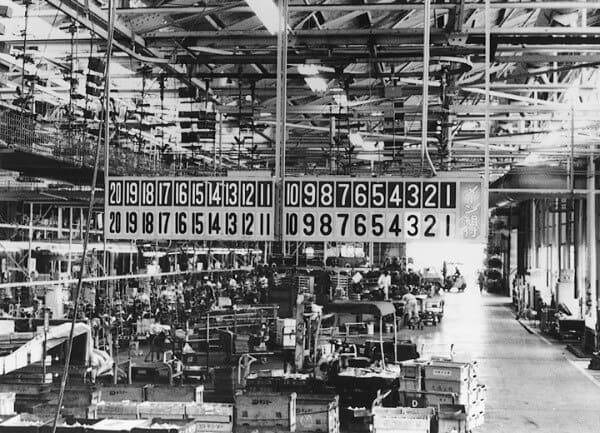
The just-in-time philosophy was initially known as the “Toyota Production System” (TPS) or just-in-time manufacturing. The approach was developed in post-World War II Japan, when car manufacturing faced shortages and had to minimize resource consumption to survive and remain competitive. Eiji Toyoda and Taiichi Ohno, Japanese industrial engineers, created the system when Toyota Motor Company (TMC) recognized that U.S. carmakers of that era were outpacing their Japanese counterparts. After some testing, they established the Toyota production system and closed the gap between 1945 and 1970. JIT has continued to grow as a practice worldwide. This system’s basic underlying idea is to minimize the consumption of resources that add no value to a product.
Produce More, Faster, With NetSuite Inventory Management
No matter the global backdrop, running JIT well depends on knowing exactly what you have, where it is, and when you’ll need more. NetSuite Inventory Management gives businesses a single, real-time view of stock across every location. This is also where AI makes the biggest difference: AI-powered insights uncover shortages, overstocks, and demand shifts before they become problems, helping lean operations strike the “just-right” balance between lean stock and resilience. The same insights also automate reordering, so companies can hold less inventory and free up cash without risking a shutdown.
JIT inventory can generate tremendous benefits, from lower costs to higher profitability, but today those gains depend on managing its risks as much as its efficiencies. To evaluate whether it’s a fit, weigh the pros and cons against your industry and business model, consider whether your organization can support the processes involved, and think about how the right technology could help you capture JIT’s advantages while staying resilient when supply chains shift.
JIT Inventory Management FAQs
What is a just-in-time inventory system?
The JIT inventory system aligns production schedules with the delivery of supplies. These systems increase efficiency and decrease waste by receiving goods on an as-needed basis.
Can JIT inventory management reduce overall costs for a business?
Yes, just-in-time (JIT) inventory management can lower several categories of cost at once. By holding less inventory, businesses reduce carrying costs, such as warehousing, insurance, and the capital tied up in unsold stock. They also cut losses from obsolete or damaged goods. The savings are greatest when a company has reliable suppliers and accurate demand forecasts. Without them, a poorly run JIT system can give back those savings through lost sales and costly disruptions.
What is the just-in-time method of inventory control?
The just-in-time (JIT) method of inventory control involves creating, storing, and tracking enough orders to supply demand. JIT differs from other inventory strategies in that businesses don’t make and hold excess inventory in anticipation of future orders.
What’s the difference between JIT inventory and JIT manufacturing?
Just-in-time (JIT) inventory and manufacturing have a similar principle: produce or receive a product only when needed. They operate at different points in the supply chain but can work together or independently.
What is the difference between just-in-time (JIT) vs. just-in-case (JIC) manufacturing?
JIT aims to reduce waste by only taking in inventory as needed for production. JIC prioritizes stocking surplus goods and outpacing the current demand to fulfill orders on time.
What is the difference between just-in-time inventory vs. Economic Order Quantity (EOQ)?
Just-in-time (JIT) secures the right quality and quantity of inventory using minimum resources, time, and material waste. EOQ is a formula used to identify stock replenishment levels to avoid shortages and extra costs. The EOQ regulates the most favorable inventory to produce or buy to minimize order and storage costs. The EOQ formula is useful for companies that have consistent demand, order, and holding costs over time.
What is an example of just-in-time delivery?
Supermarkets take advantage of just-in-time delivery by only restocking a product once customers have bought nearly all available items. The demand for any item directly affects supply, meaning the market replenishes some goods on a regular basis and others infrequently.
How does the Theory of Constraints (TOC) apply to JIT inventory management?
TOC is a continuous improvement principle and process that identifies systemic weakness or variables. In just-in-time (JIT), the TOC pinpoints the weakest part or person that may constrain system throughputs.
What are the main challenges of implementing JIT inventory systems?
The biggest challenge is that just-in-time (JIT) leaves little room for error. Because there is minimal buffer stock, a single late supplier, a demand spike, or a supply chain disruption can stall production. Success depends on accurate forecasting, strong supplier relationships, and real-time visibility into inventory. Many companies pair JIT with a “just-right” mix of safety stock and AI-powered demand planning.