
Managing vendors, suppliers, service providers, and contingent workers has become more intricate—and more important—than ever. As external workforces grow, so do the risks and inefficiencies associated with fragmented systems and inconsistent oversight. Traditional tools and manually performed processes can’t keep pace with today’s speed and scale involved with relationship management, so many businesses have begun turning to vendor management systems for help.
What Is a Vendor Management System?
A vendor management system (VMS) is software that companies use to track and support their interactions with third parties. A VMS provides a unified, often cloud-based platform for sourcing, onboarding, handling invoices, managing performance, and offboarding.
The word “vendor” can describe many types of businesses, including contingent workers and staffing agencies, as well as traditional suppliers of goods and services. Many organizations now use a VMS to manage all of their external partners.
Key Takeaways
- A VMS helps eliminate the data silos and manual processes that impede effective sourcing and oversight of external workers.
- Unified platforms make it easier to address the compliance challenges that arise with vendor management by tracking regulations, contracts, certifications, and more.
- Customizable reports produced by a VMS provide businesses with procurement, contract, performance, and risk data that lays the groundwork for well-informed decisions.
Vendor Management Systems Explained
Companies seek out vendors in order to access their specialized skills, scale flexibly, and control costs. Managing these relationships, however, is a complex, ongoing process that involves identifying providers, assessing their risk, negotiating contracts, and much more. A VMS streamlines these tasks to optimize costs, increase efficiency, improve work quality, mitigate risks, and ultimately strengthen relationships. Key VMS features, such as a centralized vendor database, performance tracking and reporting, and compliance management, help support these objectives.
Some businesses—particularly large, global enterprises—turn to vendor management to standardize selection criteria, rates, and processes that will serve multiple offices, business units, or subsidiaries. A VMS may also identify opportunities for vendor consolidation to increase cost savings.
Who Are Contingent Workers?
Contingent workers are people who perform work for a company but aren’t employees. Freelancers, consultants, independent contractors, and temporary staff are all examples of contingent workers. In the United States alone, there are 18.3 million contingent workers. Some engage directly with companies, while others are supplied through staffing agencies or other third-party providers that fulfill recruitment, payroll, and compliance functions for their clients. The very nature of this mix introduces complexity that vendor management aims to address.
Vendor management is a subset of workforce management that focuses on contingent workers and the vendors that provide them. A VMS provides clear, consistent data about these workers, their jobs, and their pay to help businesses reduce administrative burdens and make strategic staffing decisions.
Why Are Vendor Management Systems Important?
VMSs are important because they help companies deal with many of the challenges that come with employing external workforces, including fragmented data, the prevalence of manual processes, and limited visibility. Vendor data scattered among multiple spreadsheets and departments hinders accurate, real-time reporting on costs, performance, and contract status. Fortunately, the unified data and automated workflows enabled by a VMS help reduce errors and ameliorate decision-making.
Nevertheless, vendor management presents major hurdles with regard to compliance and risk management, especially for multinational companies that must juggle stringent and often fluctuating regulations. The absence of an all-in-one platform makes it difficult for businesses to track legal and contractual requirements, certification status, and audit-readiness—all of which can result in fines or brand damage. Sourcing and vendor selection become increasingly complex as businesses grow, as well. Without standardized processes and clear selection criteria, business units may evaluate and engage vendors haphazardly, leading to prolonged hiring and onboarding times, highly variable work quality, and missed opportunities for efficiency. A VMS helps address all of these issues.
Core Functions of a Vendor Management System
A VMS brings consistency and control to every stage of the external workforce lifecycle. From sourcing and onboarding to performance tracking and reporting, a VMS automates and optimizes key processes while strengthening oversight of all departments. Key functions of a VMS include:
- Procurement: A VMS helps companies source, evaluate, and select contingent workers by creating a hub for vendor information, automating workflows, and facilitating competitive bidding. By providing access to agencies, marketplaces, and other staffing sources, the system cuts down on manual effort and accelerates procurement.
- Contract management: A VMS stores contracts in a single repository and automates renewals, issuing alerts for approaching expiration dates. Consistent documentation promotes transparency and prevents missed obligations pertaining to payments and deliverables.
- Worker onboarding: The ability to automate document collection, vet workers, and provide appropriate access credentials enhances the onboarding experience and accelerates time to productivity. These capabilities also help curb manual errors that might result in legal or compliance problems.
- Risk management: A VMS identifies, assesses, and mitigates the risks associated with third-party vendor alliances. It automates compliance monitoring and flags potential snafus to protect businesses from financial, operational, and reputational harm.
- Performance management: A VMS collects worker performance data and measures it against established metrics and service-level agreements. Regular evaluation—with feedback—helps identify top vendors, address underperformance, and inform future contract negotiations.
- Deliverable tracking: Monitoring the progress and completion of contracted work helps dodge delays, fosters accountability, and supports accurate forecasting. Real-time visibility and status updates facilitate rapid responses to impending problems, increasing operational efficiency.
- Reporting: A VMS aggregates procurement, contract, performance, and risk data into customizable reports and dashboards. Analytics that yield actionable insights empower teams to make informed decisions and continually improve their vendor management process.
Key Features of Vendor Management Systems
The right VMS brings together essential tools that support both operational efficiency and strategic oversight. Here are some key features companies should consider to manage external workers and reduce risk with greater precision and consistency:
- Centralized vendor data: A VMS maintains all vendor contacts, contracts, certifications, and performance metrics. Advanced search, filtering, and permission controls give users quick access to up-to-date records derived from one secure location.
- Performance tracking: Dashboards and scorecards measure vendor progress against key performance indicators and service-level agreements. Users can configure alerts, schedule evaluations, and generate visual summaries to maintain transparency and accountability.
- Reporting and analytics: Teams can create customized reports on spending, vendor activity, compliance status, and risk exposure. Interactive dashboards visualize trends, allowing users to drill down into specific data points so they can share insights across departments.
- Compliance and risk management: A VMS automates the tracking of certifications, insurance, and regulatory requirements for each vendor. Risk management modules provide continuous monitoring, risk scoring, and audit-ready documentation to identify and address potential issues before they escalate.
5 Benefits of Vendor Management Systems
A properly implemented VMS demonstrably enhances compliance, cost control, performance, and vendor relationships. More specifically, a VMS:
- Simplifies sourcing: A VMS connects procurement teams with qualified vendors through automated workflows and centralized data. Matching requirements with preapproved suppliers saves time, allowing companies to fill roles and secure services expeditiously.
- Improves compliance: Built-in compliance checks and automated reminders let teams track certification expirations, contract terms, and jurisdiction-specific labor rules. A single source of truth for documentation creates a clear record of vendor credentials and approvals, reducing exposure to legal and financial risk.
- Optimizes costs: Standardized, automated processes reduce the administrative burden of manual reconciliation, invoicing, and reporting. Greater insights into billing rates, spending patterns, and vendor usage allow teams to identify waste and capture cost savings more easily.
- Improves vendor relationships: Consolidated communication channels and performance tracking tools promote consistent, transparent vendor interactions so that parties can resolve disputes quickly, build trust, and support long-term partnerships that deliver better outcomes.
- Increases performance visibility: Interactive dashboards and real-time metrics give stakeholders a clear view of vendor activity, project progress, and contingent workforce data. This visibility supports more accurate forecasting and resource allocation, as well as more strategic decision-making.
What to Look for in a Vendor Management System Provider
Choosing a VMS provider is a decision that will shape how a company sources, engages, and oversees its external workforce. The strongest providers combine highly capable systems—supporting everything from contingent staffing to complex services procurement—that spotlight automation, global expertise, and continued innovation. System flexibility will be increasingly important as staffing needs evolve and new talent models, such as crowdsourcing and gig work, emerge. Analytics also plays a critical role, because teams must be able to spot problems early and constantly optimize their workforce strategies to stay competitive.
Consider the total cost of ownership—including expenses related to implementation, integration, customization, and staffing requirements for ongoing support—and weigh that metric against the expected benefits of the VMS. Compatibility with existing ERP and human resource management systems helps maintain data consistency and reduce manual effort across systems, but this integration alone won’t be enough. A system that ticks all the boxes on paper may fall short in practice if it can’t scale or adapt to changing internal workflows. Configurable features allow companies to align the system with their unique risk models, reporting needs, and stakeholder roles.
Simplify Your Vendor Management With NetSuite
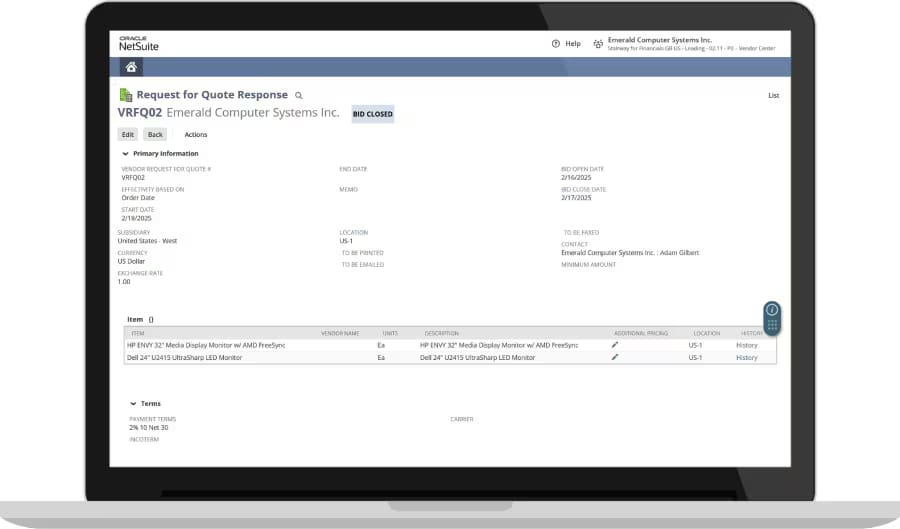
NetSuite Vendor Management centralizes vendor data, automates procurement and onboarding workflows, and provides solid reporting and compliance tools—all within a unified cloud solution to bring clarity to complex operations. Seamless integration with NetSuite ERP provides accurate, up-to-date insights into vendor performance, contract status, and spend, and offers automated alerts to prevent critical tasks from slipping through the cracks. Whether you’re managing a handful of suppliers or a global external workforce, NetSuite enables your organization to streamline vendor management, reduce risk, and derive better business outcomes.
NetSuite Consolidates Vendor Communications
Vendor management systems give businesses greater efficiency, accuracy, and control over their external relationships and contingent workers. Centralized data, automated workflows, and improved reporting help teams make smarter decisions across the vendor lifecycle from procurement to performance tracking. A VMS also reduces manual effort and supports more consistent, strategic operations. As workforce models continue to evolve, VMS will play an increasingly important role in driving business agility.
Vendor Management System FAQs
What is the difference between vendor management and supplier management?
The difference between vendor management and supplier management is that vendor management involves oversight of relationships with contingent workers and service providers, and supplier management focuses on building long-term partnerships with providers of raw materials and goods.
Can vendor management save costs?
Yes. Because it unifies data, automates workflows, and provides better visibility into spending and performance, a vendor management system saves money by identifying waste and streamlining sourcing to capture cost savings.
What is an example of a vendor management system?
An example of a vendor management system is NetSuite Vendor Management, which consolidates vendor data, automates procurement and onboarding, and provides robust reporting and compliance tools. This type of cloud-based system helps companies manage their vendor relationships more efficiently and strategically.