
Telecommunications companies must juggle complicated billing methods, inventory distribution, ever-changing regulatory requirements, and customers that expect immediate service activation and support. Disconnected systems and manual processes lead to billing errors, service delays, lost inventory, and missed revenue opportunities, all stemming from a lack of visibility into—and control over—what’s actually happening within the business.
ERP systems solve these challenges by unifying business operations on a single platform. And with cloud technology making ERP solutions even more accessible, telecom companies now have more options than ever before. This guide explores how ERP systems meet the unique requirements of the telecom sector by highlighting key features, detailing the associated benefits, and providing a framework for choosing the appropriate solution.
What Is ERP in Telecommunications?
Telecom ERP is an integrated software system that consolidates the business data and processes of a telecom company to provide real-time visibility into operations and performance. These systems integrate financial management, supply chain operations, CRM, billing, revenue management, and network asset management into a single platform.
Like most ERP solutions, telecom ERP systems eliminate interdepartmental data silos and automate processes to improve operational efficiency. But unlike generic software, telecom ERP systems have built-in features that address the industry’s unique complexities, such as multiservice billing, network infrastructure management, and telecom regulatory compliance. These purpose-built telecom ERP platforms support a wide variety of industry-specific tasks, including managing large customer accounts and usage transactions, coordinating field service, and tracking network equipment.
Key Takeaways
- Telecom ERP systems have industry-specific features that bring together billing, inventory, customer, and financial data to provide complete operational visibility.
- Specialized telecom ERP features accelerate service delivery and reduce errors through automated billing, multilocation inventory management, integrated order management, and performance monitoring.
- Role-based access to customizable dashboards gives users at all levels greater financial control to strengthen margins and improve customer retention.
- Telecom companies should choose ERP vendors with proven industry expertise, scalable platforms, ongoing support, and roadmaps for deploying emerging technologies like 5G and AI.
ERP in Telecom Explained
ERP systems allow telecom companies to address operational challenges—such as revenue leakage from billing errors, excessive inventory carrying costs, and high customer churn rates—by providing comprehensive visibility and control. These tools connect business functions from the moment a customer places an order through service activation, billing, and ongoing support. Telecom companies can use this increased transparency and automation to strengthen margins and deliver faster, higher-quality service to customers.
These benefits stem from two primary features: automation and integration. When a customer places an order, the system automatically activates several parallel workflows—billing and revenue recognition teams receive contact and payment information, service technicians schedule installations, and inventory teams prep the necessary equipment. Meanwhile, procurement modules automatically update stock levels and trigger reorders if stock levels are too low to meet expected demand. This automation also extends to financial reporting and regulatory compliance, allowing telecom companies to scale operations without proportionally increasing overhead.
Key Features of a Telecom ERP
Specialized telecom ERP capabilities go beyond standard ERP functionality to target specific industry needs, such as bundled billing calculations or multistep, cross-network order fulfillment. ERP systems address these challenges by establishing a strong management foundation with features drawn from eight main categories.
-
Procurement:
Telecom procurement often requires managing large global supplier networks composed of technical supply manufacturers, customer equipment providers, electronics suppliers, and structural component vendors. ERP procurement modules support complex contract structures with different pricing tiers and service level agreements, and facilitate multivendor strategies to avoid single-supplier dependencies. Additionally, automated reorders for critical supplies help telecom companies continually optimize their procurement in line with forecasted demand. Ongoing spend analytics, meanwhile, monitors vendor performance to inform contract negotiations. -
Supply chain management:
Telecom supply chains connect suppliers, central warehouses, regional distribution centers, local depots, field technician vehicles, and even customers’ homes. ERP supply chain modules coordinate inventory across these facilities and provide end-to-end visibility throughout order fulfillment, including supplier deliveries and customer installations. The systems also track serialized equipment warranties and coordinate just-in-time deliveries, as well as strengthen reverse logistics for equipment returns, refurbishment, or waste removal. -
Inventory management:
Managing diverse inventory categories—high-value network infrastructure, customer premises equipment, technical supplies, and critical spare parts—is table stakes for telecom companies. ERP inventory management offers features that monitor equipment and products at all locations by serial number, batch, stock levels, and service level agreements. This detailed approach allows companies to manage rapid obsolescence cycles and complex network assets by tracking installed equipment as either inventory or a fixed asset, depending on the item. Field technicians can also leverage cloud-based or mobile-optimized ERP systems to access accurate inventory data for parts and equipment from the field, reducing delays to service. -
Customer relationship management:
Telecom providers must manage consumer, business, and enterprise customer segments, each with its own unique pricing and subscription hierarchy. According to Simon-Kucher’s “2025 Global Telecommunications” study, 95% of customer lifetime value (CLV) is derived from existing customers—who spend 7% more than new customers. ERP CRM modules help telecom companies maximize CLV by tracking complete lifecycles from lead generation to service activation; the modules also provide detailed analytics useful for usage patterns, support interactions, and retention initiatives. These systems maintain consistent customer profiles at all touchpoints—call centers, retail locations, and digital channels—to support omnichannel communications, giving service teams opportunities to identify customer support issues and upsell opportunities. -
Billing and revenue management:
Telecom companies often experience revenue leakage, which occurs when they deliver services—such as voice calls, data usage, or subscription access—but fail to bill accurately or collect the full amount owed, due to system errors, billing mistakes, or gaps in tracking customer usage. ERP billing modules consolidate multiple services into a single invoice—including both prepaid and postpaid account structures—to process daily account charges quickly and accurately. These systems also manage roaming and interconnect charges by arranging settlements with other carriers in accordance with local billing regulations. Meanwhile, revenue assurance features automatically detect billing anomalies, reconcile usage records with charges, and prevent rating errors or incomplete service capture. -
Financial management:
Financial management tools track multisegmented operations and capital assets per preconfigured revenue recognition and accounting standards. ERP financial modules automate journal entries; support parallel, multibook recording for regulatory and commercial accounting; consolidate multicurrency transactions for international businesses; and maintain accurate and detailed tax and compliance documentation. These systems scale as telecom companies add new customers and services. They are particularly valuable when managing the industry’s unique mix of high-volume, low-value transactions and major capital network investments. -
Order management:
Telecom order management executes fulfillment workflows that operate in parallel to span service configuration, network provisioning, customer interactions, equipment delivery, and technician scheduling. ERP order management modules coordinate multiservice bundles and leverage provisioning systems to automate service activation, all while providing real-time order updates to customers and service representatives. These systems simplify how companies modify, suspend, or cancel services through billing and CRM integrations. Their capabilities are especially beneficial for complex accounts, such as those with multiple locations, or when customers switch carriers. -
Performance management:
Telecom ERP software lets providers monitor key performance indicators (KPIs) through customizable dashboards, including such metrics as network availability, service activation times, adherence to service level agreements, first-call resolution rates, and technician productivity. Managers can monitor broad KPIs or drill down for greater detail to paint a complete picture of overall performance, contextualizing analysis with financial metrics like revenue per user, margin analysis, days sales outstanding, and capital efficiency ratios. Users customize these dashboards to show real-time performance metrics at different organizational levels, receiving automated alerts when metrics fall outside acceptable ranges.
Benefits of ERP for Telecom Businesses
Telecom ERP software can bring measurable improvements that directly address core challenges by protecting revenue, controlling costs, and relieving specific customer pain points. Here are some of the key benefits telecom companies can expect to experience:
- Increased financial control: ERP systems provide immediate visibility into revenue streams, cost centers, financial projections, and capital expenditures. Automated billing features cut down on incorrect charges and unbilled services to maximize revenue capture and accelerate cash flow. Additionally, regular and ad hoc reporting features help financial teams speed up their month-end close and generate more accurate forecasts for future decisions.
- Improved customer experience: With an ERP platform, service representatives can access complete customer histories to resolve issues quickly and offer personalized recommendations based on customer profiles. Meanwhile, automated order processing, provisioning, billing, and self-service portals shorten service activation times and decrease call center volumes, giving service teams more time to focus on high-value work.
- Better decision-making: Managers configure their ERP dashboards to convey real-time, relevant analytics that replace weekly or monthly historical reporting. Built-in planning tools allow decision-makers to model various scenarios—such as network investments, service launches, and market expansions—before committing resources. After deployment of new strategies, drill-down analytics tools help managers monitor progress and address any performance issues before they impact customers or revenue.
- Enhanced security and regulatory compliance: Role-based access controls and automated approval workflows help telecom companies meet regulatory requirements to protect both customer and internal data. Compliance modules track regulatory changes and maintain appropriate audit trails, limiting compliance costs and risks.
- Greater efficiency: Automating mundane or routine tasks eliminates manual data entry, avoids related errors, and gives staff plenty of time to work on strategic initiatives. These efficiency improvements accelerate the entire operational cycle—from placing supplier orders and receiving inventory through processing orders and activating services—resulting in optimized costs and improved service quality at each stage.
How ERP Addresses Key Challenges in the Telecom Industry
The specific functionalities within telecom ERP systems are designed to combat some of the challenges in the telecom industry that have been known to erode profits and push customers toward more flexible competitors. ERP tackles many of these common pain points, replacing error-prone processes with sophisticated workflows and tools that:
- Simplify billing: Different pricing schemas for voice, mobile data, internet, and bundled services can cause billing errors that frustrate customers and hurt revenue. ERP systems centralize invoicing to calculate accurate charges for all services and automatically validate bills before sending them.
- Optimize operations: Disconnected systems force employees to juggle multiple platforms, resulting in inefficiencies and the risk of being left with missing or inconsistent data. ERP integration connects procurement, inventory, order management, and financial systems into one interface that employees can navigate without being forced to switch screens or re-enter data, thus eliminating manual handoffs and accelerating processes.
- Deliver faster service: Manually scheduling and activating services for sales, field teams, customer service, and billing departments can be cumbersome and time-consuming. ERP systems automatically and simultaneously activate workflows and optimize technician scheduling and routing to decrease the time between initial customer interaction and activation.
- Centralize data: Information that’s scattered among departmental silos prevents managers from seeing the complete operational picture. Telecom ERP platforms create a single data source that all departments access in real time, which minimizes the possibility of creating conflicting reports that result in unforeseen downstream impacts on decisions.
- Enable traceability: Audits and customer disputes require scrutiny of detailed transaction histories that many legacy systems can’t provide. ERP systems maintain detailed audit trails for every transaction that support comprehensive compliance protocols and rapid issue resolution.
How Telecom Companies Can Choose the Right ERP System
According to a McKinsey survey of telco C-suite executives, implementing digital, AI, and automation tools at scale is the number one choice for creating value. But these tools produce value only when they’re carefully chosen, implemented, and maintained in line with the company’s needs. When choosing an ERP system, telecom providers should consider both current friction points and future growth plans. The scope and complexity of a company’s offerings—for example, whether they’re managing multitiered pricing bundles or pursuing diverse network coverage for various devices—heighten the importance of evaluating products beyond simple feature comparisons. The following six steps can help telecom leaders choose an ERP solution that suits their company’s outlook as they expand their services and customer volume:
- Identify what specific needs and requirements your ERP system will need to accommodate: Document specific operational challenges, such as billing complexity for service bundles, multilocation inventory management, customizable network configurations, legacy integrations, or regulatory requirements. Consider both immediate needs and anticipated growth—new service launches, geographic expansion, increasing transaction volume—as different ERP types excel at different scales and capabilities.
- Ask yourself how much technical support you’ll want from your vendor: Determine the amount of internal IT expertise you’ll require for system configuration, integration, and ongoing maintenance, and consider those vendors that fill any skill gaps. Factor in acceptable downtime levels and support protocols, as telecom operations typically need 24/7 support to manage round-the-clock service.
- Consider what levels of scalability and customization you’ll need: Evaluate whether the system can handle increasing revenue streams, transaction volumes, and customer accounts without involving major overhauls or replacements. Though standard configurations may ease implementation and simplify maintenance, some systems may require customization to suit existing workflows and maximize ROI.
- Audit your vendor’s reputation, both generally and within your industry: Research the vendor’s track record with similarly sized telecom companies, and check references and case studies that cover both implementation and post-deployment support. Also assess their financial stability, industry experience, and commitment to industry-specific product development.
- Analyze the total cost of ownership: Calculate comprehensive costs, including licensing fees, implementation expenses, infrastructure and integration requirements, training, and ongoing support. Be sure to tally hidden costs, such as data migration and revenue loss from downtime during the transition, as well as the cost of adding more modules as the business evolves.
- Determine whether the ERP system in question can support future growth: Weigh each potential vendor candidate’s ability to incorporate emerging technologies to increase productivity and automate customer service. For example, AT&T has turned to AI to reduce software development time by 10% and save customer service agents several minutes per call, according to PWC’s “Perspectives from the Global Telecom Outlook 2024-2028” report. Consider whether the ERP solution you’re considering can adapt to new business models and support new service offerings by integrating with future technologies as they arise. The same PWC report estimates that 5G subscriptions will more than quadruple to 7.51 billion by 2028, so telecom providers will need to take proactive steps to adopt necessary innovations to capture those new customers.
A Dependable ERP Solution in NetSuite
Telecom providers must manage large customer bases and myriad combinations of services and pricing plans. Companies that rely on manual processes often struggle to overcome disconnected systems that leave customers frustrated by slow-to-respond service teams and vague status updates, especially during rapid growth periods. NetSuite Telecom ERP uses preconfigured telecom workflows, billing and revenue management, automated customer support, and real-time, companywide visibility to help telecom businesses provide consistent, high-quality service to all their customers. NetSuite’s cloud-based platform integrates financial, operational, and customer systems into one system, scaling operations as companies expand services and reach. Built-in analytics dashboards and automated regulatory compliance reporting give telecom companies the operational foundation they need to cut costs, accelerate service activation, and seize new revenue opportunities without adding on-premises infrastructure and internal ERP expertise.
NetSuite’s ERP Dashboard
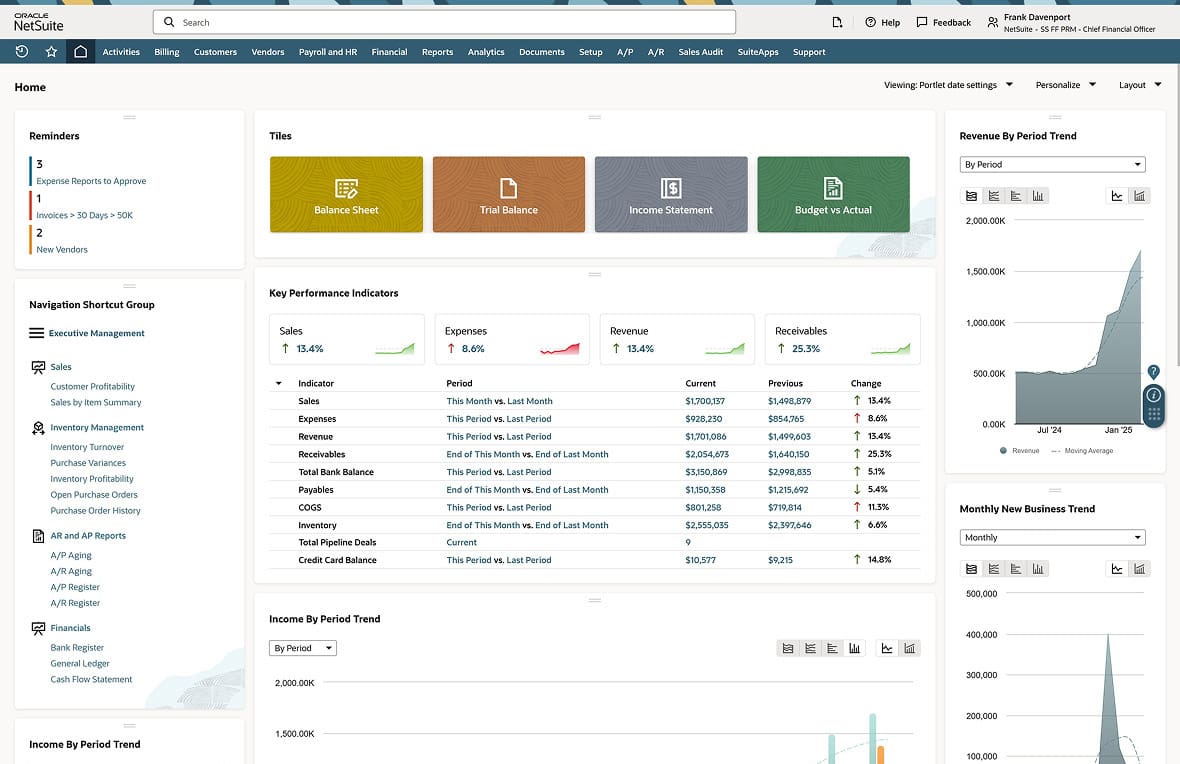
ERP systems have become increasingly accessible and effective tools for telecom companies navigating the industry’s complexities—billing requirements, multichannel operations, evolving regulatory demands, and rising customer expectations, to name a few. ERP software consolidates financial, supply chain, inventory, performance, and customer data into a unified platform, giving telecom companies the visibility and control they need to protect revenue and improve the customer experience. However, choosing the right ERP solution requires careful evaluation of current operational challenges and future growth requirements. An appropriate choice should effectively balance telecom-specific functionality with scalability and usability—all while keeping total costs within budget. As customers demand more comprehensive and responsive service, ERP platforms provide telecom providers with a flexible management framework that boosts profitability and builds lasting competitive advantages.
Telecom ERP FAQs
What are the most common ERP components?
The most common ERP components include modules that manage procurement, supply chain, inventory, customer relationships, billing and revenue, financials, orders, and performance. These core modules automate routine processes to improve operational efficiency while eliminating data silos among departments, providing users with a unified view of operations.
What ERP modules matter most for telecom companies?
For telecom companies, the most critical ERP modules are typically billing and revenue management for complex service charges, order management for coordinating diverse service activations, ongoing customer relationship management, and inventory management for tracking network equipment and customer devices. Financial and performance management are also essential for assessing ongoing sustainability and operational efficiency.
What are three tiers of ERP?
ERP systems are typically categorized into three tiers, based on company size and complexity:
- Tier 1: Enterprise-grade solutions for large multinational corporations
- Tier 2: Mid-market solutions for midsize businesses
- Tier 3: Smaller, often industry- or region-specific solutions for small businesses
However, cloud-based ERP has blurred these distinctions by allowing smaller companies to access enterprise-level capabilities in configurable systems without incurring massive up-front investments.