
The telecom industry is at an impasse. Growth is slowing, competition is intensifying, and once-lucrative voice and data services have become commoditized. As over-the-top (OTT) platforms—WhatsApp, Zoom, Netflix, and others—capture consumer attention and 5G rollout costs rise, telecom providers are under growing pressure to find fresh sources of income. On that front, there’s good news: Opportunities for revenue growth exist for telecom companies willing to adapt to the changing landscape and invest in their future. Bundling complementary services, controlling costs, expanding into new markets, and leveraging advanced technology all contribute to telecoms’ ability to redefine how they generate and grow revenue. The 16 strategies outlined in this article can help telecom providers strengthen profitability and secure long-term growth, despite the myriad challenges.
Revenue Challenges in the Telecom Industry
Total revenue in the global telecom industry rose by 4.3% in 2023, hitting an impressive $1.1 trillion, yet the sector faces a sluggish outlook amid rising costs, increased competition, and muted subscriber growth. In fact, average revenue is projected to rise only 2.9% annually through 2028 across mobile, fixed broadband, and voice services—slower than inflation, according to a 2025 PwC report.
Indeed, a 2024 McKinsey survey shows that profitability tops the list of concerns for telecom CEOs and other top executives, followed by competition from new business models. After all, in many regions, mobile and broadband penetration rates are already near their peak, leaving limited room for subscriber growth. At the same time, intense competition has customers expecting unlimited data and low-cost plans, forcing telecom operators to compete on price. Worse still, the commoditization of core services—voice, messaging, and data—has eroded traditional revenue streams that once sustained high margins.
Another major challenge: the rise of OTT services from the likes of WhatsApp, Zoom, and Netflix, which bypass traditional telecom infrastructure to deliver messaging, voice, and content directly to consumers. These businesses are capturing monetization opportunities that used to belong to telecom providers. Meanwhile, the heavy capital investments required for 5G network upgrades and other infrastructure improvements have put additional pressure on profitability. These industry-specific challenges require telecom companies to rethink their strategies and reinvent their business models, forcing them to leverage data, seek emerging technologies, and forge strategic partnerships to create new, sustainable sources of revenue.
16 Strategies to Increase Revenue for Telecom Companies
With competition intensifying and margins shrinking, telecoms can’t rely on old playbooks. They need to uncover new income streams and embrace creative ways to grow. Here are 16 practical strategies for boosting revenue, ranging from exploring new markets to maximizing software investments:
- Dive into your data: Telecom providers sit on a goldmine of operational and customer data—network usage, call records, service interactions, and billing patterns. By harnessing advanced analytics, companies can identify high-value opportunities, such as predicting which segments are ready for upgrades, optimizing network investments for maximum ROI, and detecting underutilized capacity in high-demand areas. AI-driven analytics can also change the game by enabling predictive maintenance, reducing churn by anticipating service disruptions, and strengthening network reliability, all contributing to a healthier bottom line.
- Improve customer segmentation: By studying usage patterns, engagement data, and lifetime value, telecoms can tailor their offerings to target specific customer segments with greater precision and propel measurable results. High-data users, for example, may respond to bundled streaming or cloud solutions, while cost-sensitive customers may prefer flexible, usage-based plans. Machine learning (ML) segmentation allows for continuous refinement, revealing emerging microsegments and real-time opportunities to cross-sell, upsell, and proactively prevent churn.
- Explore new markets: Sustainable revenue growth requires looking beyond traditional voice and data services. Providers can explore new geographies, partner with OTT platforms by bundling subscriptions, or deliver high-value offerings, such as Internet of Things (IoT) connectivity, mobile financial services, or smart home solutions. Entering the IoT space, for instance, could position a regional operator to serve fleet management companies with internet connectivity inside trucks to assist with vehicle tracking, fuel management, and driver performance monitoring. After all, the global IoT fleet management market is expected to grow 17% annually, reaching nearly $21 billion by 2030, according to Grand View Research.
- Negotiate vendor contracts: Telecom providers work with a wide range of suppliers, including network equipment vendors, software companies, and cloud service providers—and small differences in contract terms can have a major financial impact. By negotiating all-in pricing, operators can eliminate hidden fees and avoid unexpected cost increases. Telecoms should also push for caps on price increases, perhaps by signing long-term partnerships, and clearly define maintenance and support responsibilities to make sure costs are predictable. Beyond price negotiations, operators should closely monitor their inventory and regularly compare vendors, evaluating their performance to gain the highest-quality service at the most competitive rates.
- Tailor customer service: Providing excellent customer service in each and every interaction is foundational to success. Telecoms can leverage customer analytics, AI, and automation to reach out to their audiences more effectively and deliver support that feels human and relevant. For example, predictive analytics can identify customers who overuse data, experience frequent dropped calls, or are delayed in making payments, then initiate proactive outreach or new plan recommendations. Plus, AI-powered chatbots and self-service tools can handle routine inquiries quickly, freeing up human agents to focus on higher-value interactions. By accessing unified customer profiles that include preferences, service history, and predictive insights, agents can resolve issues more quickly and offer personalized upgrades or add-ons that solidify customer relationships over the long haul.
- Sell excess capacity: Many telecom networks operate below full utilization, especially during off-peak hours, presenting an opportunity for businesses to monetize excess bandwidth. Providers can lease or sell unused capacity to businesses that experience variable demand, such as event organizers, logistics companies, or streaming services that need temporary bandwidth boosts. This approach helps maximize infrastructure ROI without the need to make significant capital investments. In addition, some operators have launched network-as-a-service models, offering flexible bandwidth access on demand to attract enterprise clients and diversify revenue sources. Telecoms can also explore infrastructure-sharing agreements with smaller carriers or private networks by offering leasing agreements on towers to generate recurring income.
- Bundle complementary services together: Bundling services, such as mobile, broadband, and cloud storage, can give telecom providers more average revenue per user (ARPU) and improve customer retention. Bundled offerings simplify billing, create price advantages, and make it harder for customers to switch providers. And bundling allows telecom operators to regularly cross-sell and upsell new digital services. Customers often perceive these bundles as offering greater convenience and value, which can strengthen their loyalty to a brand.
- Implement a referral system or loyalty program: Referral and loyalty programs are powerful tools for telecom operators looking to increase customer acquisition and retention while reducing marketing costs. A well-designed referral program leverages existing satisfied customers as brand advocates, encouraging them to bring in new users through structured incentives, such as bill credits, bonus data, or device discounts. Because word of mouth tends to carry higher trust than advertising, referred customers often come with higher lifetime value and lower churn. Additionally, loyalty programs deepen customer relationships and increase ARPU by rewarding tenure and spending with redeemable points, which may encourage customers to keep spending and perhaps even consolidate more services with one provider.
- Develop cross-promotional partnerships with other companies: Telecom companies can expand their reach and enter adjacent markets without making heavy capital expenditures by developing cross-promotional partnerships. Collaborating with companies in complementary sectors, such as streaming platforms, ecommerce retailers, banks, and mobility providers, allows telecoms to create co-branded offers that boost visibility and subscriber engagement. Plus, telecom providers can establish B2B cross-promotions with logistics, manufacturing, and IoT companies, offering integrated solutions that combine connectivity with industry-specific applications. These collaborations have the potential to open new vertical markets while also generating recurring, service-based revenue streams.
- Consider value-added services: As connectivity becomes more commoditized, telecom providers should consider differentiating themselves from the competition through value-added services that extend beyond basic data, voice, and messaging. Services ranging from cloud storage and cybersecurity to home automation and digital wellness offer new ways to attract and retain customers. The key is aligning these services with customer needs and usage patterns. For instance, small businesses may be interested in cybersecurity or cloud collaboration tools, while consumers may value identity protection and streaming bundles.
- Optimize costs: Cost optimization remains essential to telecom profitability, especially as margins tighten. Operators can optimize costs, in part, through network automation, which allows tools powered by AI and ML to manage traffic, predict maintenance, and provide real-time fault detection that lessens downtime and quells the need for manual intervention. Energy efficiency is another approach. Field service management teams can deploy renewable energy systems and smarter cooling technologies to lower overall energy use in data centers, cell towers, and edge networks. Meanwhile, deploying AI-driven network management tools helps with predictive maintenance and resource allocation, cutting downtime and operational expenses. Reviewing legacy contracts and outsourcing non-core operations can further reduce costs while allowing the business to maintain—or even improve—performance.
- Simplify the customer experience: In a market saturated with complex plans and multiple digital options, simplicity can be a key differentiator. Telecoms can improve revenue outcomes by streamlining the customer journey at every step, from onboarding to issue resolution. Simplified plan structures and transparent pricing that limit hidden fees can eliminate confusion and build customer trust. Besides, simplifying the experience may tempt customers to explore additional services. And a seamless digital experience across mobile apps, websites, and retail channels goes a long way toward showing customers they can easily manage their accounts, purchase add-ons, and upgrade services on their own.
- Invest in digital transformation: Digital transformation is essential to remaining competitive and profitable in the always-evolving telecom industry. Transformation should include migrating operations to the cloud, adopting advanced automation, employing data-driven decision-making, and monitoring key performance indicators. These efforts will smooth internal processes, facilitate operational efficiency, and lower costs, freeing up resources to invest elsewhere. After all, digitally mature telecoms have an edge: They can rapidly launch new services, personalize offers using granular user data, and proactively address customer needs through predictive analytics and AI. As a result, they’re positioned to unlock new sources of digital revenue from self-service platforms, value-added apps, and smart home solutions. Not only will productivity improve, but telecom providers will be able to quickly pivot in response to emerging trends, regulatory changes, and new market opportunities.
- Improve customer retention: Focusing on customer retention is key to capturing long-term profitability and market share. Reducing churn shelters recurring revenue sources and also lowers acquisition costs, which are typically much higher than the cost of keeping existing customers on the books. One way to improve retention is to identify at-risk customers early and implement targeted retention campaigns, such as personalized offers or rewards to boost loyalty. In addition, listening to customers and adjusting pricing models, data packages, and customer support processes are important tactics to strengthen brand trust, which acts as a safeguard against customer turnover.
- Advertise on different media channels: Diversifying advertising media gives telecom companies the opportunity to reach different audiences. While traditional channels, such as newspapers, television, and radio, bring brand awareness on a wide scale, digital platforms like social media, search engines, and streaming services allow for highly targeted campaigns. Brands that execute integrated multichannel campaigns often achieve higher purchase rates and retention. Indeed, a 2024 Nift survey found that direct-to-consumer and retail brands using three or more marketing channels were 73% more likely to achieve higher return-on-ad spend.
- Get the most out of your software: Relying on legacy CRM, billing, and analytics systems—or neglecting to use upgraded systems to the fullest extent—may lead to inefficient operations and untapped opportunities that curtail cost savings, revenue growth, and decision-making capabilities. By fully harnessing their software systems, telecom operators can address these issues. For example, when AI-powered ERP systems are fully leveraged, telecoms can create more efficient workflows, automate repetitive tasks, seamlessly manage orders, and gain actionable insights into customer behavior and network usage. As a result, companies experience improved forecasting, faster service rollout, better customer experience ratings, and, ultimately, new revenue streams—just by optimizing their software. In fact, a recent IBM study of more than 2,400 IT decision-makers showed that 47% are seeing positive ROI from their AI investments.
Nurture Revenue Growth With NetSuite ERP
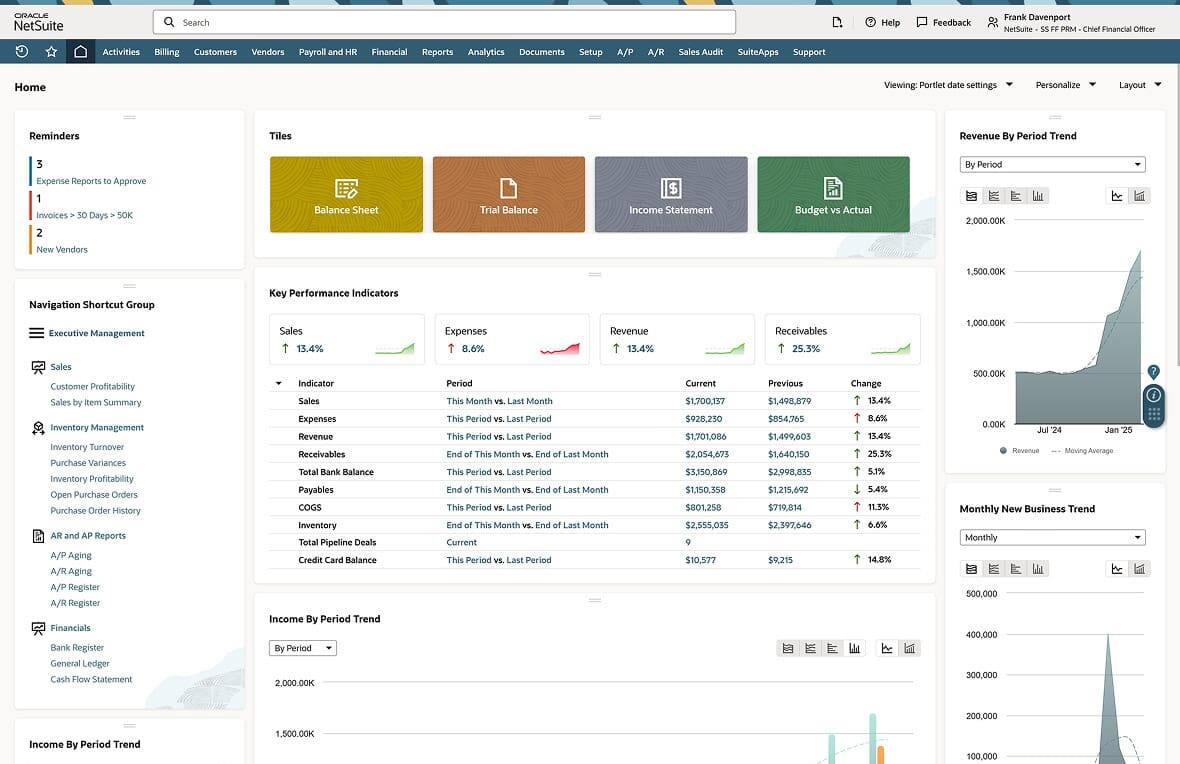
Telecom providers can’t expect to thrive by relying on fragmented systems, manual processes, and limited visibility into financial and operational performance. These inefficiencies can stall revenue growth and limit scalability. NetSuite Telecom ERP helps businesses overcome these challenges by unifying core business functions—finance, inventory, order management, procurement, and CRM—within a single, cloud-based platform. With real-time visibility into the entire business, telecom operators are able to make faster, data-driven decisions and improve their financial controls. Plus, the system’s automation capabilities improve billing and revenue reporting, freeing teams to focus on strategic initiatives to grow the business, rather than tending to administrative tasks. NetSuite ERP’s scalability allows businesses to expand into new markets or launch new products without having to overhaul their systems. And its analytics and forecasting tools allow leaders to identify high-margin opportunities, optimize pricing, and manage cash flow more effectively, all essential for sustaining and accelerating revenue growth.
NetSuite ERP
To remain profitable in a stagnated industry, telecom companies need to be bold enough to rethink how they create and capture revenue beyond merely providing connectivity. Chasing new subscribers isn’t enough. Instead, telecoms must boost their revenue by transforming their operations, deepening their customer relationships, and uncovering untapped opportunities hidden in data and technology. Whether through smarter pricing, new partnerships, or advanced automation, telecom providers should look to build agile, insight-driven organizations capable of unlocking their full revenue potential and scaling for the future.
Revenue Growth in the Telecom Industry FAQs
What are the seven core principles of revenue management?
The seven core principles of revenue management are segmenting customers based on their behavior and needs; forecasting demand; pricing dynamically based on demand; controlling inventory; managing how and where products and services are sold; measuring performance; and optimizing customer value by aligning pricing and service delivery to strengthen loyalty.
How do you increase ARPU in telecom?
Telecoms can boost average revenue per user (ARPU) by deepening customer value and expanding their service offerings. This includes upselling premium plans; bundling mobile, broadband, and entertainment services; and introducing usage-based pricing to encourage higher consumption. Leveraging analytics and AI helps companies personalize offers based on customer behavior, and partnerships with over-the-top providers and other digital service companies can create new high-margin revenue streams that contribute to sustained ARPU growth.
What are the growth drivers of the telecom industry?
Telecom industry growth is driven by a comprehensive 5G rollout, rising demand for mobile and broadband data, and value-added services like Internet of Things and digital entertainment. Expanding into new markets, forming strategic partnerships, and using software to optimize networks and personalize offerings can also boost revenue.