
When consulting engagements—or other project-based work—extend over weeks or months, firms want steady cash flow, not a single lump-sum payment months down the line. Clients, meanwhile, want assurance they’re paying for tangible progress. Milestone-based billing helps both sides get what they need.
What Is Milestone-based Billing?
Milestone-based billing is a payment structure where clients are invoiced incrementally as predefined project milestones are completed, rather than paying hourly, on a fixed schedule, or in a lump sum.
Key Takeaways
- Milestone-based billing matches payments to project milestones and measurable deliverables to promote transparency and shared accountability.
- This incremental approach helps consulting firms and clients manage expectations, risk, and cash flow.
- Detailed completion criteria and payment schedules minimize scope creep.
- Accounting software that automates milestone tracking and invoicing can cut down on manual work and increase accuracy.
Milestone-based Billing Explained
Milestone-based billing is common in consulting, but it’s also widely used in construction, software development, architecture, and other project-based industries. Unlike other project billing methods that prepare invoices on a set schedule or at project completion, milestone-based billing ties billing to the completion of predefined deliverables. This helps both parties manage expectations, risk, and cash flow—protecting the time and resources firms invest by providing revenue throughout an engagement. At the same time, clients can verify that they’re paying for tangible progress and can budget for smaller installments, rather than prepping for one large payment.
How Does Milestone-based Billing Work?
Milestone-based billing requires documented project parameters that have been agreed on by both parties, addressing scope, deliverables, timeline, and budget. Projects are divided into milestones or phases, with payment amounts assigned to each. Completion of each project milestone triggers an invoice to the client:
- Milestones are established: The business breaks down the project into discrete milestones, defines specific requirements and deliverables for each, and obtains client approval. These terms are typically formalized in a statement of work (SOW) or project contract that both parties sign before work begins.
- Payment schedules are developed and agreed on: Schedules dictate the timing of installment payments, each representing a percentage of the total project fee. Either a retainer or an initial milestone payment should cover the up-front discovery or strategy work. The remainder of the project fee is then allocated in increments to subsequent milestones, including a final completion payment. Clients pay as work is completed, while the business receives payment before incurring costs for subsequent phases.
- Progress on milestones is tracked: The business and its client agree on a shared monitoring method that allows both to transparently track milestone progress. This promotes accountability and confirms that all conditions have been met before invoicing. Common tracking methods include project management software, regular status meetings, or shared documentation that provides audit trails for both accounting and project management purposes.
- Invoices are sent only on milestone completion: The business typically issues invoices after the client approves the deliverables and completion criteria for each milestone. Proper documentation of milestone completion—such as client sign-off emails or approval forms—is essential for revenue recognition and supports the billing in case of disputes or audits.
How Milestone-based Billing Works
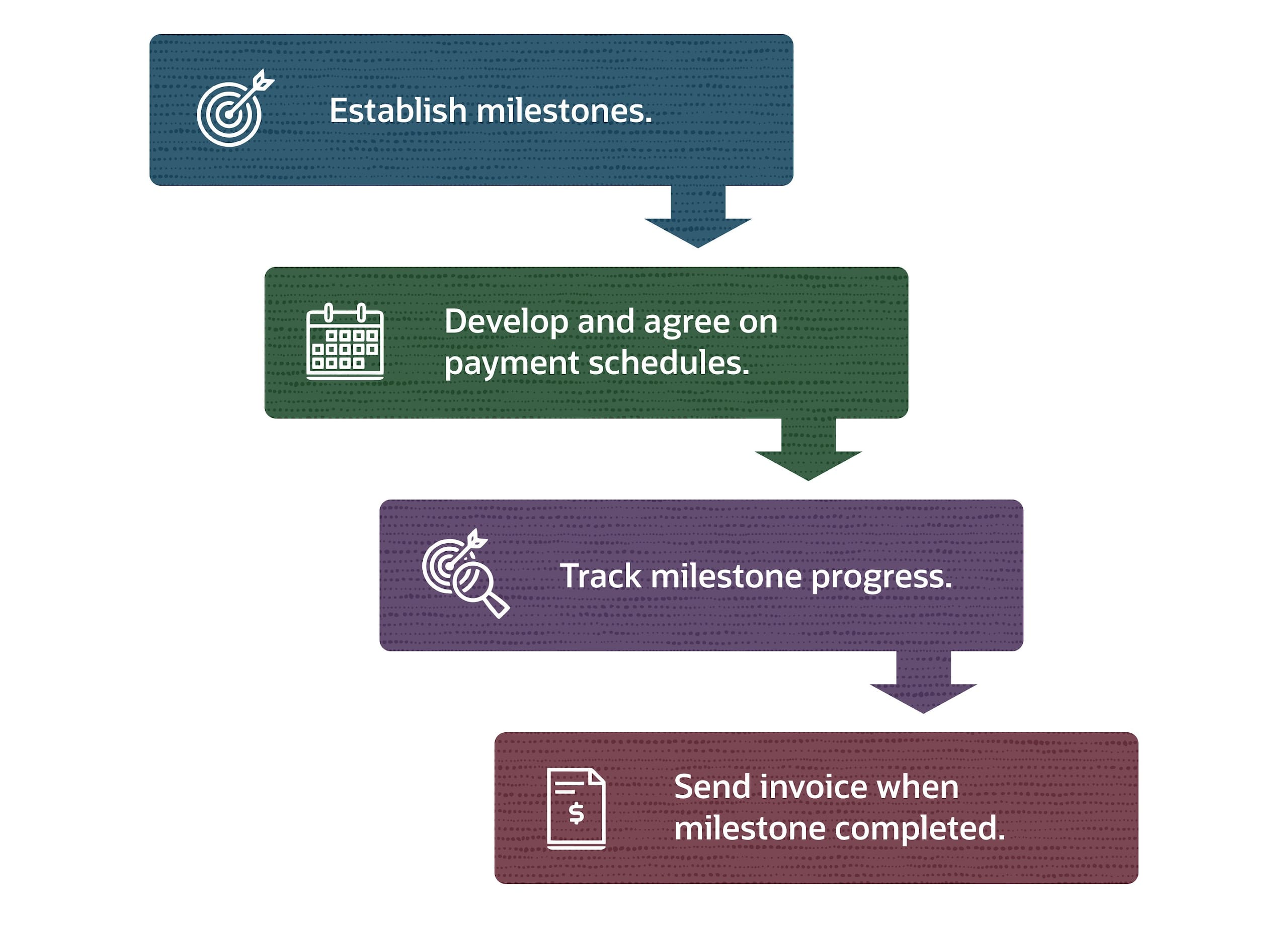
Milestone-based Billing Example
A software vendor hires a consulting firm to reduce customer churn over a four-month period. Together they outline the project’s goals and scope. Both parties approve three project milestones: completing the churn analysis, developing a retention strategy, and executing the plan while tracking key performance indicators (KPIs). Each milestone has corresponding deliverables—a churn report, a strategic plan document, and a performance dashboard—that the client must approve before payment is triggered.
The billing schedule includes an up-front payment for project setup and discovery, with subsequent installments due upon each milestone completion. The client reviews and signs off on each deliverable before the consultant issues an invoice. Payment is then due within the terms specified in the contract.
Advantages of Milestone-based Billing
Milestone-based billing can build trust because both sides have clear stakes. Clients see exactly what they’re being charged for before they pay. Businesses get paid as they deliver, not months later. And staggered payments keep both sides engaged throughout the project. For both parties, the benefits are concrete. Milestone-based billing:
- Promotes project progress: Billing linked to specific project milestones incentivizes timely completion on both sides—businesses deliver work as prescribed, while clients provide prompt feedback and approvals to keep projects moving.
- Maintains cash flow: Phased payments provide steady revenue over the course of a project and allow clients to spread costs across budget periods, instead of having to absorb one large expense.
- Enables transparency: Documented milestones and payment schedules create shared accountability and avoid misunderstandings about scope, timing, and costs.
- Controls budget: Clear milestones and approval conditions help prevent scope creep by defining exactly what’s included in each phase. Any project changes require formal adjustments to both scope and payment terms.
- Lowers project risk: If a project stalls or needs to be terminated early, both parties have clear stopping points with work completed already paid for without initiating disputes over partial completion.
Challenges of Milestone-based Billing
Milestone-based billing works best when both parties communicate clearly and document everything. When they don’t, the structure intended to create accountability can just as easily create friction, ranging from disagreements over deliverables and hazy milestones to dealing with scope changes and early discovery work. Challenges include:
- Disputes over deliverables: Ambiguous contract language can lead to disputes and payment delays if milestone deliverables and approval criteria aren’t explicitly defined.
- Difficulty defining milestones: Milestones that are too granular create administrative burden, while milestones that are too broad leave businesses waiting too long between payments and give clients less visibility into progress. Plus, businesses and clients don’t always agree on what constitutes a milestone or when it’s complete in the first place.
- Managing changes in scope: Scope changes are inevitable, but they create friction. Clients may expect additional work to be absorbed into the existing fee; businesses may expect additional payment. Without clear change-order processes, scope creep can lead to project overruns, slipped timelines, and milestone schedules that lose meaning.
- Charging for up-front work: Without the existence of a defined initial milestone or retainer, early discovery or strategy work may go unpaid, leaving businesses to eat the cost or chase payment after the fact. It can also set an uncomfortable tone for the relationship.
- Waiting for approvals: Clients that are slow to review deliverables can hold up the entire billing cycle. Without clear timelines for approvals, businesses may complete work but have to wait weeks to invoice, hurting cash flow.
- Administrative complexity: Milestone billing requires more documentation, tracking, and approval workflows than simpler billing methods, such as fixed-price or retainer arrangements. If handled manually, overhead costs can increase for both parties.
When Should You Use Milestone-based Billing?
Milestone-based billing works best for project-based engagements where scope and objectives are clearly defined and work can be segmented into phases with concrete deliverables. It’s a good fit for businesses seeking predictable cash flow and clients that want cost clarity throughout the project. Projects that span several months, involve distinct phases, or require significant up-front investment are natural candidates. The same goes for work where progress depends on client input and approvals—or where delayed payment would create real financial strain for either party.
When Should You Not Use Milestone-based Billing?
Milestone-based billing isn’t recommended for advisory services, projects with fluid scopes, or work that produces more subjective deliverables. Milestones that are difficult to define or measure could result in delayed or contested payments. Businesses seeking steady, predictable monthly revenue may opt instead for retainer arrangements or time-and-materials billing.
Accounting Software’s Critical Role in Milestone-based Billing
Accounting software addresses many of the challenges outlined above. It can automate milestone-based invoice processing and track milestone progress, cutting down on manual work and increasing accuracy. And compared to spreadsheets or point solutions, it offers tighter control over billing and cash flow management. Accounting software also generates accurate financial reports that support proper revenue recognition and provide audit trails for milestone completion.
Strengthen Project Oversight With NetSuite for Consulting Firms
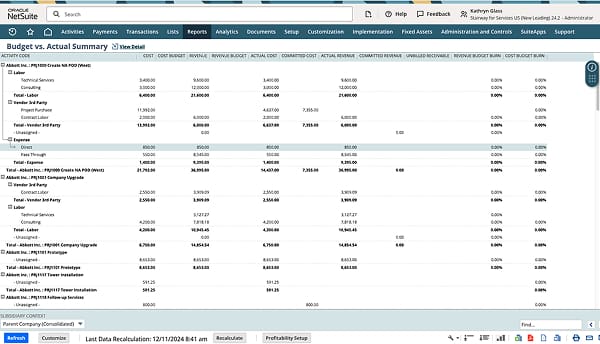
NetSuite Accounting Software for Consulting Firms integrates accounting functions with project and billing data on a unified cloud platform. The solution automates financial management tasks, including billing and accounts receivable, and uses AI-enabled monitoring to strengthen cash flow oversight and project tracking. Its advanced project accounting supports multiple billing models—including milestone-based billing—with automated revenue recognition and flexible invoicing. These capabilities help improve billing speed and accuracy, budgeting, expense tracking, and forecasting.
Advanced Project Accounting
Unlike time-based or lump-sum billing, milestone-based billing ties client payments directly to completed deliverables—giving both parties clear checkpoints and shared accountability throughout the project. The method’s reliance on mutually approved project milestones, completion requirements, and payment schedules reduces the likelihood of conflict. Accounting software makes the process easier, with automated milestone tracking and invoicing that minimizes errors and keeps projects moving.
Milestone-based Billing FAQs
Are milestone payments the same as performance-based payments?
No. Milestone payments are triggered by completing a defined phase or deliverable. Performance-based payments tie client billing to results or outcomes—such as hitting an agreed-upon performance metric—rather than completing specified work.
What is the difference between progress billing and milestone billing?
Both involve incremental payments. Under progress billing, invoices are issued at regular, set intervals or when designated percentages of an overall project are completed. Milestone billing links invoices to completed project phases or deliverables.
What types of projects benefit the most from milestone-based billing?
Milestone-based billing is well suited for medium to large, multistep projects with well-established scopes and objectives—work that can be broken into measurable phases or deliverables, each with completion requirements.