
Every order that leaves a warehouse is a reflection of the team’s precision—and the processes behind it.
With rising labor costs and more stringent consumer expectations, it’s more important than ever for warehouse managers to keep picking errors to a minimum. A 99% accuracy rate may sound impressive until you realize that 1% can translate to hundreds or thousands of mistakes in a given year, depending on order volume. Even the most organized facilities aren’t immune: A mislabeled bin, a skipped scan, or a momentary lapse of attention can lead to a picking error that slows fulfillment, hikes costs, and undermines customer satisfaction.
Fortunately, there are numerous best practices that can leverage warehouse management system (WMS) technology, help identify process bottlenecks, reduce warehouse picking errors, and more.
What Is a Picking Error?
A picking error in a warehouse refers to any mistake made while collecting items to fulfill a customer order.
In warehouse operations, the terms “picking error” and “mispick” are often used interchangeably. In reality, a mispick is just one type of picking error—it refers specifically to selecting the wrong SKU. Picking errors, on the other hand, actually cover more ground than that and can include pulling the wrong quantity, skipping an item altogether, adding a damaged product to a tote or cart, or even choosing the right item from the wrong location. Any one of these errors has the capacity to throw off inventory accuracy and trigger downstream fulfillment problems.
Key Takeaways
- The cost of picking errors—monetary or otherwise—ratchets up progressively, depending on the stage of the fulfillment process at which the mistake is discovered.
- Even a 1% picking error rate can surreptitiously erode profit through added shipping costs, labor, and loss of customer loyalty.
- Investing in employee training, warehouse layout optimization, and a WMS can help prevent or identify picking errors early.
Picking Errors Explained
Because order picking accounts for the bulk of warehouse labor, even small mistakes carry outsized consequences that contribute to costly rework, higher labor expenses, and inventory inaccuracies. Together, these issues harm operational efficiency, customer satisfaction, and profitability.
Picking errors can often be traced to human error, resulting from a missed barcode scan, mislabeled bins, or mispicks. High picking error rates usually point to broader operational problems. Among them:
- Disorganized or confusing warehouse layouts that contribute to picker fatigue and cognitive overload, making it easier for workers to grab from the wrong location or skip an item.
- Overworked or undertrained team members who make mistakes due to fatigue, distraction, or inconsistent procedures.
- Limited visibility into inventory levels, exposing pickers to having to work from outdated or incomplete information and leads to delays, mispicks, or stockouts.
- Picking strategies that are incompatible with the layout or volume of sales, amplifying confusion during high-volume periods and making it harder to scale without sacrificing accuracy.
Addressing root causes through training, automation, and improved software and systems may require a sizable up-front investment, but ignoring high rates of picking errors can cost companies more in the long run.
What Are the Costs of Picking Errors?
There’s effectively no such thing as a “minor” picking error. Each one triggers a cascade of costs that continues to accumulate for as long it goes unnoticed—and, sometimes, even after it’s resolved.
For instance, even if a picking error is identified before the item is delivered to the consumer, the fix isn’t free. Repicking, restocking, and recounting all require extra labor and time. If the order has already shipped, the price climbs higher. An inaccurate fulfillment includes customer service time to handle the complaint, the cost of the returned shipment (or a sunk cost, if the business lets the customer keep the wrong item), and labor to receive, inspect, rework, and repackage the item before restocking it. At the same time, the correct item must be picked and shipped out again, often at the business’s expense. (In 2025, 94% of businesses report covering the costs of shipping, picking, and inventory errors when they’re at fault.)
The actual cost of picking errors varies by industry, product value, and how the business accounts for extra labor, shipping, and lost margins. Warehouse management sources cite figures ranging anywhere from $30 to upward of $100 per incident, meaning that costs quickly add up even at modest volumes.
For example, a midsize operation processing 1,000 orders per day over 260 business days with a 1% error rate and an average cost of $50 per mistake would lose about $130,000 per year. For a high-volume operation handling 10,000 orders a day, that number climbs to $1.3 million annually.
And that’s just the tangible side of the equation. Picking mistakes that reach the customer—whether by causing fulfillment delays or resulting in returns or exchanges—can hurt satisfaction and loyalty. Even when most businesses cover the costs of reshipping, customers expect to receive the right order, on time. When they don’t, the risk of attrition increases.
12 Strategies to Reduce Warehouse Picking Errors
One-time quick fixes won’t bring down picking error rates, nor will investing only in technology help companies uphold accuracy as order volumes grow. Warehouse teams need to fortify consistency within its people, processes, and systems. The following 12 strategies blend a mix of physical and digital approaches that provide a practical roadmap to more reliable fulfillment.
-
Identify Picking Bottlenecks
To identify bottlenecks, start by looking closely at where and why certain mistakes happen. Common patterns often appear around similar-looking SKUs, crowded shelves, and specific shifts. Reviewing recent orders and noting which items or zones show higher error rates can reveal whether issues come from layout, labeling, or process gaps. A warehouse management system can help here by tracking scan exceptions and picker performance, making it easier to pinpoint recurring problem areas, instead of relying on anecdotal observations.
-
Audit Your Warehouse Layout
An efficient warehouse layout can support smoother movement and help businesses make fewer mistakes. Auditors or warehouse managers should check that sections are clearly defined and that similar-looking products aren’t stored too closely together, as that can lead to more mix-ups. Shelves and bin numbers benefit from periodic reviews to catch missing or inconsistent labels, and the overall warehouse map should be revisited regularly to keep slotting aligned with current product demand and picking volume.
-
Optimize Picking Routes
Picking paths should stay open, logical, and easy to follow. High-volume SKUs are best placed near packing and shipping areas, while slower-moving stock may be stored farther back to reduce congestion. Grouping items by category or order frequency helps create a natural flow through each zone and cuts down on backtracking. Many WMS tools analyze travel paths and time-per-pick data to pinpoint inefficiencies, helping teams design routes that balance speed and accuracy. However, because demand patterns can change, route layouts should be reviewed and adjusted as needed to fit current order profiles.
-
Integrate Barcodes and Scanners
Scanning barcodes is a way of adding an extra checkpoint between selection and shipment. Each scan confirms the SKU, quantity, and location before the product moves to the next step in the fulfillment process, creating a digital record in real time. When workers rely solely on matching printed labels, it’s easier for similar SKUs or misplaced boxes to slip through unnoticed. Scanners lower that risk, increase traceability, and simplify future audits—especially during returns or stock reconciliations.
-
Invest in Employee Training
Consistent training keeps warehouse teams aligned with current processes and tools. Short, focused sessions tend to work better than lengthy workshops, and should be scheduled during slower shifts to minimize disruption. Many businesses pair new hires with experienced employees so they can learn the flow before working independently. Managers gain from brief refreshers to reinforce picking sequences, labeling standards, and zone-specific safety steps.
-
Consider a Different Picking Strategy
The picking method that once worked efficiently might start causing delays as order volume or SKU variety grows. Single-order picking is straightforward but can become time-intensive for large operations. Zone picking keeps workers within specific areas to remain closer to their assigned products, minimizing unnecessary travel time. Batch picking combines several small orders in one trip, limiting repeated passes through the same aisles. Wave picking groups orders by schedule or carrier to maintain a steady outbound flow. Using a WMS to model and simulate different picking strategies can help zero in on an approach that improves picking accuracy, but it’s still important to test a new method using one product line or shift, as this can reveal whether the change is able to improve flow without disrupting the rest of the operation.
-
Check in With Your KPIs
The first step to fixing an issue is to identify it. Key performance indicators (KPIs) are invaluable tools for doing so, and they provide a basis for businesses to turn a day-to-day activity into action. Monitoring and measuring warehouse and fulfillment KPIs, such as picking accuracy, error rate, order cycle time, and labor utilization, helps managers spot where performance is slipping before issues compound. A spike in mispicks rates and increased cycle times, for instance, likely signal process issues or training gaps. Ideally, teams should be monitoring KPIs in dashboards that provide real-time visibility into trends—this way, they can make adjustments earlier, rather than reacting only after errors have reached customers.
-
Conduct Regular Inventory Checks
Inventory accuracy is essential for picking accuracy. Cycle counts and spot audits can find missing or miscounted items before they turn into picking errors. Checking inventory of high-velocity SKUs may take time out of the day, but that up-front investment could save many more hours of rework. Using barcode scanners or mobile WMS applications keeps records current and greatly minimizes manual entry errors—especially in larger or fast-changing organizations.
-
Update Signage and Documentation
Disorganized, confusing, inconsistent, or inaccurate signage slows pickers’ progress and increases the risk of errors. Labeling bins clearly and consistently, ideally using color-coding supported by visible SKU documentation, can make it significantly easier for employees to find and verify items quickly. Up-to-date visual cues and reference material (such as standard operating procedures) can help employees work more efficiently and accurately, even during peak demand periods or when temporary staff and new hires join the floor. Just be sure to keep signage and documentation in line with current inventory layouts and processes.
-
Consider the Picking Order
Organizing picking sequences logically—whether from left to right, top to bottom, or by zones, batches, or waves—cuts backtracking and worker fatigue. Grouping SKUs from the same area on a picking list can also shorten travel time for multi-item orders. Many WMS applications have built-in routing optimization capabilities that automatically arrange picks to minimize walking distance. But even in smaller warehouses that don’t yet warrant a full-fledged WMS, simply reviewing how orders are physically picked can uncover simple layout or sequencing adjustments that both save time and reduce errors.
-
Organize Picking Bins
Cluttered picking bins invite picking errors. Each SKU should have its own bin and clearly labeled space. Similar-looking SKUs should be separated to help prevent mix-ups. Dividers organize small parts, and clear containers make contents easy to verify at a glance. Products with the highest volume should be placed in the easiest-to-access location, preferably at waist height, to limit strain and picking time. Occasional bin resets (such as removing obsolete items and confirming quantities) keep worker areas organized.
-
Upgrade Your Warehouse Management Software
As operations expand, older or disconnected WMS solutions can struggle to keep pace with demand. Upgrading to a modern WMS provides real-time visibility into inventory levels, order status, and picker performance to help minimize human errors. These systems support guided picking, barcode or RFID validation, and automatic inventory updates that verify each pick before it moves forward. With better data and connected workflows, warehouse teams can make quicker decisions without sacrificing accuracy, even as demand grows.
Improve Order Fill Rates With NetSuite WMS
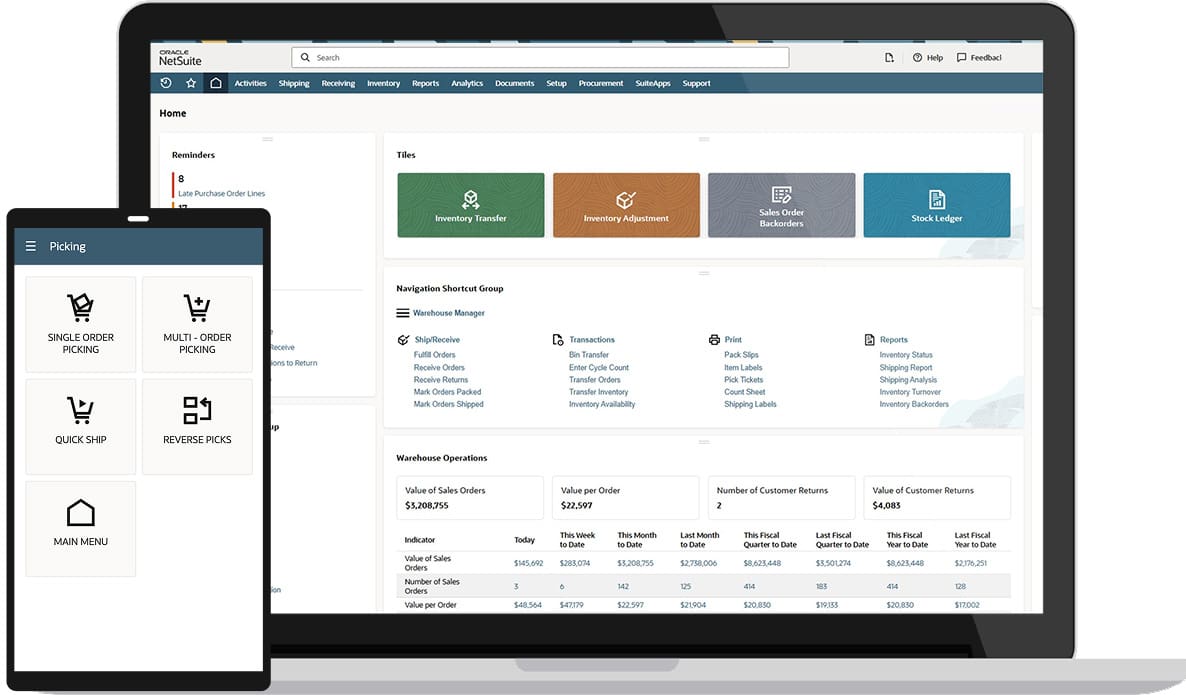
Manual checks and fragmented tools make accuracy harder to sustain as operations grow. NetSuite Warehouse Management System (WMS) connects every step in the fulfillment process—receiving, stocking, picking, shipping, and returns—within a single system. Real-time visibility, barcode validation, and guided workflows help catch inaccuracies before products leave the floor, while managers gain a clear view of stock levels, labor activity, and order status.
When integrated with NetSuite ERP, WMS links warehouse performance to accounting, procurement, and customer records, updating them automatically as orders move through fulfillment. Automated capabilities, such as guided wave picking, mobile scanning, and rule-based task assignment, help maintain near-perfect accuracy even as volumes rise. Together, NetSuite ERP and WMS give warehouse teams the connectivity and control to raise fill rates, protect margins, and confidently deliver every order.
NetSuite’s Pick, Pack, and Ship Dashboard
Accuracy is much more than an operational measure; it’s the basis for building customer trust and profitability. Even a 99% accuracy rate can quietly take a toll on margins through wasted labor, added shipping costs, and lost loyalty. But reducing picking errors isn’t only about saving time or money—it’s also about protecting reputation and improving customer satisfaction and retention. Warehouses that combine clear processes, well-trained teams, and connected technology achieve repeatable accuracy and scalable efficiency, so that every order leaves the dock on time, complete, and correct.
Reducing Picking Errors FAQs
How do you improve inventory accuracy in the warehouse?
Accurate stock records depend on regular verification. Cycle counting confirms that physical quantities match system data. Using barcode scanning at every stage from receiving to packing can further help reduce errors and keep records up to date. And organized storage and clear labeling make it easier for workers to find and confirm the right items quickly and without confusion.
How do you increase the pick rate in the warehouse?
Pick rate improves when paths are straightforward and movement is reduced. Grouping high-demand items near packing areas is one way to shorten travel time, as is choosing the right picking method for your warehouse’s needs. Digital route guides or handheld scanners connected to a warehouse management system further support consistency by directing workers through each pick in the most efficient sequence.
What is the formula for picking accuracy?
Picking accuracy measures how often items or orders are picked correctly during order fulfillment. It can be calculated either at the order level or by individual items:
- Order-level accuracy: [(Total orders – Picking errors) / Total orders] x 100
- Item-level accuracy: [(Total picks – Picking errors) / Total picks] x 100
The result is your picking accuracy percentage. The higher the percentage, the fewer the errors and the more reliable the fulfillment.
What are the most frequent kinds of picking errors?
The most common picking errors are mispicks, which happen when a picker mistakenly selects the wrong SKU.