
A business can post strong revenue and still struggle financially if it doesn’t convert enough of that revenue into profit. Margin analysis provides visibility into a business’s potential margin-eroding inefficiencies by breaking down profitability at various operational stages from production to the bottom line, allowing finance leaders to better gauge and manage business performance.
What Is Margin Analysis?
Margin analysis is the process of calculating and evaluating a company’s various profit margins to assess financial performance. A “margin” represents the percentage of revenue that remains as profit after deducting specific costs—essentially, how many cents of each sales dollar a business keeps at different stages. It differs from absolute profit in dollars by expressing profitability as a percentage, thus enabling meaningful comparisons across time periods and business scales.
Margin analysis measures operational efficiency that leads to profit—or a lack thereof. It answers questions like: How effectively does the company turn revenue into profit? Where are costs eroding profits? How does margin performance compare with that achieved in prior periods or with competitors’ numbers?
Margin analysis is sometimes confused with marginal analysis, an economic concept focused on the incremental costs and benefits of producing one additional unit of something. Though both functions inform business decisions, margin analysis evaluates overall profitability while marginal analysis examines the change in total cost or benefit from a specific incremental decision. This discussion is about margin analysis.
Key Takeaways
- Margin analysis measures profitability at different business stages to see how efficiently a business turns revenue into profit at the gross, operating, and net margin layers.
- It exposes where costs erode returns and where efficiency breaks down, eventualities that might otherwise be obscured by revenue swings.
- Finance leaders use margin analysis to guide pricing, control costs, allocate resources, and support strategic decisions.
- Accurate data, consistent methodology, and comparative analysis are essential to avoid common pitfalls.
- Accounting software automates real-time margin calculations and, when paired with AI capabilities, can unveil potential issues sooner.
Margin Analysis Explained
A type of financial statement analysis, margin analysis follows the structure of the income statement by measuring profitability at successive stages as different categories of costs are deducted from revenue. It starts with gross margin—the percentage of revenue left after subtracting the direct costs of producing goods or delivering services. Operating margin then accounts for the additional expenses required to run the business, such as administrative overhead. Finally, net margin reflects what’s left after all expenses are deducted and nonoperating activity, such as interest income or expense, is netted out and added or subtracted. Each profit margin tells a different part of the story; analyzing all three together provides a complete picture of where profit is generated and where it leaks away.
Margin analysis can be applied to an overall business or at the division, department, product line, or even individual SKU level. These varying levels of detail help business managers reach targeted decisions but require more sophisticated cost accounting, particularly for allocating shared costs.
A single margin calculation has limited use; its real value is revealed through comparison. Tracking margins across multiple periods discloses trends and trajectories. Benchmarking against industry peers helps assess competitive positioning. And analyzing variances between actual results and forecasts or budgets uncovers what’s driving changes, enabling financial analysts to spot inefficiencies or opportunities.
Why Is Margin Analysis Important?
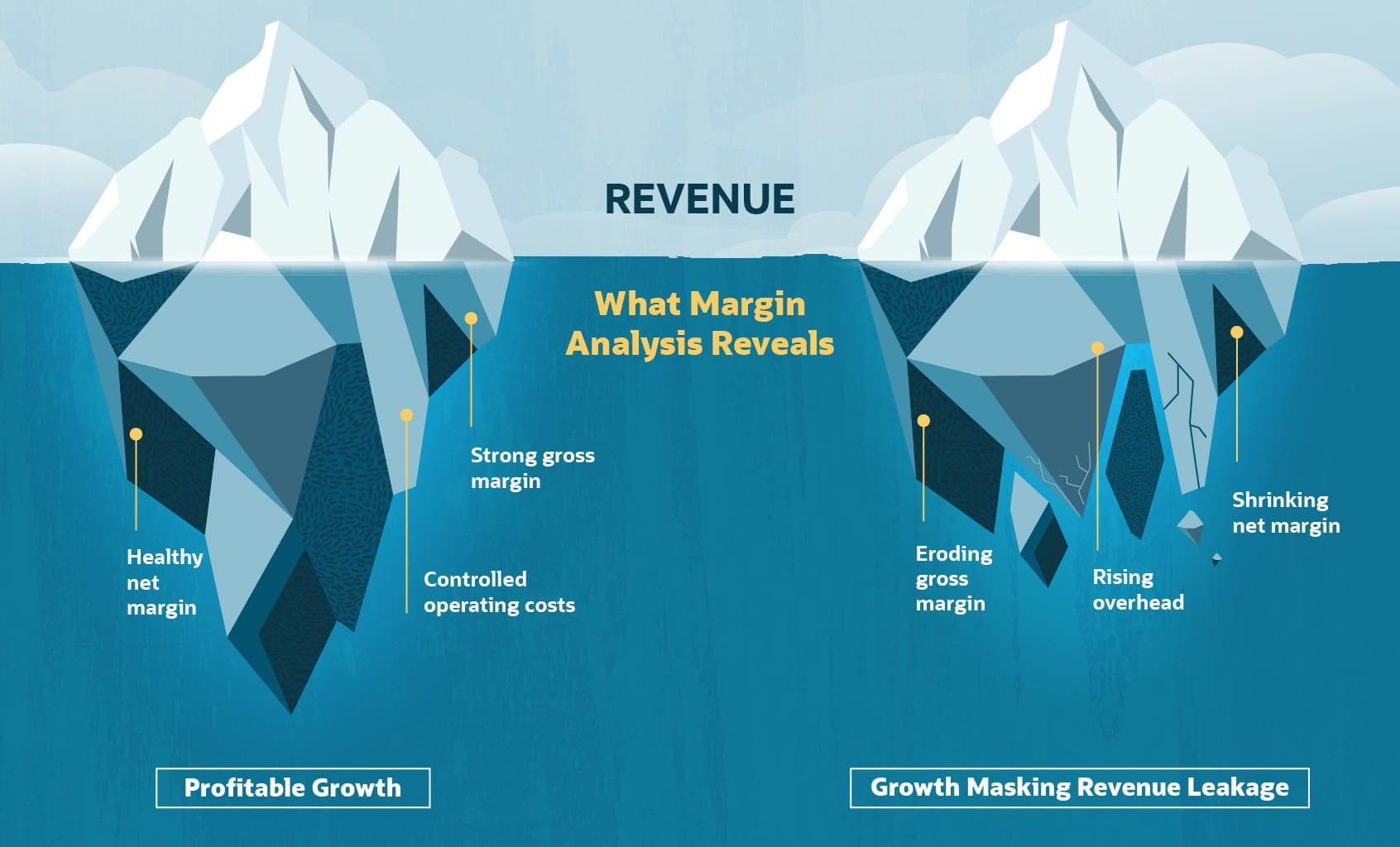
Margin analysis applies to all businesses, regardless of lifecycle stage, market dynamics, macroeconomic conditions, or the competitive landscape. When revenue and profit are growing in absolute dollars, margin analysis clarifies whether that growth is healthy or masking underlying margin leakage. For example, a business might increase sales yet experience margins quietly eroding because it is underpricing products to win market share. Conversely, when revenue stagnates or declines, margins become the primary measure of operational health. Stable or improving margins in flat revenue scenarios demonstrate resilience and cost discipline, while declining margins signal deteriorating profitability with no top-line growth to offset it. Failing to conduct a margin analysis allows detrimental issues to remain hidden until they become critical.
Margins reveal how efficiently the business operates at any scale, which is why both internal and external stakeholders often scrutinize margin trends more closely than absolute profit numbers when assessing a management team’s effectiveness and a business’s sustainability.
In addition to identifying problems, margin analysis pinpoints where to focus corrective action. A company with strong gross margins but weak operating margins has a profitable core business but is losing points from overhead costs, indicating that issues lie in selling, general, and administrative (SG&A) expenses rather than in production or supplier costs. Declining gross margins with stable operating margins can be a sign of problems with production costs or pricing pressure. Industry margin comparisons will further reveal relative efficiency and market power, providing context for whether performance issues are company-specific or industrywide challenges.
Same Revenue, Different Operational and Financial Stories
What Is the Purpose of Margin Analysis?
Margin analysis translates data into actionable insights by connecting financial performance to operational priorities. It supports decisions in key areas and provides an objective basis for evaluating management effectiveness across divisions or business units. Specific applications include the following:
- Cost control: Identifies which expense categories consume disproportionate revenue by isolating costs at production, operations, and total business levels. This increases visibility of spending drift, which is especially useful when reviewing indirect costs that are shared across the organization and thus can be harder to track.
- Pricing strategy: Informs the pricing process and illuminates whether current pricing supports the business’s desired profitability or if discounts, promotions, or competitive pressures are squeezing returns. Effective pricing initiatives can add up to 3% of revenue to the bottom line, according to business consultants at Deloitte.
- Performance management: Furnishes clear benchmarks for measuring operational efficiency and assessing whether performance is improving, holding steady, or declining at various levels of the business.
- Resource management: Clarifies the best allocation of time, capital, and head count by highlighting which activities and operations contribute most to profitability. Margin analysis can also flag where to focus an investigation, either by detecting underperformance or exploring untapped opportunities.
- Informed strategic planning: Provides the data foundation for major business decisions by spotlighting areas that deliver the strongest returns. Margin analysis can guide product portfolio decisions and clarify which lines to grow, maintain, or phase out based on profit contribution. It informs competitive positioning and decisions about expanding or contracting market presence. Margin analysis is also helpful when evaluating strategic initiatives like acquisitions or operational restructuring by quantifying their potential impact on overall financial performance.
Types of Margin Analysis
Among the many noteworthy margin metrics, gross margin, operating margin, and net margin form the core. Selecting the type of margin to analyze depends on the business question being asked. Gross margin shows whether production and delivery are efficient and whether pricing covers direct costs. Operating margin illuminates how well the business runs, independent of financing decisions and tax situations. Net margin captures the bottom line after accounting for everything.
Other measures can be used for more specialized margin analysis. For example, earnings before interest, taxes, depreciation, and amortization (EBITDA) is useful for comparing companies with different capital structures or evaluating acquisition targets, since it removes the effects of financing, taxes, and noncash expenses. Segment margin can pinpoint a business’s strongest and weakest ares by breaking down profitability by business unit, region, or product line. Cash flow margin tells the rate at which revenue converts to actual cash. Analyzing contribution margin—which isolates and subtracts the variable costs that change in proportion to production or sales volume—is widely used in managerial accounting and is a key component in break-even analysis.
Gross Margin
Gross margin measures the percentage of revenue that remains after subtracting the cost of goods sold (COGS) or cost of sales (COS) for services. COGS includes the costs of producing or acquiring goods and services, such as raw materials, direct labor, and manufacturing overhead. For service businesses, COS includes the labor and materials required to deliver services. Gross margin analysis shows what remains after covering production and delivery costs. The higher the gross margin, the more room for absorbing operating expenses while still generating profit. Gross margin answers basic questions: Is the core business model viable? Can the company make (or acquire) its products and sell them at prices that exceed the full cost of production? A declining gross margin can point to rising production costs, pricing pressure, or an unfavorable product mix.
Gross margin is useful for evaluating pricing strategies, comparing production efficiency across accounting periods, and identifying which products or services are most profitable. The formula for gross margin is:
Gross margin = [(Revenue – COGS) / Revenue] × 100
Operating Margin
Operating margin measures the percentage of revenue remaining after subtracting both COGS and operating expenses. Operating expenses include SG&A costs, such as salaries for nonproduction staff, rent, utilities, marketing, administrative overhead, research and development (R&D), and depreciation and amortization of nonmanufacturing assets. Operating margin captures profitability from core business operations before interest and taxes are factored in.
This margin tells whether the business is operationally sound after accounting for the costs of running the company, not just making the product. Deteriorating operating margins can signal, for instance, that SG&A costs are growing faster than revenue or that R&D or marketing investments are outpacing returns.
Operating margin analysis is useful for comparing operational efficiency across periods and benchmarking against competitors. Because it excludes interest and taxes, it provides a cleaner view of operational performance when comparing companies with different capital structures or tax situations. It’s particularly valuable for assessing a business’s ability to scale efficiently. If operating margin improves as revenue grows, the company will achieve greater operational leverage. Operating margin analysis is calculated as:
Operating margin = (Operating income / Revenue) × 100
Net Margin
Net margin measures the percentage of revenue that remains as profit after deducting all items, including COGS, operating expenses, nonoperating activity, interest, and taxes. It’s the most comprehensive view of profitability. Net margin can vary significantly across companies, making direct comparisons less straightforward than they are when reviewing operating margin.
Net margin is valuable for tracking profitability trends over time, evaluating the combined impact of operational and financial decisions, and understanding how much of each revenue dollar translates to bottom-line profit. This makes it useful for assessing overall financial health and understanding returns available to shareholders.
Net margin benchmarks vary dramatically by industry and business model. High-volume, low-margin businesses may operate successfully at net margins in the single digits, while asset-light businesses may achieve 20% to 30% or higher. Net margin analysis works best when comparing peers and trends over time, as well as in combination with other margins. For example, a declining net margin with stable gross and operating margins can indicate rising interest costs or deteriorating nonoperating performance. Net margin is calculated as:
Net margin = (Net income / Revenue) × 100
How to Perform Margin Analysis
Margin analysis isn’t complicated, but it does require good data and a clear process. The calculations rely on financial reporting standards—either the US’s Generally Accepted Accounting Principles or the International Financial Reporting Standards. These define how revenue must be recognized, how costs are classified, and how income statements are structured. Standardization eases the process of making meaningful comparisons.
To perform margin analysis, start with a well-defined objective, select the right margin for the question, and follow these steps:
- Gather the data: Start with accurate financial data from the income statement, specifically revenue, COGS, operating expenses, interest, taxes, and net income. For a more detailed analysis, gather data by segment, such as by product line, customer group, region, or business unit.
- Classify costs: Organize costs into the appropriate categories. Separate direct costs (COGS) from operating expenses (SG&A, R&D, depreciation). For contribution margin calculations, distinguish between fixed and variable costs.
- Calculate margins: Use the formula for the selected margin, applying it to the business as a whole and to individual segments, if relevant. Consistency matters. Use the same methodology across periods and segments for the best comparisons.
- Analyze results: Look beyond the numbers. Compare margins across fiscal periods to identify trends. Benchmark against industry peers to assess competitive positioning. Analyze margins at multiple levels of granularity. Investigate what’s driving the results.
- Act on insights: Use what the analysis presents to guide action. Margin insights can guide pricing adjustments, cost-reduction initiatives, resource reallocation, and strategic decisions. Present a well-documented plan with targets and milestones.
Example Margin Analysis
The following fictional example illustrates how to perform a margin analysis following the steps outlined in the previous section:
-
Gather the data: GreenWave Sports, a hypothetical sporting goods manufacturer, pulls income statement data for two consecutive years.
Year 1 Year 2 Revenue $10,000,000 $11,000,000 COGS $6,000,000 $7,040,000 Operating Expenses (SG&A) $2,500,000 $2,310,000 Interest Expense $100,000 $110,000 Gain on Sale of Investments $0 $250,000 Taxes* $280,000 $358,000 Net Income $1,120,000 $1,432,000 * GreenWave’s effective tax rate is 20%.
-
Classify costs: Using the general ledger’s chart of accounts, costs are organized into the appropriate categories. COGS includes raw materials, such as performance fabrics; direct labor for cutting and assembly; and manufacturing overhead, including facility costs, equipment depreciation, and utilities at the company’s plant in Aaron, Louisiana. Operating expenses include sales commissions, administrative salaries, rent, and R&D. Interest, gains on investment sales, and taxes are separated as nonoperating items. Consistent classification across periods is necessary for reliable comparisons.
-
Calculate margins: Here’s how to calculate gross, operating, net margins using the formulas from above:
Gross margin:
Year 1: ($10,000,000 – $6,000,000) / $10,000,000 = 40%
Year 2: ($11,000,000 – $7,040,000) / $11,000,000 = 36%Operating margin:
Year 1: ($10,000,000 – $6,000,000 – $2,500,000) / $10,000,000 = 15%
Year 2: ($11,000,000 – $7,040,000 – $2,310,000) / $11,000,000 = 15%Net margin:
Year 1: $1,120,000 / $10,000,000 = 11.2%
Year 2: $1,432,000 / $11,000,000 = 13.0%Year 1 Year 2 Change +/(-) Gross Margin 40% 36% (4.0%) Operating Margin 15% 15% 0 Net Margin 11.2% 13% 1.8% -
Analyze results: Revenue grew 10% in Year 2 ([$11,000,000 – $10,000,000]/ $10,000,000), and operating margin held steady at 15%. Net margin also improved from 11.2% to 13%. On the surface, Year 2 looks like a strong year. But the margin analysis leads to a different conclusion:
- Gross margin dropped 4 percentage points, from 40% to 36%, indicating rising production costs.
- Disciplined SG&A costs were down from $2,500,000 to $2,310,000, offsetting the gross margin decline at the operating level.
- And a one-time gain on the sale of investments boosted net income, inflating net margin. However, excluding the gain, net margin would have been flat at 11.2% ([$1,432,000 – $200,000 after-tax gain] / $11,000,000).
The seemingly improved Year 2 bottom line is covering up a core profitability problem in production.
-
Act on insights: Based on this analysis, GreenWave’s finance team recommends investigating the drivers behind rising COGS. It considers options targeted at increasing gross margin, including renegotiating supplier contracts for performance fabrics (the costliest raw material), reducing labor overtime costs, and assessing the possibility of raising sales prices to recover margin. The team advises executive management that the underlying production cost issue must be addressed to sustain profitability.
Tips for Avoiding Common Margin Analysis Mistakes
Margin analysis is only as useful as the data and assumptions behind it. Avoid these common pitfalls when performing margin analysis:
- Don’t misclassify costs: Allocating costs to the wrong category distorts the analysis. A cost classified as COGS in one period and SG&A in another makes trend analysis faulty. Be consistent in how each expense is treated.
- Don’t overlook indirect costs: Focusing only on direct costs like raw materials and ignoring manufacturing overhead, such as plant utilities, rent, or shared services, leads to inflated gross margins. If shared costs aren’t allocated properly, some products or segments will appear more profitable than they are.
- Don’t make assumptions based on a single snapshot: One quarter’s margins don’t tell the full story, and neither does a single margin type. Look at trends over multiple periods, as short-term fluctuations from seasonality or one-time events can be distortive. Analyze gross, operating, and net margins together for a fuller picture of performance.
- Don’t ignore external conditions: Margins are affected by variables, such as macroeconomic trends, supply chain stability, competitive dynamics, and regulatory changes. Interpret results with these factors in mind.
Gain Real-Time Financial Performance Insights With NetSuite
NetSuite Cloud Accounting Software provides the foundation for reliable margin analysis and can automate the calculations with connected systems for greater accuracy, speed, and visibility. A simplified chart of the accounts structure organizes accounting data for cleaner reporting, and unlimited custom general ledger segments offer consistent classification by department, location, product line, or profit center so managers can analyze margins at any level of the business. Role-based dashboards display current margin performance, and multidimensional reporting makes it easy to drill down into the details. AI-powered analytics help identify patterns and anomalies, guiding management intervention.
Margin analysis peels back the layers of financial performance to explain not just whether a business is profitable, but why and where that profitability is at risk. Gross, operating, and net margins each measure something different. Analyzing them together—and tracking them over time and against business goals and industry standards—gives finance teams the ability to isolate operating issues and shape decisions about pricing, costs, and resource allocation. A consistent approach, supported by the right software, helps avoid common mistakes and makes margin analysis a repeatable discipline.
Margin Analysis FAQs
What does a margin analysis tell you?
Margin analysis tells how effectively a business converts revenue into profit at different stages of its operations. Gross margin shows whether prices cover production costs. Operating margin reveals how well the business manages overhead. Net margin reflects the rate of profit after all activity. Together, these metrics highlight the strongest and weakest areas of profitability.
How can a business use a margin analysis?
Businesses use margin analysis to guide pricing, control costs, evaluate product and segment profitability, and benchmark against competitors. It also informs strategic decisions, including which products to prioritize, which markets to pursue, and where to allocate resources. Tracking margins over time helps spot problems before they escalate.