
Every consulting firm knows the feast-or-famine nature of project-based work. One quarter, you’re slammed and turning away work; the next, you’re scrambling to pump up the pipeline. Retainer agreements offer an alternative that yields predictable recurring revenue and potentially stronger client loyalty.
But retainers aren’t magic. Poorly structured agreements can lead to scope creep and billing disputes that compound month after month. This guide covers what you need to know (and avoid), including the different types of retainers, how to set your fee, and best practices for writing a contract.
What Is a Consulting Retainer?
A consulting retainer is a recurring agreement in which a client pays a fixed fee for ongoing access to a consultant’s services, expertise, or defined scope of work. Unlike project-based engagements, which often don’t pay until delivery milestones are met or upon project completion, retainers establish an ongoing relationship and regular billing cycles.
A retainer also represents a commitment to capacity and governance. It defines what’s included in the plan, how requests are handled, how value is reported, and how billing occurs.
Key Takeaways
- Retainers shift consulting away from project-by-project administration to a predictable operating cadence.
- Four retainer models exist, each with a distinctive risk profile.
- The contract terms most often disputed are operational, not legal.
- Fee-setting balances scope, capacity, value, and risk.
- Integrated systems turn retainer administration into a repeatable process.
Consulting Retainers Explained
Firms that succeed by using retainer agreements treat them as an operating model. The benefits they are meant to deliver—namely, stable revenue and stronger client engagement—materialize only when their mechanics work well.
In a typical retainer arrangement, the client and consultant agree on a recurring fee, billing cycle (usually monthly or quarterly), and scope of services or access. The client pays the retainer at the beginning of each designated period, before work is performed, and the consultant delivers in accordance with the agreed entitlements—the specific support levels, deliverables, and usage rights cited in the contract—throughout that period. At the end of the cycle, the consultant reports on work completed or access provided. Unused hours may roll over, expire, or lead to a conversation, as stipulated by the contract; overages beyond scope typically require separate approval and billing. Then the cycle starts over.
Retainers front-load cash and create revenue predictability, but they also front-load administrative demands: tracking what’s owed, reporting time and activities, and billing accurately—every cycle. When an agreement repeats monthly, so do any weaknesses in scoping, tracking, or invoicing. For example, a vague definition of scope may cause minor friction on a single project, but in a retainer it can lead to time-consuming extra meetings and ad hoc support that drain margins over 12 billing cycles.
In fact, revenue leakage—work delivered but not properly billed—in the professional services industry increased to 5.3% in 2024, up from 4.7% in 2023, according to a 2025 industry benchmark report. The culprits? Billing errors, inability to bill delivered work, and poorly written statements of work.
Types of Consulting Retainers
No single retainer structure will fit every engagement. The right model depends on what the client is paying for (deliverables versus access), how work gets measured, and what the firm can actually administer well.
The following four approaches are the most common:
- Pay-for-work: The client pays a recurring fee for a defined package of work—for example, specific deliverables or a bank of hours—within each period. Newer consultants tend to prefer pay-for-work retainers because they closely resemble project work. The risk is scope creep: When value delivered exceeds value priced, margins shrink.
- Pay-for-access: The client pays for priority access to expertise, usually with defined response expectations and boundaries that clarify what is—and is not—covered under the agreement. The client pays for availability and quick turnaround when issues arise, not guaranteed monthly deliverables. Challenges emerge when “access” is open-ended and unpredictable.
- Advisory retainers: The client pays for ongoing strategic guidance—roadmaps, operating reviews, risk management, leadership counsel, and the like. Advisory retainers work best when the consultant provides transparent reporting and establishes decision-support cadences. Trust matters here more than with other models—the client is paying for judgment, not deliverables, so value is harder to prove.
- Hybrid approaches: This model combines baseline access, defined deliverables, and explicit overage rules. Hybrids often match midmarket reality, where client needs can vary month to month. The trade-off here is administrative complexity: Access consumption and deliverable completion both demand solid tracking.
Components of a Consulting Retainer Contract
A well-structured retainer agreement reduces friction by zeroing in on the terms most likely to cause conflict. Research has found that while negotiations often focus on traditional, legal risk terms, most disputed items stem from execution. The following components address that reality:
- Retainer structure: The agreement should specify whether the retainer is access-based, work-based, advisory, or hybrid. Entitlements, rollover rules for unused hours, and overage treatment should also be included. Ambiguity leads to missed deliverables and scope spats, both of which are key contributors to contract value loss, according to World Commerce & Contracting.
- Scope of work: Included services and exclusions should be spelled out in detail, defining what triggers a change order or falls outside the agreement. Retainer scope and specifications are two of the most contested terms, so specificity prevents problems down the line.
- Success metrics: Consulting firms should define measurable performance outcomes—response times, delivery cadence, key performance indicators tracked, stakeholder satisfaction—in their agreements. Ambiguous value terms increase the likelihood of problems arising during renewal. Firms with real-time data visibility outperform those that operate within data silos, according to a 2025 industry benchmark report.
- Retainer term and renewal: Firms should establish term length, renewal mechanism, notice periods, and pricing adjustments, if needed, to avoid lost revenue. Clear terms and automated reminders reduce the risk of missed renewals or messy, last-minute renegotiations.
- Deliverables and reporting: Retainers require ongoing proof of value, so the agreement should specify deliverables (if applicable), reporting artifacts, cadence, and stakeholder touchpoints. Without regular reporting, clients question what they’re paying for—especially during quieter months.
- Confidentiality and compliance requirements: Nearly 90% of business users find contracts difficult or impossible to understand, according to World Commerce & Contracting. Standardized, understandable language matters to support consistent execution—particularly when confidentiality, data handling, or compliance obligations are involved.
- Responsibilities for each party: Unclear obligations can lead to delays and delivery issues. Agreements should spell out both client inputs (data and approvals) and consultant commitments. Workflow-based approvals and auditable decision trails help hold parties accountable.
- Payment terms and payment schedule: Invoice confusion and late payments are common causes of disputes, per World Commerce & Contracting. Consulting firms should lay out invoicing timing, due dates, late fees, and billing mechanics in the retainer agreement. Explicit payment terms and automated invoicing also decrease the number of disputes and accelerate timely collections.
- Termination clause: Loosely defined termination terms invite conflict. Straightforward exit provisions that spell out termination rights and notice periods protect both parties and preserve the relationship’s chances for future work.
Benefits of Using Consulting Retainers
In the professional services sector, unbilled work is increasing, utilization is stagnating, and delivery performance is slipping. Retainers offer stability, but only when they’re properly instrumented. Manage them correctly, and the advantages accrue to customers and consulting firms alike.
Benefits for Clients
- Simpler budgeting: Predictable recurring spend replaces variable project costs, and clients can secure preferential rates compared to one-off pricing.
- Access to specific expertise: Retainers reserve priority access to specialized knowledge without the commitment and expense of a full-time hire.
- Priority status: Retainer clients typically move to the head of the line when issues arise, preventing small problems from escalating.
Benefits for Consulting Firms
- Predictable revenue: Retainers provide steady revenue streams to support resource management and investment. Generally speaking, firms that retain clients outperform those chasing new business quarter after quarter.
- Improved client collaboration: Ongoing engagement deepens the firm’s understanding of the client’s business and fosters trust, driving referrals and repeat business.
- Increased cash flow: Retainers shift billing from reactive (invoice after work) to proactive (invoice at the start of a period). This can improve cash flow forecasting, although the 2025 industry benchmark report shows that days sales outstanding (DSO) continues to average 43 days when invoicing and collections lack discipline.
How to Set a Consulting Retainer Fee
Fee-setting is part design exercise, part risk management. With revenue leakage rising, the right fee and structure can determine whether retainers contribute to profitable recurring revenue or compound margin loss. Six steps can help consulting firms get their fees right.
-
Assess Service Scope
Scope encompasses what’s included and excluded in the agreement, as well as how the relationship will adapt when needs change. This includes documenting specific deliverables, time commitments, and boundaries.
-
Tabulate Time Commitment
Realistic estimates should account for both client-facing work and administrative requirements. Time estimates should include delivery time plus governance overhead: reporting, meetings, coordination, and communication. When billable utilization declines, capacity errors quickly become profitability problems.
-
Determine Value and Set Consulting Rate
This step involves deciding what the client is truly paying for—availability, speed, deliverables, or outcomes—and how that will be measured. Pricing should reflect the value of what’s created for the client, not just hours worked. Outcome-based pricing often yields higher project fees than hourly billing, since fees are tied to results rather than time logged.
-
Calculate Base Fee
The base fee should cover delivery cost, overhead, governance time, and a risk buffer. Even small execution gaps, such as invoice errors, can multiply into material margin loss at scale. A sufficient margin provides a cushion for the inevitable hiccups.
-
Choose a Retainer Type
The structure should align with the nature of the client-consultant relationship. Each retainer type has its own operational requirements and failure modes. For example, pay-for-work is vulnerable to scope creep, pay-for-access to capacity unpredictability, and advisory to unclear value. The right choice balances client fit and the firm’s ability to administer it cleanly.
-
Set Terms for Overages and Unused Hours
The agreement should define how work beyond scope will be handled, including overage pricing and approval requirements. Disputes tend to center on amendments and invoices. Monthly usage statements and automated overage approvals reduce client frustration and billing surprises.
When Should You Use a Consulting Retainer?
Retainers fit clients with ongoing needs and those that value continuity and fast response times over one-off project delivery. They also work best when the consulting firm can consistently measure and report on its work.
The ideal time to propose a retainer is after completing a successful project, when you’ve demonstrated your value and established trust. Watch for signals: The client asks what else you can work on together, mentions ongoing challenges in your area of expertise, or expresses concern about losing access to your knowledge.
Retainers are less effective when the engagement is truly one-time, the client’s needs are unpredictable, or the firm lacks the ability to track entitlements and bill accurately. Proposing a retainer too soon, before you’ve truly had the chance to prove yourself as a go-to partner, may also backfire.
Choosing the right retainer model matters, but its execution matters more. Firms with consistent delivery, accurate billing, and strong client communication will find retainers profitable.
Best Practices for Writing a Consulting Retainer Contract
Most retainer problems lie in operational issues. These practices address what often goes wrong:
- Include provisions for work outside of scope: A clear change mechanism—new statement of work, change order, or rate card—should be part of every retainer. Amendments and scope changes are common sources of disagreement; formalizing how to handle out-of-scope requests heads off arguments later.
- Set client expectations early: Clients often ask, “What if we don’t use you much some months?” The answer? Retainers function like an insurance policy; clients pay for priority access and peace of mind, not just hours consumed. Regular check-ins reinforce value, even during quieter periods.
- Get specific about deliverables and value: Inexact descriptions like “ongoing consulting support” make it hard to justify continued investment. Agreements should paint a picture of what success looks like, such as specific monthly deliverables or the types of issues the consultant will help solve.
- Include confidentiality clauses: Confidentiality and data-handling terms should be standardized. Plain, consistent language prevents misunderstandings and builds client confidence.
- Specify procedures for handling disputes: Escalation steps, timelines, and dispute workflows belong in the agreement. Invoicing and pricing are frequent points of debate. A precise resolution process shortens dispute cycles and protects the business relationship.
- Review the retainer periodically: Quarterly reviews to assess value delivered, discuss changes in the client’s business needs, and adjust terms help the agreement remain relevant. Many contracts are too rigid to adapt to changing circumstances; regular reviews are the antidote.
- Use software: Retainer administration belongs in integrated systems, not email threads and spreadsheets. Contract data that is scattered across multiple systems reduces visibility. Centralized contract management—linked to time tracking, billing, and performance metrics—reduces administrative burden and improves accuracy.
Enhance Contract Management With ERP Software
The problems that sink retainers share a root cause: fragmented systems and manual processes. When entitlement tracking lives in one spreadsheet, time capture in another, and invoicing in a third, errors compound and visibility suffers.
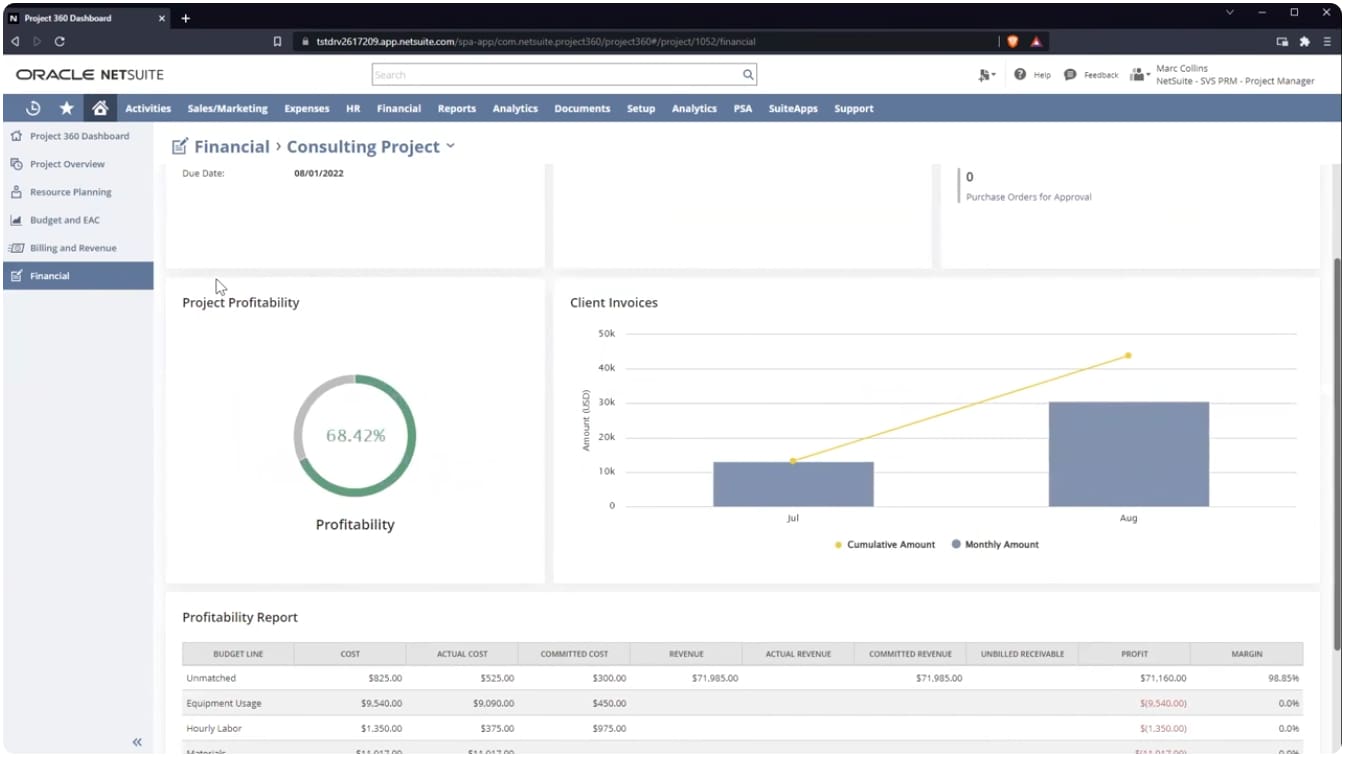
NetSuite ERP for Consulting Firms connects billing, finance, resource management, and project delivery in a single cloud system. That integration helps firms maintain the operational discipline retainers demand, so retainers stabilize the business. Automated billing for time-and-materials, milestone, and fixed-fee engagements shortens DSO; mobile time sheets capture every billable charge accurately; real-time dashboards flag revenue leakage before it becomes a problem; and structured approval processes minimize scope creep and billing disputes.
Real-Time Visibility Into Retainer Performance
Every month that a retainer is allowed to run despite vague scope, sloppy billing, or inconsistent reporting, money walks out the door—and those losses compound. Consulting firms that build discipline now, with clear entitlements, accurate billing, and systematic renewals, will do more than stop the bleeding. They’ll have a real advantage over competitors that are still managing retainers with spreadsheets and good intentions.
Consulting Retainer FAQs
What is a consulting retainer agreement?
A consulting retainer agreement is a contract for recurring consulting services or expertise that covers entitlements, billing, and renewal terms. Unlike project contracts with fixed end points, retainers create an ongoing relationship that includes predictable billing.
What are some common mistakes in consulting retainer agreements?
Common mistakes in consulting retainer agreements include vague scope definitions, unclear billing mechanics, weak change-control procedures, unclear service-level expectations, and ambiguous responsibility assignments—all of which can lead to recurring friction and margin erosion.
What are the advantages and disadvantages of a retainer fee?
Advantages include predictable revenue for the consultant, simpler budgeting for the client, deeper business engagement over time, and priority access to the consultant’s expertise. Disadvantages include potential scope creep, client concerns about “paying for nothing” during quiet months, and administrative overhead. Clear contract structure, discipline, and execution can mitigate these risks.