
Consultants juggle numerous projects for multiple clients, so it’s easy to see how billing can quickly become a nightmare of overflowing spreadsheets, untracked hours, delayed payments, and customers fuming over surprise charges. This guide cuts through the noise by exploring the most widely used consulting billing models—from time-based approaches to outcome-centered strategies—and outlines factors to consider when choosing a method.
What Is Consulting Billing?
Consulting billing refers to the process of charging and invoicing clients for professional services. The process typically includes documenting the work completed, applying the contracted rate, adding reimbursable expenses, and issuing detailed invoices with remittance instructions.
Depending on the agreement between consultant and client, consultants may bill customers based on hourly rates, fixed project fees, or retainers, or they may structure pricing around meeting certain milestones or delivering a specific level of performance.
Key Takeaways
- Hourly billing remains one of the most popular models among consultants, but sometimes clients dislike the approach.
- Value-based pricing allows experienced consultants to charge premiums linked to tangible business wins.
- Scope creep is a common problem that can hurt margins and client relationships without the proper protections.
- When choosing a billing model, consultants should consider the complexity of the project, industry norms, client needs, and more.
Popular Consulting Billing Models
Consultants may choose from among several different billing methods, depending on the type and scope of work, as well as client expectations and industry norms. Let’s take a look at six of the most widely adopted consulting billing models and the distinct pros and cons of each.
-
Hourly Billing
With hourly billing, consultants charge clients according to the number of hours worked multiplied by an agreed-upon hourly rate. This method is straightforward to implement and works especially well for open-ended projects, advisory services, and situations where the scope of the work may evolve. In today’s consulting landscape, hourly billing remains common, with 66% of tax and accounting professionals saying their firms continue to use hourly or time-based billing, according to a 2024 Thomson Reuters Institute survey. While the method is simple and transparent, offering flexibility and low up-front risks for consultants, it has its disadvantages. For instance, clients may worry that costs can be unpredictable and that the structure rewards longer timelines, rather than faster, outcome-focused results.
-
Project-based Billing
Project-based billing involves setting a fixed fee for completing a defined scope of work, regardless of the number of hours required. This model, which has become more popular in response to clients’ increased demand for more predictable pricing, provides clear cost expectations for customers and encourages consultants to work efficiently to maintain healthy margins. Project-based billing is appropriate for well-scoped deliverables with clearly defined outcomes, such as conducting market research and audits or creating strategic roadmaps and presentation decks. That said, this model works smoothly only when the scope of the initiative is spelled out clearly from the start. If the expectations of consultants and clients aren’t aligned—or if clients add new requests without fee adjustments—a project can quickly grow beyond what was originally planned, cutting into profits and causing frustration on both sides.
-
Value-based Billing
Rather than charge by the hour or project, value-based billing ties a consultant’s fees to the actual impact the work has on a client’s business—for example, generating measurable revenue increases, achieving cost savings, or making other quantifiable improvements. As clients increasingly seek agreements that reward results, this model has gained significant traction in recent years. In fact, 48% of tax and accounting professionals in the 2024 Thomson Reuters survey said their firms use value-based billing, and another 18% said they plan to offer it. Experienced, specialized consultants tackling high-impact, clearly measurable problems often favor this model since they can charge premium fees for their work, especially in fields like tax and accounting, marketing, and certain legal or strategy engagements where results can be quantified. At the same time, value-based billing requires consultants to negotiate more up front and to carefully define metrics and targets.
-
Milestone-based Billing
Milestone-based billing breaks a larger consulting engagement into a series of agreed-upon checkpoints or deliverables, with clients making payments only when each milestone is completed and accepted. It’s most often used for projects with a clear sequence of steps, such as phased technology implementations or staged product rollouts, allowing both sides to manage risk and cash flow more predictably. This model appeals to clients because they can pay incrementally for progress, and it motivates consultants to meet tangible targets on schedule. Keep in mind, though, that milestone-based billing requires clear communication and planning from the get-go to define exactly what’s considered a completed milestone.
-
Retainers
With retainer billing, clients pay a recurring fee, typically on a monthly basis, in exchange for ongoing access to a consultant’s expertise, services, or a defined bundle of work. Consultants often use retainers when clients need consistent, long-term support, such as for strategic advising, ongoing project management, or continuous improvement services. From the client’s perspective, retainers create a predictable budget and guaranteed access to trusted expertise, which can be especially valuable if the client’s needs suddenly spike or shift from month to month. The trade-offs include the need to spell out what is and isn’t included in the scope of work so expectations don’t drift, and to set boundaries around responsiveness and availability so the retainer doesn’t slide into scope creep.
-
Daily Rates
A consultant may charge a daily rate—or a flat fee for each full day worked—to make billing less tedious than tracking time by minute. This approach is common for short-term engagements, such as workshops or intensive strategy sprints, where clients prefer to budget by the day and gain access to the consultant’s full attention for a set period of time. For consultants focused on concentrated work blocks and hoping to avoid the administrative overhead of precise time tracking, daily rates can be a practical approach.
Why Is It Important for Consultants to Choose the Right Billing Model?
Choosing the appropriate billing model is vital because it shapes consultants’ profitability and sets a certain tone with clients. A misaligned model can leave money on the table or make clients feel nickel-and-dimed, whereas the right choice sets clear expectations and syncs the consultant’s incentives with the client’s needs. Billing also influences how clients perceive a consultant’s value—whether they see the consultant as a strategic partner that drives outcomes, a specialized expert who solves defined problems, or a vendor that bills for time.
Moreover, the billing model affects operations and growth, determining how predictable revenue will be, how easily the business will be able to scale, and how much financial risk is shared between the consultant and client—all of which is especially important at a time when many consultants are struggling to hit their margin targets. Though the target gross margin consultants aim for is 50%, a 2024 survey by the Consultancy Growth Network found that the actual average gross margin is 41%.
Considerations for Choosing a Billing Model
Several practical factors should guide the billing-model decision, from the nature of the engagement to how much risk a consultant is willing to share with the client. Let’s explore the factors consultants should consider when choosing a billing model:
- Ongoing work versus project-based work: How consultants bill for their work will differ depending on the job. Ongoing work, such as regular IT support, often benefits from monthly retainer billing, giving the consultant predictable recurring revenue and the client reliable access to the consultant’s skills. Meanwhile, project-based work is usually better priced as a fixed-fee project or a series of milestone payments tied to clear deliverables. Open-ended projects, such as diagnosing the root cause of a recurring system outage, might be a better fit for hourly billing because the scope is harder to estimate from the start.
- Client expectations: The preferences and expectations of clients heavily shape a consultant’s billing choices. Some clients demand detailed time tracking and transparent hourly billing to verify the effort consultants put in; others prefer retainers to secure ongoing access to experts. Budget-conscious buyers often push for a capped number of hours or fixed project fees to make sure their total costs are predictable. Outcome-focused clients, meanwhile, tend to favor value-based or milestone models that tie payments directly to measurable results.
- Industry-specific pricing trends: Specific sectors often follow established norms that dictate how consulting services are handled. Technology consulting, for instance, leans toward value-based or outcome-driven pricing tied to cost savings or revenue growth, while legal and compliance often favor carefully tracked hourly billing due to the unpredictable scope of the work and the need for regular audits. Manufacturing and supply chain projects, for their part, might use fixed project or milestone structures for implementations, and retainers are common in marketing for ongoing work.
- Project complexity: The more complex an engagement, the more difficult it is for a consultant to estimate the effort and risk involved. Highly complex projects—consider a digital transformation that involves multiple stakeholders—may warrant hourly billing or a tiered pricing structure that adjusts for additional phases or potential challenges. Simpler projects with well-defined objectives often lend themselves to fixed fees. Conduct an accurate assessment of the complexity of a project to avoid underpricing.
- Likelihood of scope changes: Scope creep is one of the most persistent and costly challenges in consulting—and when it happens, consultants spend more time on projects without making more money. In fact, projects with lower levels of performance tend to show higher rates of scope creep, according to a 2024 Project Management Institute survey. To predict the likelihood of scope changes up front, assess the complexity of projects, the client’s track record, and any external pressures, such as market shifts. Projects prone to these red flags often suit hourly billing. In general, if a client requests changes that aren’t part of the original scope of work, be sure to clarify any additional costs to avoid absorbing unpaid labor.
- Cash flow considerations: A consulting firm’s billing model determines when revenue is actually collected—and for many firms, consistent cash flow is essential to cover payroll, rent, technology subscriptions, and other recurring expenses. Monthly retainers and structured milestone payment schedules provide greater income predictability. Billing only when a project is complete, on the other hand, may require the firm to finance months of work before receiving payment. To minimize the risks, consider requiring an up-front deposit—typically about 30% for large, fixed-fee engagements—to allow for greater cash flow and to confirm that a client is committed to the relationship.
- Regulatory requirements: In some industries, consultants must follow strict billing and documentation standards. Government contracts, for example, often require detailed time tracking, labor classifications, and cost breakdowns, making hourly billing more practical than loosely defined fixed fees. In healthcare, consulting work that involves accessing a doctor’s clinical systems or patient data must align with privacy and security regulations, affecting how projects are documented and invoiced. And firms serving financial institutions or publicly traded companies may need to maintain detailed audit trails to satisfy regulatory oversight and internal control requirements.
- External dynamics: Broader economic and market trends often shape a consultant’s pricing strategy. During economic downturns, clients may become more cost-sensitive, favoring predictable, fixed pricing. However, in a tight labor market in which consultants are experiencing significant demand, firms may shift toward value-based pricing, charging high premiums for their expertise. Monitor inflation, interest rates, and competitor pricing to adapt pricing models in real time and to avoid reliance on outdated assumptions.
5 Consultant Billing Best Practices
Consultants can’t afford to track time inconsistently, send out vague invoices, or wrestle with unclear payment terms. The right billing practices are key to getting paid quickly, making a good impression, and solidifying strong client relationships. Here are five essential billing practices consultants should follow:
- Track time meticulously: Even consultants that charge fixed fees should track time internally to ascertain whether projects are profitable, identify scope creep, and provide documentation should billing questions arise. For hourly billing, precise tracking is obviously critical—after all, clients often expect itemized lists to show dates, hours worked, and tasks completed.
- Send consistent, detailed invoices: Getting paid on time can be as straightforward as improving your invoice process. Every invoice should clearly outline the billing period, services, hours, rates, expenses, applicable taxes, and total amount due. For example, instead of presenting a vague line item like “consulting services: $10,000,” a stronger invoice would list the hours required for individual services—strategic planning, market analysis, executive summary preparation—and include the total cost of each task. Be sure to send invoices on a predictable schedule, such as monthly or at predetermined project milestones, to avoid payment delays.
- Give clear payment instructions: The last thing a consultant should do is to make payment difficult for clients by providing unclear instructions, omitting key information, or creating administrative hassles. Every invoice should clarify payment terms, including the payment methods the consultant accepts, the due date, and remittance details. Invoices should also identify the best person to call or email in case questions arise about specific charges.
- Nurture client relationships: The billing process runs more smoothly—and relationships last longer—when consultants prioritize clear, proactive communication. Frame billing conversations as collaborative partnership moments by asking about the client’s priorities mid-project, sharing how progress aligns with the client’s goals, and celebrating accomplishments. On longer engagements, consider scheduling informal check-ins to solicit feedback, discuss tangible wins, and explore how the work is driving broader objectives.
- Automate billing procedures: When consultants handle billing manually, invoices are easier to forget, mistakes slip through more often, and firms end up spending too much time chasing payments instead of focusing on client work. Accounting software can automate billing procedures by generating recurring invoices for retainers, sending automatic payment reminders to clients, tracking outstanding balances, and integrating directly with a consultant’s CRM or project management system to keep client, billing, and project data in sync.
Billing Tools and Software for Consulting Firms
Dedicated billing software makes sure invoices are accurate and timely, automates payment reminders, minimizes time tracking mistakes, and maintains compliant records for taxes and audits. Just as important, the tools give consulting firms real-time visibility into revenue, outstanding receivables, utilization rates, and project profitability to guide their strategic decisions.
Consultants can choose any of a variety of tailored tools to fit their needs. Accounting and invoicing platforms take care of core tasks, such as generating invoices, tracking payments, and producing financial reports. Time tracking and project billing systems integrate with those platforms, capturing hours in the field automatically so they flow into invoices. And advanced solutions take things a step further by combining project management, resource planning, and billing in a single dashboard, helping firms closely monitor the time, scope, and budget of a project.
Unify Billing and Expense Tracking With NetSuite for Consulting Firms
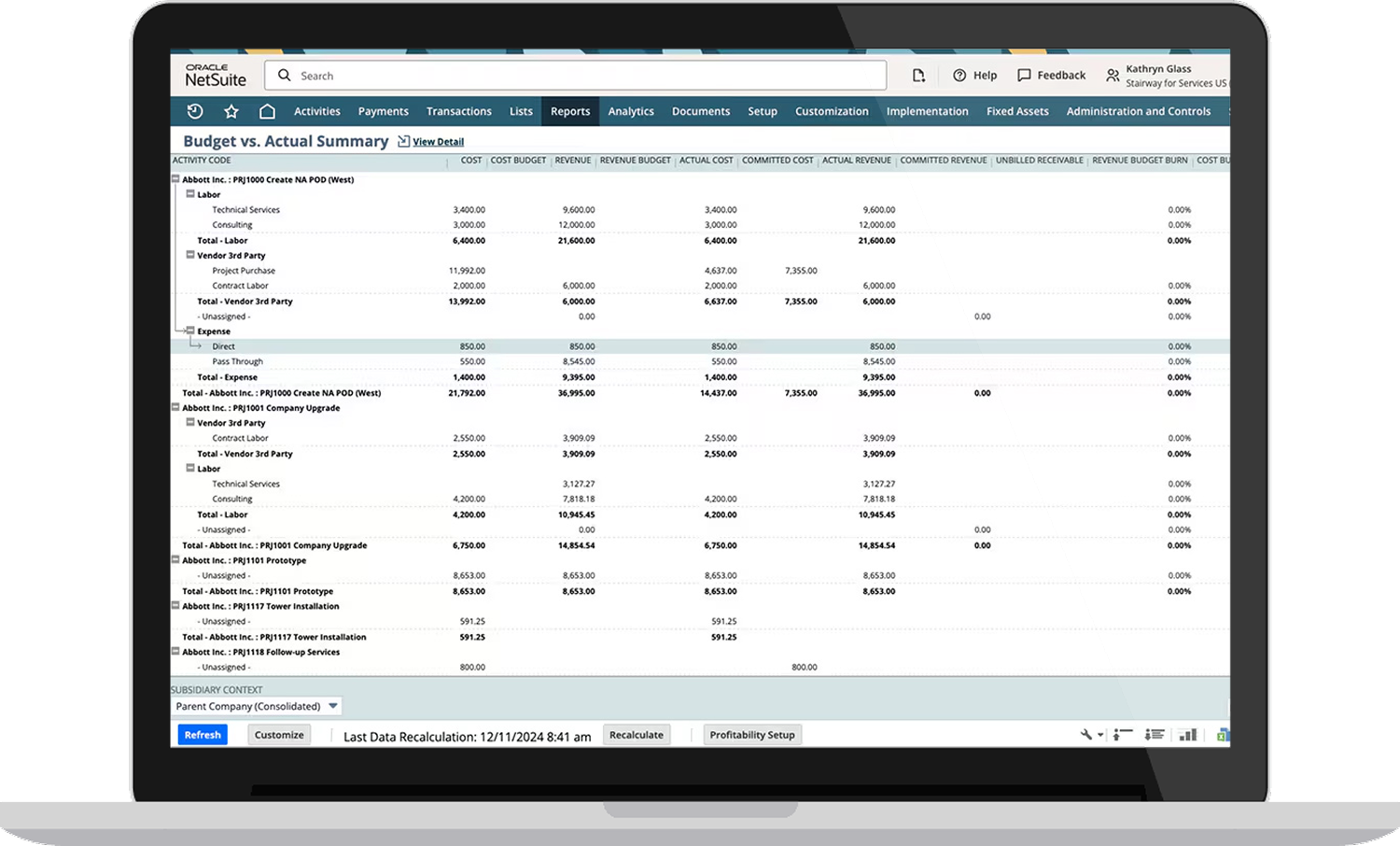
Consulting firms often struggle with fragmented financial data, slow collections, and limited visibility, leading to errors and cash flow gaps. NetSuite Accounting Software for Consulting Firms addresses these pain points, serving as a cloud-based financial management solution tailored to the specific needs the consulting industry. The software links project and billing activity directly to consulting firms’ accounting operations, providing complete visibility into cash flow, margins, resource utilization, and compliance status. Expense tracking is embedded into the same workflow, so consultants can submit receipts directly related to projects and gain approvals quickly. Meanwhile, NetSuite SuiteBilling provides greater control over the billing process by supporting multiple pricing models, ranging from simple flat rates to more complex tiered scenarios. What’s more, the software allows consultants to prorate billing, consolidate multiple charges on a single invoice, and auto-generate renewal invoices to boost client retention.
NetSuite Accounting Software for Consulting Firms
For consultants, getting billing right is essential to earning a steadier income, creating healthier margins, and building stronger client relationships. By choosing the best model for the job, tracking the work closely, leaning on software to automate invoicing, and treating every payment discussion as a chance to build trust, consultants can turn what’s often a headache-filled process into one that help the business grow.
Consulting Billing FAQs
How does consulting billing work?
In most cases, consultants agree with clients on a pricing model, track the work they perform, and invoice clients according to the agreed-upon rates, scope, and payment terms. The process typically includes a written contract, time and deliverable tracking, and clear invoices that spell out the services, dates, and amounts due.
What is a reasonable consultation fee?
Consultation fees vary widely based on the experience and market of a particular consultant, but many independent professionals charge between $100 and $300 per hour. However, less-experienced consultants may charge less, while highly specialized or experienced consultants may seek significantly more.
What is the most common billing model used by consultants?
The most common billing model consultants use, at least to start, is time-based billing—especially hourly billing—because it’s easy to track and familiar to clients. As consultants gain experience and provide proof of the results they can achieve, many gradually shift to project-based fees, retainers, or value-based pricing for some clients, but still billing hourly for others.