
More so than almost any other industry, apparel companies only succeed when they thrive simultaneously across two different time periods. First, the clothes they sell must be of the moment, offering consumers the fresh designs and styling they want right now. Yet, to deliver those products, fashion companies must also operate in the future, anticipating consumer tastes long before they’re evident and designing collections to suit those tastes. Fashion forecasting is the process that bridges those two timelines.
What Is Fashion Forecasting?
Fashion forecasting describes the art and science of accurately envisioning what people are going to want to wear. The goal is to anticipate the styles, fabrics, and colors that will define a fashion moment so that apparel companies can meet the trend and maximize sales.
Key Takeaways
- Fashion forecasting enables clothing companies to anticipate and match consumer demand.
- A multifaceted process, fashion forecasting is comprised of six core components vital to guiding real-world decisions that affect business success.
- Bringing the concepts of fashion forecasting to life requires a practical, repeatable four-step framework.
- Using both short-term and long-term forecasting helps brands balance immediate sales opportunities with strategic, sustainable growth.
- Technology has been instrumental in fashion forecasting’s shift from largely intuitive thinking to a process grounded in data analytics.
Fashion Forecasting Explained
Fashion forecasting, a form of demand forecasting, is necessary because no one can know with certainty how new clothing trends will unfold. This forces clothing companies to guess which styles, cuts, and colors will excite consumers enough to buy them. It’s a high-stakes game: The right guesses drive sales, boost profits, and polish brand identities, while miscalculations feed landfills, hinder profits, and weaken brand loyalty.
Guesses must be as on-target as possible, and forecasting is the means to that end. It has always been a complex—and often lengthy—process, but the elements of forecasting have morphed to reflect changes in society and technology.
Traditionally, forecasters’ most powerful tool was intuition. They studied the designer collections showcased on fashion runways and in magazines and projected which clothes were likely to appeal to the public. Forecasters also considered a wide range of cultural, political, and economic factors that could influence trends. And, of course, they looked at sales figures. Over time, advances in technology have made that analysis faster, more accurate, and more thorough.
Today, forecasting fuses speculative artistry with data science. AI tools and analytics track sales trends, social media posts, website traffic, and search-query data to give forecasters real-time insights into consumer thinking. But algorithms alone can’t predict taste. Human forecasters still play a critical role by interpreting subtle cultural shifts, understanding emotion and identity, and spotting emerging trends that numbers can’t capture. The best forecasters successfully meld hard data with human intuition.
How Does Fashion Forecasting Work?
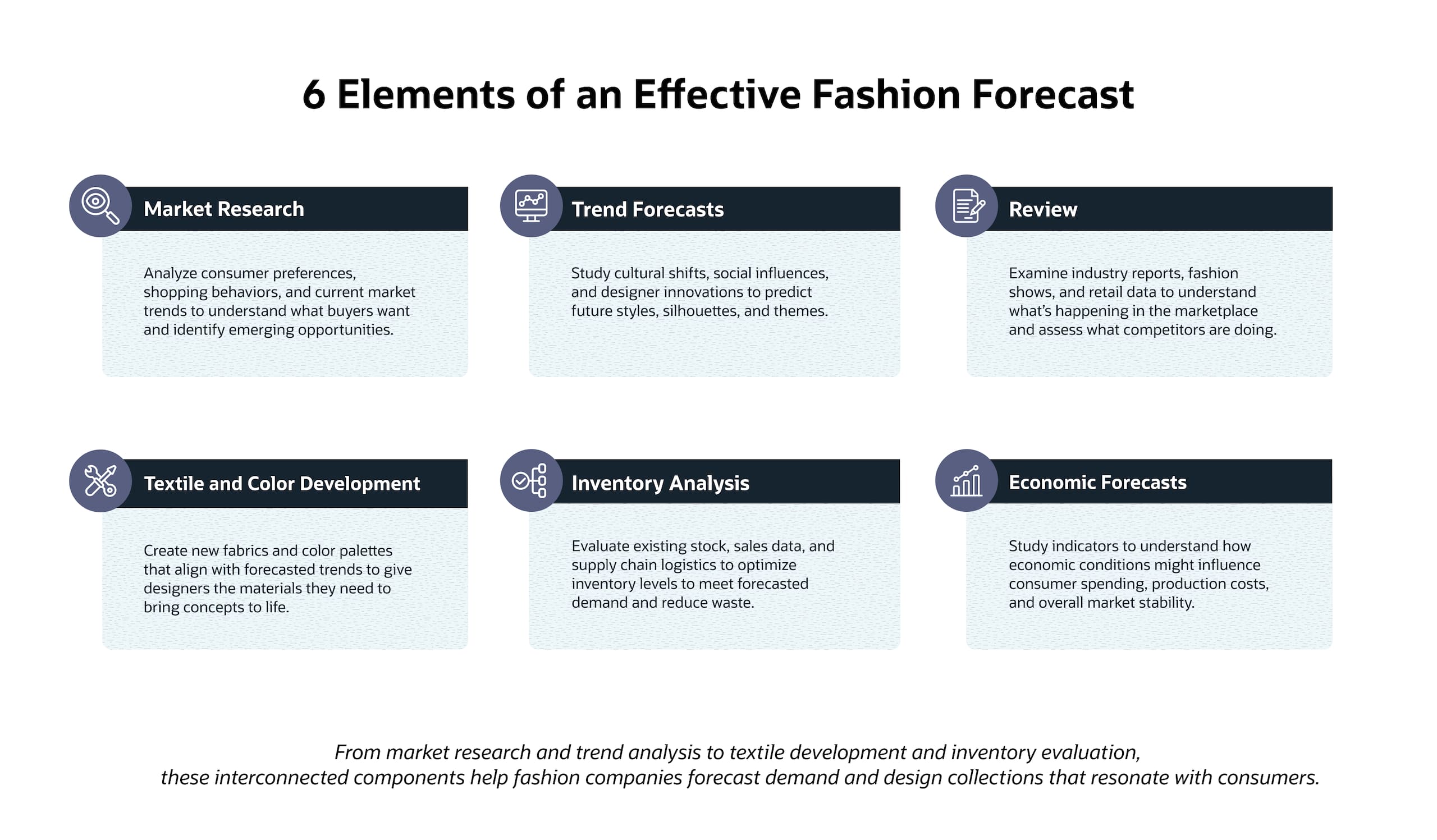
Fashion forecasting is informed by six core components, each of which plays an important role in helping companies transform insights into real-world decisions that support stronger sales. Whether done internally or outsourced to a forecasting firm, fashion forecasts depend on the following:
1. Market Research
Anticipating where fashion is headed is impossible without a thorough understanding of where it is currently, and that comes from extensive market research. Some of that work is analytical: slicing and dicing sales data, tracking economic indicators, parsing online and social media activity, and taking deep dives into demographics. This facet of the research often involves asking consumers for their perspectives through surveys (via email, telephone, or online), focus groups, or in-store conversations with shoppers.
In a sense, conducting market research is more art than science, with much of the process consisting of observation—attending fashion shows, evaluating popular designer collections, reading fashion publications, observing street fashions and pop culture, and networking with designers and other fashion professionals.
2. Trend Forecasting
Forecasters synthesize the data, their observations, and their intuition to then project the fashions they believe buyers will want in the future. These trends may be broad, such as anticipating a shift toward clothes suited to an active lifestyle. But forecasts can also be very narrow, isolating specific colors, cuts, fabrics, or detailing predicted to be popular.
Trend forecasting also tends to include a practical aspect: assessing such factors as production costs, supply chain logistics, and the feasibility of bringing new designs to market. This pragmatism helps brands plan collections that are not only visionary but also commercially viable.
3. Industry Review
Every clothing company has competitors, and ignoring their actions can lead to business problems. Forecasters conduct industry reviews to assess competitors’ activities and spot overall shifts. Through the review, they seek to understand which apparel industry trends are gaining traction and how brands are positioning themselves. This analysis helps companies identify opportunities and challenges within the industry that can inform strategic decisions for upcoming collections.
For example, if the industry review reveals that competitors are increasingly incorporating sustainable fabrics and eco-friendly practices, a brand might conclude that sticking with traditional fabrics would put it at a disadvantage. But such a shift isn’t always straightforward; it might require resource reallocation, choosing different suppliers, and modifying design processes.
4. Textile and Color Development
Consumers carefully weigh fabric and color when choosing a garment, so both elements get considerable attention during forecasting.
Technology is making it possible to develop new fabrics, and breakthroughs may increase the functional value—and, therefore, the commercial appeal—of certain clothing. The evolution of workout wear is one example. Some modern fabrics are infused with silver ions, copper, triclosan, and other compounds that inhibit bacterial growth, reduce odors, and improve hygiene. Similarly, some modern fabrics draw moisture away from the skin to keep athletes dry and comfortable during exercise, while still others integrate water-repellent coatings to improve performance in the rain. Forecasters must evaluate the appeal of alternative fabrics among consumers and estimate how much people will be willing to pay for the benefits.
Although technically there’s no such thing as a “new” color (the wavelengths of light don’t change), fashion companies are constantly exploring color. It’s a powerful tool for grabbing attention and triggering emotions, and simply switching the color of an otherwise unchanged design can make it seem new to consumers. Likewise, fabric innovations (such as materials with light-scattering properties) may foster the perception that people are seeing a new color. Of course, some colors are more popular than others, though that popularity is prone to change—viewers of old movies, for example, have probably noticed that aqua was popular in the 1950s while orange was more popular in the 1960s. Forecasters must be ahead of the curve in anticipating the next hot color.
5. Inventory Analysis
Although much of fashion forecasting looks at external elements, effective forecasting also requires looking internally. Inventory analysis focuses on current stock, sales data, and inventory levels to assess how well products on hand align with projected trends. This process helps companies optimize future production. For example, a company might have a substantial inventory of solid-color men’s shirts while demand has shifted to striped shirts. In such a case, the company can slow (or even stop) production of solid-color shirts. Shifting quickly can help the brand stay relevant.
6. Economic Forecasting
Economic forecasting provides a global, sociopolitical context within which fashion forecasters can anticipate consumer demand, spending habits, and market stability. Economic indicators, such as GDP growth, employment rates, and consumer confidence levels, predict how much consumers are likely to spend on clothing. These trends can, therefore, affect pricing strategies, inventory plans, production schedules, and marketing efforts.
The Two Types of Fashion Forecasting
The reality that clothing companies must always be of the moment yet preparing for the future is reflected in the two types of forecasting. Short-term and long-term forecasting serve different purposes, support different stakeholders, and require different approaches. Clearly distinguishing between—and using—these forecasts helps brands allocate resources and balance immediate sales opportunities with strategic growth. The following highlights the differences between the two:
- Short-term forecasting: Sometimes called fad forecasting, short-term forecasting typically focuses on a few weeks at a time, and no longer than a year. It relies on sales data, current trends, and real-time insights to shape current collections and refine specific designs so brands can respond quickly to the market. For instance, short-term forecasting considers the colors and fabrics that are driving sales, as well as what’s trending on social media, in pop culture, and in the news.
- Long-term forecasting: This approach projects what will happen two years (or longer) into the future. Long-term forecasting is largely used by executives for corporate planning because it shapes strategies for brand growth and positioning, product development, and entering new markets. Because the forecast is broader, so are the factors in consideration: socioeconomics, cultural shifts, new technologies, and environmental concerns.
4 Steps in the Fashion Forecasting Process
Bringing the concepts of fashion forecasting to life requires a practical, repeatable framework. Organizing the process into the following four clear, actionable stages clarifies how to collect, analyze, and report data and insights:
- Aggregate data: Data from sales figures, merchandising, market research reports, social media metrics, runway shows, shopper surveys, economic forecasts, and even environmental sustainability trends are collected and organized. Technology, ranging from spreadsheets to trend analysis software and data visualization programs, makes this possible.
- Identify potential influences: The next step focuses on identifying what the data reveals about what’s shaping future trends. Forecasting considers such influences as social and political movements, pop culture, new textile technologies, economic indicators (including inflation rates and employment levels), green initiatives, demographic trends, and supply chain disruptions. Recognizing these influences can help in the development of accurate and responsive forecasts.
- Gather trend predictions: In this step, forecasters feed hard data and potential influences into forecasting tools, ultimately combining results with their own experience and intuition. Predictions about specific colors, styles, fabrics, and silhouettes are compiled to guide product development and strategic planning.
- Report findings: To be most valuable, predictions are presented as a clear, complete action plan or report. This report becomes a central resource that all stakeholders (designers, marketers, merchandisers, executives) can draw from to make informed decisions. Ideally, reports should include visuals, reasoning behind each prediction, and explicit recommendations regarding which product categories to develop and marketing messages to emphasize.
Impacts of Effective Fashion Forecasting
At the highest level, fashion forecasting helps businesses reach decisions that keep them competitive. But many of the effects are more granular, rippling throughout the business in a variety of positive ways. For instance, forecasting not only guides product development but also can refine clothing inventory management and support sustainability efforts—all while keeping brands relevant. More specifically, effective fashion forecasting offers the following impacts:
- Informs product design: Anticipating trends encourages designers to experiment with new silhouettes, materials, and techniques, which keeps collections fresh. Forecasting can also influence classic designs, by suggesting updated—or retro—color choices or changes to trim.
- Optimizes inventory management and drives down costs: Predicting trends helps companies align their offerings with consumer demand and refine inventory management. For instance, forecasting by geography makes it easier to have the right product in the right place at the right time. It also helps lessen the risk of rolling out designs people don’t want, thereby cutting manufacturing, shipping, and storage costs.
- Keeps your apparel brand relevant: No fashion brand benefits from the perception that it’s old news or seen as always just behind the curve. Offering consumers what they want, when they want it, not only drives sales, it reassures them that the brand understands their hankerings. Such perceptions keep brands top of mind in their target demographic.
- Aids sustainability efforts: Overproduction is a costly problem for clothing manufacturers. In 2023, the industry produced an estimated 2.5 billion to 5 billion items of excess stock. Much of the excess ends up in landfills, which isn’t good for companies trying to foster a green reputation. Keeping pace with consumer expectations may prompt companies to choose more sustainable fabrics.
- Creates a competitive edge: Effective forecasting empowers companies to become trendsetters, rather than followers. Being ahead of the curve helps companies differentiate themselves through unique product offerings that resonate with fashion-conscious consumers. It also supports forward-thinking decisions in marketing, merchandising, and retail planning, keeping brands responsive in a highly competitive marketplace.
Challenges in Fashion Forecasting
Forecasting offers numerous advantages, but getting it right isn’t always easy. Data can be unreliable, trends change in the blink of an eye, and many markets are saturated—all of which can make it tough to pinpoint what’s relevant and actionable. Forecasting challenges include the following:
- Rapid trend turnover: Bell-bottom jeans were popular for more than a decade in the 1960s and ’70s. Despite a few short-lived resurgences since, that kind of consistent trend longevity is almost unheard of. Today’s rapid shifts, driven by social media, influencer culture, and fast-fashion business models, can give forecasters whiplash and make it hard to launch a product at just the right time in the cycle—even for apparel companies using on-demand manufacturing.
- Data accuracy and reliability: Fashion forecasters are only as good as their data, and getting accurate data is harder than it sounds. Manual inventory counts may leave forecasters working with incomplete or outdated numbers. External data presents its own obstacles: Privacy laws restrict access, reports from social media platforms lack consistency from one to the next, and online engagement may reflect niche audiences, rather than broader market trends. Without rigorous validation, forecasters risk building predictions on shaky foundations.
- Separating signal from noise: Random sales spikes, flash-in-the-pan fads, exaggerated social media posts, and irrelevant data points create noise that distracts from the trends and consumer preferences that genuinely influence the future. Skilled forecasters learn to identify the most reliable and impactful insights.
- Standing out amidst market saturation: When numerous clothing companies all try to match customer preferences by offering similar styles, designs, and products, it’s difficult for any one brand to get noticed. Brands that bolster their offerings with innovative marketing, brand storytelling, or sustainability efforts can pull ahead.
How Does Software Help Fashion Forecasting?
Software has been instrumental in fashion forecasting’s seismic shift from largely intuitive thinking to a data-driven process. The pillars of that shift include ERP, inventory management systems, and AI.
Apparel ERP systems improve the accuracy of forecasting by pulling data from sales, inventory, production, and other departments into a single platform with real-time visibility. This unified view eliminates data silos susceptible to discrepancies that contribute to faulty predictions. Auto-updated and readily accessible data makes it easier for forecasters to spot patterns, identify emerging trends, and base their forecasts on reliable facts.
Sophisticated inventory management software aids forecasting by aligning inventory levels with predicted demand. These controls minimize excess and shortages.
AI in the fashion industry can quickly analyze vast amounts of data from social media, runway shows, and consumer behavior to detect patterns and predict future trends with more precision. Still, experts caution that AI is only a tool. It can’t replace forecasters, who contribute experience, context, cultural insights, and intuition that AI cannot replicate. Forecasters excel when they critically evaluate AI-generated predictions, adjust for unforeseen factors, and provide strategic judgment.
Accurate Inventory Management Can Inform Fashion Forecasting
NetSuite Inventory Management gives forecasters a single, real-time view of inventory throughout all sales channels, all enhanced by dynamic, demand-based replenishment tools. Teams can track trends as they emerge and adjust reorder points, preferred stock levels, and purchasing decisions based on average lead time, historical demand, and days of supply. And because it connects seamlessly with NetSuite Apparel ERP, data flows automatically among inventory, production, and financials, so planners, merchandisers, and accountants are all working from the same playbook. The result is faster decisions, better inventory management, and a forecasting process grounded in real performance data.
When done skillfully, fashion forecasting blends intuition with technology to turn creative instinct into data-backed precision. In turn, brands can spend less time chasing the future and more on shaping it. Effective forecasting cuts through the noise, predicting what the next trend will be before everyone else catches on. In the high-stakes world of fashion, mastering forecasting means holding the power to redefine and lead the industry.
Fashion Forecasting FAQs
What is a simple example of fashion forecasting?
Here’s one hypothetical example of fashion forecasting. Based on trends gleaned from fashion shows, social media buzz, and consumer interest in vintage aesthetics, forecasting predicts renewed popularity in 1970s-inspired clothing: namely, flared jeans and earth-tone colors. Retailers then make plans to stock these styles ahead of the trend’s peak, giving them a competitive edge.
How does accurate forecasting help cost control?
When forecasts accurately predict demand, companies can choose to order only as much material as they need, prevent overproduction, and decrease waste. This efficiency lowers storage costs and reduces the risk of lost revenue from unsold inventory.
How is AI used to predict trends?
AI predicts trends by analyzing vast amounts of data from diverse sources. These systems can quickly detect subtle shifts in style, color, and fabric choices, providing early insights into what’s gaining popularity.
What factors influence fashion forecasting?
A variety of interconnected factors dynamically shape fashion forecasting. Cultural shifts often dictate new styles, colors, and silhouettes. Social media platforms accelerate the rate at which trends spread, making it more challenging for forecasters to keep up. New technologies, such as innovative fabrics, expand design possibilities. Economic conditions impact consumer spending habits and, therefore, pricing. Environmental concerns shape material choices and design philosophies. Influencers, street style, and runway shows serve as immediate sources of inspiration.