
Competing in the fashion industry means adapting to new styles quickly, managing diverse product lines, and coordinating with global suppliers, retailers, and distributors—all on tight margins. Manual processes or basic software that works for a small seasonal collection can’t keep pace with growing catalogs and the added complexity of each new item’s unique sizes, colors, and locations. Apparel industry ERP software can help firms navigate these challenges through features specially tailored to meet their needs.
What Is Apparel ERP Software?
Apparel ERP software refers to business management platforms that integrate various aspects of fashion and clothing operations. This software connects previously isolated departments and processes to provide the company and its supply chain with real-time visibility into design, sourcing, production, inventory, sales, and returns.
Apparel-ERP systems are intended to address the industry’s specific requirements, such as managing multiple colors, sizes, and seasonal garment lines; tracking fabric and trim inventories; preparing production schedules; and coordinating complex supply chains. These systems also include product lifecycle management, material requirements planning, and multichannel order fulfillment.
Key Takeaways
- Apparel ERP is business management software that integrates operational and financial functions, connecting design, production, and fulfillment.
- Fashion-specific capabilities include size/color inventory management, seasonal demand planning tools, vendor relationship management, and multichannel fulfillment.
- Integrated workflows and automated data sharing help apparel companies speed time to market for new products, limit errors and waste, and optimize inventory.
Apparel ERP Software Explained
The fashion world is famously fickle. Apparel ERP software helps businesses quickly adapt their operations as trends evolve and customers clamor for fast delivery. It also provides employees with the real-time information they need for their work, be they designers monitoring inventory and trending sales data before creating a new line or sales teams pulling production schedules to devise delivery timelines. This connectivity helps apparel companies respond to new market demands and allocate resources where they’ll earn the highest returns.
Apparel-specific ERP software can automate workflows and data sharing across the company to accelerate production cycles and reduce mistakes. Automation allows businesses to coordinate operations among sales, production, fulfillment, and delivery teams so apparel businesses can balance inventory levels and production schedules as they work to meet demand without holding excess stock that may fall out of style.
Why Is ERP Software Important for Apparel Businesses?
Apparel companies frequently operate on thin margins—sometimes so slim that one late shipment or inaccurate forecast can turn a profitable season into a losing one. They must also maintain sufficient inventory to serve a variety of sales channels, if they hope to both satisfy customers and compete with fast-fashion ecommerce businesses capable of bringing new apparel trends from the runway to retail in weeks.
Manual spreadsheets and basic software may work for a handful of SKUs or collections, but they fall short when businesses are handling thousands of style-color-size permutations, especially when selling in global markets. Integrated ERP systems give businesses data-driven insights into critical metrics, such as supplier performance and determining whether raw material reserves can meet forecasted demand. As companies turn away from costly reactive measures—for instance, rushed shipments and marked-down surplus inventory—and embrace more proactive strategies, they can begin to outpace their competitors.
Benefits of Apparel ERP Software
ERP software collects and organizes companywide data to help managers identify and address operational bottlenecks that can impact profitability and the customer experience. The resulting improvements and benefits include:
- Increased efficiency: Apparel ERP software helps cut down on duplicated data entry and manual handoffs between departments so that orders can be processed more quickly. Staff can stop searching records and performing other administrative tasks and can instead pursue growth initiatives, such as developing new product lines.
- More accurate inventories: Real-time inventory tracking for all locations and sales channels shows exactly what items are in stock, in production, or sold. Procurement and production teams can use this information to avoid selling out of popular items, as well as to decrease inventory carrying costs and dead stock.
- Improved customer experience: Accurate inventory counts and timely production schedules help sales teams (or automated systems) provide customers with verified delivery dates and regular order updates. Reliability and responsiveness at every fulfillment stage build trust and repeat business, especially when the ERP software is paired with 24/7 billing software and a diversity of payment methods that suit customers’ preferences.
- Less waste: Aligning demand forecasting with material planning helps procurement teams order just enough fabric and materials to match production with actual demand, with little left over. Reducing manufacturing waste in this way helps cut material costs and builds a more sustainable operation.
- Enhanced supply chain management: Apparel ERP software enables ongoing monitoring of such supply chain metrics as supplier performance, material availability, and production capacity. This helps managers spot bottlenecks before they impact customers. Businesses also use ERP systems to trace the effectiveness of supply chain risk mitigation strategies, such as diversifying suppliers or adjusting production schedules.
- Better decision-making: Consolidated, organization wide data and key performance indicator (KPI) analyses present leaders with a timely view of operations. Whether a business is expanding into a new market or developing a new product line, this level of information enriches choices that are based on real conditions.
Core Features of Apparel ERP Software
Many fashion businesses use multiple unconnected legacy systems or standardized software for accounting or inventory tasks. But growing companies need scalable systems that tackle industry-specific challenges, such as SKU tracking or agile fulfillment operations that can keep up with customers chasing the latest fashion fads. Here are a half-dozen core capabilities you can expect to find in an apparel ERP.
Inventory Management
Apparel ERP inventory management capabilities go beyond counting units on shelves; they can track each item by style, color, size, and location. Within each of those categories, the system can monitor the corresponding raw materials, works in process, and finished products at all suppliers, factories, warehouses, stores, and fulfillment centers. The ERP uses this information in concert with sales velocity and regional customer data to either prompt procurement alerts or automatically place orders. Then businesses allocate materials and goods to the optimal location based on item availability, logistics, shipping, and storage expenses.
Order Management
Apparel ERPs coordinate fulfillment steps for every order, including sales from wholesalers, retailers, or direct-to-consumer ecommerce shoppers. The system automatically checks each bill of materials against inventory locations, allocates stock based on preset rules, and sends fulfillment commands to the appropriate facility. For wholesale or B2B orders, common features include managing buyer-tailored catalogs, tracking preorders, and coordinating time-sensitive retail shipments. These systems can also process high return volumes—common in the fashion industry—to issue refunds and update inventory in real time.
Demand Planning
Apparel demand forecasts use historical sales data, market trends, and seasonal patterns to predict upcoming needs. Analytics based on sales performance—again, segmented by style, color, size, and location, depending on the needs of the business—as well as variables like weather, promotional events, and social media trends, gives companies insights into what will likely influence sales. This information helps merchandisers estimate order quantities, plan markdowns to limit dead stock, and identify emerging trends in time to adjust production. Many modern ERP systems leverage AI algorithms and scenario planning tools to adjust forecasts as real results come in, sending automated alerts for any unexpected deviations.
Financial Management
Many apparel ERP systems apply prebuilt workflows and templates to manage a variety of pricing structures and can track costs for multiple product lines and currencies. Automated features can handle fashion accounting tasks, such as calculating duties and freight costs, as well as product-specific profitability analyses that factor in returns and markdowns. These systems automatically generate financial statements that provide visibility into performance, funding sources, and resources tied up in raw materials and finished goods. Apparel ERPs can also calculate sales commissions and royalties for licensed brands, as well as automate currency conversions for international transactions.
Vendor Relationship Management
Apparel companies require a wide range of vendor metrics that track pricing and delivery performance, quality, and compliance or sourcing certifications. Supplier relationship management tools capture this information, including internal vendor profiles that store records on lead times, minimum order quantities, on-time delivery rates, and historical quality scores. These records help businesses quickly compare quotes from multiple suppliers so they can diversify orders and negotiate terms. With the price of textile inputs, including silk, polyester, cotton fabrics, and synthetic fibers, spiking since 2021, according to US Federal Reserve data, any procurement savings can turn into a competitive advantage.
Multichannel Fulfillment
Apparel customers expect integrated shopping experiences. Multichannel fulfillment features coordinate all sales channels to give customers more delivery options, such as ship from store. Some ERP systems can automatically route new orders based on inventory location, shipping costs or methods, and delivery expectations, updating stock levels in real time. Purchases and returns can be recorded in unified customer profiles that maintain customer data for future analysis.
How to Choose the Right Apparel ERP Software
ERP selection criteria should be based both on a business’s current needs and its future growth plans. Start by identifying pain points—inventory inaccuracies, production headaches, or supply chain weaknesses, for example. Potential vendors should demonstrate successes in the fashion and apparel industry, as generic ERP solutions may lack important features, such as size and color management or seasonal production planning. Request demonstrations that use actual business scenarios and incorporate knowledge of peers’ experiences.
The system you choose should also meet your business’s desired deployment timeline and budget limitations, and account for implementation, training, and support costs. Cloud-based ERP software generally incurs lower up-front costs and can be rolled out faster than an on-premises implementation. Cloud software usually includes timely vendor-provided updates and, given the nature of cloud services, can scale rapidly to keep up with a business’s growth, without requiring major IT investments. Conversely, on-premises systems need internal IT infrastructure and maintenance. The right ERP vendor often acts as a partner by providing a capable platform, industry expertise, and ongoing support.
A Modern ERP System Can Transform Your Apparel Business
Managing the complexities of apparel trade—such as quickly shifting production to embrace a new trend or embarking on multichannel fulfillment—is a challenge for any kind of company. But it’s even more so for apparel businesses still engaged in slow manual processes and inflexible workflows. NetSuite Apparel ERP comprises a unified software suite that integrates data from all sales channels and locations to give businesses a complete view of inventory and financials. It’s capable of tracking cash flow profitability for every item and style. The system’s built-in demand planning, industry templates, and business intelligence tools help apparel companies adapt to seasonal trends by delivering real-time insights into sales, inventory turnover, and supplier performance. The cloud-based system’s flexible architecture supports ecommerce, third-party logistics integration, supply chain management, and order fulfillment processes, all of which can scale with your organization’s growth. NetSuite helps fashion companies accelerate time to market and increase profits as they consistently deliver the high-quality goods that customers demand.
NetSuite’s ERP Dashboard
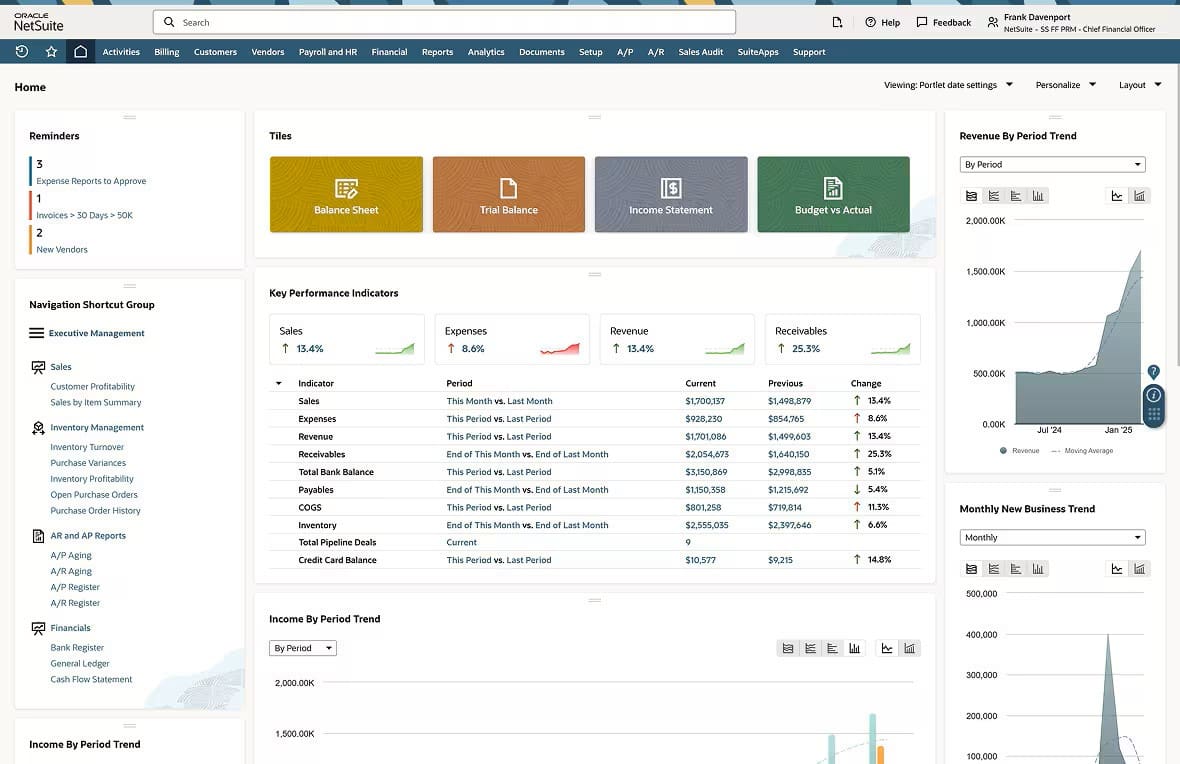
Apparel ERP software is purpose-built for the fashion industry with features that range from sorting thousands of SKUs into seasonal product lines to coordinating complex fabrics and materials from global suppliers and distributors. Integrating core business functions via ERP software gives apparel companies tighter control over their operations, helping them remain flexible enough to capitalize on new trends while still increasing their profit margins. The right ERP solution paves the way for apparel businesses—from new, fast-growing fashion brands to established companies modernizing their legacy systems—to compete in an industry where speed and adaptability often determine success.
Apparel ERP Software FAQs
What is apparel ERP?
Apparel ERP is business management software designed for the fashion and clothing industry. It integrates core functions—inventory tracking, production planning, order management, and financial reporting—into one system built to handle unique requirements, such as size and color matrices, seasonal collections, and global supplier networks.
Do fashion companies use ERP?
Yes, fashion companies of all sizes use ERP systems to manage their operations and stay competitive. Major brands leverage ERP software to achieve rapid product turnover. Small and midsize fashion businesses often adopt cloud-based ERP software solutions that require less up-front investment.
What are the three types of ERP?
The three main types of ERP are on-premises (installed on company servers and maintained by the business), cloud-based (hosted and maintained on vendor’s servers and accessed via the internet), and hybrid (a combination of on-premises and cloud).