
Many steps go into fulfilling customer orders for goods or services, from sourcing raw materials to manufacturing, inventory, and delivery. To meet demand, businesses must be able to plan for each of these interdependent processes. And inherent to planning is mastery of the concept of lead time—how long it takes, from start to finish, to complete a given process in the production or delivery of a company’s goods and services. To maximize efficiency of operations, businesses must account for lead time in their schedules and have on hand just the right amount of inventory to fulfill customer orders.
Not surprisingly, baking lead time into schedules is growing in importance as more businesses sell online, because delivering a positive customer experience drives repeat sales. Accurate lead time forecasting also helps businesses better manage their manufacturing, inventory, and supply chain operations.
What Is Lead Time?
Lead time refers to the latency, or time interval, between the start and completion of a business process. It’s often used by suppliers and manufacturers that must understand the time involved in sourcing, producing, and delivering their goods.
Companies use numerous measures of lead time to inform their operations, manage business relationships, and set customer expectations. For example, project managers use lead time to understand how long specific tasks will take, such as the time required for the review and signing of contractual documents with third parties. Procurement teams track supplier lead times to determine when to reorder materials, while sales teams use delivery lead times to give customers accurate fulfillment windows. When lead times are well understood and consistently tracked, businesses can plan inventory, allocate resources, and make promises they can actually keep.
Key Takeaways
- Lead time is the total time it takes to complete a business operation.
- Accurate lead time forecasts are crucial to a business’s operations, driving efficiencies and cost savings from supplier management to inventory to fulfillment.
- Software-based planning solutions can help shorten lead times.
Lead Time Explained
Lead time measures the length of time—days, weeks, months—that elapses from the beginning to the end of a business process, such as the production of a car. Each process includes a number of smaller, distinct processes that must all be taken into account when calculating lead time. When dealing with suppliers, these might include the time required for processing an order, sourcing raw materials, and delivering completed goods.
By continuously measuring, tracking, and benchmarking lead times for various processes, companies can automate appropriate tasks, improve productivity, and strike a realistic balance between their capabilities and output. For example, with an accurate forecast of lead time for the silicon used in its semiconductors, a computer chip company can set realistic expectations for the technology companies that rely on its products farther down the supply chain. The company can also set benchmarks and find ways to scale lead times in line with market demand.
In most cases, businesses want to reduce lead times, as this generally leads to faster output and drives more sales. However, with so many interdependent processes connecting their supply chain, manufacturing, inventory, and fulfillment operations, it’s equally important they strike a balance that eliminates bottlenecks and loss from having too much inventory on hand.
Total Lead Time
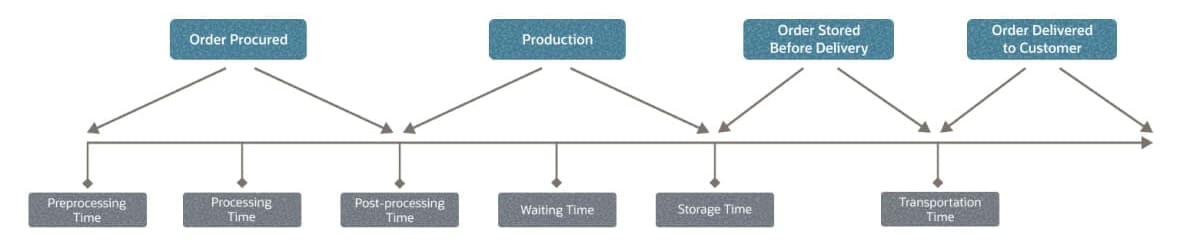
Lead Time vs. Cycle Time
Cycle time is the time that passes to complete a specific task from start to finish. It’s a component of lead time, which measures the total time for a business process to be completed from start to finish.
Consider the example of a car manufacturer under pressure to deliver 200,000 completed vehicles to its dealer network in the next three months. Cycle time calculations might include how many door panels it can paint in an hour and how many engines it can assemble in a day. The lead time measures the total time required to assemble and deliver a car from start to finish.
Lead Time vs. Delivery Time
Delivery time is another component of lead time. It measures the time required for goods to be delivered from a business to its customers, whereas the total lead time for those goods includes the time needed to prepare, manufacture, and deliver them to the customers.
Delivery time is a major consideration for consumers deciding whom to buy from. This is especially true in the ecommerce sector, where competitive offerings are just a mouse click away. Retailers have been investing heavily in software and logistics solutions to shorten their delivery times and better compete with large marketplaces.
Why Is Lead Time Important to Inventory Management?
Lead time has numerous implications for inventory management. For one, decisions about inventory are made as a function of production times. Inaccurate forecasts can lead to stockouts, wasted space in warehouses, and unfulfilled orders. These outcomes, in turn, can result in financial loss and damage customer relationships. Suffice it to say, well-informed lead-time projections—everything from supplier lead time to production lead time to delivery lead time—are crucial to effective inventory management. Here are five reasons why lead time is an integral factor in a business’s success.
-
Smoother Workflows
Accurate lead times help businesses properly time the connections between individual processes, rather than creating gaps, bottlenecks, and overall inefficiencies.
-
Reduced Storage Costs
Insight into inventory lead times allows businesses to optimize their warehouse operations. For example, rather than investing in too much square footage to accommodate maximum inventory at all times, companies can refine their inventory projections based on accurate lead time forecasts, thus lowering costs.
-
Better Customer Relationships
Customers generally favor short lead times and have little tolerance for late deliveries or orders that are delivered when they’re not around to receive them. Setting and meeting expectations underpin business success.
-
Business Resilience
Businesses live and die by their ability to change course quickly and adapt to new realities. Lead time should build in a reasonable amount of time for unforeseen circumstances, be it a delay in the supply chain or an unexpected spike in customer demand for a particular product. These forecasts position the company to take change in stride, rather than falling behind.
-
Greater Confidence in Output
Accurate lead times give businesses greater confidence in their ability to meet operational and sales targets. This means they can operate in a leaner way. If a fashion brand knows it can source, manufacture, and deliver 10,000 T-shirts each month under current supply chain conditions, it can reduce its safety stock.
What Causes Long Lead Times?
Long lead times rarely stem from a single source. They’re typically the result of multiple factors interacting and compounding across the supply chain, some of which are outside of the business’s control. For example, even though delivery times for raw materials have been improving, they’ve yet to reach pre-pandemic norms, according to Deloitte’s “2025 Manufacturing Industry Outlook”. These delays impact lead time before production even begins. Some other common culprits include:
- Natural disasters or external factors: Hurricanes, floods, geopolitical conflicts, and maritime security threats can shut down suppliers, close ports, and force shipments to reroute mid-journey. In 2024, for example, disruptions in the Red Sea, Suez Canal, and Panama Canal increased freight rates and shipping distances, significantly extending delivery times worldwide.
- Delays in procurement: Slow internal approvals, incomplete specifications or bills of materials, supplier constraints, and long qualification processes for new vendors can all slow down the process of acquiring necessary materials.
- Manufacturing inefficiencies: Excessive queue time between production steps, unbalanced lines, large batch sizes, labor shortages, and poor scheduling all slow down manufacturing. This is often one of the most controllable causes of lengthy lead times.
- Rework requests and quality concerns: Defective goods must be reworked or replaced, taking up time, equipment, labor, and, ultimately, funds that could go toward fulfilling new orders, especially for defects discovered late in production. These delays also impact service providers, as technicians get tied up fixing others’ mistakes, rather than addressing new tickets or staying ahead of new trends.
- Mishandled shipments: Shipping errors, damaged goods, incorrect documentation, and customs holds can delay deliveries and lead to costly returns or reshipments.
- Equipment failures: Unplanned downtime can delay or halt production entirely until repairs are complete. Preventive and predictive maintenance help minimize this risk.
- Poor or shortsighted planning: Inaccurate demand forecasts and inadequate estimates of supplier lead time can cause rushed orders that cut into margins and risk missing delivery dates.
- Global component shortages: Supply-demand imbalances for key components—like the semiconductor shortage of 2020–2022 that left IT services providers scrambling for hardware—can extend timelines regardless of a company’s internal efficiencies.
- Labor shortages: Reduced capacity, fewer drivers, understaffed distribution centers, and skills gaps all contribute to bottlenecks that extend lead times.
Lead Time and Supply Chain Management (SCM)
An efficient supply chain depends on accurate lead time projections at every step of the chain and with regard to all sources of materials. This is especially true in the case of goods that require parts from various suppliers, such as smartphones or flat-screen televisions.
By analyzing and basing their schedules on accurate supply chain lead times, companies can procure all the components required to assemble their finished products at the same time, or in the right order, so as not to delay the manufacturing process. This can improve workflows, optimize shipping and receiving costs, and make it easier to predict lead times farther down the chain.
Lead Time and Manufacturing
Accurate lead time is central to the success of nearly all manufacturers. By precisely measuring the time required to source materials, produce goods, and deliver them to their customers, manufacturers can shape their processes in the most efficient way possible.
Manufacturing lead time is based on a variety of factors that depend on the goods a company produces. For instance, when it comes to shipping times for raw materials, some companies will simply measure the time from their initial order to delivery from a supplier. Others must build in the time needed to process raw materials for the next step of the manufacturing process, like a jewelry company that must process and clean precious materials before integrating them into its products.
Companies that practice just-in-time (JIT) manufacturing—meaning materials arrive at the time they’re needed for production—must keep an especially close eye on lead times. JIT aims to reduce variability in the completion of manufacturing processes, which requires incredibly accurate lead time calculations across the supply and production chains.
Types of Lead Times
Businesses track several types of lead time, each providing specific insights into various stages of the order-to-delivery process. Understanding each type below helps analysts pinpoint root causes of delays and where improvements can have the largest impact:
- Procurement lead time: The time from when a purchase order is placed to when goods are delivered and processed for use. This includes order processing, fulfillment, shipping, and inspection upon receipt.
- Customer lead time: The total time a customer waits between placing an order and receiving it—one of the biggest drivers of customer satisfaction and competitive standing. For services businesses, such as managed service providers (MSPs), customer lead time measures how quickly technicians are deployed or hardware is installed, so monitoring customer lead times is considered a high-priority best practice to increase retention.
- Materials lead time: The time between identifying a need for raw materials and when those materials are ready for production. Long material lead times can slow down manufacturing and force companies to hold larger safety stocks.
- Production lead time: The time it takes to complete a finished product, starting when the work order is released. This typically includes setup, processing, queue time between operations, and final inspection.
- Delivery lead time: The time required to transport finished goods from the warehouse or factory to customers. This measure is influenced by shipping methods, carrier performance, and geographic distance, as well as external events like customs snags or inclement weather.
- Cumulative lead time: The total time required to fulfill an order with no existing inventory—in other words, to create a finished good from scratch and deliver it. This is often used as a “worst-case” figure for safety stock planning, as it represents the sum of material, production, and delivery lead times.
Components of Lead Time
Lead time measures the cumulative time it takes for a supplier to complete a given set of processes from the moment an order is made until delivery. This total time is the sum of smaller components, each with its own lead time. It’s important for companies to factor in any of the following seven components that apply to their processes to calculate accurate lead time forecasts across their operations.
-
Preprocessing Time
Also known as planning time, preprocessing time captures the time it takes to receive a purchase request for an item, understand the request, and create a purchase order. In the case of a smartphone company, preprocessing time would include the time required to set up a manufacturing task or activity in order to deliver a new order of phones in time for Black Friday.
-
Processing Time
Once preprocessing is complete, processing time is the time needed to procure or manufacture an item. For our smartphone manufacturer, processing time includes the time required to source raw materials from various suppliers and manufacture the phones.
-
Post-processing Time
Post-processing time refers to the span between when a purchased item is received until it becomes available in inventory. Depending on the item, post-processing might include inspection and safety checks, such as whether the smartphones do indeed turn on or that the casing is, as promised, waterproof.
-
Waiting Time
Waiting time represents the time that elapses between procurement of raw materials until incorporating them into production or manufacturing processes. If our smartphone company uses an external supplier for its screens, it will need to calculate the time it takes to procure them until they’re ready to be integrated into the production process.
-
Storage Time
Storage time refers to how long the smartphones sit in a warehouse until they’re ready for delivery. For companies that don’t have warehouses, these items might sit directly in their factories.
-
Transportation Time
As its name implies, transportation time is the time it takes to transport an item from the warehouse or factory to the point where it reaches a customer. For example, retail outlets may have to wait one week after a new order of smartphones is manufactured before receiving them in store.
-
Inspection Time
Inspection time refers to the time spent verifying that goods meet quality standards before they move down the production line or ship to customers. For the smartphone manufacturer, this might include testing device functionality, checking for cosmetic defects, verifying software installs, and confirming packaging accuracy.
How to Calculate Lead Time
Lead time calculations vary depending on the process being measured, but they all follow the same principle: Break the process into individual steps and assign a realistic time to each, with different calculations requiring different components.
Lead Time Formula:
To demonstrate how this works in practice, let’s compare two common lead time formulas: manufacturing and retail inventory. Manufacturing lead time adds the time spent procuring materials, producing goods, and shipping orders, as shown by this formula:
Manufacturing lead time = Procurement time + Manufacturing time + Shipping time
In contrast, retail inventory lead time includes the time it takes for suppliers to deliver items and any internal reordering delays, as expressed below:
Inventory lead time = Supplier lead time + Average reordering delay
Regardless of the formula in use, it’s crucial that every relevant element be included in calculations and that projections and expected delays are based on strong historical data. Companies often rely on software-assisted lead time calculations to handle the heavy lifting.
What Factors Should Be Considered When Calculating Lead Time?
Lead times involve more than number-crunching in simple formulas. Analysts must account for real-world conditions that introduce uncertainty and variability. A supplier’s average delivery time, for example, is a good baseline, but it represents just the middle of a range of outcomes that can disrupt plans. Whether you’re a manufacturer scheduling production runs in execution systems or an MSP coordinating hardware deployments from a centralized ERP platform, consider how the factors below can impact your lead times:
- Procurement procedures: Complex approval hierarchies and manual handoffs can add unpredictable delays before procurement teams even place a purchase order.
- Supplier availability and reliability: A supplier that averages 14 days but ranges from 7 to 21 days adds significantly more uncertainty than one that consistently delivers in two weeks.
- Inventory levels: Existing safety stock can shorten effective lead time, but once it runs out, low inventory can extend lead times, especially during peak demand.
- Product or service demand: Volatile demand exacerbates lead time variability, especially for goods with long production cycles. Larger safety stock reserves can minimize the risk of stockouts but come with higher carrying costs.
- External factors: Geopolitical events, weather disruptions, port congestion, and regulatory changes can shift lead times significantly, often with little warning and few options for mitigation.
- Shipping distance: A 30-day overseas shipment is more vulnerable to delays than a five-day regional shipment. Consider this variability when choosing carriers and shipping methods.
- Production process: Setup times, batch sizes, equipment availability, number of handoffs, and workflow efficiency all determine how long it takes to turn materials into sellable goods.
- Complexity of supply chain: Multi-tier supply chains, where materials are sourced from two or three suppliers before reaching the manufacturer, can lead to compounded delays and higher costs that can be difficult to anticipate or control.
Forecasting Lead Time
Forecasting lead time is a complex process. It involves calculating individual supply chain and delivery times, production and manufacturing times, inventory and inspection times, transportation times, and other factors specific to an individual organization. Errors can lead to a range of issues, from operating inefficiencies and wasted inventory to lost sales and customer dissatisfaction, especially if projections are off by a significant degree.
Seasonality is an important consideration for accurate lead-time forecasting. For example, supply chain pressures are higher during peak shopping periods, like at the end of the year, so some retailers will add a buffer to their lead time calculations. Meanwhile, car manufacturers know their sales spike comes in the spring, so they, too, are wise to adjust their forecasts accordingly.
Businesses operating globally must also be conscious of local particularities that can affect their supply chain or manufacturing lead times. A high-end toy company that relies on parts from Germany must account for major German holidays when factories might be closed.
On the flip side, forecasting lead time based on the worst-case scenario—in other words, building in too much time to account for the unexpected—isn’t advisable. Doing so may cause companies to invest in additional safety stock, for example. It can also slow down processes, create potential bottlenecks, and raise inventory costs. Worst of all, it may lead to disappointed customers in an era where faster is better. Many businesses have turned to sophisticated software to improve their lead time forecasting. AI, in particular, helps them account for the immense number of variables and their interplay in a global operation.
Examples of Lead Time
Consider a local chain of office supply stores in the United States that must order 5,000 mechanical pencils in time for the new school year shopping rush, with 1,000 pencils going to each of its five franchises. Once the pencil manufacturer in China receives the order, it takes one day to process the request, another day to prepare and package the order, a week to deliver it to the office supply store’s central location, and another day to deliver 1,000 pencils to each of the store’s other locations. The total lead time is 10 days (1+1+7+1).
Or consider a mobile phone provider that must fulfill an order for 1,000 of the latest Android phones to be delivered on the day the product launches. The provider sends a purchase order to the phone manufacturer, where it takes two days to process the order before it’s forwarded to the manufacturing facility. That facility is served by three suppliers—one for the phone’s standard components, one for the phone camera, and another for silicon chips. The longest lead time among these suppliers is two weeks due to a chip shortage, so the phone manufacturer must allow for a minimum of two weeks lead time before receiving the materials, at which point it needs two more weeks to assemble the phones, prepare the order, and deliver it. The lead time in this example is four weeks and two days (2+14+14).
Five Tips for Shortening Lead Time
There are multiple ways businesses can cut the time between an order being placed until its delivery. Let’s explore five of the most common.
Choose Local Suppliers
While businesses might source specific materials and products from abroad to minimize their costs, using local materials and labor can speed up transportation and manufacturing processes, which in turn drives down costs in the long run.
Cut Unnecessary Tasks
Lead time calculations can reveal process inefficiencies. Every business has room to optimize and, by benchmarking themselves frequently, they can position themselves for continuous improvement.
Change Shipping Methods
As with its choice of suppliers, a company’s choice of shipping methods for fulfillment requires careful analysis. Less-expensive shipping methods might seem attractive at first glance, but more flexible shipping partners might allow for more frequent shipments, which drives down lead times and might pay off in the medium to long term.
Bring Processes In-house
While certain processes are highly localized, such as the sourcing of alpaca wool in South America, many processes can be sped up by being brought in-house. Rather than waiting on external suppliers for materials and manufacturing operations, companies can look to own as much of the process as possible, giving them control over lead times. This is also known as vertical integration.
Automate Inventory Management
Human error is a major cause of delays, and human errors in inventory are among the biggest culprits for businesses. By automating inventory management, businesses can significantly reduce the risk of human error, making their inventory operations and lead times significantly more efficient.
Improve Lead Times With Software
Software solutions can help companies stay on top of lead times and, as a result, operate more effectively. NetSuite Demand Planning helps businesses—manufacturers, in particular—align planning with supply and demand for their goods to prevent issues such as excess stock or production delays. In parallel, NetSuite Inventory Management removes the risk of human error that could lead to misinformed inventory management decisions. This, in turn, drives down lead times and benefits fulfillment accuracy and customer satisfaction.
The ideal approach is to integrate supply chain, production processes, inventory management, and logistics on a single software platform. A unified platform, such as NetSuite ERP, provides companies with visibility across each of these business functions. That way, they’re operating from a single and accurate data source to optimize virtually any operation that affects lead time.
NetSuite’s Order Management Dashboard
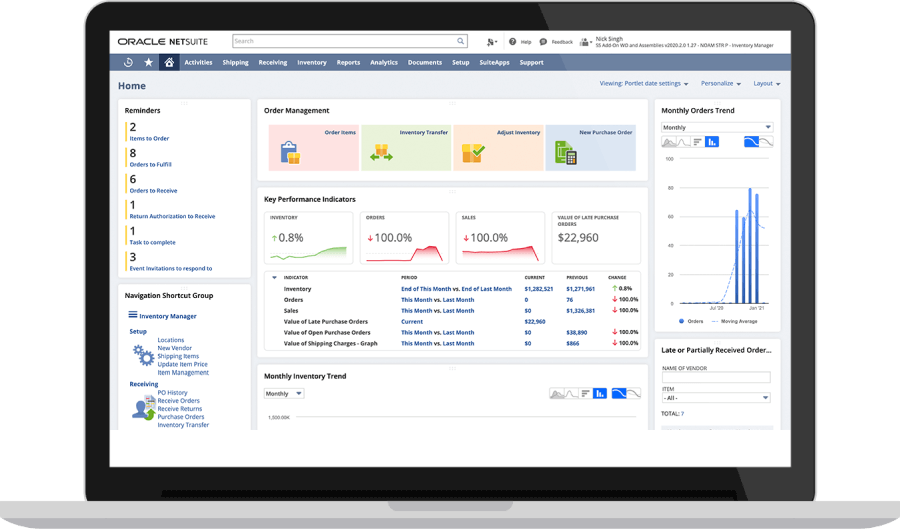
Optimizing lead time is a top priority regardless of industry. A company’s ability to track, benchmark, and reduce the time it takes to complete a given process in the production or delivery of its goods and services helps it set realistic expectations for customers and is directly linked to its success. As supply chains and supplier relationships grow in complexity, software-based practices can help companies create accurate forecasts.
Lead Time FAQs
What is lead time and why is it important?
Lead time is the time required to complete a business process from start to finish. Proper calculation helps companies optimize management of suppliers, production, and inventory. This, in turn, makes them function more effectively while setting realistic expectations for customers.
How is lead time calculated?
Lead time is the sum of all the steps involved in a given process. This includes time spent on planning and preprocessing orders, sourcing raw materials from suppliers, manufacturing, transportation, and delivery. Companies increasingly rely on software to forecast and calculate lead time accurately.
What is the difference between lead time and delivery time?
Delivery time is a component of lead time. Delivery time describes the time it takes to complete the last step of an order, which is delivery of an order to the customer.
What tools can help track and improve lead time?
Inventory management software and demand planning tools, often integrated into an ERP system, help businesses track lead time components in real time. This visibility helps teams identify bottlenecks and forecast lead times throughout the supply chain. Built-in analytics and dashboards also allow teams to visualize supplier performance, inventory levels, supply chain vulnerabilities, and order status.
How does lead time impact delivery and efficiency?
Predictable lead times allow businesses to carry less safety stock and minimize warehousing costs, while short lead times allow companies to quickly respond to changes in customer demand. Conversely, long or variable lead times can lead to bottlenecks and missed delivery commitments that frustrate customers, hurting retention.