
In the late 1990s, “cloud” was not a word most people associated with technology. It was certainly not recognized as the future of software.
But a few visionaries saw the benefits and tremendous potential of delivering software over the internet. One of them, Oracle co-founder Larry Ellison, convinced entrepreneur Evan Goldberg of the promise of web-based software, leading Goldberg to launch NetLedger, the company that would become NetSuite in 1998.
Today, NetSuite’s cloud enterprise resource planning (ERP) system gives companies all the applications they need to run their businesses efficiently while nurturing growth. Organizations of all sizes and across dozens of industries run on NetSuite, harnessing the vast capabilities of its applications for finance, supply chain, customer relationship management (CRM), human resources, professional services, ecommerce, and more.
What Is NetSuite?
NetSuite is a software company that has developed a cloud-based business management platform used by more than fast-growing organizations across the globe. That platform consists of a suite of applications that help companies run their business, understand the performance of their businesses, and drive major efficiency gains and cost savings.
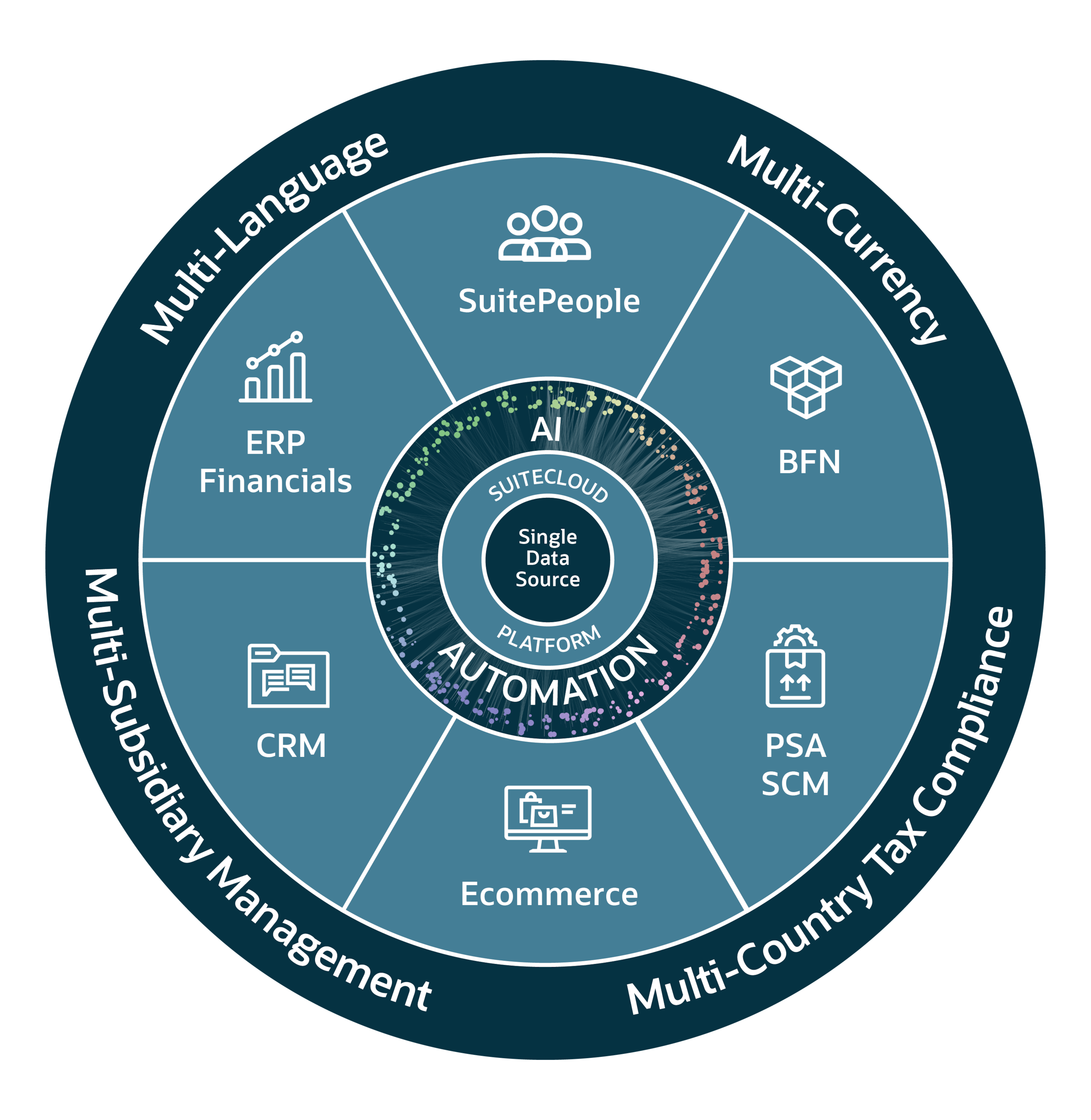
The company’s ERP system manages core functions, including finance and accounting, inventory, orders, and procurement. Customers can add options including CRM for sales, service and marketing automation, human resources (HR) for personnel records, performance management and payroll, professional services automation (PSA) to plan and track projects, and omnichannel commerce for both online and in-store sales. All of these modules share a common database. Thanks to that central data source, information from across the system updates in real time and is accessible to authorized users across business functions. This data then feeds NetSuite’s AI capabilities embedded throughout the platform to further automate tasks, generate deeper insights, and identify patterns that human analysts or traditional tools might miss.
That gives leaders a real-time, 360° view of the business so they can see which processes or departments are exceling and which need a boost.
NetSuite uses the software as a service (SaaS) model: Customers pay a subscription fee to access the technology but are not responsible for any underlying infrastructure or system maintenance, including purchasing and setting up servers, installing software, or testing and deploying patches and upgrades. Oracle NetSuite handles all of that for customers, with two new software updates per year.
Eliminating the maintenance and upgrade costs that come with on-premises solutions not only saves money, it frees employees to focus on the company’s mission and serve customers.
The SaaS model also provides scalability: Businesses can add functionality as they need it without worrying about infrastructure and staff resources. For example, a B2B manufacturer may add NetSuite’s ecommerce module after it decides to start selling online.
Ultimately, NetSuite gives businesses visibility and control through a single source of real-time information and the ability to add modules on the fly. That increases their efficiency and agility.
Video: What Is NetSuite & How Does It Work?
History of NetSuite
NetSuite is often recognized as the first cloud software company.
Goldberg and a few partners launched the company, then called NetLedger—a reference to accounting ledgers—in 1998 in an office located above a hair salon in San Mateo, Calif. NetLedger accounting software was hosted on the web, forming the foundation for what Goldberg envisioned as a unified software suite that could eventually replace the disconnected systems that companies then used to run their business.
Ellison, a mentor to Goldberg, was a key early supporter—his Tako Ventures invested $125 million to get the company off the ground. Other investors included venture capital firm StarVest Partners and software vendor ADP as well as PaineWebber Group, part of Swiss bank UBS.
In 2002, NetLedger became NetSuite after the company added applications for inventory management and CRM. That same year, Zach Nelson took over as the company’s CEO and kicked off a period of rapid growth, as annual revenue climbed from about $1 million to nearly $1 billion over the next 14 years.
At the beginning of 2007, NetSuite made waves when famed Oakland Athletics General Manager Billy Beane—the subject of the best-selling book and movie “Moneyball”—joined the board of directors. That year ended with a successful initial public offering (IPO) on the New York Stock Exchange. NetSuite issued 6.2 million shares at $26, raising more than $160 million and giving the organization a market cap of $1.55 billion.
In July 2016, Oracle announced it had made an offer to acquire NetSuite for $9.3 billion to support its shift to becoming a cloud software provider. After independent committees reviewed and approved the deal, it closed that November, and NetSuite began operating as a Global Business Unit within Oracle.
NetSuite has continued to grow rapidly since the acquisition and has offices and employees around the world.
Six Core Features of NetSuite
Although NetSuite may be the oldest, it is not the only provider of cloud ERP software. So what separates NetSuite from other cloud solutions? Here are six highlights:
- Unified view of the business: NetSuite empowers any firm to run its entire business from a single platform. It brings together finance, supply chain, manufacturing, HR, and ecommerce on one system, with one database, rather than using disparate software for each of those functions. Employees simply log in and, with a few clicks, monitor the status and performance of any aspect of their operations.
- Native integrations: All NetSuite applications feed information into, and pull it from, the central database to maintain only one source of knowledge. The platform’s natively integrated modules negate the need for third-party integrations that may be unreliable or unable to support real-time updates. This unified architecture delivers a common user interface across all modules; that decreases training time and gets people productive faster. This model also allows users to complete order-to-cash, procure-to-pay, and other multi-step processes from a single application without re-entering or exporting information.
- True cloud: NetSuite was born in and built for the cloud. In contrast, many “cloud” ERP systems are actually hosted or hybrid cloud—essentially, on-premises software retrofitted for access through the internet. Such solutions suffer from many of the problems that plague traditional systems, like version lock, slow upgrades, and lack of scalability. NetSuite is a multi-tenant, vendor-managed cloud solution with endless room to support growth.
- Deep reporting capabilities: The vast amount of data flowing from departments and business units into the NetSuite platform fuels its extensive reporting capabilities. Users can pull reports on everything and anything they may want to measure or understand, thanks to the system’s built-in reporting tools. NetSuite also has role-based dashboards that quickly give employees, managers, and executives the information they need to make informed decisions.
- Built-in flexibility: NetSuite can serve a broad array of industries not only because it comes with impressive functionality, but because it can adapt to meet the requirements of different businesses. The platform can be customized to accommodate your processes and corporate structure through SuiteCloud apps and tools, whether you’re a multinational brand with six subsidiaries or a startup still building its first product.
- Embedded AI: NetSuite integrates AI throughout its platform, leveraging the data that flows between modules to enhance analysis and automation across a company. With NetSuite’s unified data repository, AI can draw on real-time data to deliver deeper and more accurate insights than disjointed tools can provide. AI features handle routine tasks such as invoice capture and anomaly detection, generate plain-language narratives and explanations from complex data sources, and incorporate cross-functional information to improve planning and budgeting. Businesses can also use tools like Prompt Studio and the SuiteScript GenAI API to tailor AI capabilities to their needs.
Products Overview
NetSuite can adapt to meet the needs of diverse businesses because it has a wide array of modules dedicated to critical business functions and processes.
Finance
-
Financial management:
NetSuite’s financial management solution handles many bookkeeping tasks by automatically updating the general ledger, tracking accounts receivable (AR) and accounts payable (AP), and submitting invoices. This module speeds up the monthly close and simplifies the creation of key financial reports for regulatory and statutory reporting. It supports complex revenue recognition standards and easily consolidates financial statements from subsidiaries—including business units in other countries—with real-time currency conversion. NetSuite’s AI-powered analytics apply insights from prior bills to improve accuracy and help AP and AR teams identify payment patterns that support healthy cash flow. By using generative AI (GenAI) to examine rich transaction data, NetSuite increases the number of bank transactions that can be automatically matched, accelerating reconciliation. -
Global business management:
NetSuite OneWorld allows multinational and multi-subsidiary companies to manage their entire enterprises in one system. It can handle the diverse needs of global businesses via support for diverse currencies, languages, tax laws, and reporting requirements. OneWorld offers financial roll-ups at the regional, country, and global level, so decision-makers can get as broad or as focused a view of the business as they desire. -
Planning and budgeting:
NetSuite Planning and Budgeting gives business leaders everything they need to create detailed departmental or companywide budgets and forecasts. The module also provides financial analysts with access to statistical models that allow them to run what-if scenarios that project revenue, expenses, and more based on different possible outcomes. AI tools can add more detail by modeling additional scenarios and translating complex projections into plain-language explanations that make findings more accessible to stakeholders without deep financial expertise. -
Billing:
NetSuite SuiteBilling helps companies manage invoicing and billing. It supports transaction, subscription, usage-based, and other billing models, reducing the complexity of managing financials for many businesses. SuiteBilling records revenue in compliance with current revenue recognition standards. This module helps businesses stay flexible and profitable. NetSuite also offers AI-powered features, such as Bill Capture, that use object detection and optical character recognition to reduce manual data entry and keep more accurate records.
Operations
-
Inventory management:
NetSuite Inventory Management provides a single view of inventory across all channels and locations, automatically updating levels in real time. The inventory management module can use sales data to set reorder points and alert purchasing managers when it’s time to place replenishment orders. It also manages cycle counts. All of this functionality helps businesses keep the ideal amount of stock on hand and avoid both out-of-stocks and excess inventory, boosting cash flow and profitability. NetSuite’s AI monitoring capabilities track inventory flow to detect unusual patterns or supply chain disruptions, flagging potential delays before they affect stock availability. -
Order management:
NetSuite Order Management handles the complete order lifecycle, from receipt through delivery, at each stage—as they’re placed, released, shipped, and settled with the customer. This module can automate order processing and manage fulfillment across channels based on predefined rules. All of this leads to faster, more accurate fulfillment that reduces shipping costs while increasing on-time delivery rates and customer satisfaction. AI tools monitor order exceptions, analyze potential causes, and recommend actions to help companies keep orders running smoothly, even when demand spikes or KPIs shift unexpectedly. -
Procurement:
NetSuite Procurement can improve the complete procure-to-pay process to save businesses time and money. Customers can keep a list of approved vendors, collect quotes, and automate purchase orders while granularly monitoring performance and spend along with vendor self-service and expedited payment options. AI billing tools automatically match invoices with POs and receiving documents so vendors are paid on time and raw materials keep flowing. -
Warehouse management system (WMS):
NetSuite WMS builds on the system’s inventory management capabilities, adding functionality for putaway, order picking, barcode scanning, and returns authorization. The WMS module can run on mobile devices to direct warehouse employees through receiving, picking, and cycle counting. The application, which also reports on warehouse activity, boosts warehouse efficiency, and helps companies fulfill and ship orders faster. -
Manufacturing:
NetSuite Manufacturing is built for companies that make or assemble products. The module helps with production planning and scheduling, shop-floor management, and monitoring production to reveal insights and improvement opportunities. It helps the business keep all the right supplies and parts in the right place at the right time and allows managers to build, release, and track work orders. That visibility into the entire production process can maintain quality standards, reduce costs, and increase on-time delivery. -
Demand planning:
NetSuite Demand Planning can help plan future demand for the products and services you offer based on historical data, existing opportunities, or imported sales forecasts. The module can plan using the moving average, linear regression, or seasonal average methods. Demand planning also helps with supply planning, automatically creating purchase and work orders based on the demand plan. Advanced prediction capabilities use AI to analyze multiple business drivers at once and generate potential scenarios—best-case, worst-case, and most-likely—alongside confidence intervals to help teams stay prepared as conditions change.
Customers
-
Customer relationship management:
NetSuite CRM presents a 360-degree view of customers. Sales force automation features help manage leads, quotes, and sales to speed up the lead-to-cash process. Forecasting tools review sales data to more accurately predict future sales. The CRM application also improves customer service by combining all important data, like sales history and active support cases, in one place. Marketing automation tools in the CRM help companies manage campaigns and segment customers so they can be targeted with more relevant messaging. Features like Intelligent Item Recommendations leverage AI and customer histories to suggest personalized products throughout the sales process, helping increase average order size. -
Commerce:
NetSuite SuiteCommerce allows retailers, distributors, and manufacturers to create outstanding omnichannel shopping experiences. The application allows companies to launch and manage mobile-friendly ecommerce sites with user-friendly tools. Multi-channel, multi-location businesses can connect all transactions and visits by unifying SuiteCommerce with the SuiteCommerce InStore point-of-sale application. The result is better customer experiences on the front end and a seamless order flow on the back end, with all payment and customer information automatically flowing into the ERP.
Additional Capabilities
-
SuiteApps:
SuiteApps are a vast catalog of applications (opens in new tab) developed by Oracle NetSuite and partners that extend the capabilities of your NetSuite instance, whether through additional functionality or integrations with other SaaS solutions. There are SuiteApps for all types of industries and business needs, and most of them run within NetSuite to fully utilize the platform’s automation and AI capabilities. -
Payroll:
NetSuite Payroll automates calculations of earnings, deductions, taxes, bonuses, and paid time off, accounting for variations in taxes across the United States. With the module, businesses can pay employees via direct deposit or print checks, file payroll taxes, and create tax forms (like W-2s and 1099s) for employees. The payroll solution reduces the time spent processing payroll and supports compliance with oft-changing employment laws and regulations. -
Human resources:
As NetSuite’s HR system, SuitePeople weaves human resources data throughout the suite. This solution stores personnel information, guides new hires through onboarding, and tracks promotions and compensation changes. It gives employees self-service tools to request time off, view directories and org charts, and publicly congratulate colleagues, while allowing managers to conduct and track performance reviews. SuitePeople lets employees handle more tasks on their own and helps organizations retain top performers. NetSuite’s customizable Text Enhance feature uses GenAI to help HR teams draft job descriptions, performance reviews, employee goals, and other communications quickly and in multiple languages. -
Professional services automation:
NetSuite PSA solutions are designed for services companies or services divisions within product companies. This system provides project and resource management, billing, time and expense management and project accounting capabilities. OpenAir can track time and expenses in detail, then automate customer billing based on project milestones or a set schedule. The module delivers better resource utilization, a higher rate of on-time projects and increased profitability. AI-powered features can generate project status summaries, flag risks, and recommend staffing adjustments based on project needs and profitability data. -
Analytics:
SuiteAnalytics harnesses all the data in the NetSuite platform to provide deeper insights, from summary to transaction levels. The SuiteAnalytics workbook allows users to build on saved searches and reports with custom filters and visualizations. Employees can get answers to pressing questions with simple drag-and-drop tools—there’s no need for coding or complex queries. Analysts can also use the built-in AI capabilities of NetSuite’s Analytics Warehouse—trained on the company’s own data—to unveil hidden patterns, predict operational outcomes, and create easy-to-digest data visualizations.
How Does NetSuite Work?
All NetSuite solutions are delivered through the cloud in a subscription model. NetSuite was a cloud pioneer and remains fully committed to that deployment model—it does not offer any on-premises options.
It’s a multi-tenant cloud solution, meaning all customers run on the same version of the software and its back-end infrastructure and regularly receive updated versions, automatically. Each customer’s data is stored and secured separately. This creates economies of scale because everything runs on the same code.
Users access the platform securely through a browser from any device, whether a laptop, smartphone, or tablet. This flexibility empowers decision-makers to track the performance of their business and be alerted to any problems regardless of where they are, so long as they have an internet connection. Role-based access gives authorized employees the information they need to excel in their roles without viewing data not relevant to their jobs.
NetSuite users access all ERP modules, and the functionality within them, through a single sign-on portal—all the key information and tools needed to run your business are in one place. This single database of information forms the foundation for two analytical tools: dashboards and AI. Customers can use simple drag-and-drop tools to personalize their home dashboard with the metrics, charts, graphs, reminders, and shortcuts that are most critical to their roles.
Meanwhile, embedded AI capabilities within each module analyze companywide information to assess performance and recommend actions. These recommendations are tied to operational goals, whether that means identifying inventory patterns to minimize carrying costs, suggesting a payment prioritization to accelerate cash flow, or generating an easy-to-read summary of financial data for executives. This intelligence is built directly into the workflows staff already use, so they don’t need to switch between systems or manually pull data together—insights come to them.
How NetSuite Can Be Customized to Meet Your Exact Requirements
NetSuite’s SuiteCloud platform allows customers and partners to extend the system’s capabilities and tailor it to their exact business needs. This gives customers the flexibility to meet the shifting business challenges of today and tomorrow. There’s no threat of version lock, as all customizations automatically carry over with platform upgrades.
Here’s a quick breakdown of SuiteCloud applications and developer tools:
- Customizations: This tool makes it easier for developers to create custom fields, forms, records, and roles. With SuiteBuilder, companies can tweak the system to reflect their organizational structure and terminology.
- Process Automation: Developers can build custom workflows for different business processes with SuiteFlow. They can use an intuitive user interface to automate processes like lead nurturing and approvals for purchase orders and sales discounts.
- Platform Development: Developers and NetSuite administrators can build almost any new application or process they can dream up with this tool. They do this through JavaScript application scripting, and SuiteScript can debug their code.
- Integration: SuiteTalk allows developers to build custom integrations so data flows smoothly from NetSuite to outside software applications. It does this through a few different integration tools.
- Application Distribution: This tool helps both customers and partners bundle customizations and applications they develop for faster, easier deployment. SuiteBundler makes it easier for partners to send out new versions of these applications and for customers to apply customizations to different accounts.
- Internationalization: Create an environment for end-users and administrators that feels completely natural no matter which local language, currency, or tax and accounting rules apply to your global company or offshore subsidiary.
- Performance Monitoring: Performance health dashboards provide visibility into system health to maintain business continuity and optimal performance and stability of your NetSuite account, keep users productive, and include integrated tools to rapidly identify root cause issues affecting product experience.
What Type of Businesses Use NetSuite?
NetSuite has become the industry leader in cloud ERP because it can address the needs of businesses of all shapes and sizes. That includes early-stage startups up to household-name enterprises, products-, and services-based organizations and companies that sell to other businesses, consumers, or both.
The more than customers that use NetSuite operate in a variety of industries, including:
- Advertising and Digital Marketing
- Apparel, Footwear and Accessories
- Campus Stores
- Consulting
- Education
- Energy
- Financial Services
- Food and Beverage
- Health and Beauty
- IT Services
- Manufacturing
- Media and Publishing
- Nonprofit
- Professional Services
- Restaurants and Hospitality
- Retail
- Software and Technology
- Transportation and Logistics
- Wholesale Distribution
NetSuite supports employees across various departments and roles within these companies, from the C-suite down to sales reps and HR professionals. In addition, the software supports more than 190 currencies, 27 languages and automated tax compliance in 100-plus countries.
How Is NetSuite Implemented?
SaaS ERP systems typically are implemented quickly when compared with on-premises systems because there are no servers to set up or devices to configure.
NetSuite builds on that advantage with its SuiteSuccess implementation methodology, an approach that no other software vendor offers.
SuiteSuccess, launched in 2017, tailors the implementation to the business based on its industry and size. NetSuite offers SuiteSuccess editions for 12 verticals: agency, apparel and footwear, food and beverage, IT value-added reseller, manufacturing, media and entertainment, nonprofit, publishing, retail, software, solution provider, and wholesale distribution. In addition, there are product-specific editions for financials, planning and budgeting, SuiteCommerce, SuitePeople, and a starter edition for small, fast-growing companies.
The SuiteSuccess approach leverages industry-leading practices NetSuite has developed more than two decades of experience to deliver faster deployments and rapid time-to value, resulting in increased employee adoption—and more success for customers. The system comes with preconfigured KPIs, reports, dashboards, and reminders. Many companies have gone live on NetSuite in 100 days or less thanks to the SuiteSuccess methodology.
While SuiteSuccess is designed with established best practices, the platform can be configured and customized to meet a company’s exact requirements. NetSuite was built with flexibility in mind and has a team of consultants ready to help customers get the most out of the solution.
How Much Does NetSuite Cost?
Companies subscribe to NetSuite for an annual license fee. That license is made up of three main components: core platform, optional modules, and number of users. That annual license fee stands in contrast to the large, one-time payment businesses are charged for a perpetual license to use on-premises systems as well as ongoing maintenance and support.
Accounting, inventory management, order management, and tax management capabilities are included with the core NetSuite platform. NetSuite’s modular pricing design means customers pay only for what they need, when they need it. As a business grows, it can easily activate new modules and add users—that’s a key upside of cloud software.
Because every module is different and delivers unique capabilities, license costs vary. There is also a one-time implementation fee for initial set up. To receive a more detailed quote specific to your business needs or to simply learn more about NetSuite, schedule a free consultation.
There’s a reason so many business owners and leaders trust NetSuite to manage their most critical processes and information. It’s a proven, reliable platform that helps organizations of all kinds grow and reach their goals. Having all key business information in a single system leads to more informed decision-making and allows leaders to resolve problems before they cause major disruptions.
Simply put, there is no replacement for drawing insights into your operations and running your entire company from one source of data, in one interface.
NetSuite FAQs
Is NetSuite similar to QuickBooks?
NetSuite and QuickBooks are both digital business solutions, but they serve different functions. QuickBooks is accounting software primarily focused on the needs of small and medium-sized businesses, while NetSuite is a full cloud ERP system. ERP systems integrate financials, inventory, CRM, ecommerce, and more into a single platform to better address the challenges of growing businesses—and of scaling beyond basic bookkeeping tools.
Is NetSuite an ERP or CRM?
NetSuite is an ERP system, but its unified suite includes a full CRM module. NetSuite’s integrated platform allows companies to manage financials, supply chain, and customer relationships in one location with a shared database, rather than requiring separate systems for each.