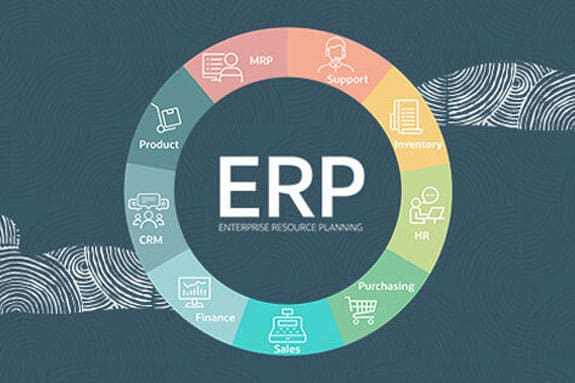
An enterprise resource planning (ERP) system is the key to integrating critical business functions across an organization. The widespread growth of ERP system adoption illustrates the importance of ERP to successful businesses.
ERP has become part of the standard business technology lexicon. The history of ERP systems is longer than you might think—they’ve been around for about 60 years. But there have been several generations and many names for ERP systems over that stretch.
Brief History of ERP
ERP history started with material requirements planning (MRP) systems in the 1960s, when J.I. Case, a manufacturer of tractor and construction machinery, worked with IBM to develop what is believed to be the first MRP system. Thereafter, large manufacturers built these MRP solutions themselves.
While they were expensive to create, required a team of experts to maintain, and took up a lot of space, early MRP systems enabled businesses to track inventory and production. That helped manufacturers manage raw materials procurement and delivery of product to the factory so they could better plan production runs.
Although adoption of MRP systems gained traction in the 1970s, the technology remained limited to large companies that had the budgets and resources for in-house development. Eventually several large software providers, including Oracle and JD Edwards, set out to make this software accessible to more businesses.
History of ERP in manufacturing: The ‘80s marked a milestone in the history of ERP systems when the first manufacturing resource planning (MRP II) systems appeared. These more sophisticated solutions supported manufacturing processes beyond inventory and raw materials procurement. MRP II systems allowed the various departments involved in manufacturing to coordinate, and they had more advanced production scheduling capabilities.
It wasn’t long until other industries realized that manufacturing firms were onto something.
Evolution of ERP Systems
By 1990, research firm Gartner coined the term “enterprise resource planning.” The new name recognized that many businesses—not just manufacturing—were now using this technology to increase the efficiency of their entire operations.
This is when ERP systems took on their current identity: a unified database for information from across the company. ERP systems brought in other business functions, like accounting, sales, engineering, and human resources (HR), to serve as a single source of accurate data for all employees.
ERP systems continued to evolve throughout the ’90s. One major breakthrough was the advent of cloud ERP, first offered by NetSuite in 1998. With cloud ERP, widely seen as an improvement over on-premises systems, businesses could access critical business data through the web from any device with an internet connection. Cloud solutions meant companies no longer needed to purchase and maintain hardware, reducing the need for IT staffers and leading to easier implementations.
This cloud model made ERP systems, once limited to enterprises, accessible to smaller companies that lacked the capital to launch and support a resource-intensive on-premises solution. Small and midsize businesses across industries could enjoy the same benefits as their larger counterparts, including automated processes, improved data accuracy, and greater efficiency.
In 2000, Gartner introduced the idea of ERP II to refer to internet-enabled systems that could pull data from other sources, including front-office applications, like customer relationship management (CRM), ecommerce, and marketing automation, and back-end applications like supply chain management (SCM) and human capital management (HCM).
This was a significant advance because the more information that feeds into the ERP system, the easier it is to identify and resolve issues and capitalize on opportunities for improvement.
Today, leading ERP systems are vast repositories of information able to generate reports that can spotlight the performance of every aspect of the business, from sales and marketing to product development to HR and operations. There are countless applications available, designed for different industries, business models, and challenges, and ERP acts as command central for what can be a vast network of software.
History of ERP
ERP has become a standard part of business lexicon, but the history of ERP systems is longer than many realize. These systems have evolved over the last several decades, incorporating many generations of advancing technology.
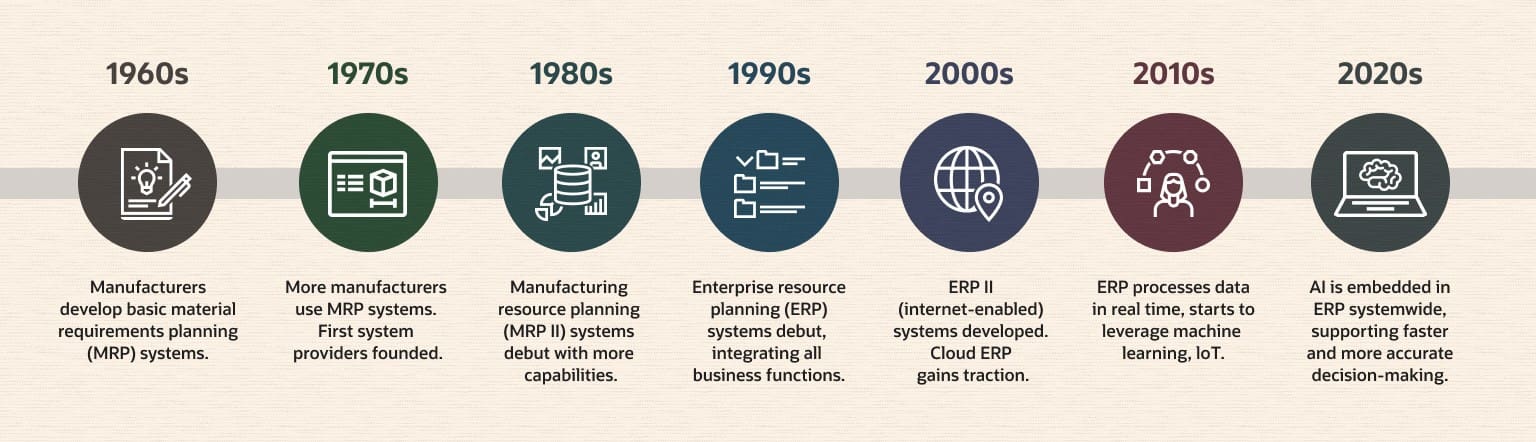
1960s: Manufacturers developed basic material requirements planning (MRP) systems. MRP systems were primarily used by large manufacturers to track inventory and coordinate production schedules. Adoption was limited to companies with significant IT resources because they ran on mainframe computers and required dedicated teams to maintain.
1970s: More manufacturers started using MRP systems, and the first system providers were founded. Companies no longer needed to build systems from scratch, though implementations were still complex and costly. The software still focused on manufacturing processes: managing bills of materials, scheduling production runs, and controlling inventory.
1980s: Manufacturing resource planning (MRP II) systems debuted with more capabilities. MRP II systems included more complex tasks, such as capacity planning, shop floor scheduling, and demand forecasting. For the first time, multiple departments involved in production could coordinate through a shared system.
1990s: Enterprise resource planning (ERP) systems debuted, integrating business functions to create the core concept of the ERPs we know today. Their information architectures established a single unified database shared by multiple business functions across an organization. That approach formed a strong platform for extensibility; ERP systems could support finance, HR, sales, and procurement, alongside manufacturing.
2000s: ERP II (internet-enabled) systems were introduced. These systems connected to even more business applications, such as CRM and ecommerce. Cloud-based ERPs like NetSuite became more common as they reduced infrastructure costs and made ERP accessible to small and midsized businesses.
2010s: ERP systems began processing data in real time, leveraging machine learning and IoT. Connected devices fed operational data directly into ERP systems to support faster responses to supply chain disruptions and unlock more powerful predictive analytics.
2020s: AI becomes embedded throughout ERP platforms, completing the shift of ERP from a system of record to a system for proactive decision-making. AI tools monitor performance, flag exceptions, and recommend strategies, while generative AI helps teams create reports, draft documents, and interpret complex data in plain language.
The History of ERP
Future of ERP
The integration of artificial intelligence—happening now—is defining the future direction of ERP evolution. ERP systems’ integrated repositories of business data have traditionally served managers’ decision-making; now, AI is transforming the extent and speed at which companies turn that information into insights that drive action.
As embedded AI capabilities expand, businesses will use ERP software to automate increasingly complex tasks, surface patterns in larger and more complex datasets, and generate deeper and more nuanced recommendations for everything from labor and inventory allocation to pricing strategies and procurement timing. GenAI tools, for example, will draft financial reports targeted at specific stakeholders or objectives, write job listings, develop marketing strategies, and create virtual prototypes for rapid R&D. AI agents will handle multistep workflows with minimal human intervention. With each update, developers are adding capabilities and businesses are putting them to use in new ways.
The value of these capabilities depends on the quality and integration of the underlying data. ERP systems, especially those with IoT scanners and trackers, capture real-time performance data at every step, whether it’s a sale, an inventory transfer, a financial transaction, or a supply chain slowdown. This complete view of operations provides the foundation AI needs to deliver the most accurate insights and predictions.
Even with this potential, only about 40% of companies report enterprise-level financial impact from their AI initiatives, despite about 80% of companies “using GenAI in at least one function,” according to McKinsey. This divide highlights the importance of integrating AI with core ERP capabilities in targeted and proven ways, rather than deploying it piecemeal. As AI technologies mature, ERP systems will increasingly act as the intelligence that powers business performance—connecting data and helping organizations adapt to changing conditions and customer needs.
Embrace the Future With NetSuite and AI
As enterprise software continues to evolve, businesses need an ERP platform that can fully realize the potential of new capabilities. NetSuite embeds AI throughout its cloud ERP system, leveraging its companywide database to deliver insights and automation that siloed tools can’t match. The platform’s AI features adapt to each business’s unique processes, integrations, data sources, and customer patterns to fit individual user’s needs. Additionally, GenAI features help teams accelerate their work through more sophisticated reporting and deeper analysis. Moreover, NetSuite’s scalability and extensibility supports business growth at any speed—organizations can add new features, modules, and users without ever facing a replatforming decision.
ERP History FAQ
Who invented ERP?
Tractor and construction machinery manufacturer J.I. Case worked with IBM to develop what is believed to be the first MRP system in the early 1960s.
What’s the difference between an MRP and ERP system?
MRP systems preceded ERP systems. Early MRP, or material resource planning, systems offered basic inventory control to help manage procurement and delivery of goods. ERP systems first appeared in the ’90s and pulled in information from other parts of the business, like accounting, sales, and HR.
What is manufacturing resource planning, a.k.a. MRP II?
Manufacturing resource planning (MRP II) systems arrived in the 1980s and were a significant step up from first-generation MRP systems. They incorporated additional manufacturing processes and got other departments involved in manufacturing to improve production efficiency and scheduling.
When did ERP systems become popular?
This software became more accessible and affordable in the ’80s and ’90s as companies like Oracle and JD Edwards developed and sold solutions. This meant businesses no longer had to build these systems themselves.
What is cloud ERP?
Cloud ERP is an ERP solution delivered through the internet that doesn’t require on-premises servers or other infrastructure. It first appeared in the late ’90s, gained traction in the mid-late 2000s, and has become extremely popular in recent years.
What is ERP II?
ERP II refers to internet-enabled ERP systems, including cloud solutions, that use web connections to send and receive information from various applications. Gartner came up with the term “ERP II” in 2000 to christen a new generation of ERP systems.
How do ERP systems use machine learning?
Machine learning technology uses data and feedback to learn patterns and make judgments that inform additional analytics and insights. In the context of ERP, machine learning can automate reporting, reconciliation, and the flagging of inconsistencies or errors.