
Enterprise resource planning (ERP) solutions have matured and expanded their reach to support most business functions, from accounting and other back-end processes to front-office functions such as sales force automation, marketing automation, and ecommerce, with artificial intelligence often powering strategic functions. Businesses rely on ERP to cut costs by eliminating redundant processes and automating mundane tasks as well as provide employees access to critical information for better and faster decisions. It’s no wonder that current projections show that the global ERP software market involves spending at approximately $106 billion in 2026.
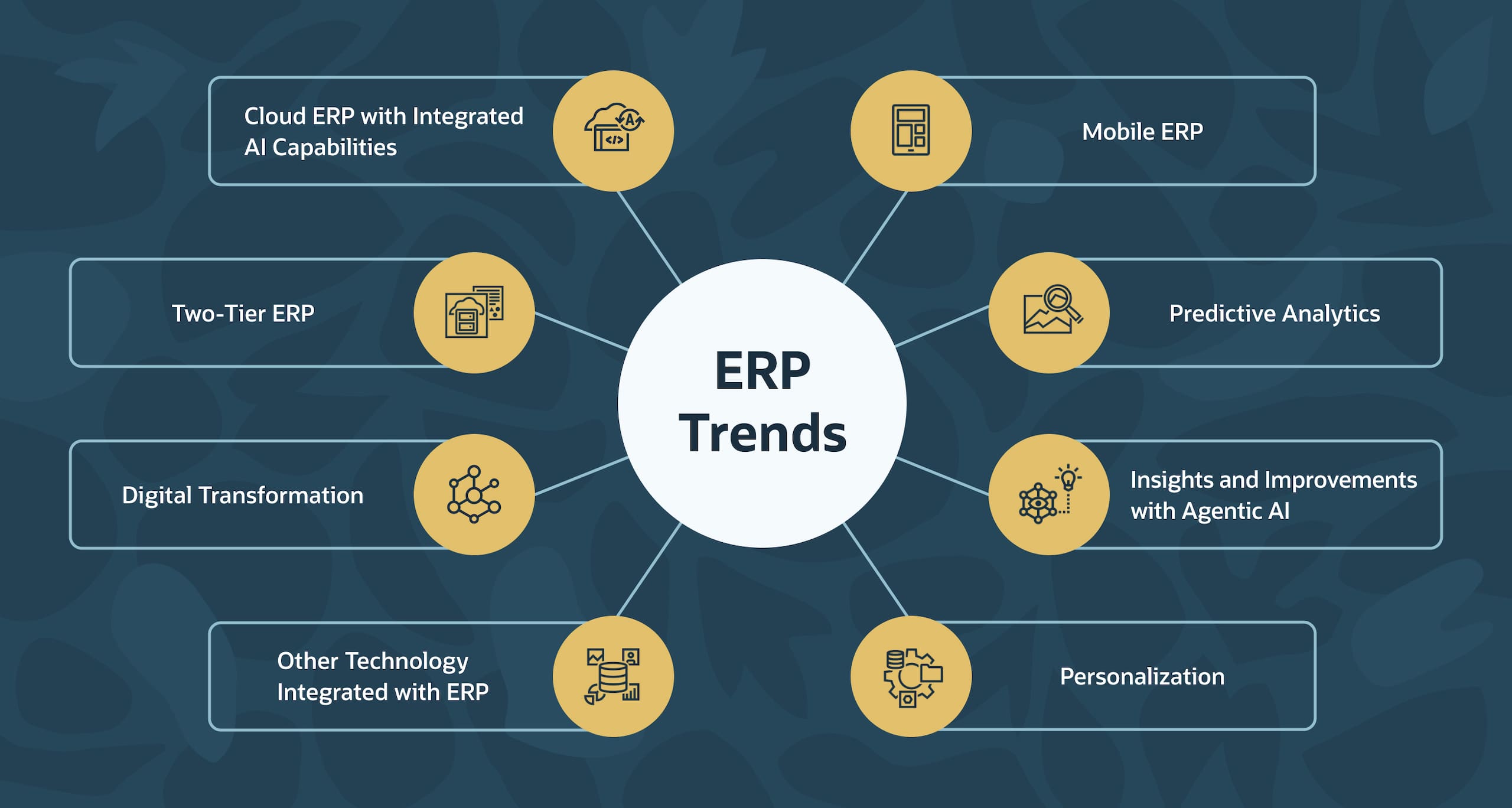
As companies increasingly rely on ERP to run their businesses, these systems continue to evolve to leverage new technologies and support a broader range of functions. In this article, we’ll cover eight major trends to keep an eye on in 2026 and beyond.
Key Takeaways
- By 2026, most companies using cloud-based ERPs are looking at new ways to leverage emerging technologies within solutions.
- AI and integrated AI agents can optimize cross-functional and complex business processes, provide new insights, and create personalized customer interactions.
- ERP is further integrating data from other platforms, such as internet of things (IoT) devices and social media, to automate even more and provide greater visibility and a better customer experience.
- Solutions that support integrated data across sources, devices, and platforms have become critical as organizations increasingly rely on connectivity to inform decision making on resources and customer experiences.
8 ERP Trends for 2026 and Beyond
-
Cloud ERP with Integrated AI Capabilities
The ERP industry has shifted, with companies fully embracing a migration from on-premises ERP applications to cloud ERP. With simpler deployment, lower costs, elasticity, new functionality, fewer internal IT resources, and the ability to easily add users and functions to accommodate business growth, the cloud has made ERP processes more flexible, scalable, and secure. But what is the next evolution of ERP?
AI has worked its way into business applications for the past decade, but in recent years, advances in capabilities have opened up an entirely new landscape of possibilities. When cloud ERP solutions come integrated with AI, automation and deep analysis become key process tools rather than pie-in-the-sky wishes. For example, AI can connect with multiple data sources across a company’s ecosystem to analyze supplier pricing, logistics, and quality reports, then either make authorized decisions for re-purchasing or provide suggestions for switching providers. AI tools like these can make teams even more adaptable than ever before, and companies should consider built-in AI integrations as an essential component to their ERP platform.
-
Two-Tier ERP
Historically, many companies tried to deploy a single ERP system for both the headquarters and all regional offices and subsidiaries. But in practice, that approach was often costly and extremely challenging to implement; subsidiaries often had specialized requirements, didn’t need the full functionality of the corporate system and struggled with the one-size-fits-all approach.
That’s why two-tier ERP remains a top ERP trend in 2026. Two-tier ERP is a strategy that enables organizations to leverage their investments in existing ERP systems at the corporate level (tier 1), while subsidiaries and divisions operate using a different ERP solution (tier 2), which is often cloud-based. Larger companies may continue to use their core ERP system for financials and other core processes, while smaller business units turn to solutions that address their specialized needs. The effectiveness of this approach depends, in part, on the ability to exchange data between the tiers — more and more tier 2 cloud solutions are including built-in capabilities for integration with corporate ERP systems, while advanced APIs are simplifying the integration process to facilitate real-time data flows and unified enterprise-wide analytics.
This approach offers a number of benefits. It’s often less costly than retrofitting the corporate ERP system to work for the entire business. A tier 2 solution may be simpler to implement and provide subsidiaries with more flexibility to respond to changing business conditions. In addition, the two-tiered approach may be better suited for organizations in high-growth mode, particularly if they utilize AI features to achieve things like faster financial close and automated resource allocation through data consolidation between tiers. As Gartner puts it, large organizations should “assess whether a two-tier ERP strategy would offer more business benefit than a single-tier one, especially by modernizing small, potentially fast-growing business units.”
-
Digital Transformation
One of the most important strategies heading into 2026 and beyond is harnessing the oncoming opportunities made available through evolving updates in cloud ERP platforms. This includes further integration of automation and AI-powered features, meaning that organizations leaning into these capabilities across departments and groups can improve both internal and external operations, from operations to management to finances.
While individual AI capabilities vary across platforms, cloud ERP systems often offer built-in tools such as the following:
- AI agents with natural language interfaces, allowing ERP users to request, analyze, and manipulate data through plain language prompts.
- Automation tools can ingest, categorize, and process incoming data from connected sources, then propagate that data into further features such as real-time analytics or outlier detection.
- Built-in AI models may offer different analytical capabilities depending on industries, including seasonal analysis, fraud detection, and root-cause analysis for issues such as overspend
A continuous process rather than a one-time initiative, utilizing the existing and oncoming capabilities of AI and data remain a key focus in 2026. Cloud ERP systems play a key role in this transformation by integrating cutting-edge technology into all business functions to improve daily operations, boost revenue and increase competitiveness — all while increasing employee productivity and improving customer service and communication.
-
Other Technology Integrated With ERP
While cloud ERP is a key element in a company’s technology ecosystem, it’s only part of a bigger upgrade strategy. Companies are integrating their business applications with other new technologies to improve core processes and operational efficiency. For example, integration with IoT capabilities is becoming increasingly sophisticated. Manufacturers might use ERP systems integrated with IoT sensors to monitor equipment performance in real time, making them capable of predicting maintenance needs before a breakdown halts operations. Similarly, in logistics, ERP systems linked with AI-powered warehouse solutions can optimize inventory management and delivery processes.
Integration with ecommerce platforms also remains crucial, especially as businesses continue to expand their online presence. When integrated with ecommerce platforms, for instance, ERP systems can support the end-to-end order fulfillment process through streamlined order processing, inventory updates, payment management, and shipping.
-
Personalization
Historically, ERP platforms with complex scripting languages were difficult to customize to the specialized needs of each business. But organizations can now take advantage of cloud ERP platforms designed for easier configuration — what analysts call “low-code” and “no-code” platforms. These tools empower companies and their users to easily tailor the ERP system to their specific needs without extensive technical expertise.
The flexibility of modern ERP systems is also contributing to a growing range of ERP solutions tailored to the needs of specific industries. For example, in the healthcare sector, ERP systems are increasingly designed with modules that manage patient records, comply with health regulations, and integrate with medical billing systems. This allows healthcare providers to focus more on patient care and less on administrative tasks.
As companies focus on delivering more personalized, relevant experiences to customers, they need ERP systems that can accommodate those needs with features like highly customizable dashboards. One emerging trend is the growing popularity of AI-based assistive and conversational user interfaces such as chatbots, which can interpret user voice or text input and respond to questions using customer and order information stored within the ERP.
-
Insights and Improvements with Agentic AI
AI is now becoming a core component of ERP systems rather than an add-on feature. Embedded within the ERP, these technologies work behind the scenes to help meet increased demand for personalization and improve a broad range of business processes. These capabilities allow businesses to exploit the latest in AI technology, such as generative AI.
AI can deliver significant benefits for businesses, including offering the infrastructure to build and deploy custom AI agents with following potential benefits:
More insights: As organizations gather more operational and customer data than ever before, AI agents can perform cross-functional analysis to deliver valuable business insights based on a range of data sources.
Faster screening and onboarding: AI agents, whether prebuilt or custom-built, can deploy within HR teams to scan through incoming applications for initial assessments about candidates. AI agents can take that one step further by handling related candidate logistics, such as requesting missing information or scheduling interviews.
Improved processes: AI agents can be built to automate steps and processes for improved workflow efficiency. For example, consider a manufacturer that adopts a just-in-time inventory strategy, which aims to deliver components at the last possible moment to minimize inventory carrying costs. An AI agent can optimize the supply delivery and labor schedules to increase productivity and lower costs by considering historical trends, seasonal patterns, and external conditions.
-
Predictive Analytics
The hunger for AI-infused ERP highlights organizations’ increasing desire to mine their operational and customer data for new and relevant insights that will increase the top and bottom lines.
While it’s always been possible to analyze ERP data to reveal what happened in a business’s past, a focus in 2026 and beyond is using advanced predictive analytics to uncover and address what is likely to happen in the future. This data can be used to predict outcomes that help companies avoid potential issues and capitalize on emerging opportunities.
For example, AI-powered software can comb through a maintenance company’s vast data repository to gather pertinent information about appliance repairs to predict when breakdowns are likely to occur. The organization can use that data to optimize maintenance schedules for servicing or replacing parts right before they cause problems for clients.
Predictive analytics is also expanding into areas like financial forecasting, demand planning, and even human resources, where it can predict employee turnover and improve hiring processes.
-
Mobile ERP
ERP often keep users connected with mobile support that provides on-the-go access to critical business data, allowing employees to conduct both back-end and front-end tasks no matter where they are, from the warehouse floor to a retail checkout terminal to an airport. Mobile ERP can also encourage collaboration for dispersed workforces in different time zones.
When combined with other connective technology such as IoT sensors, mobile ERP can help users get work done at any stage of a company’s operation – the office, the factory, the warehouse, or visiting a vendor. Employees can complete tasks like expense reporting, call logging and time tracking, and they can view the status of critical workflows or approvals from their phones. Mobile ERP offers real-time data and insights and provides overall benefits, including always-on remote access, improved productivity, faster and more accurate data capture, and increased agility.
4 ERP Predictions
Current and upcoming ERP trends are one thing, but what does the future have in store? Here’s a look at a few predictions for what ERP might entail in the future, near and far:
-
Autonomous Solutions
AI technology is only advancing, making it likely that ERP systems will move toward greater autonomy. In practice, this could mean ERP systems will be capable of proactively managing business operations thanks to AI agents making informed decisions without requiring human intervention. For example, ERPs may be able to automate complex tasks such as optimizing supply chain logistics, dynamically adjusting pricing strategies, or managing collections.
-
Blockchain Integration
Blockchain has been buzzing about for years, but the technology could increasingly be integrated into ERP systems to enhance transparency and security. This is particularly useful in supply chain management, as blockchain would allow for tamper-proof records of transactions and real-time tracking of goods and services across the globe. It’s also relevant for sustainability: Companies can use blockchain to create “green ledgers” that transparently track environmental data alongside or as part of traditional financial metrics.
-
Composable ERP
A composable ERP strategy is built on the idea of interconnected and modular services, features, and tools, all with an eye on an organization’s unique needs and constraints. With a cloud ERP as a core solution, companies can look at flexibly adapting capabilities to their needs with elements such as prebuilt integrations, modular add-ons, and third-party connectivity. This also extends to AI-based tools thanks to the use of Model Context Protocol (MCP) features that allow AI agents to interact and integrate with ERP systems.
-
Open Standards
As businesses continue to digitize and adopt various software tools, an ERP’s ability to seamlessly connect with these platforms is essential. Designed to ensure that software and hardware products can work together seamlessly, open standards are likely to simplify integration and communication between disparate systems. This helps guarantee ERP solutions and related AI agents can easily share data and functionality across an increasingly complex digital landscape.
What’s Next? The Future of ERP
The scope of cloud ERP will continue to widen as companies realize it’s much easier to gain the speed and agility needed to compete in today’s marketplace if they utilize their system’s full technological capabilities, from built-in AI tools to streamlined processes that exploit data consolidation to composable strategies using both internal modules and third-party systems. AI is at the forefront of all of this, allowing companies to further expand supply chain management capabilities. Many cloud ERP systems come with a range of built-in AI features to optimize processes against supply chain disruptions , monitor and adapt to evolving supply chain regulatory standards, or maintain cost and quality control over a global vendor network.
As ABI Research Principal Analyst Michael Larner put it, “Supply chain orchestration requires software to be more than a system of record and provide risk analysis and run simulations, enabling manufacturers to understand and prepare for supply chain shocks.”
Stay Ahead of the Curve With NetSuite’s Leading-Edge Cloud ERP
As the world’s most deployed cloud ERP, AI-powered NetSuite ERP simplifies complex business processes across multiple dimensions — from automated financial operations to optimized order management and supply chain dynamics — to position companies of all sizes at the leading edge of operational excellence. For example, with its integrated AI capabilities, NetSuite can transform vast amounts of data into actionable insights that facilitate smarter decisions, faster. And with AI tools like NetSuite Bill Capture and Text Enhance, companies can further support productivity by automating invoice data entry, as well as the creation and refinement of content like purchase orders, sales emails, purchase orders and product descriptions.
Whether managing global operations across 200 countries and handling multiple currencies or running a growing operation out of California, NetSuite equips any company with the tools it needs to stay competitive and innovative.
ERP Trends FAQ
What is the future of the ERP industry?
The future of the ERP industry will likely involve integrating cutting-edge AI technology such as AI agents and Model Context Protocol connectivity to cloud ERP solutions. From a big-picture perspective, this may involve elements such as cloud-based systems, two-tier platforms, an increasing amount of personalization and customization, a proliferation of advanced AI systems, highly capable predictive analytics capabilities, and a need for seamless integration between digital platforms.
What are the predictions about the future of the ERP market?
The ERP market is predicted to continue growing. With that growth could come more advanced capabilities and technologies, including:
- Autonomous solutions that utilize AI and AI agents to proactively manage operations without human intervention.
- Blockchain integration that allows for transparent, tamper-proof records.
- Composable ERP strategies that allow for significant levels of customization through simplified development, third-party interconnectivity, and modular features.
- Open standards, which can help ERPs seamlessly connect with various software tools and minimize incompatibility.
Is the ERP market growing?
Yes, the ERP market continues to grow as businesses continue to digitize and recognize a need for a solution that will integrate data and streamline end-to-end business processes. One report shows the cloud ERP market is expected to grow from $92.6 billion in 2025 to a projected total of $281.58 billion by 2034.