
Companies invest significant time and money into capturing leads—many of which never move past an initial form fill or demo request. Lead nurturing turns that early interest into sustained engagement throughout the sales funnel. This article explains how it helps marketing managers, demand generation teams, and sales development representatives (SDRs) convert more prospects into customers.
What Is Marketing Lead Nurturing?
Marketing lead nurturing is the process of building relationships with prospects by providing relevant, timely information that brings them closer to making a buying decision. Its goal: to convert existing leads into qualified sales opportunities.
Lead nurturing strategies typically involve a mix of content marketing, email sequences, paid advertisements, and targeted social media campaigns. They guide prospects through the buyer’s journey, from researching problems and evaluating solutions to gaining buy-in from internal decision-makers.
Key Takeaways
- Effective lead nurturing identifies and builds relationships with the prospects most likely to become customers.
- It also helps maximize marketing and sales resources.
- Clearly defined buyer personas and automated workflows allow marketing teams to nurture leads at scale.
- Vague messaging, misaligned content, and high-friction sales processes challenge marketing’s ability to convert leads.
Lead Nurturing in Marketing Explained
Lead nurturing bridges the gap between lead generation and sales conversations. Marketing managers and campaign specialists depend on it to turn their large databases of mixed-quality contacts into a subset of engaged, high-fit leads that sales can prioritize. In many companies, those databases contain names of people who downloaded a single top-of-funnel asset, highly engaged leads who regularly attend webinars, and everyone in between. They may also include contacts that don’t match the ideal customer profile—for example, students, job seekers, competitors, and companies in the wrong industries—as well as records with missing or outdated information. These contacts all look similar in a spreadsheet or CRM dashboard, making it difficult to discern those who deserve immediate sales attention.
A typical lead nurturing program relies on content, marketing automation, and CRM data to deliver context-aware messages across multiple channels. When prospects download a guide, attend a webinar, respond to an email, or repeatedly visit a pricing page, they’re signaling interest and informing which campaigns and content they receive next. Over time, these touchpoints clarify fit, refine understanding of the buyer, and pinpoint the opportunities most likely to close.
Lead Nurturing Example
Consider the following situation. A senior marketing manager at a midsize digital agency is scrolling through LinkedIn when they see an ad from an analytics platform vendor, promoting a guide about measuring campaign ROI. They fill out a brief form to download the guide, which adds their contact information to the vendor’s CRM. They are also enrolled in a nurture sequence, where the marketing automation system sends follow-up emails with resources about related topics, such as attribution models or how the platform’s campaign dashboard works. Through these emails, the manager registers for a webinar about optimizing click-through rates and, after the session, begins to explore the platform’s pricing page. These activities prompt the automation system to place the manager into a more advanced sequence that send a case study about a similar digital agency. The system also notifies an SDR that this specific contact has engaged with multiple middle- and bottom-of-funnel assets related to measurement and ROI, giving the rep clear context for a follow-up call.
Why Does Effective Lead Nurturing Matter?
Effective lead nurturing turns a one-time interaction into an ongoing conversation that can result in better-qualified sales opportunities and more predictable revenue. It also helps marketing teams make better use of their existing databases, rather than relying solely on net-new lead generation, because it:
- Identifies customer insights: As prospects interact with emails and content, they provide valuable information about which topics they find most relevant. Marketers can use this data to refine buyer personas, adjust messaging, and prioritize campaigns that speak directly to the needs of different segments. It also gives SDRs and sales reps talking points grounded in actual lead behavior.
- Improves conversion rates: Nurturing keeps a company top of mind as prospects move from early research to serious evaluation. By matching content to where leads are in the sales funnel and following up promptly after key actions, marketing and sales teams can convert more marketing-qualified leads (MQLs) into sales-qualified leads (SQLs) and, ultimately, closed-won deals.
- Increases brand affinity: Brands that consistently provide helpful content rather than aggressive sales pitches position themselves as trusted advisors to their target audiences. When leads feel like a company understands their industry, challenges, and goals, they’re more inclined to choose that company over competitors.
- Optimizes marketing costs: Nurturing gives businesses more value from their existing leads, so they don’t have to constantly chase new ones. By using marketing automation platforms to run targeted, dynamic campaigns and prioritize higher-intent leads, teams can optimize their marketing spending by allocating budget toward channels and programs that generate meaningful pipeline, rather than just volume at the top of the funnel.
Lead Nurturing vs. Lead Generation: What’s the Difference?
Lead generation and lead nurturing are both essential, yet they serve different purposes. Lead generation adds new contacts to the marketing database, while lead nurturing identifies the most promising contacts and builds relationships with them.
Lead generation relies on tactics, such as search engine optimization, social media campaigns, and paid ads, to persuade target audiences to fill out forms for access to exclusive content and entice them to subscribe to newsletters, register for events, or join private communities. Lead nurturing picks up from there, using email campaigns, retargeting, and tailored content to move those leads along the buyer journey.
Lead-generation success is measured by the number of leads, cost per lead, and ad click-through rates. Lead nurturing success is tracked through engagement quality, conversion rates between stages (such as lead to MQL, or MQL to SQL), sales cycle length, and contributions to the pipeline and revenue.
How Does Lead Nurturing Work?
Lead nurturing works best when viewed as a systematic approach. Marketing teams define target buyer personas, set up marketing automation workflows, and connect those workflows to their CRM systems so they can quickly respond to actual behaviors. The following components work together to steer leads from initial interest to sales-ready status.
Lead Segmentation and Buyer Personas
Segmentation groups contacts by attributes, such as industry, company size, role, and buying committee responsibility (decision-maker, budget owner, etc.). It also considers email engagement, specific pages visited, and other behavioral signals. Marketing teams start by creating detailed profiles of their ideal customers, including who they are, what they care about, and how they make decisions. Buyer personas then inform segmentation. For example, one segment might be “agency CMOs at midsize firms researching automation,” while another might be “campaign specialists at fast-growing startups exploring new analytics tools.” From there, tailored nurture sequences make every touchpoint feel more relevant to their target audiences.
Lead Scoring and Prioritization
Only 31% of leads become MQLs, according to First Page Sage, so treating every form fill equally wastes time that sales could spend on the highest-value, highest-intent opportunities. Lead scoring ranks contacts by their likelihood of becoming customers. It assigns a numeric value to each contact based on their title, location, company size, industry, and behavior. A senior executive who regularly visits product and pricing pages may be more ready and willing to buy than a manager who occasionally reads blog posts, for instance. In a CRM or marketing automation system, these scores update automatically as lead data and behaviors change. Contacts above a certain score are classified as MQLs and are handed off to SDRs or sales reps for direct outreach.
Progressive Profiling
Progressive profiling continually collects and analyzes additional information about leads. At the first interaction, a form might request only basic details, such as name and email address. But when that lead seeks access to other resources, subsequent forms can ask about their role, department, goals, or purchasing time frame. If answers change, marketing automation and CRM systems automatically update contact records. This approach steadily constructs a more complete lead profile without adding friction at any one interaction, increases conversion rates, and gives marketers the data they need to move on to segmentation and scoring.
Lead Monitoring
Lead monitoring tracks how individual contacts engage at particular marketing and sales touchpoints so teams can better understand which topics and campaigns are most effective and which prospects have purchasing intent. Key metrics include email opens, click-throughs, form fills, webinar registrations, and website visits. This data powers alerts and workflows that support timely, relevant outreach. For example, an SDR might be notified if a contact repeatedly visits pricing pages or returns to the site after a period of inactivity, signaling a potential readiness to buy.
Content Development and Delivery
Content moves leads from initial awareness to informed evaluation. Marketing teams develop a mix of assets, such as blog posts, guides, videos, webinars, and case studies, that are mapped to different buyer personas and funnel stages. They then deliver that content through email campaigns, social media, and other channels with messaging tailored to the lead’s industry, role, and recent behaviors. Marketing automation and CRM data indicate what content a contact has already obtained and what they’re likely to find useful next, so the experience feels more like a curated journey than a series of disconnected messages. This targeted, personalized content mix helps leads understand their options, builds brand trust, and supports more natural sales conversations.
8 Reasons Why Your Marketing Leads Might Not Be Converting
Even with a solid lead-generation engine and marketing automation in place, companies may struggle to turn leads into customers. Some challenges stem from internal missteps, while others are beyond sales and marketing’s control. Here are the most common reasons conversions break down:
- Your lead isn’t ready to buy: Many leads may still be in the awareness or early consideration stage, even if they’ve accessed middle- or bottom-of-funnel resources. If sales engages too quickly with a hard pitch, prospects may pull back because they haven’t yet compared alternatives or developed buy-in.
- Your content didn’t address a relevant pain point: If leads receive generic or misaligned content, they may not see enough value to keep engaging. Campaigns that don’t clearly connect a solution to the specific problems buyer personas face in their day-to-day work often fail to move leads farther down the funnel.
- Your product or service doesn’t have a specific enough value proposition: When messaging is broad or vague, potential customers may struggle to understand how an offering differs from that of competitors or how it supports concrete business outcomes. As a result, they may decide to choose another vendor whose value proposition is clearer.
- You might be targeting the wrong audience: If lead-generation efforts attract contacts that don’t fit the ideal customer profile—for example, companies outside the targeted size range or people who lack buying authority—conversion rates will suffer. Lead nurturing can do only so much if the underlying audience isn’t a good match.
- Your content isn’t personalized enough (or is overpersonalized): Sending the same content to everyone can make messages sound irrelevant, but overly granular personalization can also seem intrusive. The goal is to use segmentation, behavior, and progressive profiling to tailor content in a way that feels helpful and contextual, not creepy.
- Your sales and marketing departments aren’t in alignment: When marketing and sales don’t agree on the definition of an MQL, how quickly sales should follow up, or how to handle leads that aren’t ready, opportunities can fall through the cracks. Misalignment leads to inconsistent messaging, too, which can cause prospects to receive conflicting information from different teams.
- There’s too much friction in your sales process: Complex forms, slow response times, multiple handoffs, and confusing pricing can discourage otherwise interested prospects. If it’s hard to schedule a demo, get questions answered, or understand the next step, leads may drop off—even if they’ve engaged heavily with nurture campaigns.
- External factors may be in play: Sometimes leads don’t convert because of budget freezes, organizational changes, or shifting priorities, not because of ineffective nurturing efforts. Marketing can’t control these factors, but tracking their outcomes in the CRM helps distinguish messaging and targeting issues from situations where the timing simply wasn’t right.
6 Lead Nurturing Best Practices
Lead nurturing is most effective when it follows repeatable, rules-based processes. By following these best practices, marketing managers, campaign specialists, and SDRs can create consistent experiences that support higher conversion rates and healthier sales pipelines:
- Always include a call to action (CTA): Every touchpoint in a nurture sequence should guide the lead toward a clear, logical next step, whether that’s reading a related article, watching a brief video, or scheduling a conversation with sales. Well-crafted CTAs encourage prospects to engage and create a natural progression from awareness to education to evaluation.
- A/B test content to see which messages resonate: Marketing teams can test subject lines, ad and email copy, and web page designs to see which versions drive stronger open and click-through rates. The results of these experiments provide valuable insights into how different segments respond to specific topics, formats, and tones, which can then inform broader content and steer campaign strategies.
- Make your content helpful and personal: Effective lead nurturing content answers real questions and acknowledges common challenges to reflect an understanding of the prospect’s role, industry, and stage in the buying journey. Content that combines educational value with appropriate personalization builds trust and fosters ongoing engagement.
- Make sure you’re adhering to regulatory compliance: Companies that collect contact data must follow applicable privacy and communications regulations and honor communications opt-outs. Clear consent practices and preference centers, plus thoughtful email frequency guidelines, protect brand reputation and sustain nurture programs.
- Trace where in the journey your leads go cold: Mapping the funnel through CRM dashboards and tracking sales metrics like conversion rates between those stages reveals where leads are most likely to drop off—and why. If a large percentage of MQLs never become SQLs, for example, that often signals misaligned marketing and sales qualification criteria.
- Use marketing software and automation: Running complex nurture programs manually is difficult, especially when those programs span multiple campaigns, buyer personas, and regions. Marketing automation supports multistep, trigger-based campaigns, tracks engagement over time, and routes high-intent leads to sales without overburdening the team.
The Role of CRM in Effective Lead Nurturing
For many marketing managers and demand-generation teams, visibility is one of the biggest challenges to lead nurturing. Teams may be running several email and social campaigns but struggling to see how each touchpoint affects individual contacts or why some segments convert better than others. Sales and business development representatives often work with separate tools, making it hard to know which leads have already been contacted, what was discussed, and whether to move a lead into a sales sequence. These disconnects are especially acute in mid-funnel scenarios, where it’s not always clear whether a contact is still in research mode or ready for a direct sales conversation.
NetSuite CRM closes those gaps. The cloud-based solution provides marketing and sales teams with a shared, real-time view of each lead’s history from first touch through opportunity and customer status. By connecting marketing automation data with CRM records, teams can see email engagement, website activity, call notes, and campaign membership in one place, making it easier to segment leads, adjust nurture tracks, optimize advertising through integration with NetSuite ERP for Advertising & Marketing Agencies, and hand off warm prospects to sales at the right time. NetSuite supports the progression of leads as they move from awareness to consideration and decision stages, with lead scoring, task management, and pipeline tracking tools that help businesses focus on opportunities most likely to convert into solid sales.
Automate Marketing Campaigns With NetSuite
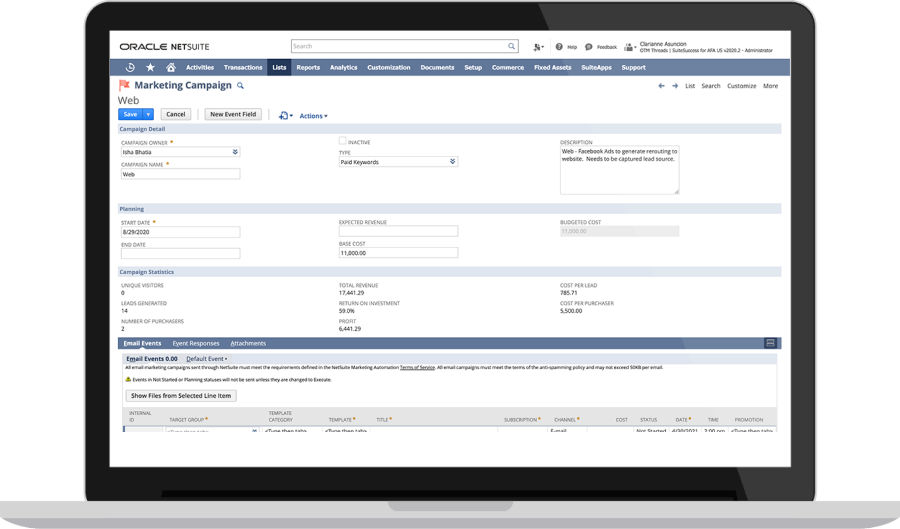
Marketing lead nurturing gives organizations a structured way to move prospective buyers from their initial interest to informed, sales-ready conversations. It aligns content, timing, and channels with buyer personas and funnel stages to improve conversion rates and make better use of existing contact databases. Together, CRM and marketing automation systems provide the data and workflows teams need to understand where leads are in their journeys and how best to engage them. As technology, buyer expectations, and channels evolve, marketing lead nurturing will remain a critical capability for turning early attention into long-term customer relationships.
Lead Nurturing in Marketing FAQs
What are the components of a successful lead nurturing strategy?
The components of a successful lead nurturing strategy are clear buyer personas, personalized communication, sales and marketing alignment, and continuous performance monitoring. Together, they create repeatable, scalable processes that turn contacts into customers.
What’s the difference between lead nurturing and lead scoring?
The difference between lead nurturing and lead scoring is that nurturing builds relationships with contacts, while scoring identifies which contacts are most likely to purchase. The two functions are interdependent; nurturing increases lead scores and lead scores determine which nurture sequences contacts receive.
What happens after the lead nurturing stage?
After the lead nurturing stage, marketing hands off qualified prospects to sales. Armed with each lead’s full engagement history, reps can make more relevant pitches and conduct more informed discovery calls.