Professional services and consulting firms depend on billable work to drive revenue and profitability. Utilization rate helps leaders understand how much of their team’s available time is spent on client-facing activities versus internal or administrative tasks. With consistent tracking, this key performance indicator (KPI) can help organizations improve resource planning, manage costs, and balance financial performance with employee engagement.
What Is a Workforce Utilization Rate?
The workforce utilization rate refers to the percentage of available employee time spent on billable work. In professional services environments, utilization rate connects staff capacity to revenue generation, helping firms evaluate how efficiently team members contribute to client work and business goals.
Key Takeaways
- Utilization rate calculates how much time employees devote to billable work.
- High utilization must be balanced with workload sustainability.
- Accurate tracking depends on clear definitions, consistent time capture, and integrated systems.
Utilization Rate Explained
Utilization rate compares staff time spent on work that can be invoiced to clients to their total available working hours. Importantly, it measures how time is allocated, not output or quality. Time spent on internal meetings, administrative work, and gaps between engagements isn’t billable.
For example, two consultants may work the same number of total hours, but if one spends 30 hours on client work while the other spends 20, their utilization rate will be different—though the former is not necessarily better than the latter. (More on that soon.) Over time, utilization data helps firms identify capacity gaps, staffing imbalances, and opportunities to improve billing efficiency.
Why Do Utilization Rates Matter?
Tracking utilization rates helps organizations align workforce capacity with business objectives in four areas:
- Workforce management: Understanding how time is distributed supports better scheduling, workload balancing, and performance planning. Utilization data reveals who’s overloaded and who may have time to spare.
- Profit margins: Utilization ties workforce output directly to revenue. Since labor is typically the largest cost in service-based organizations, even small shifts in utilization can significantly affect margins.
- Operational efficiency: Utilization data supports business efficiency by flagging possible bottlenecks, idle capacity, and process problems. It also helps pinpoint where time spent on administrative tasks impinges on billable time.
- Capacity planning: When utilization consistently exceeds targets, it signals that employees or teams are approaching their limits; when it’s low, it may indicate excess capacity or weak demand. Either way, the data informs hiring, outsourcing, and growth decisions.
Key Aspects of Utilization
For consulting and professional services firms, utilization rate is one of the most direct links between how time is spent and whether the business is profitable. Tracking this metric helps organizations align workforce capacity with business objectives in four areas.
-
Billable hours:
Billable hours represent time spent on client projects that can be invoiced. Billable work may include client meetings, project-related research, project delivery, and any other work explicitly tied to a specific engagement. Organizations that systematically track billable hours gain a solid baseline for setting rates, forecasting revenue, and evaluating performance. -
Staffing and workload distribution:
Underperformance isn’t necessarily a capacity problem—it may be an allocation problem that hampers performance, even when client demand is strong. Effective workforce management uses utilization data to redistribute work, match skills to projects, and prevent bottlenecks that delay delivery or lead to staff burnout. -
Market and client demands:
From budget freezes to new technology adoption, client demand fluctuates with economic conditions, project cycles, and industry trends. Utilization follows suit. Monitoring demand patterns over time supports more accurate forecasting and proactive staffing adjustments. -
Productive time:
Staff training, internal collaboration, and time spent on process improvements strengthen the firm over time, even though they don’t generate immediate revenue. Separating these high-value activities, known as “productive utilization,” from standard billable utilization provides a fuller picture of the workload. Without this distinction, an employee at 60% utilization because they trained junior staff could be perceived as less valuable than one at 80% who skipped internal contributions.
Utilization Rate Formula and Calculation
The standard utilization rate formula compares billable hours to total available working hours. Total available hours generally reflect standard working time, excluding approved leave, holidays, and other exempt time. Some organizations adjust the number of total hours to account for part-time schedules or regional differences.
The utilization rate formula is:
Utilization rate = (Total billable hours / Total available hours) × 100
Example Utilization Rate Calculation
Let’s use the example of a consultant with 40 available hours per week (a common baseline) who spends 30 hours on billable client projects. The consultant’s utilization rate is 75%. Here’s what the formula looks like with these variables:
Utilization rate = (30 / 40) × 100
Utilization naturally fluctuates week to week, so most firms track averages over a month or quarter to get a clearer picture.
Optimal Utilization Rates
Average billable utilization for professional services was 66.4% in 2025, down from 2024’s 68.9%, which was below the 75% optimal threshold, according to Service Performance Insight’s (SPI Research) two latest “Professional Services Maturity Benchmark” reports. Results also varied by market: In 2024, IT consulting averaged 71.0%, per SPI Research, while management consulting averaged 67.4%, underscoring the notion that a single rate rarely fits all contexts.
Employee Utilization Rate: 6-Year View
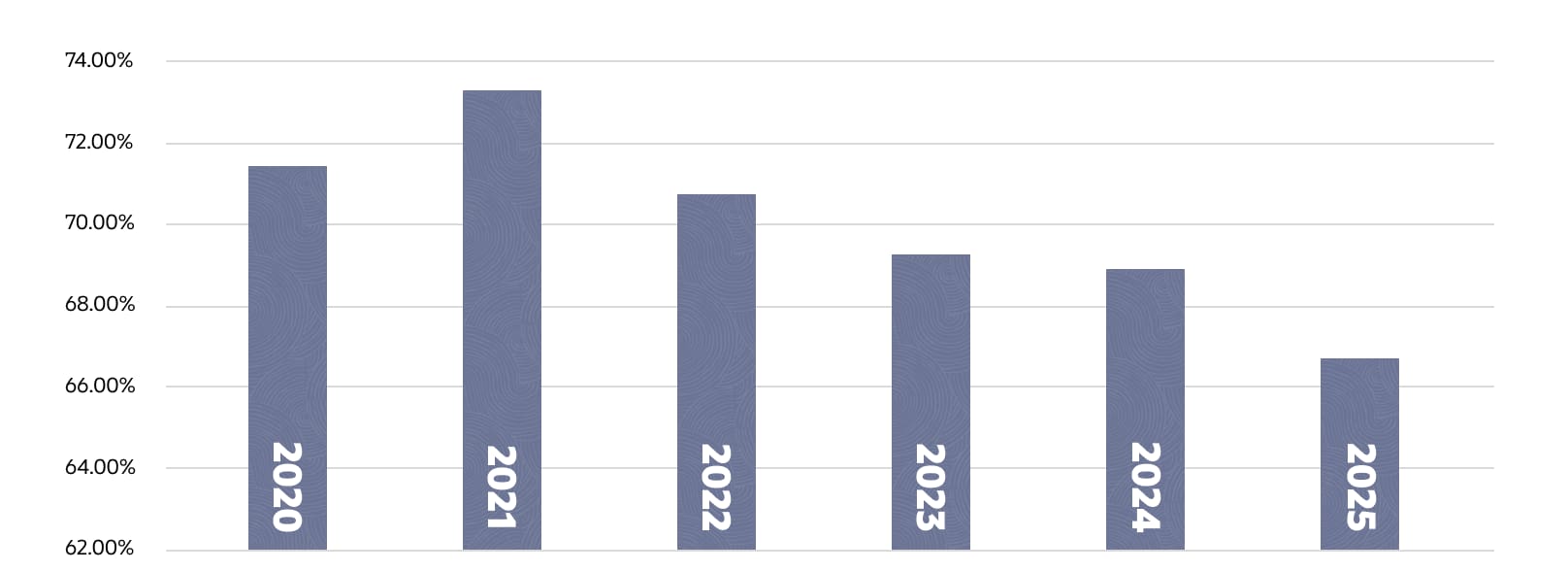
Keep in mind, rates below a firm’s target may indicate excess capacity or weak demand. Rates consistently above target may signal workload pressure and increased burnout risk. Reviewing utilization alongside revenue, retention, and employee engagement metrics provides more balanced insight.
Common Utilization Rate Mistakes
Utilization rate is easy to calculate and compare, but sometimes that means it gets more weight than harder-to-measure factors that impact long-term profitability. Common pitfalls include:
- Prioritizing utilization over work quality: Pressure to maximize billable hours can lead to rushed deliverables, shallow analyses, and less time for project reviews. It can also discourage the sharing of internal knowledge, as well as training. In other words, a consultant billing 85% on surface-level work is less valuable than one billing 70% on work that drives renewals and referrals.
- Failing to account for industry variation: “Utilization rate” has different definitions in different contexts. In manufacturing, for example, the KPI tracks machine capacity, while in healthcare it measures bed occupancy. Even within professional services, benchmarks vary across consulting, legal, engineering, and creative work. Targets should reflect these distinctions.
- Missing the signs of employee burnout: A consistently high utilization rate may seem like good news, but it can also be a signal that your “star player” is at risk of exhaustion. Companies that follow only aggregate rates can miss that nuance until it shows up as chronic absenteeism, disengagement, or staff turnover. Effective utilization management tracks individuals and prioritizes realistic workloads.
Measuring Utilization Rates
Measuring utilization accurately requires consistent time tracking, clear definitions, and systems that connect delivery activity to financial outcomes. Most firms benefit from measuring both billable and productive utilization along with other consulting KPIs, such as project margins and revenue per consultant. Together, they provide a fuller picture of whether time is being used and monetized effectively.
Accurate utilization measurement also calls for the right technology. Integrated ERP and accounting platforms that connect time entry, resource planning, and project billing in one system help companies set realistic targets and use them for informative tracking. Managers can see who’s working on what, how utilization compares to other targets, and how it all ties to profitability.
Analyze Utilization Rates With NetSuite
When time data, project costs, and billing costs exist in disconnected systems, managers spend more time—unbillable, no less—reconciling numbers than acting on them. NetSuite Accounting Software for Consulting Firms centralizes time, project, and financial data in one cloud-based platform. Capabilities like time capture with approvals, calendar-based availability modeling, and allocated-versus-actual comparisons help firms set realistic targets and spot imbalances before they become problems. And because time entries link directly to billing and revenue records, utilization rates reflect actual performance. Dashboards also offer real-time visibility into capacity, margins, and staffing needs, supporting well-informed resource management decisions.
Utilization rate helps consultancies evaluate how much employee time is spent on billable revenue. When measured consistently and interpreted in context, it supports better staffing allocation decisions and helps balance productivity with manageable workloads. Firms that use utilization data wisely pair it with financial and performance metrics, track individuals alongside averages, and invest in systems that make the numbers reliable.
Utilization Rates FAQs
What is a good employee utilization rate?
A good utilization rate depends on industry, role, and business model. According to Service Performance Insight’s “2025 Professional Services Maturity Benchmark” report, 75% is considered the optimal threshold.
How do you measure utilization?
Utilization is calculated by dividing total billable hours by total available working hours and multiplying by 100 to arrive at a percentage. Accurate measurement depends on consistent time tracking, clear definitions of billable versus non-billable work, and agreement on what counts as “available” time.
How can you improve utilization rate?
Two ways organizations can improve their utilization rates is by better balancing workloads and by using integrated systems to monitor capacity and performance. Tracking productive utilization in conjunction with billable utilization helps make sure improvements don’t come at the expense of training and development.