
Customers are willing to share their data to get deeply personalized experiences from brands, but they have no patience for companies that misuse their information. When consumers discover that a brand has stretched the truth, hidden cancellation policies, or repurposed their personal data without consent, trust disappears fast and is painfully tough to rebuild.
Indeed, consumers are filing complaints in record numbers, privacy watchdogs are aggressively scrutinizing advertising methods, and a single misleading claim can spiral from a social post into a regulatory nightmare for a business in minutes. In this environment, staying on top of marketing compliance is essential because it provides the guardrails that keep creative flair from turning into a crisis.
What Is Marketing Compliance?
Marketing compliance refers to the practice of making sure that all marketing activities, messages, and materials adhere to applicable laws, regulations, industry standards, and internal company policies. It encompasses everything from data privacy to truthful advertising claims, all with the goal of making sure every marketing campaign plays by the rules.
Compliance requirements vary by industry, location, and marketing channel. Financial service firms, for instance, face stricter disclosure rules than retailers, and businesses marketing to European customers must meet different data privacy standards than those operating in the United States. Effective marketing compliance combines external regulations with internal controls, including brand guidelines, approval workflows, and documentation processes, to keep everything in check.
Key Takeaways
- Regulations governing advertising, data use, and other marketing communications are intensifying worldwide, with violations carrying hefty fines.
- Data privacy laws require marketers to make sure opt-in forms clearly state how data will be used and to base targeted messages on first-party data, instead of external sources.
- The US Federal Trade Commission’s truth-in-advertising rules compel companies to substantiate the accuracy of their marketing claims.
- In addition to fines, noncompliant companies suffer other consequences, including reputational damage, class-action lawsuits, and disruptions to operations due to audits and campaign halts.
- Compliance software centralizes workflows, automates approvals and audits, flags risks in real time, and tracks regulatory changes to help marketers stay ahead of evolving rules.
Marketing Compliance Explained
Today’s marketers must navigate an increasingly complex web of regulations that continue to tighten around the globe. In the United States, for example, companies must comply with Federal Trade Commission (FTC) rules on truthful advertising, regulations that help customers easily opt out of email messaging, and restrictions on marketing calls and texts—plus even stricter privacy laws in some states, including California, Virginia, and Colorado. Meanwhile, companies marketing in Europe must follow General Data Protection Regulation (GDPR) rules dictating how customer data is collected and used.
The penalties for making mistakes can add up quickly, with the FTC charging up to $53,088 per violation. In Europe, GDPR-related fines totaled €1.2 billion in 2024, including LinkedIn’s €310 million fine for misusing customer data in targeted advertising, according to DLA Piper’s “GDPR Fines and Data Breach Survey.”
Why Is Marketing Compliance Important?
Marketing compliance is important because it helps businesses manage financial risks, avoid steep fines, and protect their credibility at a time when customer trust is increasingly fragile. Every interaction, such as an ad, email, or social post, shapes how customers perceive a company and determines whether they feel a business is acting in their best interests. Even minor compliance missteps may undermine customer trust, causing reputational damage that can be far more detrimental than any financial penalty. Strong compliance also helps marketing teams move more quickly by minimizing uncertainty about what’s permissible, limiting last-minute revisions, and lowering the risk of having to pull campaigns after they launch.
Types of Marketing Regulations
Companies must navigate a wide variety of overlapping requirements that govern their communication methods. Understanding the different types of marketing regulations can help teams manage risk, maintain credibility, and design effective campaigns.
-
Data privacy laws:
Data privacy laws, such as GDPR and the California Privacy Rights Act (CPRA), shape how marketers collect and use customer data, necessitating that companies be transparent about their data practices and respect people’s rights to control their information. For example, marketers need to make sure that sign-up forms, such as email subscriptions and account registrations, clearly explain how customer data will be used. Marketing organizations must also adhere to limits on how long customer data will be retained and make certain that their targeting strategies rely on first-party data that customers have explicitly agreed to share, rather than using third-party sources. -
Advertising standards:
Companies must comply with advertising standards designed to make sure consumers can trust the claims brands make in ad copy, product descriptions, and other marketing content. In the United States, the FTC’s truth-in-advertising rules require companies to demonstrate that their marketing claims are accurate and supported by evidence, while the commission’s endorsement guidelines dictate standards for customer testimonials, reviews, and influencer partnerships. For example, if a brand promotes a product as “clinically proven,” it must substantiate that claim; and if a company partners with an influencer to recommend a product, the brand must disclose the paid relationship. -
Digital communications laws:
Digital communications laws regulate how and when companies can contact consumers through email, text messages, and phone calls. The Controlling the Assault of Non-Solicited Pornography and Marketing Act outlines rules for commercial email, including obligations to clearly identify the sender, write accurate subject lines, and create visible ways for recipients to opt out of future messages. The Telephone Consumer Protection Act, meanwhile, places additional limits on marketing calls and texts, requiring companies to verify that consumers have opted in before reaching out, as well as restricting the frequency of messages. -
Industry-specific regulations:
Certain industries face heightened marketing oversight due to the complexity or sensitivity of their products and services. In financial services, for example, rules enforced by the Financial Industry Regulatory Authority and the US Securities and Exchange Commission govern how companies advertise investment products, requiring firms to clearly disclose risks and avoid presenting performance results in a way that could mislead investors. In healthcare, the Health Insurance Portability and Accountability Act limits the use of patient information in marketing communications—for example, by restricting companies from including testimonials in promotions without the patient’s explicit approval. -
Tax compliance standards:
Tax compliance standards guide how companies explain their prices, discounts, incentives, and other financial benefits in their marketing materials, while also guarding against financial statement fraud that can arise from misrepresenting promotions as revenue or expenses. Internal Revenue Service codes stipulate that many rewards and incentives are considered taxable income and may trigger reporting requirements. Marketing campaigns should clearly state who qualifies for benefits, avoid suggesting that certain perks are tax-free, and disclose any mandatory tax reporting in a clear and understandable way to prevent both consumer deception and accounting irregularities.
Legal and Financial Consequences of Noncompliance
Regulators have ramped up enforcement of marketing laws in recent years, issuing warnings and levying substantial penalties against companies accused of deceptive advertising, misleading claims, inadequate disclosures, or consumer data misuse. Consequences of noncompliance include:
- Financial penalties: The FTC has sent warnings to hundreds of companies about making unsupported claims and may seek civil penalties of up to $53,088 per violation for false advertising or improper product reviews. Meanwhile, CPRA approves fines of $2,500 to $7,500 per privacy law violation and GDPR authorizes penalties of up to 4% of global annual revenue or €20 million, whichever is higher. Regulators may also require companies to take corrective action, including providing refunds or restitution to consumers impacted by misleading marketing efforts.
- Reputational damage: When media coverage and consumer complaints reveal compliance failures, the impact on brand trust can be severe and long-lasting. Indeed, a 2025 PwC survey showed that 53% of consumers say it’s worth sharing personal information if it makes their experience interacting with a brand smoother; but if companies mishandle that data, 93% of consumers say that a brand will lose their trust. This not only kills sales in the moment, but it often forces marketing teams to spend months rebuilding credibility through costly damage-control campaigns and transparency initiatives.
- Legal action: Noncompliance exposes companies to civil lawsuits and class-action claims from consumers that allege deceptive practices, often resulting in costly settlements and exorbitant legal fees. According to TruthinAdvertising.org, more than 700 class-action lawsuits involving allegations of false or deceptive marketing were filed in 2025. Common complaints included hidden subscription terms, influencers who didn’t disclose paid partnerships, and misleading claims about product ingredients.
- Operational disruptions: Regulatory enforcement can be a huge distraction, often mandating that companies take corrective action that interrupts normal business operations. Mandatory audits, campaign pauses, compliance reporting, and other remediation efforts can divert staff from their core priorities and delay product launches, disrupt partnerships, and inflate operating costs.
How Software Helps Agencies Maintain Compliance
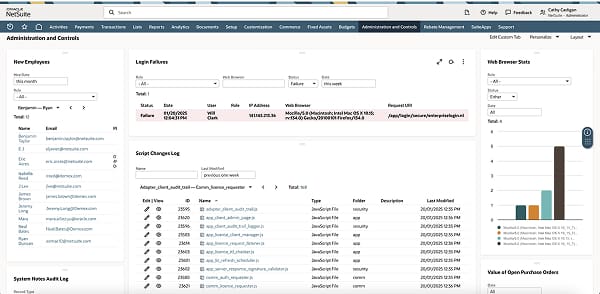
Today’s marketing agencies face growing pressure to keep up with constantly changing advertising, privacy, and tax regulations, yet many still rely on fragmented systems that make it difficult to maintain visibility and control. NetSuite Accounting Software for Advertising & Marketing Agencies solves this problem by centralizing core financial operations, including client billing, media spending, revenue recognition, and accounting, to create a single, accurate system of record that supports compliance efforts. Building on that foundation, NetSuite ERP’s governance, risk, and compliance capabilities add proactive oversight through automated controls, audit trails, and real-time risk monitoring to help agencies identify compliance gaps, enforce internal policies, and respond quickly to regulatory changes, all while carefully documenting their compliance efforts.
NetSuite ERP’s Governance, Risk, and Compliance Features
At a time when a single noncompliant ad can trigger multimillion-dollar fines, intense backlash from customers, and years of legal headaches, brands are facing intense pressure to get their marketing messages just right. Mastering marketing compliance is key. Maintaining rigorous oversight of evolving privacy laws, advertising standards, and tax rules shields companies from reputational harm, allows for faster campaign launches, and turns regulatory savvy into a competitive edge that consumers will reward with long-term loyalty and referrals.
Marketing Compliance Regulations FAQs
What are some common marketing pitfalls?
Common marketing pitfalls include making unsubstantiated claims, such as saying “clinically proven” without providing evidence; failing to disclose paid influencer partnerships; burying subscription cancellation terms in emails; and using customer data without consent.
What is the golden rule of marketing compliance?
The golden rule of marketing compliance is to always treat a customer’s data with the same honesty, respect, and transparency you’d expect if a brand were marketing to you, making sure to secure permission before using people’s information.
Which regulations should marketers be most aware of?
Marketers should be keenly aware of Federal Trade Commission truth-in-advertising rules; data privacy laws, including those mandated by General Data Protection Regulation and California Privacy Rights Act; the Controlling the Assault of Non-Solicited Pornography and Marketing Act for emails; the Telephone Consumer Protection Act for calls and texts; and industry-specific standards, such as the Financial Industry Regulatory Authority for finance and the Health Insurance Portability and Accountability Act for healthcare.