If they’re successful, small businesses quickly outgrow their improvised processes and rudimentary technologies. A company that goes from dozens of customers to hundreds, opens additional offices, and has a growing staff is going to have a hard time managing its affairs with the spreadsheets and paper records it relied on during its startup phase. But the people running these companies often aren’t sure what type of software they need—basic accounting functionality or something broader. Such companies typically end up weighing the pros and cons of accounting systems against those of ERP systems.
What Is ERP?
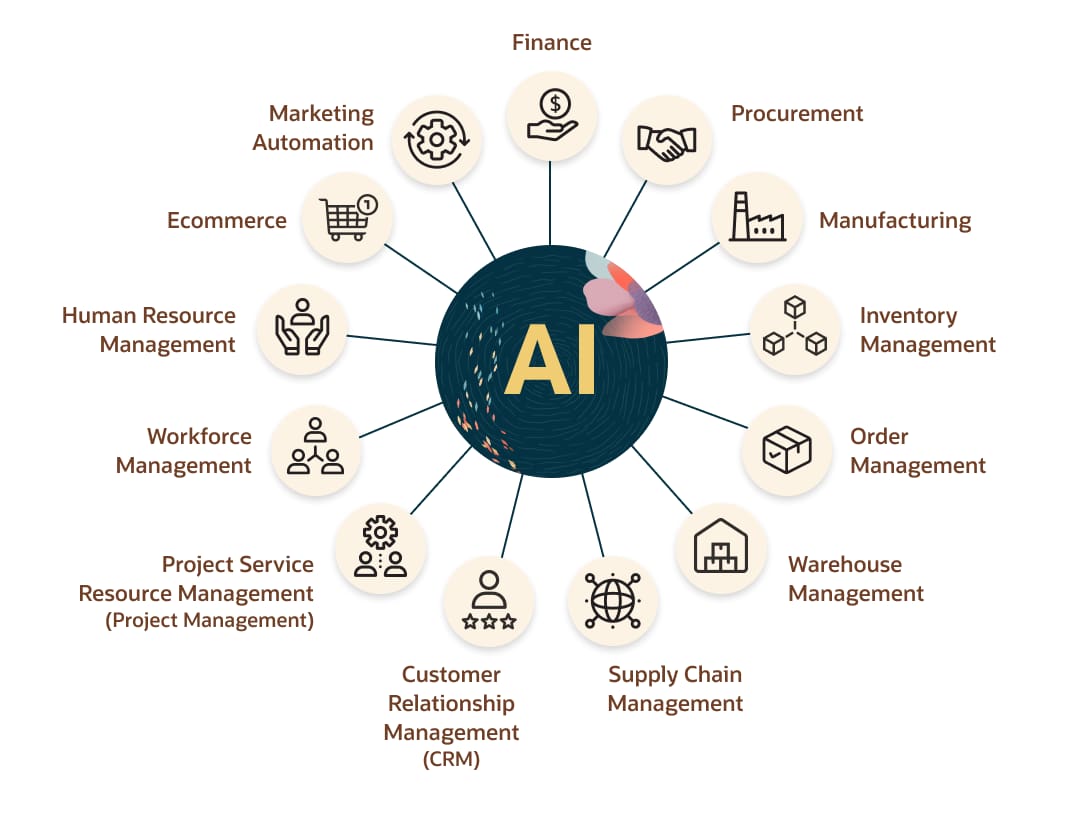
ERP is an integrated suite of software applications that companies can use to run almost every aspect of their business. The databases of ERP systems generally include inputs from accounting, human resources, manufacturing, marketing, sales, supply chain, among other departments. Thus, business managers can use an ERP system’s unified view of enterprise data to automate business processes and generate insights companywide. And company managers can use ERP systems to identify process improvements and drive efficiencies.
ERP came into the lexicon of corporate technology in 1990 when Gartner first identified it as a distinct class of software. Many of the world’s biggest and most successful companies have been using ERP systems for decades. Now, smaller companies are joining the ranks of ERP users, attracted by the availability of cloud-based ERP systems.
What Is Accounting Software?
By definition, accounting software is focused solely on a company’s financial activities. An accounting system helps companies manage their accounts payable and accounts receivable, along with their bookkeeping activities. For instance, an accounting system helps with the generation of a trial balance, an integral part of double-entry bookkeeping. Accounting software also helps companies put together financial statements, such as profit and loss reports and balance sheets.
What Is the Difference Between ERP and Accounting Software?
The big difference between ERP and accounting software relates to scope. Accounting software helps manage and automate a company’s financial activities, and in so doing, it can move small companies beyond their initial manual processes and spreadsheets. ERP software offers accounting functionality but also has many other capabilities.
How Does Accounting Software Work?
Accounting software is built for one job, and it does that job thoroughly: keeping an accurate, current record of money moving in and out of a company. Its scope stays within the finance function—transactions, accounts, and the reports built from them. The software captures each transaction, such as an invoice or a bank deposit, and codes it to the right account in the chart of accounts. Machine learning frequently handles that coding now, using prior entries to match a new invoice or bank transaction to the account and vendor it resembles, while a bookkeeper reviews anything the model can’t confidently place.
Once coded, transactions post to the general ledger and the software reconciles them against the bank feed—matching entries clear automatically, and the rest are flagged for manual review. At period end, those reconciled entries roll up into the financial statements. The result is a complete financial picture, but one confined to the money itself; the software doesn’t track the inventory, orders, or operations behind each transaction.
How Does ERP Software Work?
An ERP system widens the scope from a single accounting function to the entire business, organized around one shared source of data that every department reads from and writes to. Because operational and financial information live together, a single event can update multiple functions at once. When a warehouse manager receives a shipment, for example, the system updates inventory counts and matches them against open purchase orders in the same step—connecting a physical event to its financial and operational records simultaneously.
That shared foundation is also what lets AI act throughout the business, not just within one silo. Since purchase orders and vendor terms sit in the same database as the financials, an AI agent—software that can read data and carry out the next step on its own—can approve an invoice that falls within normal thresholds or route an exception to a manager. The same pattern applies on the sales side, where an AI agent continuously compares inventory to open orders and then generates purchase orders once stock runs low. The distinction is one of reach: Accounting software records what happened to the money, while an ERP systems coordinates the operations that drive those numbers in the first place.
Key Differences
When they reach a certain size, many small and midsize businesses find themselves spending more and more time managing their books. An entrepreneur who starts a business making and distributing meal kits might be perfectly happy doing their accounting by hand or on some sort of spreadsheet when they have 50 or 60 customers. But if their business booms and they end up with 1,000 customers—and then 5,000 and then 10,000—the accounting and bookkeeping will get overwhelming pretty quickly.
This is the point at which entrepreneurs generally start looking for software systems to make their businesses run more efficiently. Their first thought might well be of an accounting package, since their biggest problem when they’re growing rapidly is organizational—keeping track of sales, collecting payments, paying suppliers, and calculating profitability. An accounting package can certainly help with these things, but no accounting package on its own can keep track of suppliers, help manage a growing staff, or provide a view of warehouse costs and activities.
Instead of entrepreneurs having their data in separate places—accounting data in one software package and HR, manufacturing, and customer data in a patchwork of spreadsheets—they can have it all centrally located and get a view of their entire business in one ERP system. In doing so, small businesses can gain insights they wouldn’t otherwise have and make decisions that increase their companies’ profitability.
Key Differences of ERP & Accounting Software Capabilities
|
ERP |
Accounting Software |
|---|---|
| Can manage virtually all aspects of a business | Focuses on bookkeeping—general ledger, chart of accounts, accounts payable and receivable |
| Able to generate insights for all business operating areas | Analysis limited to financial data |
| Produces reports for all business aspects, incorporating financial and operational data | Produces reports based solely on financial information |
| Scales from small businesses to large enterprises | User seats or licenses and customer record numbers limit scalability |
| Costlier, but cloud-based offerings are affordable | Relatively inexpensive for small businesses |
| Requires a business case with needs analysis before deploying | Easy to deploy, even ad-hoc |
| Substantial learning curve to exploit full capabilities | Easy to learn; self-training usually sufficient |
Why ERP Is the Right Choice for Growth
When companies start out, their way of doing things is typically very ad hoc. As they grow, this must change. It may no longer make sense to maintain inventory in, or send out orders from, the founder’s garage. New resources—a mile away, a state away, half a world away—are now handling aspects of the business. And those resources must be managed.
Because ERP software has so many modules to it—supply chain management, CRM, and HR, among others—it is often the most scalable option for an expanding company. For instance, suppose an office-supply product your company recently created and patented has a long list of distributors and retail suppliers. You wouldn’t be able to keep track of the orders, shipments, and supplies in an accounting system. If that’s all you have, this data is most likely going to end up in different spreadsheets. But if you have an ERP system, you have a way to organize this information and quickly access the portions you may need at any time.
In addition to managing the different ways your business will be doing things as it grows, ERP software gives entrepreneurs an integrated view of their business because it puts all processes and functions in a single database, which can greatly improve efficiency. Take the example of a company that uses an order-to-cash process in which a sales team gets the order—or maybe the order comes through a web purchase—and sends it to the warehouse. Then a pick list has to be created, meaning someone must take the product off the shelf, record it as deducted from inventory, and bring it to the shipping department. When the product is shipped, accounting needs to send an invoice. If these activities are recorded manually, the process will be slow and prone to errors. An ERP system automates this order-to-cash process, typically by using AI agents that generate an invoice or route an exception for review without anyone prompting them.
The integrated nature of ERP—being able to see all aspects of a business together in one place and connect them with each other—could lead to other improvements as well, including optimized production planning and scheduling and supply chain automation. AI can be especially helpful here, because it can predict demand shifts and identify looming shortages in time to replenish stock.
Video: ERP vs. Accounting Software
Choose Growth, Choose NetSuite
As they get to that sought-after moment when sales take off, the first thing small companies usually think of is accounting software. Their initial goal is to streamline and automate financial tasks that are starting to become overwhelming. NetSuite ERP has a core of financial and accounting functions that can provide companies with an immediate solution. Businesses can use NetSuite ERP not only to automate aspects of their accounts receivable and payable, but also to quickly see important financial metrics and to stay in compliance with accounting standards and tax codes.
However, most fast-growing companies soon realize that other parts of their business would also benefit from automation and software. One company, for instance, may want a better way than email for doing order processing. Another may want something more than a spreadsheet for its inventory management. NetSuite ERP offers these operational capabilities and many others, including inventory and order management, HR, CRM, warehouse management, project management, and supply chain management.
“I need accounting software” is often the first thought of a small-business owner when their business starts to expand. Such entrepreneurs often feel pressure to get their financial systems under control. But most small businesses would also benefit from other types of software that manage their customers and their supply chains, process orders, and handle a variety of other operational activities. ERP systems integrate a wide range of these functionalities. For many business owners wondering how they’re going to scale, a cloud-based ERP system is well worth considering.
ERP and Accounting Software FAQs
Is accounting an ERP?
Accounting software is typically included as one part of the functionality of an ERP system. But accounting software has a narrower purpose, and the two types of software aren’t identical.
Is Xero an ERP?
Xero is a cloud-based accounting system for small businesses, not an ERP system. It’s designed to help with bill payment, expense management, and certain banking activities. It doesn’t have the broad functionality of an ERP system.
What’s the difference between traditional accounting systems and enterprise systems?
Accounting systems help companies manage the financial aspects of their business and is often used by small businesses early in their growth trajectories. Enterprise systems perform accounting tasks but have considerable functionality beyond that, including supply chain, distribution, and customer management.