
Consulting engagements often involve travel, specialized materials, and third-party services that get billed back to clients as reimbursable expenses. These costs must be carefully documented to capture accurate invoicing, avoid disputes, and maintain client trust. This article explains what qualifies as a reimbursable expense in consulting, the most common categories, and how to manage these expenses effectively.
What Are Reimbursable Expenses in Consulting?
Reimbursable expenses in consulting are costs a consultant incurs while delivering services that a client has contractually agreed to pay back. These costs, such as travel-related expenses and software licenses, are billed separately from the fees that the firm charges for its core services and must be explicitly defined in the consulting contract, statement of work, or engagement letter.
Key Takeaways
- Reimbursable expenses must be plainly defined in the consulting contract to avoid disputes and protect both parties.
- Accounting treatment depends on whether the firm acts as principal or agent for a given cost—a distinction that affects revenue presentation in financial statements.
- Clear policies, timely documentation, and integrated expense management software allow consulting firms to recover costs efficiently while maintaining client trust.
Reimbursable Expenses Explained
Consulting projects frequently require consultants to lay out money for costs that are project-specific, not part of the firm’s typical general operations—flying to a project site, purchasing specialized test equipment, or engaging a subcontractor, for example. Clients typically prefer to reimburse these costs separately, which gives them more visibility and control over project spending. As a result, firms typically submit itemized, categorized expense reports or invoices to the client along with receipts. Many contracts place restrictions on certain categories—say, requiring coach airfare or lodging within predetermined per diem rates—and specify whether consultants can add a markup when billing those costs to the client. Having clear policies pertaining to expense management averts disputes and keeps projects on budget.
The underlying accounting and tax treatment of reimbursable expenses depends on whether the consultant acts as principal or agent for the goods or services in question—that is, whether the cost is incurred to fulfill the consultant’s own obligations or on behalf of the client. For consulting firms managing multiple engagements simultaneously, project billing systems are essential for tracking which costs belong to which clients and making sure nothing falls through the cracks. Without proper systems in place, firms risk absorbing costs that should have been recovered or billing clients for expenses that don’t meet contractual requirements.
What Are the Qualifications for Reimbursable Expenses?
An expense typically qualifies for reimbursement when it meets four practical criteria:
- It has a clear business connection to the consulting engagement.
- It falls within the categories permitted in the consulting contract, statement of work, or client policy and may require preapproval above certain thresholds.
- It’s substantiated with receipts and timely reports that itemize amount, date, vendor, location, and business purpose.
- The amount is reasonable and it complies with any per diem caps, class-of-service rules, or internal procurement policies.
It bears noting that an expense that qualifies as contractually reimbursable doesn’t necessarily mean it’s tax-deductible. Entertainment costs, for instance, may be reimbursable under a contract, but they’re not deductible under current IRS rules.
Reimbursable vs. Nonreimbursable Expenses
Reimbursable expenses are costs tied to a specific client engagement that the contract allows the consulting firm to recover. Nonreimbursable expenses are general overhead or unapproved costs the consulting firm must absorb. The line between the two often comes down to contract language and approval. A hotel within per diem limits qualifies; a luxury suite above the price cap doesn’t. Meals during overnight travel may be reimbursable, but alcohol or family meals on personal days typically aren’t. The same logic applies to materials and services. Specialized equipment purchased solely for a client project is reimbursable, while general office supplies or firmwide software licenses constitute overhead that the consulting company must absorb.
Common Types of Reimbursable Expenses in Consulting
Consulting engagements generate a variety of out-of-pocket costs that clients commonly agree to cover. The specific categories depend on the nature of the work, but most fall into the following buckets, which typically appear across industries and project types:
- Project-specific materials and supplies: These include specialized equipment, such as diagnostic tools rented for an IT assessment, and consumables, such as printing and binding costs for client deliverables.
- Travel expenses: Airfare, rail tickets, rental cars, rideshares, taxis, and mileage reimbursement at standard rates (72.5 cents per mile in 2026 under IRS guidelines) fall into this category.
- Lodging expenses: Hotel stays are reimbursable when consultants must work away from home.
- Business meals: Meals during overnight business travel or working sessions are often reimbursable, subject to preapproval requirements and daily caps.
- Specialized software: This includes short-term or project-specific licenses for tools required to complete the client engagement.
Subcontractor Fees
Consulting firms often bring in third-party specialists whose fees pass through to the client. How firms record these fees depends on whether the firm is acting as a principal or an agent—a distinction that affects revenue recognition:
- Agent: If the firm is simply facilitating the subcontractor’s work—connecting the client with a specialist without controlling the output—it’s likely acting as an agent. In this case, the subcontractor’s fees pass through to the client and aren’t recorded as the firm’s revenue. Only any markup the firm charges would count as revenue. (This is called the “net” method.)
- Principal: If the firm controls the subcontractor’s work, takes responsibility for the deliverable, or sets the price to the client, it’s likely acting as a principal. Here, the firm records the full amount billed to the client as revenue, and the subcontractor’s fee as an expense; any markup is profit. (This is called the “gross” method.)
This assessment applies to each distinct service, not the contract as a whole—a firm can be principal for its own consulting work but agent for pass-through services like specialized lab testing. As a result, line items within the same contract may have different accounting treatments, which can significantly affect reported gross margins. Contracts should clearly specify how subcontractor costs will be handled, including any markup policies and approval requirements.
7 Best Practices for Managing Reimbursable Expenses
Well-managed reimbursable expenses protect profitability, strengthen client relationships, and avoid administrative headaches. Following these seven best practices allows consulting firms to handle expense reimbursement systematically:
- Define reimbursable expenses in the contract: Clauses should state which categories of out-of-pocket expenses the client will reimburse, any caps or limits, and preapproval triggers. Contracts should also address how the parties will handle mid-engagement changes to expense policies.
- Demand itemized receipts: Mandating itemized receipts from consultants above a defined threshold—typically $25 or $50—helps firms verify expenses and supports both tax and audit requirements. When expense management software captures these receipts, it feeds expense amounts directly into invoice processing and accounts receivable workflows, which reduces manual data entry and speeds up client billing.
- Require expenses be submitted in a timely manner: Expenses must have a business connection and be substantiated with receipts within a reasonable period (generally 60 days of incurring the expense). Timely submission also helps firms record costs in the same period as the related work to maintain the accuracy of project financials.
- Get client approval for large expenses: High-value or unusual expenses should receive explicit preapproval from the client. Contracts and firm policies should define these approval thresholds and workflows. Documenting approvals protects firms in the event of a reimbursement dispute.
- Communicate markup fees clearly: Clients appreciate knowing up front whether they’ll pay cost or cost-plus for project-related expenses. Markups are a commercial decision and can be acceptable if transparent and consistent with the overall pricing structure.
- Separate reimbursement charges from service charges: Separating these two expenses categories on invoices simplifies reporting and tax treatment and clarifies what clients are expected to cover. It also makes it easier to apply the correct accounting treatment when items call for different revenue presentations.
- Document expenses with accounting software: Modern accounting and expense management systems allow consulting firms to categorize expenses by client and project, apply reimbursement policies consistently, and cut back on manual entry errors. Other benefits of accounting software include faster reimbursement cycles, greater visibility into project costs, and cleaner month-end financial reporting.
Reimbursable Expenses Tax Compliance
Tax treatment of reimbursable expenses depends on whether a consulting firm is reimbursing employees or billing clients; additional complexity arises for international operations. Employee reimbursements must comply with IRS accountable plan rules to avoid payroll tax consequences. Properly documented reimbursements that meet substantiation, business connection, and return-of-excess requirements are excluded from wages and payroll taxes. Noncompliant reimbursements become taxable compensation and are subject to withholding and employment taxes.
When billing clients, most consulting firms include reimbursable expenses in gross income and deduct the underlying costs when incurred. In limited circumstances, firms may exclude certain costs from gross income by treating them as agency transactions—that is, those for which the firm acts as a conduit paying expenses on behalf of the client. This treatment requires clear contractual terms for establishing an agency relationship and typically applies to direct client costs, such as permit fees or regulatory filings, rather than travel or similar business expenses.
For firms operating internationally, value-added tax (VAT) and goods and services tax (GST) add additional layers. When a firm bills clients for reimbursable expenses, those amounts are generally subject to VAT or GST at the same rate as consulting services. However, some jurisdictions make an exception for costs the firm pays purely as an agent on the client’s behalf—such as government filing fees—allowing the firm to pass these expenses through without adding VAT or GST. The rules vary significantly by country, so it’s wise to obtain local tax advice for each jurisdiction in which a company operates or serves clients.
Examples of Consulting Reimbursable Expenses
Let’s take a look at a few examples that show how reimbursable expenses play out in practice, including how they’re typically documented and accounted for.
Consider a management consultant based in Boston who flies to a client’s headquarters on Long Island for a three-day strategy workshop. The consultant books coach airfare, stays at a hotel within the client’s per diem limits, and takes taxis between the airport, hotel, and client office. Within 30 days, the consultant submits an itemized expense report with receipts for airfare, hotel, ground transportation, and meals. The firm records these costs as project expenses when incurred. When the client is billed, the consulting firm recognizes the total amount as revenue.
Software costs follow a similar pattern. A technology consultant purchases temporary licenses for cloud testing tools used exclusively for a client’s software implementation. The licenses cost $2,500 for a three-month term and have no value to the firm once the engagement ends. The contract specifies that project-specific software would be reimbursable at cost with no markup. The firm expenses the licenses when purchased and recognizes the reimbursement as revenue when the client pays.
Subcontractor fees can be more complex. A consulting firm hires a specialized market researcher as a subcontractor to support a due-diligence engagement. Because the subcontractor controls the research methodology and provides deliverables directly to the client, the firm concludes it acts as agent for that service—recording only its coordination fee as revenue while passing the subcontractor cost through to the client. The subcontractor fees aren’t recorded as revenue; they’re reflected on the balance sheet only as offsetting receivable and payables. For its own consulting services on the same engagement, the firm acts as principal and records gross revenue.
Accounting for Reimbursable Expenses
Accounting treatment for reimbursable expenses depends on the nature of the cost and the consulting firm’s relationship with the client. Two broad patterns appear in practice:
- Disbursement/advance model: When costs are incurred on behalf of the client—such as filing fees or client-specific purchases—the firm is essentially financing an expense that belongs to the client. The cost is recorded as an asset (a receivable) when incurred and cleared when the client reimburses.
- Operating-expense model: When costs are incurred to fulfill the consulting contract, such as travel to a project site, the firm is covering its own cost of delivering services. The expense is recognized when incurred, and the reimbursement is recorded as revenue.
Under GAAP (ASC 606) and IFRS (IFRS 15) regulatory standards, consulting firms must use the gross method when acting as principal and the net method when acting as agent. In practice, most consulting firms treat reimbursed travel, lodging, and similar costs as principal transactions and recognize them as gross. For certain pass-throughs, such as government filing fees, firms may determine they’re acting as agents and present those amounts as net. Expenses incurred in foreign currency are typically translated at the exchange rate on the transaction date, with any differences recorded when payment or reimbursement occurs.
Unify Project Billing and Expense Management With NetSuite for Consulting Firms
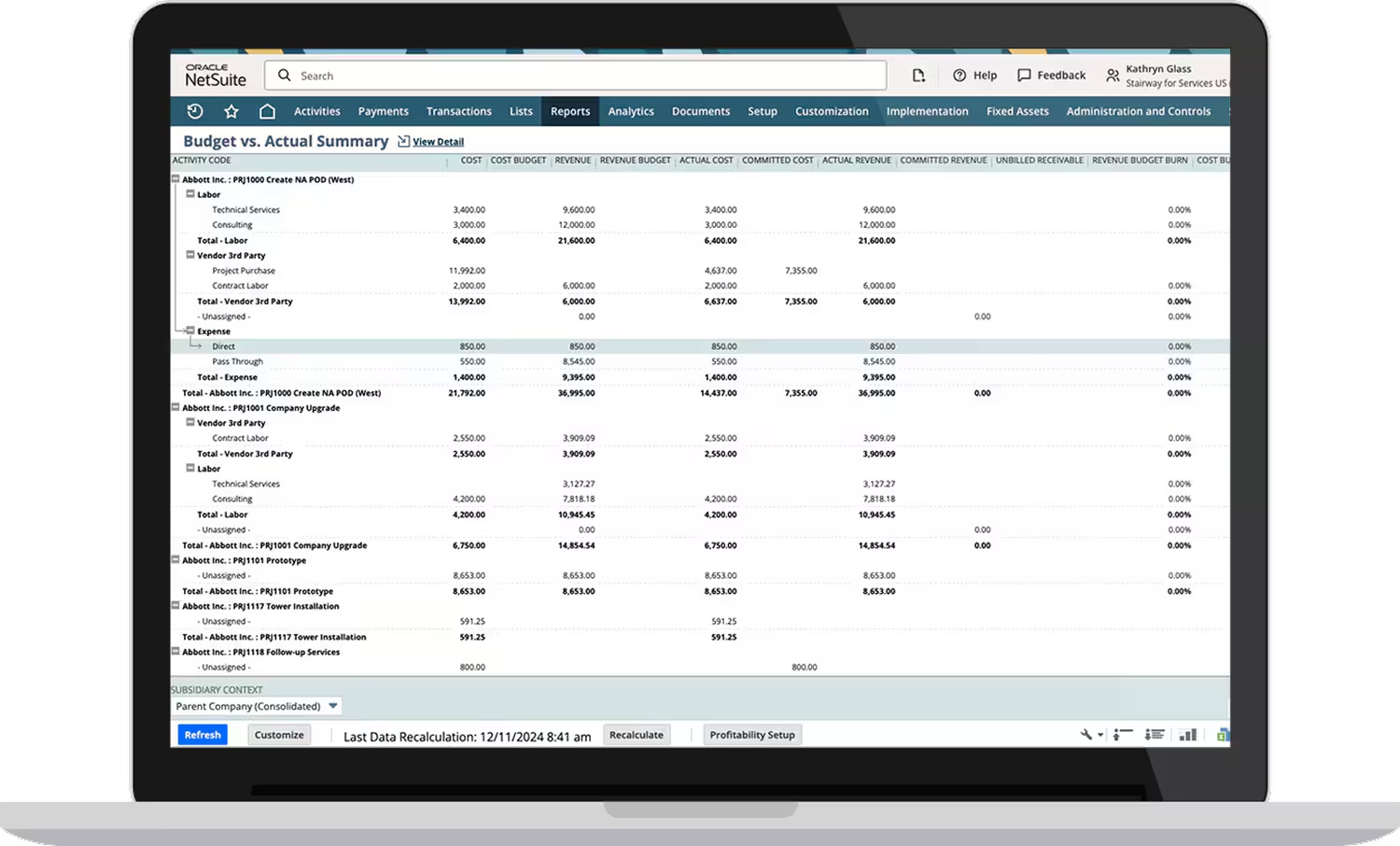
NetSuite Accounting Software for Consulting Firms unifies project billing, expenses, and core accounting functions, giving consultancies visibility into cash flow, profitability, and compliance status. NetSuite Expense Management automates the entire expense management cycle from submission and approval to posting and reimbursement. Consultants enter expenses via a web browser or mobile app, allowing expense data to flow directly to project accounting, accounts payable, and the general ledger. This provides accurate work-in-progress, margin, and cash flow views and eliminates the need to rekey data. For consulting firms managing reimbursable expenses for multiple clients and engagements, NetSuite improves accuracy and accelerates client billing.
Advanced Project Accounting With NetSuite
Reimbursable expenses are a routine, but important, part of consulting engagements. When policies are clear and documentation is thorough, firms can recover costs efficiently and maintain client trust. As consulting engagements grow more complex and clients demand greater transparency, managing reimbursable expenses effectively will provide a competitive advantage.
Consulting Reimbursable Expenses FAQs
What are typical reimbursable consulting expenses?
Typical reimbursable consulting expenses include travel costs (airfare, rental cars, mileage, lodging), business meals, project-specific materials and supplies, specialized software licenses, and approved subcontractor fees.
What’s the difference between a billable expense and a reimbursable expense?
A reimbursable expense is a cost that must be paid back to the person or entity that incurred it, while a billable expense is one that a firm intends to invoice to a client. An expense can be both, one, or neither, depending on the arrangement.
Are reimbursable expenses taxable?
Employee reimbursements are generally not taxable income to the employee when properly documented under an accountable plan. Reimbursements treated as revenue by a consulting firm are included in taxable income and offset by the corresponding expense deduction, usually resulting in no net tax impact.