
Growing businesses often face a familiar cash flow conundrum: After the sale is made and the invoice is sent, they must wait to get paid—but operating expenses don’t wait.
Accounts receivable (AR) financing converts outstanding invoices into immediate working capital. In other words, cash. Rather than waiting 36.7 days—the current US average AR collection time—businesses can obtain cash quickly for selected invoices. This is a very helpful tool for finance leaders who need to smooth cash flow without increasing traditional debt. However, there are trade-offs to consider. This guide discusses different types of AR financing, how they work, and their advantages and risks.
What Is Accounts Receivable (AR) Financing?
AR financing is a form of working capital financing that allows businesses to access immediate cash by either using their outstanding invoices as collateral or selling those invoices to a third-party financing company. Instead of waiting for customers to pay their invoices, businesses get cash right away from the third party.
It’s a particularly common practice among B2B companies that offer customers extended payment terms. The third-party financing company advances the invoice value in return for a fee or a percentage, accelerating the business’s cash flow. This type of asset-backed financing provides an alternative to traditional loans, one that doesn’t represent new borrowing. Rather, it unlocks the money owed to the company yet currently uncollected.
Key Takeaways
- AR financing turns outstanding invoices into immediate cash by allowing the business to either use them as collateral for a loan or sell them outright to a financing company.
- The two types of AR financing—AR loans and factoring—have cost, visibility, administration, and eligibility trade-offs.
- This financing approach relies on the customer’s credit rating rather than the business’s; nevertheless, it can be costly.
- AR financing works best with “clean” invoices from reliable customers and is not appropriate for businesses with frequent disputes or poor collection processes.
- Integrated financial systems can reduce the need for AR financing through better AR management, as well as expedite financing when needed.
AR Financing Explained
Businesses turn to AR financing to bridge the gap between when they deliver goods or services and when they receive payment. That gap causes a working capital challenge in that costs have already been incurred to fulfill the order, but the revenue is tied up in an unpaid invoice. AR financing solves this predicament by closing the gap so that business can immediately access funds to cover payroll, take advantage of supplier discounts, invest in growth opportunities, or simply maintain smooth operations. For businesses operating on tight margins or pursuing rapid growth, eliminating that delay can be the difference between preserving a sustainable cash flow or having unpaid bills, despite the underlying business being healthy and profitable.
Industries that regularly choose AR financing include manufacturing, distribution, staffing and recruiting, professional services, transportation and logistics, and wholesale trade. At the organizational level, B2B companies operating with30-, 60-, or 90-day payment terms commonly consider AR financing. Everyday use cases include the following:
- Manufacturers and distributors that must pay suppliers and maintain inventory while waiting for customer payments.
- Staffing and professional services firms with significant payroll obligations but long engagements or delayed client payments.
- Fast-growing companies whose revenue is increasing faster than cash collection, creating a working capital squeeze.
- Seasonal businesses that need cash flow stability during slower periods.
How Does AR Financing Work?
AR financing has three primary players: the business that made a sale on credit, the customer that owes the business, and a financial institution. The business initiates the financing transaction, usually based on cash flow needs, by approaching an AR financing provider with its receivables portfolio. AR financing providers are usually banks or specialized commercial lenders. The lender’s underwriting process focuses primarily on the customer’s credit profile rather than the business’s. This is a crucial distinction, in that the financing provider is essentially betting on the customer’s ability and willingness to pay and the validity of the underlying sale, not on the business’s financial strength.
During the application process, the lender reviews customer invoices, customer payment history, and the creditworthiness of the customers. Lenders look for “clean” invoices, meaning that the work has been completed or goods delivered and that the customers have a track record of paying their bills. Receivables tied up in disputes, subject to performance conditions, or owed by customers with poor payment histories typically won’t qualify for financing. Businesses either select qualified invoices to finance or can finance their entire AR portfolio. For example, a business might choose to finance one large invoice to cover a sizable anticipated expense, or it might use AR financing only during a seasonal cash crunch and manage normal collections itself at other times.
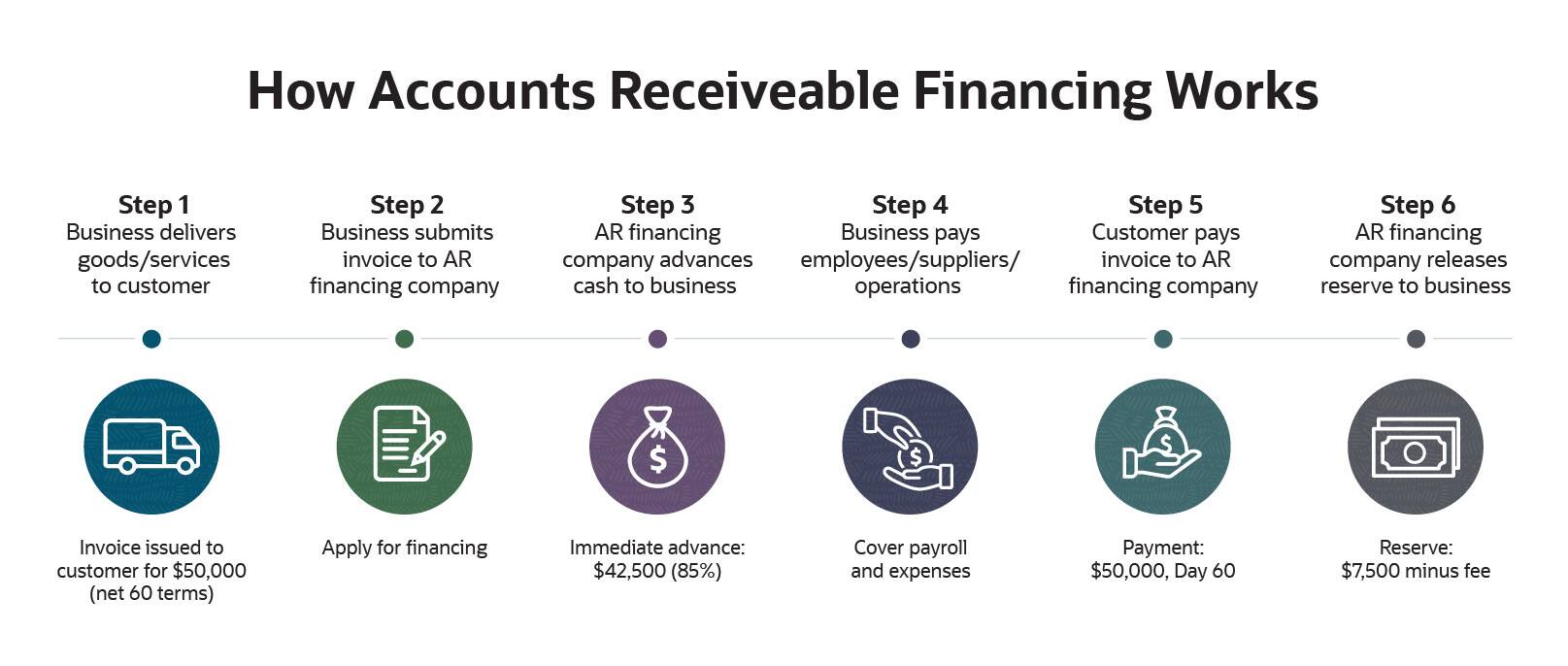
Assuming the receivables pass muster, the lender advances the business a percentage of their face value, usually between 70% and 90%, but it can reach as high as 97% for invoices from highly creditworthy customers or those in low-risk industries. The remaining 10% to 30% is held in reserve. For example, financing a $50,000 invoice at an 85% advance rate means the business receives $42,500 immediately, with $7,500 held back. Once the customer pays the invoice, the financing company releases the reserve to the business minus its fee. Fees are assessed based on many variables, including the invoice amount, the customer’s credit quality, the business’s invoice volume, the invoice payment terms, and whether the arrangement is recourse or nonrecourse (explained below). These fees can add up quickly.
AR financing can be structured as notification or non-notification. In notification arrangements, the customer is informed that the invoice has been sold or assigned to the financing company and that they should remit payment directly to that firm. In non-notification deals, the customer pays the business as normal, and the business forwards the payment to the lender. Notification arrangements are more common because they reduce risk for the financing company; non-notification options exist primarily for businesses concerned about customer perception.
For accountants, AR financing incurs additional requirements, including separate tracking of financed invoices, proper balance sheet recording of advances, and extra bookkeeping attention for the reserve and fees until customers pay. The fees are recorded as interest expenses and must be teased apart from the net reserve remittance.
AR managers play an important part in verifying that AR financing works properly. On the front end, their knowledge drives the selection of invoices to finance thanks to a greater understanding of both customer payment patterns and receivables best suited for financing. On the back end, they facilitate the process appropriate to the financing structure: In notification arrangements, AR managers help customers understand why a third party is collecting payment and make sure that payments are directed correctly, while non-notification structures create additional tracking requirements.
Types of AR Financing
Receivable financing companies offer two main AR financing types: AR loans and factoring. Both unlock cash tied up in outstanding invoices, but they differ in ownership, credit risk allocation, and accounting treatment. In AR loans, invoices serve as collateral, but the business retains ownership of the AR; in factoring, the invoices are sold outright to a third party. This distinction leads to different implications for financial reporting, customer relationships, and ongoing obligations.
Several details influence a business’s choice between the two types, with cost often being the primary consideration. AR loans generally cost less than factoring, but the difference narrows when you include the value of outsourcing AR collections, which is part of any factoring deal. Customer relationships play a role, as well. In notification factoring, customers know a third party has purchased their invoices and may interpret this as a sign of a business in financial difficulty. Some businesses find this trade-off worthwhile for the administrative relief of outsourcing collections; others consider it a dealbreaker. Qualification requirements also differ substantially. Both types focus mainly on customer creditworthiness, but AR loans also review the business’s financial health and require minimum monthly sales thresholds. Factoring focuses almost completely on customer creditworthiness. Finally, flexibility varies: Factoring generally allows businesses to choose which invoices to finance, while AR loans often require pledging all receivables as collateral.
- Receivables loans: AR loans are a form of asset-backed lending in which invoices are used to secure a loan or line of credit. The business retains ownership of the receivables, keeping them on its balance sheet as assets, and remains responsible for them. Collection may be handled by the business or the lender. The loan appears as a balance sheet liability, with interest charges and fees reflected on the income statement. AR loans generally cost less than factoring, but they are harder to qualify for and are more administratively burdensome in that they require businesses to provide ongoing reporting to lenders about the quality and aging of the receivables serving as collateral.
- AR factoring: In factoring, a business sells its invoices outright, at a discount, to a factoring company. Serving as an asset sale rather than a loan, the sold invoices come off the balance sheet without adding a corresponding liability, which is important for businesses concerned about leverage ratios. The factoring discount reduces the net proceeds from the sale and is recorded as a financing expense. Factoring arrangements can be structured as recourse, where the business must buy back the invoice or repay the advance if the customer fails to pay, or nonrecourse, where the factor absorbs the loss. Nonrecourse arrangements typically cost more due to the additional risk they present for the factor.
AR Financing Example
To illustrate how AR financing works, consider this hypothetical example. Cascade Distribution is a wholesale supplier of industrial equipment that sells to manufacturers on net 45-day payment terms. In March, Cascade delivered $85,000 worth of equipment to Dawn Industries, a long-standing customer. Normally, Cascade would receive payment in mid-May, but Cascade’s CFO knows that the company needs cash now to purchase inventory for another large order.
Cascade’s CFO approaches an AR financing provider and uses the $85,000 invoice as collateral for an AR loan. After verifying Dawn’s creditworthiness and confirming that the goods were delivered, the provider approves an 82% advance rate. Because Cascade chose a notification loan structure, Dawn Industries is notified that payment should be directed to the financing company rather than to Cascade.
The following explains how the transaction flows and how Cascade accounts for it:
Initial advance (Day 1): Cascade receives $69,700 (82% x $85,000) from the provider. The remaining $15,300 is reserved. No adjustment to the receivable is needed since Cascade still owns it.
| Cascade’s journal entry: | |
|---|---|
| Debit: Cash | $69,700 |
| Credit: AR financing loan | $69,700 |
| To record the cash received and create a loan liability. | |
Customer payment (Day 45): Dawn pays the $85,000 invoice, according to the original terms, but pays it to the financing company directly, not Cascade.
| Cascade’s journal entry: | |
|---|---|
| Debit: AR financing loan | $69,700 |
| Debit: Due from lender | $15,300 |
| Credit: Accounts receivable | $85,000 |
| To remove the receivable from Dawn since it has been paid. Remove the satisfied loan liability (the lender collected the collateral) and record the reserve (18% x $85,000) now owed to Cascade by the lender. | |
Reserve release (Day 46): The financing company releases the reserve, minus its 3.5% fee (3.5% x $85,000 = $2,975). Cascade receives the net amount of $12,325 ($15,300 reserve – $2,975 fee).
| Cascade’s journal entry: | |
|---|---|
| Debit: Cash | $12,325 |
| Debit: Interest/Financing expense* | $2,975 |
| Credit: Due from lender | $15,300 |
| To record net cash received for reserve and financing fee. Eliminate reserve due from the lender. | |
Summary:
Total revenue: $85,000
Total cash: $82,025 ($69,700 + $12,325)
Total financing cost: $2,975
Net impact: Cascade received cash 45 days earlier, paying $2,975 for that acceleration, roughly equivalent to a 35%** simple annualized interest rate. For Cascade, incurring the additional $2,975 cost was an acceptable trade-off for being able to capture another sale with more profit.
Advantages of AR Financing
The appeal of AR financing is straightforward: Invoices that normally tie up capital for months can instead quickly convert to cash. This addresses one of the most common constraints facing growing and capital-intensive companies—strong sales but limited cash flow. AR financing is unlike equity financing, which dilutes ownership, and unlike traditional debt, which relies solely on a company’s own financial history. This makes it more common for businesses with limited borrowing capacity.
Other advantages of AR financing include the following:
- Immediate liquidity and cash flow: AR financing converts invoices that normally require 30-90 days for collection into cash within days. Faster access to cash allows businesses to seize opportunities without waiting for customer payments, and the greater predictability of cash flow makes financial forecasting more accurate. It also helps finance teams know when they can capture early payment discounts, saving money and strengthening supplier relationships.
- Lower barrier to qualify: AR financing is easier to obtain than traditional loans because it is primarily based on the customer’s creditworthiness, so the business avoids extensive credit checks. This helps startups, fast-growing companies, and those with low credit scores qualify for capital as long as they have creditworthy customers and clean invoices. In general, the approval process is typically faster than that for traditional loans.
- More flexibility: AR financing, particularly factoring, allows businesses to select individual invoices to finance based on their current cash flow needs, rather than committing all receivables. This selective approach gives businesses greater ability to use AR financing when needed—such as during seasonal cash crunches or to fund specific opportunities—but otherwise manage normal collections themselves. The financing also scales naturally with sales, so the business need not reapply for an increased credit limit.
- Mitigated credit risks: Nonrecourse factoring transfers the risk of customer nonpayment to the factor, protecting businesses from losses if a customer fails to pay. Even in recourse arrangements, the factor’s underwriting process serves as an additional layer of customer credit vetting, helping businesses identify potential payment risks. Whenever the third party also handles collections, it frees capacity within a business’s AR team, allowing it to focus on other core business activities and risks.
Risks of AR Financing
AR financing isn’t appropriate for every situation. Certain arrangements can create operating constraints or financial and administrative burdens that outweigh the benefits. It works best with verified invoices from financially stable customers, so businesses that struggle with customer disputes, performance-based contracts, or customers with poor payment patterns may not be candidates. Even with qualified invoices, advance rates generally mean 10% to 30% of each invoice’s value remains tied up until the customer pays, which may not fully solve cash flow constraints for businesses operating on very tight margins.
Beyond practical limitations, AR financing sometimes carries strategic and relationship risks. In notification arrangements, customers know a third party has purchased or holds rights to their invoice. Such an action may be interpreted as financial distress, which then risks future transactions while potentially damaging the business’s reputation. Outsourcing collections through factoring can weaken customer relationships and reduce visibility into payment behaviors that might signal emerging problems. Additionally, businesses can become dependent on AR financing by using it as a permanent solution rather than addressing the root causes of cash flow problems. If slow payments stem from operational issues, product quality concerns, or poor AR management, AR financing only provides temporary relief rather than fixing the underlying problem.
Other risks of AR financing include the following:
- Risky providers: The AR financing industry is a varied group that includes both reputable lenders and problematic operators. Some lenders use vague practices that can bury fees in complex contracts or impose unexpected charges. Due diligence is essential to avoid surprises.
- Potential contractual restrictions: Restrictive terms can limit flexibility. Some contracts require minimum financing volumes, charge penalties for early termination, or lock businesses into lengthy commitment periods. AR loans may require pledging all receivables as collateral, instead of allowing selective financing.
- Higher fees when compared to traditional loans: AR financing costs significantly more than traditional bank financing. For example, a 3% fee on a 60-day invoice represents an 18% annual rate. Other fees, such as discount rates, service fees, processing fees, and wire transfer fees, add to the overall cost and reduce profits on the underlying sale.
- Can increase liabilities: AR financing creates financial obligations that affect a company’s balance sheet. AR loans add debt as a liability, impacting leverage metrics and potentially limiting other borrowing capacity. They also may require ongoing reporting about receivables quality and aging, leading to administrative obligations and potential covenant compliance issues. In factoring, recourse arrangements create contingent liabilities—if customers don’t pay, the business is on the hook to buy back the invoice or repay the advance. In addition, recourse arrangements force companies to evaluate whether the transaction qualifies as a true sale under accounting standards. Otherwise, it must be recorded as an AR loan and thus adds to balance sheet liabilities.
Optimize Financial Operations With the Power of AR Software
NetSuite Accounts Receivable addresses manual invoicing, delayed billing, and other inefficient AR processes to optimize operations, improve cash flow, and provide financing when working capital is needed immediately. NetSuite automates tasks such as invoicing and collection, opening the door to more flexible payment options while providing real-time payment cycle data and reducing manual follow-up. Should financing needs arise, NetSuite Capital provides invoice financing directly from within the AR system, with funding, fees, and repayments automatically posting to the correct accounts for immediate payment reconciliation. For businesses considering AR financing, this embedded capability shrinks data transfer needs, relieves administrative burden, and provides seamless visibility into both AR performance and financing activity.
AR financing eliminates the wait for customer payments, offering businesses a way to bridge cash flow gaps without applying for a more conventional bank loan. For companies with strong sales but extended payment terms, it can fund growth opportunities, smooth seasonal fluctuations, or cover operational expenses. But it involves trade-offs, as AR financing costs more than traditional debt, requires clean invoices from creditworthy customers, and may affect customer relationships. Choosing the right approach—AR loans, factoring, or integrated financing solutions—depends on business circumstances, customer base, and cash flow needs.
AR Financing FAQs
Is AR factoring considered debt?
No. Factoring is an asset sale, not borrowing. The invoices are sold to a factoring company at a discount, requiring the accounts receivable to come off the balance sheet without adding a corresponding liability. This is a distinguishing characteristic between AR factoring and AR loans.
What is an AR credit?
AR credits refer to credit memos that decrease accounts receivable. Credit memos are issued to account for returns, allowances, or billing adjustments, resulting in a credit that reduces accounts receivable and debits the corresponding expense or contra asset account.
What is AR advance rate?
The AR advance rate is the percentage of an invoice’s value paid upfront by a financing provider. Higher-quality invoices from creditworthy customers command higher advance rates. The reserve rate is the complement to the advance rate. The financing provider holds this reserve until the customer pays.