
Telecommunications providers occupy a unique financial position defined by massive infrastructure projects and constant pressure to retain subscribers that could—and will—switch services the moment a better deal emerges. In addition, stringent regulations and rapid technological change can render today’s strategies obsolete for tomorrow’s market. Any other missteps along the way can also erode already tight margins.
Fortunately, telecom companies with a strong financial management framework can tackle these challenges and maintain profitability as they grow. This article explores telecom finance—how it differs from standard business finance, common activities and challenges, performance metrics, and the emerging trends currently reshaping the industry.
What Is Telecommunications Finance?
Telecommunications finance refers to the management practices providers use to fund, operate, maintain, and expand their networks and services. Activities include preparing budgets, allocating capital, managing revenue and cash flow, and monitoring performance—each aspect shaped by the industry’s capital intensity, subscriber economics, and regulatory demands.
Key Takeaways
- Telecom finance primarily focuses on long-term infrastructure investment, subscriber revenue, industry-specific expenses, and regulatory compliance.
- Providers face ongoing challenges, including pricing pressures and high capital expenditures.
- Metrics like average revenue per user and customer churn track profitability and inform revenue and cash flow forecasts.
- Modern accounting tools use AI and complex billing features to automate revenue processes and give providers real-time financial visibility.
Telecom Financial Management Explained
Part utility company, part tech innovator, telecom providers contend with complex financial dynamics that make standard budgeting and forecasting more difficult. This is, in large part, due to the need to manage thousands or even millions of ongoing subscriber contracts, each with distinct pricing models that require sophisticated revenue management and billing. They must also be able to fund rapid advancements in 5G/6G networks, AI-driven services, and edge computing alongside the recurring operational demands of massive subscriber bases. These factors influence nearly every financial decision a telecom company makes, from how it plans network investments to how it recognizes revenue.
Indeed, new cables, wireless towers, switching equipment, data centers, and other infrastructure necessitate extensive capital expenditures (CapEx) beyond the norm for other industries, making long-term capital planning essential. Revenue comes mainly from ongoing contracts with subscribers, many of which can’t be counted on for their loyalty. To expand margins, companies have to increase customer lifetime value (CLV) relative to subscriber acquisition cost (SAC). But that requires overcoming the industry’s high customer turnover rate, attributed to increasingly commodified services and low customer satisfaction. In fact, telecom companies average a net promoter score of just 14—significantly lower than most other industries, according to Simon-Kucher’s “Global Telecommunications Study 2025.”
As a result, finance teams must be steadfast in monitoring such occurrences as churn, revenue leakage, and fraud, which can significantly impact the bottom line. That’s why CLV matters so much. According to Simon-Kucher, 95% of CLV comes from subscribers that have been with the company for three or more years. Existing customers also spend 7% more than new customers, and retaining them is 10X more cost-effective than acquiring new ones.
But holding on to customers isn’t easy. Billing errors and poor customer experiences can manifest in lost revenue and higher churn, making revenue assurance and billing accuracy critical finance functions. Meanwhile, telecom fraud results in multibillion-dollar losses, according to the Communications Fraud Control Association, which is why fraud detection has also become a core financial management priority.
How Is Telecommunications Finance Different from Standard Business Finance?
Finance departments industrywide track inventory turnover, short-term liquidity, and other pertinent metrics. But telecom teams tend to spend more time on long-term asset management, focusing on the substantial debt and lease obligations that typically come with funding generational network upgrades. These industry-specific priorities shape how telecom companies approach five key aspects of their financial responsibilities:
- Capital intensity: With so much capital tied up in fiber-optic networks, tower leases, data centers, and enterprise equipment, telecom companies tend to focus less on immediate profit margins and more on other measures of success, such as return on invested capital (ROIC). According to BCG’s “2025 Telco Value Creators Report,” the median telecom operator’s ROIC was around 7% to 8%—slightly higher than the 7.1% cost of capital in the industry. This means many providers barely earn back their investment costs—if they do at all.
- Infrastructure investment cycles: Network generations rarely pay for themselves before customers demand the next one. For example, when the 5G rollout began, 4G costs were still on many providers’ books, yet companies had to have enough cash to cover both leftover debts and new investments, such as for the FCC’s subsequent 2021 C-band auction.
- Complex revenue recognition: Accounting rules for revenue recognition (IFRS 15 and ASC 606) require telecom companies to allocate revenue across performance obligations and recognize it as services are delivered. That’s especially challenging with bundled services, when invoices reflect various packages with distinct pricing rules.
- Regulatory financial burdens: Telecom providers operate essential public infrastructure, which means they face regulatory costs tied to universal access and spectrum management. Without proper financial management, Universal Service Fund (USF) contributions, spectrum auction payments, licensing fees, and data privacy compliance add up and can chip away at the bottom line. As regulations evolve—the USF changes every quarter, for instance—liabilities change, too, challenging finance teams to keep up.
- High leverage: Telecom operators often carry high debt to meet their capital demands. Many manage these liabilities with innovative financing approaches. For example, Verizon has issued $6 billion in green bonds since 2019, mainly to fund energy-efficient equipment upgrades, thereby diversifying debt sources on its balance sheet.
Key Activities in Telecom Financial Management
Telecom finance teams juggle a range of activities to control costs, capture revenue, plan investments, and manage risk. Because subscriber contracts—not individual transactions—are the fundamental unit of value, financial management strategies focus on maximizing CLV across seven key areas.
-
Revenue management:
Telecom revenue management is an exercise in scale, with millions of subscribers across voice, data, messaging, content, and equipment services. Capturing usage data, matching it to subscriber plans, and issuing accurate bills requires complex rating engines and billing systems working in sync. Telecom revenue assurance programs provide real-time monitoring to catch unbilled services, rating mismatches, fraud, and integration failures before small errors compound into material leakage. -
Expense management:
Telecom operating expenses include typical business overhead plus industry-specific expenses, such as interconnect fees, roaming settlements, regulatory fees, and licensing costs—many of which are variable. Finance teams must work alongside network operations, best accomplished through integrated digital systems, to manage telecom costing, detect fraudulent traffic routing, forecast expenses and budgets, and negotiate terms with vendors and wholesale partners. -
Financial forecasting:
Telecom finance teams often model subscriber growth, average revenue per user (ARPU), churn rates, capital expenditures, and cash flows years into the future when planning investments. Forecasts are revised as actual results come in, accounting for shifts in new technology, regulations, customer behavior, and competition. These updates contribute to decisions about network buildouts, debt financing, pricing, and dividend policies. -
Compliance and taxation:
Common regulatory obligations include mandatory contributions to USFs, telecom-specific taxes, relay service fees, spectrum license requirements, and data privacy mandates. Every additional expense has the potential to strain capital and cut into margins. Finance teams must monitor ongoing regulatory changes, plan for variable liabilities, calculate their tax obligations, and produce accurate financial statements to avoid monetary and legal consequences for noncompliance. -
Network investment budgeting:
Network investments lock up capital for years before generating returns. Finance teams must weigh investments in new network technologies—5G, fiber to the premises, capacity upgrades, Internet of Things (IoT) integration, and regional expansion, for instance—against expected returns and strategic priorities. These decisions must also account for competitive pressures to offer new capabilities at affordable prices, an especially significant challenge during periods of high interest rates or increased competition, when ROIC is more apt to trail the cost of capital. -
Network asset management and utilization:
Telecom networks involve billions of dollars’ worth of physical assets, and finance teams must track each one through construction, deployment, depreciation, and eventual retirement. Telecom asset management entails registering assets, calculating depreciation schedules, monitoring utilization rates and performance standards, and planning retirement obligations for legacy infrastructure, such as copper networks. The latter, for example, requires working through regulatory notice periods and accelerating depreciation, potentially affecting reported earnings. -
Risk assessment:
Telecom companies face risks across multiple fronts: Subscriber defaults create credit exposure, network outages disrupt operations, policy changes bring regulatory uncertainty, and schemes like SIM box fraud or subscription fraud drain revenue. Managing these risks involves continuous monitoring, scenario planning, proactive vulnerability assessments, and coordination among security, financial, and operations experts to protect revenue and maintain reliable service.
The Top Financial Challenges Facing Telecom Companies
Despite revenues topping $1 trillion since 2023, the telecom industry “faces a sluggish outlook amid rising costs and competition, muted subscriber growth, and lingering macroeconomic and geopolitical pressures,” states PwC’s “Global Telecoms Outlook 2024-2028” report. Overcoming these realities requires a multifaceted approach focused on four primary areas:
-
Pricing Pressures from Competition
Connectivity has become increasingly commoditized, especially with the rise of low-cost mobile virtual network operators that rent network infrastructure from major carriers, rather than own the equipment themselves. Additionally, bundled offerings from major cable companies and free Wi-Fi in both public and private spaces further erode pricing power. According to the PwC report, ARPU is expected to decline approximately 2% per year through 2028, with mobile ARPU falling 1.3%, voice dropping 4.7%, and fixed broadband service dropping 0.1%. These trends hinder providers’ ability to pass rising costs on to subscribers without losing them.
-
Adherence to Complex Regulations
Overlapping federal, state, and international regulations add variability to operators’ financial obligations. For example, the FCC requires telecom companies to contribute 37.6% of their interstate end-user revenues (as of Q1 2026) to support universal service access programs. Infrastructure regulations—such as the number of days providers have to issue retirement notices—also force telecom providers to adjust their depreciation schedules or asset accounting during transition periods. Additional obligations, including spectrum auction payments, data privacy compliance standards, and asset retirement rules, require precise tracking and reporting, as well.
-
High Capital Expenditure
Network infrastructure demands sustained investment that consumes a significant chunk of revenue. The average ratio of telecom capital expenditures to revenue in 2023 was about 17%, according to a 2025 McKinsey analysis. Providers must fund these expenditures without straining cash flow or debt loads, a challenge exacerbated by new network generations that require heavy investment before monetization and returns can be accurately predicted. These periods of delayed returns complicate cash flow forecasts and capital budgeting.
-
Disruptions and Downtime
Network outages, cyberattacks, weather events, and overloaded or improperly maintained equipment can create immediate revenue loss and long-term customer churn. Finance teams must consider the potential costs of service credits, emergency repair, and regulatory penalties while budgeting for network resilience initiatives. Traffic concentration can also shift dramatically—as it did during the rise of remote work—raising the stakes for service continuity and amplifying the impact of any outage.
Financial Management Metrics and KPIs for Telecom Companies
Telecom finance teams need metrics that capture the interplay between subscriber economics, infrastructure investment, and operational efficiency. For example, a slight uptick in churn may signal pricing problems that can reduce revenue, which, in turn, cuts into operating cash flow and the funds available for future network investments. The following KPIs and formulas provide a comprehensive view of financial performance:
- Average revenue per user (ARPU) is the amount of revenue a typical
customer generates. ARPU demonstrates how effectively operators monetize their customer
base and can be calculated over different periods (monthly, quarterly, etc.).
ARPU = Total recurring revenue / Average number of subscribers
- Churn rate is the percentage of subscribers that discontinue service
during a given period. When calculating churn, some companies measure their total
customer base at the period-start and period-end or as an average, depending on how they
track subscriber growth. High churn decreases CLV and often leads to higher acquisition
costs in an effort to maintain profitability.
Churn rate = (Customers lost during period / Average customers during period) × 100
- Capital expenditure (CapEx) includes spending on network
infrastructure, equipment, and other long-term assets. Finance teams often assess CapEx
as a fraction of revenue to show how effectively the business is reinvesting its
capital.
CapEx-to-sales ratio = (Total capital expenditures / Revenue) × 100
- Operating expenses (OpEx) include labor, interconnect fees, marketing,
and overhead, representing the ongoing costs of running the business. Tracking OpEx
trends against revenue growth helps providers assess changes in profit margins and
monitor the impact of efficiency improvements.
OpEx ratio = (Operating expenses / Revenue) × 100
- Free cash flow (FCF) is the cash available for debt repayment,
dividends, strategic investments, and other obligations after subtracting major asset
purchases, including property and equipment. FCF is a common way for investors
to assess a company’s financial health and stability.
FCF = Operating cash flow – CapEx
- Revenue growth rate quantifies period-over-period changes in total
revenue. This broad metric reflects the net effect of subscriber growth, pricing shifts,
ARPU changes, and new service adoption.
Revenue growth rate = [(Current period revenue – Prior period revenue) / Prior period revenue] × 100
- EBITDA margin measures a company’s earnings before interest, taxes,
depreciation, and amortization (EBITDA) as a percentage of revenue. EBITDA helps finance teams
analyze operating profitability before accounting for capital structure and noncash
factors.
EBITDA margin = (EBITDA / Revenue) × 100
- Debt-to-equity ratio compares a company’s total debt to its shareholder
equity. Some analysts calculate a similar version of this KPI using total
liabilities—including leases, deferred revenue, and other non-debt items—while others
use only interest-bearing debt to focus specifically on financial leverage. An
increasing debt-to-equity ratio can imply that a company is using debt to grow, but it
can also signify higher risk if that debt can’t be repaid with FCF.
Debt-to-equity ratio = Total debt / Total shareholders’ equity
- Net promoter score (NPS) measures customer loyalty based on how likely
customers are to recommend the service on a 0-10 scale. “Promoters” choose 9 or 10,
while “detractors” choose 0-6. Providers use NPS to predict churn and benchmark service
quality against competitors.
NPS = Percentage of promoters – Percentage of detractors
Future Trends in Telecommunications Finance
Flexible financial management practices are key if telecom companies want to keep pace with rapid technological changes and evolving customer expectations for faster, more reliable—yet affordable—services. From AI-driven automation to more complex billing models, the following trends are directing providers toward ways to manage their revenue and costs:
- Artificial intelligence has made inroads into operational finance. For example, AI-powered predictive models help billing teams flag accounts at risk of delinquency. In addition, sophisticated anomaly detection tools enable revenue assurance teams to identify leakage and fraud patterns in real time by automatically reconciling data between network records and billing transactions.
- Convergent billing platforms consolidate fixed-line, mobile, TV, and IoT service records, decreasing processing costs and simplifying customer invoicing. These platforms can handle diverse rating logic and real-time usage events beyond the capabilities of siloed legacy systems, while maintaining compliance with internal policies and regulatory requirements.
- Sustainability remains a priority for telecom customers, prompting many providers to disclose their environmental, social, and governance impact in addition to their finances. For example, operators often create detailed energy consumption reports that segment their carbon emissions by type—direct (Scope 1), indirect (Scope 2), or value chain (Scope 3)—to demonstrate progress toward sustainability goals. An added benefit: Energy costs represent a significant operating expense, so precise monitoring helps providers protect their bottom line.
- Usage-based pricing lets providers supplement or replace fixed monthly subscription fees with real-time billing engines that automatically track data consumption and apply dynamic pricing rules. This model also allows telecom companies to monetize emerging service categories that are susceptible to unpredictable, variable demand.
How Does Accounting Software Serve Telecom Business Growth?
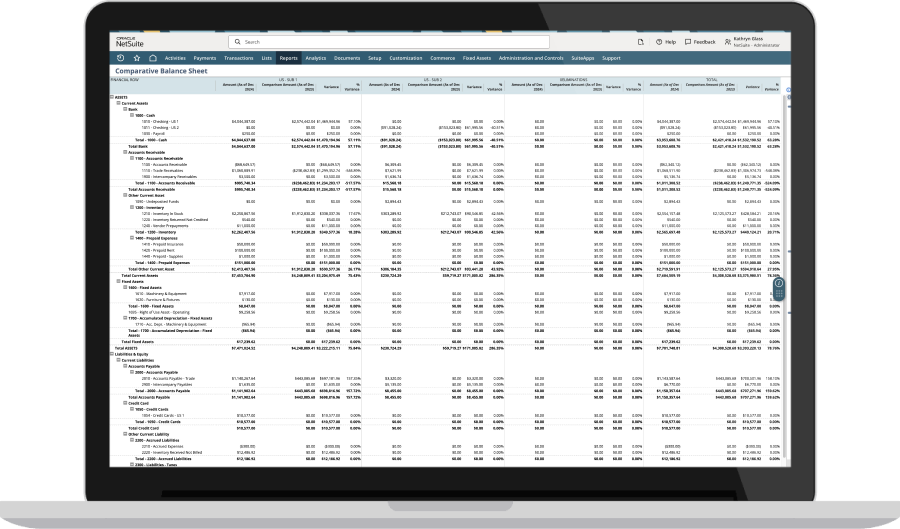
Telecom providers that rely on disconnected billing tools and manual reconciliation processes often realize the consequences only after they’ve lost money or customers. NetSuite Telecom Accounting Software brings billing, financial reporting, revenue recognition, and scenario planning into a unified platform. NetSuite automates statement generation to meet IFRS 15 and ASC 606 revenue recognition requirements. It also handles complex bundles and usage-based pricing, giving users real-time insights into ARPU, churn, cash flow, and margins across customer segments. The platform’s integrated cloud accounting features automate journal entries and manage multicurrency transactions while maintaining the audit trails needed for everything from FCC USF contributions to spectrum-related obligations.
NetSuite’s Financial Management Dashboard
Telecom providers must carefully balance two often competing financial objectives: making strategic network infrastructure investments without compromising near-term profitability. Pricing pressures, intensifying competition, persistent churn, and complex regulations make doing so all the more complicated. By implementing rigorous revenue assurance processes, integrated billing and accounting systems, and disciplined KPI monitoring, providers can make well-informed financial decisions that drive CLV and long-term sustainability. As the telecom industry continues to innovate with next-generation services, sound financial management helps providers maintain the resources they need to meet customer demand and stay competitive.
Telecom Financial Management FAQs
Why is financial management important for telecom companies?
Financial management helps telecom companies secure the funds needed for capital-intensive network infrastructure investments amid complex billing and regulatory requirements. Without a robust financial management strategy, providers risk revenue leakage and cost overruns that reduce investment returns and profitability.
What is the role of revenue assurance in telecom finance?
Revenue assurance helps providers detect and prevent revenue losses from billing errors, data-integration failures, and fraud. Continuous reconciliation between network usage records and customer invoices allows finance teams to quickly identify and address anomalies before they become widespread problems.
How does digital transformation impact telecom finance?
Digital transformation is reshaping telecom finance through automation, AI, predictive analytics, and integrated software platforms. For example, automated revenue recognition systems support compliance with complex accounting standards in real time, while many AI models detect fraud patterns and predict subscriber churn with greater accuracy than is possible using more traditional means. The newer tools are often part of comprehensive cloud-based ERP platforms that offer real-time visibility into financial performance.