
Telecom providers handle enormous transaction volumes across broad and evolving service portfolios, creating countless opportunities for revenue slippage. Many of these losses aren’t discovered until it’s too late to recover them, especially when disconnected legacy systems, manual reconciliation processes, and complex, multiservice bundles are involved. The results range from shortfalls caused by routine billing errors to significant losses tied to large-scale fraud.
As competition intensifies and pricing pressures, infrastructure investments, and customer expectations rise, revenue assurance becomes a defining capability. Companies that make it a priority are better positioned to protect margins, while others risk falling behind. This guide covers what revenue assurance is, why it matters, how it works, and the technologies that help telecom providers protect every dollar they earn.
What Is Revenue Assurance in the Telecom Industry?
Revenue assurance in the telecom industry is the systematic process providers follow to prevent and recover revenue losses within their billing and operational systems. It includes the policies, procedures, controls, and technologies that help companies accurately account for and monetize all billable services.
Key Takeaways
- Revenue assurance helps telecom providers identify, prevent, and recover revenue losses caused by billing errors, fraud, and gaps in system configuration or data integrity.
- Core revenue assurance activities include data reconciliation, fraud detection, usage analysis, rate verification, process optimization, and compliance monitoring.
- Providers are replacing manual processes and disconnected systems with continuous, real-time monitoring that identifies issues in time to prevent or recover losses before they snowball.
- Strong revenue assurance programs protect the margins needed to fund network infrastructure investments and new service capabilities.
Revenue Assurance in the Telecom Industry Explained
The need for revenue assurance stems from the scale and complexity of telecom operations. With multiple service offerings (voice, data, roaming, multiservice bundles), disconnected legacy platforms, third-party partnerships, and transaction volumes reaching into the billions all in the mix, even small discrepancies can trigger substantial revenue leakage and weaken financial performance.
These vulnerabilities are magnified by broader industry pressures: aggressive pricing competition, capital-intensive infrastructure demands, and increasingly complex service portfolios. Revenue recovered and protected through revenue assurance efforts supports day-to-day financial obligations—such as payroll, taxes, and loan repayments—as well as long-term investments in network expansion and technologies like 5G or artificial intelligence.
The importance of revenue assurance becomes clearer when looking at the journey of a single transaction. A customer’s contract is negotiated, service is provisioned, usage is tracked, an invoice is generated, and payment is collected. Each step presents opportunities for revenue leakage: Contracts may include undervalued rates, technicians might activate the wrong services or equipment, tracking systems could miscalculate usage, and customers might pay late or not at all. Companies waiting for month-end reconciliations or quarterly audits to catch discrepancies may find it’s too late to recoup those losses. Therefore, leading telecom providers are adopting proactive, technology-based revenue assurance strategies with real-time monitoring to protect revenue streams and financial stability.
What Activities Encompass Revenue Assurance?
Revenue assurance relies on a set of interconnected activities that run through every stage of the billing process from data reconciliation and fraud detection to rate verification and process mapping. Coordinating these functions across departments and systems gives providers comprehensive revenue coverage and helps them address discrepancies before they compound into losses that affect cash flow:
- Data reconciliation: Revenue teams compare records in network systems, mediation platforms, billing systems, customer accounts, and financial ledgers to identify inconsistencies between usage and invoices. The idea is to reconcile transactions: Match each record to the corresponding billing event to catch missed revenue and keep financial statements accurate.
- Fraud detection: Unauthorized usage patterns, SIM clones, subscription fraud, hacked accounts, and other schemes can generate network traffic without producing revenue. Behavioral analytics and AI pattern-detection algorithms can flag such anomalies as unusual calling activity, impossible travel scenarios, or suspicious activation sequences.
- Usage analysis: Providers review consumption patterns for voice, data, messaging, and other value-added services to verify that usage aligns with subscriber plans and that all billable events are captured. This includes identifying delivered but unbilled services and applying promotional offerings correctly.
- Rate verification: Revenue assurance teams verify the pricing variables that affect rates, such as tariffs, volume-based pricing, discounts, contractual terms, and specialized service bundles. They also confirm rates for wholesale agreements, roaming partners, and third-party content providers involved in shared revenue arrangements.
- Process mapping and correction: Revenue assurance protocols document end-to-end revenue flows to detect control gaps and develop corrective measures that mitigate revenue leakage. Mapping helps providers understand how data moves through their systems and where manual data entry or disconnected tools introduce risk.
- Compliance audits: Regular audits demonstrate adherence to revenue recognition rules, including reporting guidelines, internal financial controls, and accounting standards (such as ASC 606 under US GAAP and the internationally applied IFRS 15). These audits reassure executives, boards, auditors, and regulatory agencies that reported revenue accurately reflects business performance.
Why Does Revenue Assurance Matter to Telecom Businesses?
Inadequate revenue assurance creates both immediate revenue losses and long-term pressure on profit margins. These risks are especially problematic for telecom companies, where competition compresses pricing, regulatory demands raise compliance costs, and fraud continues to accelerate. Together, these pressures limit the revenue providers can retain, making leak prevention essential.
Fraud, in particular, has become a growing threat: The Communications Fraud Control Association’s 2023 global survey reports a 12% increase in telecom fraud between 2021 and 2023, totaling an estimated $38.95 billion in losses in 2023 alone—2.5% of industry revenue. The rise of account manipulation schemes, such as fraudulent subscriptions or account takeovers, makes the challenge even more acute. These schemes pass through billing and provisioning systems as legitimate activity, generating losses that are difficult to detect without strong revenue assurance controls. At the same time, average revenue per user is declining 1.5% annually, according to PwC’s “Perspectives from the Global Telecom Outlook 2024-2028.” With less revenue generated per customer, providers have less room to absorb avoidable losses, further elevating the importance of protecting every revenue stream.
Weak revenue assurance also affects operational performance and stakeholder confidence. Inaccurate financial reporting can weaken investor trust and invite regulatory scrutiny, while billing errors damage customer relationships, raise churn risk, and increase administrative costs due to disputes and corrections. These issues compound quickly in high-volume environments, where small discrepancies can quickly snowball.
At the leadership level, accurate revenue data supports sound planning and smart decision-making. Strong revenue assurance gives CFOs and executives reliable insights for forecasting and planning. It also strengthens a company’s position in mergers, acquisitions, and capital market activities by relieving uncertainty around financial performance.
What Is the Purpose of Revenue Assurance?
Revenue assurance is done for several reasons, the most obvious of which being preventing revenue leakage. But it’s also important for maintaining billing accuracy, increasing transparency, correcting errors, and improving compliance. Each of these activities serves a specific strategic role; collectively, they strengthen a company’s financial foundation. Understanding these core purposes—all aimed at translating services rendered into revenue collected—helps organizations prioritize investments and measure program effectiveness over time:
- Prevent revenue leakage: The primary purpose of revenue assurance is to identify and eliminate revenue leakage before it affects the company’s financial position. These efforts address system configuration errors, inconsistent data between systems, process gaps, and integration failures that leave billable services unrecorded, underpriced, or unpaid.
- Maintain billing accuracy: By validating that billing processes are being managed correctly, providers strengthen customer trust and retention—an advantage in an industry where existing customers outspend new customers by 7%, according to Simon-Kucher’s 2025 global telecommunications study. Accurate, first-time billing also removes missed revenue, lowers dispute volume, decreases administrative costs, and improves cash flow.
- Strengthen transparency: Revenue assurance gives finance leaders a clearer look into complex financial operations by showing where revenue originates, how it moves, and where vulnerabilities exist. This level of insight supports better resource allocation, strategic planning, data-driven pricing, and informed decisions about future service offerings.
- Detect and correct errors: Revenue assurance aims to identify discrepancies while they remain manageable rather than after they’ve compounded into significant losses, making it an effective early warning system. Swift corrections limit financial impact and prevent persistent issues in future billing cycles—for example, catching a pricing error on a specific service tier before invoices reach thousands of accounts.
- Support compliance adherence: Telecom companies operate under strict financial reporting requirements and industry-specific regulations. Revenue assurance provides the controls and documentation needed to accurately report financial results and meet revenue recognition and taxation standards, easing the chances of either internal or external audits.
What Are the Challenges of Revenue Assurance?
For many telecom providers, achieving effective revenue assurance is difficult, especially for companies that rely on siloed legacy systems with limited integration capabilities. Fragmentation between network systems, CRM platforms, provisioning tools, and financial ledgers often forces revenue teams to manually reconcile data—a time-intensive and error-prone process. With high-volume, low-value daily transactions moving through multiple systems every day, delays in reconciliation can leave discrepancies undetected for weeks or months, making recovery increasingly difficult as billing cycles close or customers churn.
These challenges intensify as service portfolios grow more complex. When providers add new services or bundle voice and data services with cloud applications, Internet of Things connectivity, 5G network capabilities, or digital content subscriptions, for instance, the number of potential leakage points increases sharply. Many of these offerings rely on data-intensive, real-time billing, rather than traditional monthly invoicing, boosting the likelihood of missed or misrated usage. Third-party relationships, such as content delivery partnerships, roaming agreements, and wholesale arrangements, increase complexity due to differing data formats, billing cycles, and contractual terms. Combined, these factors can quickly turn minor process gaps into significant and persistent revenue loss.
Accounting Software Helps Telecom Companies Maintain Profitability
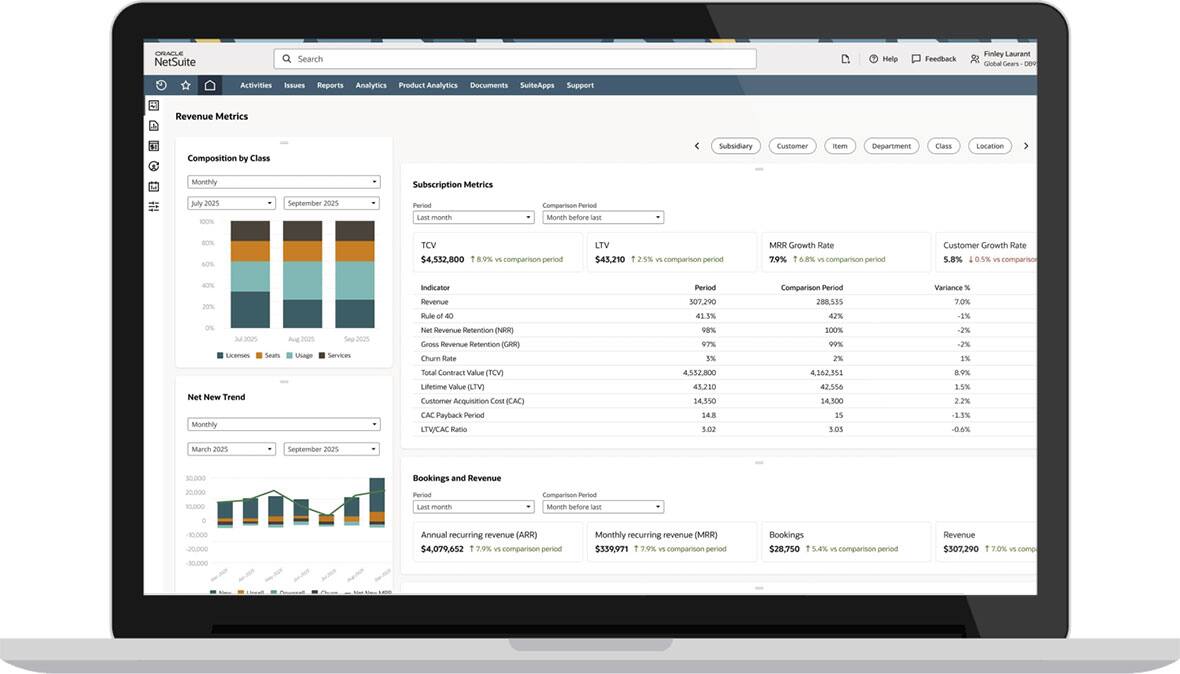
NetSuite Telecom Accounting Software brings billing, financial management, and revenue recognition into one system for clear views of revenue streams from activation through payment. Combined with NetSuite SuiteBilling, teams get comprehensive, real-time visibility into service delivery, usage tracking, invoicing, and customer account status. These features drive identification of issues such as misrated usage, unbilled services, and other discrepancies, often while still recoverable. Meanwhile, automated reconciliation flags anomalies for investigation, and built-in analytics gives finance leaders and revenue managers insight into leakage patterns and revenue performance. By replacing fragmented processes with a connected financial foundation, NetSuite helps telecom providers protect margins as they grow and introduce new services.
NetSuite Billing Dashboards
Revenue assurance gives telecom providers the control needed to manage increasingly complex service portfolios and prevent small discrepancies from turning into significant revenue loss. By implementing programs that combine data reconciliation, fraud detection, and continuous monitoring, businesses can safeguard the revenue streams that fund critical investments in next-generation infrastructure and emerging digital services. Prioritized revenue assurance better prepares companies to maintain profitability and support growth as the industry moves toward data-intensive services and real-time usage charging.
Revenue Assurance in the Telecom Industry FAQs
What is the role of revenue assurance in the telecom industry?
Revenue assurance protects telecom companies from financial losses by verifying that all services are accurately captured, priced, and billed throughout the revenue cycle. It involves several activities, such as fraud detection, billing verification, data reconciliation, and compliance oversight, to detect discrepancies before they lead to losses.
How has AI affected revenue assurance?
AI has made revenue assurance more proactive by replacing periodic audits with continuous, real-time monitoring. AI-powered systems analyze transactions at scale to identify anomalies, predict potential leakage points, and detect discrepancies that would otherwise take human analysts weeks—or months—to discover. Machine learning models improve over time as they process more data while learning the patterns associated with billing errors, fraud, and system integration failures. These advanced tools can also recommend fixes to prevent or recover losses.