
Telecom engineers and operations teams oversee an increasing number of devices, dynamic traffic flows, and ever-changing hybrid infrastructures. Simply put, communications networks have grown too large and complex for manual management. Luckily, there’s help: Automation allows telecom companies to keep pace by replacing routine manual tasks with adaptive, intelligent systems. This article explains how telecom automation is reshaping both network operations and customer service, and how operators can take advantage of all it offers.
What Is Telecom Automation?
Telecom automation is the use of software and advanced technologies, including AI, machine learning (ML), and robotic process automation (RPA), to optimize the way networks and services are managed. It automates once-manual processes, such as device configuration, performance monitoring, and fault resolution, among others. By replacing repetitive work with programmable systems, telecom automation supports faster, more reliable networks, boosting customer satisfaction in the process. It also helps companies adapt to the telecom industry’s constantly shifting traffic patterns, market demands, and business priorities.
Key Takeaways
- Telecom networks are expanding in scope and complexity at a pace that manual processes can no longer match.
- RPA, AI, and orchestration tools help telecom providers build self-monitoring autonomous systems that optimize business processes and enhance customer experiences.
- Automation facilitates better performance and reliability by linking previously siloed platforms and distributed infrastructures.
Telecom Automation Explained
Decades of telecom innovation have steadily reduced network operations’ reliance on human intervention. For example, electromechanical switches, invented in the late 19th century, automatically routed telephone calls, but they didn’t completely replace manual switchboards until well into the 20th century. Later, the introduction of digital switches and computerized network management systems accelerated the pace of innovation, marking major steps toward fully automated operations. By the late 20th century, IP-based technologies unified diverse network hardware and equipment under common protocols, such as the Simple Network Management Protocol, which provided centralized oversight and gave telecoms real-time visibility into equipment status, performance, and faults. Software-defined networking (SDN) and network function virtualization arrived in the 21st century, allowing telecom companies to configure and modify networks programmatically instead of physically adjusting hardware.
These advances paved the way for the automation of the entire telecom ecosystem. Today, policies and workflows adjust network configurations automatically, reroute traffic during outages, and optimize resources based on demand. Modern systems also predict and prevent trouble before it occurs. Beyond the network, automation extends into service provisioning, billing, and customer support to boost efficiency companywide.
Why Are Telecom Companies Leveraging Automation?
Growth in 5G, the advent of Internet of Things (IoT), and cloud computing adoption have exponentially increased the number of connected systems and devices that must work together. The result is a dense, interconnected environment that demands constant monitoring and fine-tuning across vast physical and virtual infrastructures. Many of these challenges stem from the convergence of legacy and next-generation systems. Providers still depend on decades-old infrastructure that was never designed to interface with virtualized or cloud-native environments. Integrating these technologies introduces compatibility issues, data silos, and inconsistent workflows that slow progress and increase operational risk.
Emerging architectures require additional layers of coordination. The rollout of 5G and fiber networks, along with the rise of edge computing, forces telecoms to manage distributed resources located in data centers, at field sites, and on customer premises. Each layer depends on the others, emphasizing the need for real-time synchronization and automated control. Manual intervention simply can’t scale to meet these demands. Data management has become an equally significant challenge. Telecom operations generate enormous volumes of information, but much of this data remains fragmented, inconsistent, or unstructured. Discrepancies between documentation and reality—often created through mergers, acquisitions, and rapid buildouts—make planning and troubleshooting more difficult.
People problems compound these technical issues. The expertise required to manage hybrid infrastructures and multivendor environments is in short supply. Skilled engineers are retiring faster than they can be replaced, while younger specialists gravitate toward emerging technology sectors. Telecom providers face the dual burden of maintaining legacy systems and advancing modernization efforts with fewer hands. External pressures leave little room for error. Customers now expect rapid service activation and constant, reliable connectivity. Regulators demand traceable, auditable operations. And competition is intensifying as cloud providers and software vendors enter the market. Under these conditions, automation has become the only practical way to sustain reliability, agility, and growth.
How Does Telecom Automation Work?
In telecom, some automation technologies perform specific repetitive tasks, while others orchestrate complex workflows involving multiple systems. By cutting down on manual labor and providing advanced analytics, the following technologies help coordinate large-scale operations and complex infrastructures:
- Robotic process automation: RPA uses software bots that mimic human actions, such as clicking and typing, to handle billing, customer onboarding, compliance reporting, data entry, and other rule-based tasks. This accelerates processes and avoids manual errors.
- Artificial intelligence: AI systems analyze live network data to detect anomalies and predict failures in advance of potential service disruptions. They also use customer data and sentiment analyses to power intelligent chatbots and recommendation engines for more personalized customer support.
- Cloud software and orchestration tools: Cloud software hosts and manages the core automation technologies that control network operations. Orchestration frameworks running on cloud software automate provisioning, monitoring, and scaling across distributed environments, which allows networks to instantly respond to new service demands or changes in performance.
Benefits of Automation in the Telecom Industry
Telecom networks run on massive infrastructures that never stop changing. Automation helps providers keep pace, maintain control, and make better use of their staff’s time and expertise. By transferring routine work to systems that monitor themselves and adjust accordingly, companies can optimize operations, increase customer satisfaction, and achieve the following benefits:
- Less manual work: RPA tools handle a wide range of tasks that once demanded constant human attention, such as monitoring network performance metrics and manually configuring or updating network devices. These automated workflows complete in seconds what once took hours, freeing network and operations staff to focus on planning, architecture, and optimization.
- Greater accuracy: Every manual configuration or data handoff has the potential to introduce errors. Automation applies the same logic and validation rules to thousands of devices or records, resulting in more consistent results and cleaner data.
- Faster issue identification and resolution: Automation shortens the time between diagnosis and response, which stabilizes service and minimizes customer impact. Telecoms maintain higher uptime, protect service-level commitments, and lower the operational cost of outages.
- Better network performance: Automation tools read traffic flows in real time and adjust accordingly. Using orchestration and AI, they can balance loads, reroute around hardware faults, and allocate extra bandwidth during usage spikes without waiting for manual input.
- Improved customer experience: AI-driven chat interfaces and self-service portals give customers quick, accurate responses around the clock. Automated provisioning shortens the lag between a customer order and service activation, creating smoother, more predictable interactions.
- Stronger compliance: Telecom operations generate constant audit trails that must stand up to regulatory review. By automatically tracking every change, verifying adherence to standards, and documenting results, companies get a level of transparency that manual reporting rarely provides.
- Room to innovate: When daily maintenance no longer dominates the schedule, technical teams have more time to experiment. Stable, automated environments make it easier to pilot new offerings, test updates, and introduce emerging technologies without compromising live service.
- Lower costs: Fewer manual steps and related errors add up to measurable savings. Over time, automation helps telecoms redirect spending from repetitive operations toward modernization, network expansion, and customer-facing improvements.
Benefits of Telecom Automation
| Less manual work | Frees up staff for higher-value tasks |
| Greater accuracy | Generates consistent results and cleaner data |
| Higher uptime | Identifies and resolves issues faster |
| Better performance | Automatically adjusts to traffic flows |
| Improved CX | Provides quick, accurate responses 24/7 |
| Stronger compliance | Tracks and documents all changes |
| More innovation | Easily facilitates pilot tests of new offerings and updates |
| Lower costs | Shifts spend from ops to modernization |
Telecom Automation Use Cases
Automation touches nearly every part of telecom operations from network design to customer engagement. It links systems that once operated independently and introduces consistency into large, distributed infrastructures. The following use cases show how automation technologies—AI, RPA, orchestration, and ML—work together to improve performance, speed, and reliability throughout the business:
- Network automation: SDN and orchestration give telecom companies centralized control over thousands of interconnected network devices. They can instantly push policies out to any and all devices as conditions change to adjust routing, bandwidth, and configurations.
- Fault detection: AI-driven analytics scan performance data to spot unusual patterns or equipment anomalies. Once detected, the system can isolate the fault, alert technicians, even initiate recovery steps automatically to prevent service disruption.
- Predictive analytics: ML models examine historical data to forecast where failures are likely to occur. These insights help telecom operators with spare-parts planning and resource allocation long before disruptions become visible on the network.
- Automated billing: RPA tools manage invoicing, payment validation, and error reconciliation with minimal oversight. They quickly generate accurate bills by pulling data directly from usage systems, cutting down on customer-initiated billing disputes.
- Order processing: Automated order processing connects previously siloed sales, provisioning, and network activation workflows. Customer orders move through the system without requiring duplicated data entry, which shortens the path from purchase to delivery.
- Compliance data collection: Auditing tools collect configuration data, compare it to internal or regulatory standards, and log and report the results automatically. This simplifies the proof-of-compliance process for audits and inspections.
- Service personalization: AI analysis of customer behavior, location, and service history helps telecoms tailor communications or promotional offers. Dynamic adjustments to service quality and bandwidth hone alignment of resources with individual usage patterns.
- Account validation: Automation verifies customer identities by instantly cross-referencing account information, device activity, and behavioral data. This helps prevent fraud and maintain trust without adding friction to onboarding.
- Threat detection: ML models analyze traffic, looking for possible intrusion attempts or data breaches. When risks appear, automated defenses isolate affected segments and alert security teams within seconds.
Change Management Considerations for Automation Adoption
Automation changes how telecom networks operate—and how employees work. Successful deployments require clear communication, well-defined processes, and a shared understanding of how the ensuing changes will affect day-to-day operations. Without that alignment, even the most advanced automation tools can generate confusion or resistance.
The first priority is building buy-in from technical and business teams. Involve employees in early planning discussions, share the reasons for automating, and explain how new systems will help teams work more efficiently. A readiness assessment often follows, in which companies identify skill gaps, resource needs, and systems that require modification prior to implementation. Rolling out automation in phases keeps the transition manageable; these pilot projects let teams test workflows, refine parameters, and measure results before scaling. Structured governance—supported by policies and approval workflows aligned with Information Technology Infrastructure Library best practices—improves accountability and consistency.
Communication remains essential throughout the process. Frequent updates and transparent decision-making minimize uncertainty and preserve trust, while comprehensive documentation makes sure automated processes can be audited, adjusted, and transferred among teams as needed. Training plays another major role, especially in the areas of process design, data interpretation, and system management. Security and compliance oversight must evolve as well, as automation introduces new dependencies and access pathways that require rigorous testing and monitoring. By treating change management as a continuous discipline rather than a one-time project, telecom providers can introduce automation safely, steadily, and with lasting results.
Automation Future Trends for Telecom Companies
Telecom automation is moving from reactive management to predictive analytics and autonomous control. As digital transformation accelerates and AI systems grow more capable, networks will make more of their own operational decisions to optimize performance, balance resources, and protect data. One of the most significant developments in this area is the emergence of agentic AI. Independent, continuously learning AI agents can make routine adjustments, detect inconsistencies, and coordinate incident responses without direct supervision, freeing teams to focus on more important priorities.
The continued rollout of 5G—and early work on 6G—will push automation deeper into spectrum allocation, edge orchestration, and real-time resource management. With growing demand for low-latency applications in autonomous vehicles and industrial IoT, networks will need to make split-second decisions at the edge, closer to where data is generated. Cloud-native architectures will reinforce this evolution with open, modular systems that support quicker development and deployment cycles. These architectures also make it easier to integrate new automation tools and scale them globally.
Cybersecurity automation will become more critical as well, with network threats continuing to evolve faster than manual response teams can react. AI-driven security frameworks and zero-trust models will take a more active role in identifying and neutralizing these risks. Customer-facing automation is advancing in parallel. AI-powered chatbots and predictive engagement systems will create more responsive, personalized experiences, while background systems adjust network conditions to support those interactions.
The next generation of telecom automation will look more like an interconnected, self-improving, and adaptive ecosystem. Over time, networks will evolve into self-managing systems capable of optimizing and defending themselves—rendering human expertise even more strategic and essential.
Automate Operational Processes With NetSuite ERP
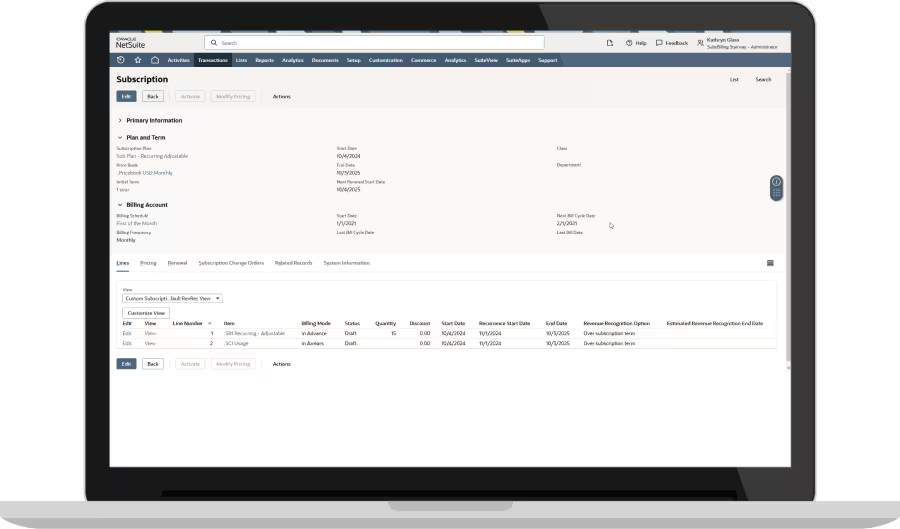
Telecom leaders must constantly adapt to rising operational costs, rapidly shifting customer expectations, and massive amounts of data. With each new demand, manual processes slow decision-making, siloed financials make it harder to measure profitability, and compliance requirements grow tougher. To stay competitive, executives need a unified view of their business that connects every function in real time. NetSuite Telecom ERP leverages automation to provide that foundation through a single, intelligent solution designed to support telecoms’ dynamic environment. Its AI-powered forecasting, automated revenue management, and advanced subscription billing simplify complex pricing models and improve cash flow accuracy. Built-in analytics and real-time reporting give leaders a complete view of performance for all subsidiaries while reducing manual workloads and error rates. By unifying financial, operational, and customer data, NetSuite ERP helps telecom providers accelerate growth and focus on innovation.
Automate Subscription Billing With NetSuite
In an industry defined by complexity and constant change, telecom companies are turning to automation to modernize business processes, increase reliability, and better serve customers. Automation reduces manual effort, improves data accuracy, and gives providers the flexibility they need as network demands grow and service models evolve. Looking forward, agentic AI and autonomous systems will further push telecoms beyond basic process automation toward intelligent, adaptive networks that continuously improve performance.
Telecom Automation FAQs
Is automation the same thing as AI?
No, automation isn’t the same thing as AI, although the former often incorporates the latter. Automation performs repetitive or rule-based tasks with minimal human input, while AI involves machines analyzing data and making decisions.
What are the tools used in telecom automation testing?
The tools used in telecom automation testing are network analyzers for inspecting traffic, generators for simulating load, and voice testers for assessing call quality. They also include automated suites for functional testing, compliance validation, security analysis, and network emulation.