
Long gone are the days when handshakes were enough to secure a consulting contract. Firms that understand the dos and don’ts of writing a consulting proposal are better positioned to win more business, retain clients, and avoid problems down the line. This article breaks down the core components, common mistakes, and tools that can help consulting firms get proposals right.
What Is a Consulting Proposal?
A consulting proposal is an official document that details a consultant’s strategy for solving a client’s business problem. It outlines the services to be provided, intended outcomes, the timeline for completion, pricing and payment details, and legal terms.
Key Takeaways
- A consulting proposal translates a client’s needs, budget, and desired outcomes into a structured bid for business.
- Successful proposals typically share the same eight components adapted to the specific engagement.
- Ambiguous or poorly timed proposals can cost a firm the project or lead to scope disputes if they win.
- Tools like generative AI and ERP systems can speed up proposal creation and connect it directly to project execution.
Consulting Proposals Explained
The purpose of a consulting proposal is to convert a general, presales discussion into a clear offer for a prospective client to review, negotiate, and—if all goes well—ultimately approve. Consulting proposals are either driven by a formal request for proposal (RFP) from a client or initiated by a consulting firm, following exploratory calls. The starting point shapes the process. With an RFP, the client sets the framework for what it wants to know while self-initiated proposals allow the consultant to frame the problem, propose the solution, and set the commercial terms.
In either scenario, proposal creation is a critical part of the consulting sales cycle. After holding preliminary discussions with the prospect to understand the context, a consulting team will draft a proposal that includes a summary of the client’s current situation; an explanation of the proposed solution, with deliverables and timelines; pricing structure; terms and conditions covering legalities and documenting assumptions; and an overview of the consulting team that would be responsible for the project. The proposal is then reviewed by the client, revised as needed after negotiations, and, if everything goes smoothly, accepted. At this point, the contract can be signed.
Proposal timing matters. If it’s submitted too early in the sales cycle—before the consulting firm has a clear understanding of the client’s reason for seeking assistance and other critical details—chances of misalignment increase, and win rates drop. Even if a formal RFP clearly outlines the specifics, a well-timed, personalized proposal tends to win more often than a generic or rushed response.
What Is the Purpose of a Consulting Proposal?
The main purpose of a consulting proposal is to create a tangible offer that is based on discovery conversations, explaining in detail how a consultant’s product or service can help solve the client’s problem. For the consulting firm, the proposal serves as an internal checkpoint—one that often requires senior approval—to be sure the scope and pricing are sound before a pitch is proffered. For the client, the proposal is one of its main decision-making tools. It helps determine whether the consultant truly understands the issue, whether the recommended approach (including the timeline and outcomes) makes sense, and whether the investment is justifiable.
Once a contract is signed, the proposal continues to serve as a reference guide for managing the client-consultant relationship throughout the project, providing a clear record of solutions, services, and timelines.
The Consequences of a Poorly Constructed Consulting Proposal
Poorly constructed consulting proposals can create problems at virtually every stage of an engagement. At the pitch and sales junctures, a weak proposal can lose the deal entirely. A proposal that isn’t tailored to the client’s specific context can suggest that the consultant didn’t do their homework, didn’t understand the issue to be solved, didn’t think through the solution, or even recycled a different client’s pitch.
Once a project is underway, the consequences shift to decreased profit margins. Vague deliverables and missing exclusions, for example, tie directly to scope creep—typically, the result of extra analyses, extended workshops, or a reporting layer that wasn’t in the original brief—and revenue leakage. Disputes can jeopardize client relationships; so can disagreements over what the completed project should look like.
What Are the Core Components of a Consulting Proposal?
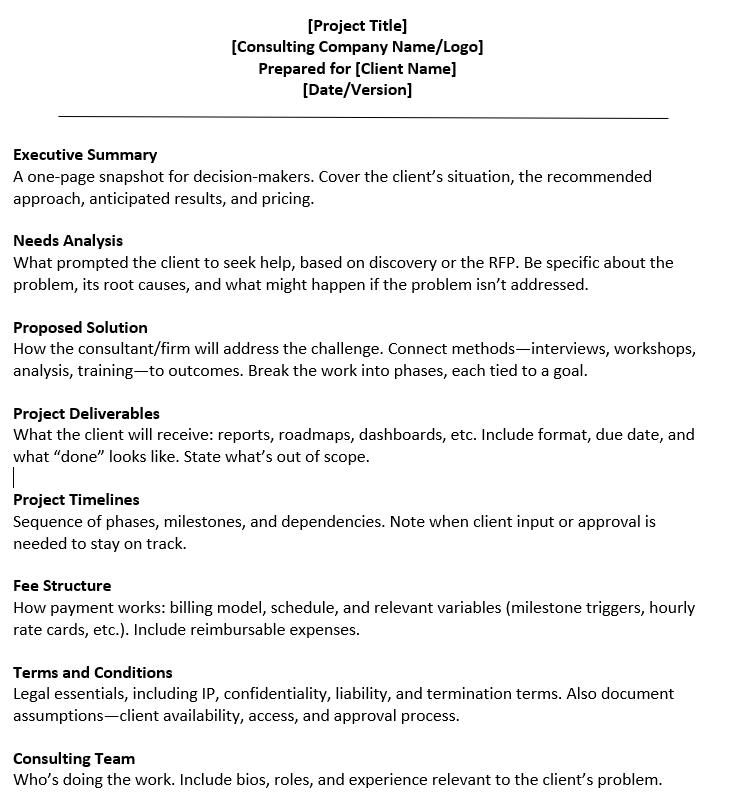
Most consulting proposals share the same core elements. Below are eight components that consistently appear in winning proposals and hold up across many project types. For repeat clients with existing master service agreements (MSAs), some sections may reference broader terms already in place, but the core structure remains.
1. Executive Summary
The executive summary condenses the full proposal into a roughly page-long overview for busy stakeholders and senior decision-makers. It typically includes the client’s current position, the consultant’s suggested course of action, expected results, and a high-level view of the fees involved.
2. Needs Analysis
The needs analysis section draws on information from discovery conversations or the RFP, detailing the client’s situation and factors that prompted it to seek help. References to the client’s pain points should be specific, including an analysis of the possible root causes and the implications of doing nothing.
3. Proposed Solution
The proposed solution presents the game plan for addressing the client’s challenge. This section links activities and methods—such as interviews, workshops, data analysis, and training—with the desired outcome. Proposals should be results-oriented and framed around the client’s goals.
4. Project Deliverables
Deliverables are the project’s tangible outputs presented throughout or at the end of a consulting engagement. They should be itemized, along with their due dates and acceptance criteria. Examples of deliverables include strategy documents, reports, process maps, dashboards, and training manuals. This section should also outline what’s explicitly not in scope, especially deliverables that might seem related but aren’t part of this engagement.
5. Project Timelines
Project timelines specify the order, due dates, and dependencies of the phases and activities outlined in the proposed solution. For RFPs, the timeline is usually spelled out in the initial request. For proposals initiated by the consulting firm, there’s room for negotiation before a final schedule is set. Deadlines for client approvals and feedback are also worth including to keep the project moving forward.
6. Fee Structure
The fee structure section describes payment terms for services: the billing model (hourly rates, time-and-materials, fixed-fee, or retainer), payment schedule, and model-related variables, such as invoice triggers for milestone-based billing or role-based hourly rate cards. Reimbursement terms for travel, software, or other third-party costs should also be stated.
7. Terms and Conditions
Terms and conditions cover intellectual property ownership, confidentiality obligations, liability, termination rights, and references to financial obligations. If the client has an ongoing relationship with the consulting firm, this section may refer to the MSA and outline only those provisions that are exclusive to the proposed project. This section also documents the availability of client resources, required access, approval chains, and other assumptions.
8. Consulting Team
Especially important for new clients or competitive RFPs, this section lists the professionals who would be involved in the project. It includes their bios, roles in the engagement, and, for highly tailored proposals, their relevant experience contextualized against the client’s problem. For repeat engagements, this section may be edited, since the client will already be familiar with the firm and its players.
Example Consulting Proposal
A consulting proposal follows a narrative arc that moves the prospective client from concept to commitment. A well-constructed proposal demonstrates a thorough understanding of the problem, then lays out the proposed solutions, methodologies, and timelines to solve it.
Consulting Proposal Template
Avoiding Common Consulting Mistakes
A well-structured proposal is not enough to raise win rates if it lacks depth or does a poor job of convincing the client that the consultant understands its needs. The following mistakes regularly show up in firms where proposals are treated as a formality, rather than as a strategic tool.
-
Misunderstanding the client’s needs:
A proposal that fails to address the client’s actual problem won’t win. The difficulty begins before the proposal is even written—in the discovery phase, when the right questions aren’t asked or the conversation stays too surface-level to uncover the real issue. A good rule of thumb: If a consultant can’t describe the client’s problem the way the client described it, they’re not ready to write the proposal.
-
Sending the proposal too early:
Submitting a proposal before the competition may seem advantageous, but sending it too early might actually hurt a firm’s chances. The challenge lies in how much an early proposal can actually cover when teams have not had the time to fully understand the client’s situation. Even when the content is solid, early proposals tend to be evaluated on price alone—since there’s little else on the table to judge them on.
-
No client follow-up or review:
Submitting a proposal kicks off the follow-up process. Consultants should be ready to answer questions about the proposed solution, methodology, and implementation. Asking for a client review meeting demonstrates confidence in the offer and gives stakeholders a chance to voice concerns. Even if the proposal doesn’t win, feedback from that conversation can sharpen the next one.
-
Generic or vague deliverables:
Clients notice the difference between a “strategy document” and a “three-year market strategy, including a phased implementation timeline and impact estimates.” A vague proposal can cost the deal, though if it does get accepted, it can lead to scope disputes later. The more specific the deliverables—scope, format, success criteria, due date—the less room for misinterpretation when the project starts.
-
Failing to prepare for objections:
Clients push back on proposals for predictable reasons: The price is too high, the timeline doesn’t fit, or the scope is too narrow or too broad. Anticipating likely objections—and preparing responses—helps prevent negotiations from stalling. If a client balks at price, for example, being prepared to offer tiered options or a phased approach that lowers the initial commitment can keep the deal alive without undercutting the full value of the work.
-
Pricing fees without factoring in value:
Pricing a consulting engagement based solely on hourly or effort estimates shifts the client’s focus from outcomes to cost. A more useful approach is for the consulting firm to price its work relative to the value it delivers. Project-based and value-based pricing models better reflect that relationship and tend to attract clients that prioritize results.
How Does Software Help Proposal Management?
Managing consulting proposals manually might work for a handful of projects, but it doesn’t scale. Version tracking, consistent formatting, and timely follow-up get harder as a consulting firm’s pipeline grows.
Generative AI is changing the early stages of proposal development. According to a 2025 LexisNexis survey, 80% of management consultants now use GenAI tools in their daily work, with proposal creation cited as a key use case.
Beyond drafting, proposal management platforms can handle the operational side: centralizing templates, smoothing content reuse, managing versioning, simplifying approvals, and supporting pricing modeling, all of which cut response time. Once a proposal wins, firms using modular ERP or CRM platforms benefit from their integration. An accepted proposal can automatically generate projects, contracts, and invoices, reducing manual re-entry, the potential for human error, and handoff friction between sales and delivery. Clean data from proposal through project close also creates an audit trail that holds up in disputes.
Win More Proposals With NetSuite ERP
Accuracy, or lack thereof, makes or breaks a proposal. NetSuite ERP for Consulting Firms connects billing, finance, resource management, and CRM data in real time, giving consulting teams the information they need to build stronger proposals. Staffing decisions draw on live availability and skills data. Pricing reflects actual project history. For returning clients, proposals can be grounded in full account context.
NetSuite’s capabilities extend throughout the project lifecycle. Integrated with SuiteProjects, proposal data moves directly into project management and billing, eliminating manual handoffs between sales and delivery. From there, teams can track project costs on real-time dashboards, capture all billable time and expenses, and flag scope changes before they become disputes. The result: tighter project control and engagements that deliver on what was promised.
A consulting proposal serves two purposes: to secure business and to safeguard the project once underway. Getting both angles right requires thorough discovery, precise scope, and pricing that reflects value. When both sides are clear on what’s expected, work can move forward on solid ground.
Consulting Proposals FAQs
How do you create a compelling consulting proposal?
A compelling consulting proposal reflects thorough discovery, directly connecting the client’s problem to a proposed approach and desired outcome. It also lays out clear deliverables, timelines, pricing, and other terms that protect both sides.
What are the six elements of a business proposal?
Most business proposals include an executive summary, a problem statement or needs analysis, a proposed solution, a scope of deliverables, a project timeline, and a fee structure. Additional sections for terms and conditions, plus backgrounds on the consulting team, are also common.
How can a consultant improve their proposal win rate?
Pursuing fewer, better-fit opportunities and qualifying potential clients tend to improve win rates. High-quality proposals also depend on understanding and tailoring content to the client’s actual challenge and presenting strong follow-up workflows.