
While the broader manufacturing industry faces significant headwinds, including rising costs, a talent shortage, and rapid shifts in customer demand, the industrial machinery sector is growing at pace. According to Mordor Intelligence, the industrial machinery market will generate $1.3 trillion by 2031.
That’s not to say industrial machinery manufacturers don’t face hurdles of their own. Builds are becoming more complex, customers expect higher levels of post-sales support, and a lack of skilled workers is putting pressure on their productivity. But by staying on top of the trends impacting their market, industrial machinery manufacturers can position themselves to mitigate these challenges and stay on the path to profitable growth. This article breaks down the top trends manufacturers should be mindful of and how businesses can capitalize on them to drive success.
Industrial Machinery Is Evolving
Powerful forces are transforming the industrial machinery sector. Technological change is among the primary drivers, with smart manufacturing practices, AI, and autonomous robots changing the way industrial machinery manufacturers conceive and build their equipment. In parallel, regulatory and market forces require manufacturers to operate more sustainably, be it by replacing old motors and systems with energy-efficient alternatives or by building machines with recyclable components. In a similar vein, industrial machinery manufacturers are adopting more modular approaches to production, not just to operate faster and more efficiently, but also so they can customize end products to meet customers’ needs while minimizing waste.
It’s also impossible to ignore the sweeping transformation occurring in the industrial machinery industry’s talent and skill sets. With more manufacturers relying on advanced technologies to power their equipment and systems, they’re racing to hire employees familiar with tools like AI, the Internet of Things, data analytics, and factory robots, while simultaneously upskilling their existing teams to develop these capabilities.
10 Industrial Machinery Industry Trends to Follow in 2026
From technological innovations and macro-economic drivers to changes in customer demand and expectations, the industrial machinery industry is evolving fast, and the pace of change will only accelerate. Industrial machinery makers are pursuing every measure possible to stay ahead of the game, with a particular focus on the 10 trends described below.
-
Artificial Intelligence and Agentic AI
To call AI the future of manufacturing is an understatement. According to Bain, 75% of advanced manufacturing companies say adopting AI ranks among their top priorities. Current use cases for AI in industrial machinery manufacturing include equipment assembly and maintenance, quality control for manufactured products, and manufacturing warehouse logistics. Another attractive capability of AI technology is that it can take on repetitive and time-consuming tasks, such as data analysis, which both improves the accuracy of repetitive manufacturing workflows and frees employees to focus on more strategic tasks that demand human creativity and reasoning.
The latest wave of AI innovation in industrial machinery manufacturing is agentic AI. Also referred to as AI agents, these autonomous systems use large language models to set goals, plan, and execute manufacturing tasks with little or no human input. The technology’s role in industrial manufacturing is still being defined, but the prospect of using AI agents to create an autonomous management layer that can handle critical but time-consuming workflows—think: equipment inspection, quality control, maintenance—is generating significant buzz.
-
Sustainability Efforts
Governments, regulators, investors, and the public at large are all pushing for greater sustainability in industrial manufacturing processes. Specifically, manufacturers are being asked to be more energy efficient, use more recyclable materials, and generate less waste. In the United States, sustainability regulation includes both federal mandates, such as the Securities and Exchange Commission’s Climate Disclosure Rules, and state laws, like California’s Climate Corporate Data Accountability Act.
Leading industrial machinery manufacturers treat the market’s growing appetite for sustainability as an opportunity. By cutting waste from their manufacturing processes, companies will not only address external demands for change but also make their processes more cost- and time-efficient, which, in turn, improves their bottom line. Some industrial machinery manufacturers are even taking advantage of government subsidies for renewable energy sources, such as solar panels, by integrating these technologies into their manufacturing operations.
-
Modular Designs
Modular design involves using manufacturing machines with interchangeable components that can easily be adapted to a variety of production processes without overhauling the entire system. For industrial machinery manufacturers, this means faster assembly, simpler maintenance, and shorter lead times; when a module fails or needs an upgrade, technicians replace that component rather than taking the whole machine offline. Modular designs also make it easier to customize equipment for different customers or production requirements without engineering from scratch each time. The approach is especially relevant for discrete manufacturing sectors like automotive and aerospace, where production lines must adapt quickly to new models or product variations.
-
Smart Manufacturing
Smart manufacturing refers to the combination of advanced digital technologies with traditional manufacturing processes to make teams and systems more efficient. Instead of rigid, siloed operations, smart manufacturing systems connect companies’ teams, operations, and information in a cloud-based system that makes critical data available across their organization and improves decision-making. This data-driven approach also underpins the adoption of leading-edge manufacturing technologies, such as AI, collaborative robots, and the use of augmented reality, for equipment maintenance and employee training.
Speaking of employees, industrial machinery manufacturers are complementing these investments by hiring tech-savvy talent and building data literacy into their workforce so employees can leverage smart manufacturing technologies and ways of working. It’s also worth noting that businesses that have embraced smart manufacturing are more attractive to potential hires, a valuable differentiator that can help manufacturers find skilled workers in a shrinking pool of qualified talent. For these reasons and more, 80% of manufacturing executives plan to invest at least 20% of their improvement budgets on smart manufacturing initiatives.
-
Predictive Maintenance
Predictive maintenance is a strategy whereby manufacturers proactively monitor their equipment to detect anomalies before they become problematic and cause failures. By fine-tuning and repairing equipment before it fails, industrial machinery manufacturers can lower their maintenance costs and minimize—even eradicate—downtime. The cost of unscheduled downtime for manufacturers today is growing, reaching up to $250,000 per hour, in some cases. Predictive maintenance works by collecting data from sensors installed on a company’s manufacturing equipment and using analytics to interpret and analyze this information for anomalies in real time.
-
Supply Chain Complexity
Modern supply chains involve countless procurement, production, and distribution workflows. They also require industrial machinery manufacturers to manage a variety of partners operating in different locations and geographies. The interdependencies of all these discrete parts make manufacturing supply chains complex to manage. This complexity is only growing in a world of increasing globalization, where on-time delivery is often difficult to achieve.
A simple supplier shortage or transportation issue can generate a major ripple effect across the supply chain, causing delays to manufacturing processes and driving up production costs overnight. In the worst case, these issues can bring a manufacturer’s entire operations to a halt. To further complicate matters, manufacturers also face more cyberattacks than ever, with bad actors attempting to breach their IT systems to steal valuable data or disrupt their operations. To counter the challenges of supply chain complexity, industrial machinery manufacturers are bolstering their cyber defenses and adopting data-driven supply chain management systems to unlock efficiencies and make their supply chain operations more resilient.
-
Additive Manufacturing
Additive manufacturing—also known as 3D printing—is a process whereby manufacturers create three-dimensional products by printing and joining materials in layers, using digital designs as their basis. The process can be used with common manufacturing materials, including ceramics, metals, and plastics, decreasing production times and cutting costs when applied at scale. This second point is crucial: Previously reserved for prototyping, additive manufacturing is now becoming a core strategy in manufacturing design and production scaling. 3D printing has also unlocked new ways for industrial machinery manufacturers to design and refine complex parts while keeping waste to a minimum.
-
Reshoring
For years, manufacturers embraced globalization and shifted their manufacturing and sourcing of goods to foreign countries. But rising labor costs, unpredictable trade relations, and the rising risk of shipping disruptions are now swinging the pendulum back. Industrial machinery manufacturers across the United States are bringing some or all their production and supply chain operations back to domestic markets. This repatriation tactic is called reshoring, and many companies are weighing the pros and cons of this approach as they look to bring more certainty and consistency to their production, supply chains, and forecasting capabilities.
-
Robots and Cobots
Industrial machinery makers are incorporating robots into their facilities to work more productively and accurately. Unlike human employees, who need rest, robots can work at all times of day, which accelerates output. Robotic assembly lines are also safer, as they don’t require that humans expose themselves to dangerous manufacturing processes or hazardous products and chemicals.
Today’s industrial robots are also being enhanced with AI capabilities. Manufacturers can program these AI robots to produce and assemble their products, bringing new levels of efficiency and quality control to their operations. Another popular strategy gaining traction among industrial machinery manufacturers is the use of collaborative robots, called cobots. These cobots work alongside assembly workers to complete manufacturing tasks that require machine assistance, be it handling large items that are too heavy for a human to carry or powering through repetitive assembly tasks that would otherwise be too dangerous or difficult for employees to perform alone.
-
Virtual Tours and Simulations
Until recently, businesses looking for a manufacturing partner had to visit their facilities in person to assess the quality, speed, and cleanliness of their operations. Although necessary, this process is tedious and time-consuming. Today, manufacturers can invite prospects and potential partners to visit their facilities virtually, through 3D tours that can be accessed online or on their mobile devices. Whether focusing on factory layouts, production capacity, or specific machinery needs, virtual tours and simulations allow manufacturers to walk customers through their equipment and operations, building their confidence without making prospects travel long distances for a site visit.
Industrial Machinery Sector Outlook
The industrial machinery sector is poised to grow steadily, driven by technological advancements, such as automation, AI, and robotics, as well as by flexible working methodologies that make assembly operations and teams more efficient. Additionally, ERP software allows manufacturers to manage production, inventory, service, and financials from one cloud-based platform to control costs and optimize operations. In the United States, government investment in the manufacturing sector will continue to accelerate the pace of reshoring for manufacturers that previously produced their goods abroad.
Specific sectors poised for growth include the semiconductor and data center industries, with demand for IT infrastructure soaring across the country and globally. The pharmaceutical sector is also ripe for growth, with the FDA publishing the Framework for Regulatory Advanced Manufacturing Evaluation initiative to drive the use of automation, AI, continuous manufacturing, and real-time analytics to make pharmaceutical manufacturing more accurate, efficient, and secure.
NetSuite Enables Efficiency for Modern Equipment Manufacturers
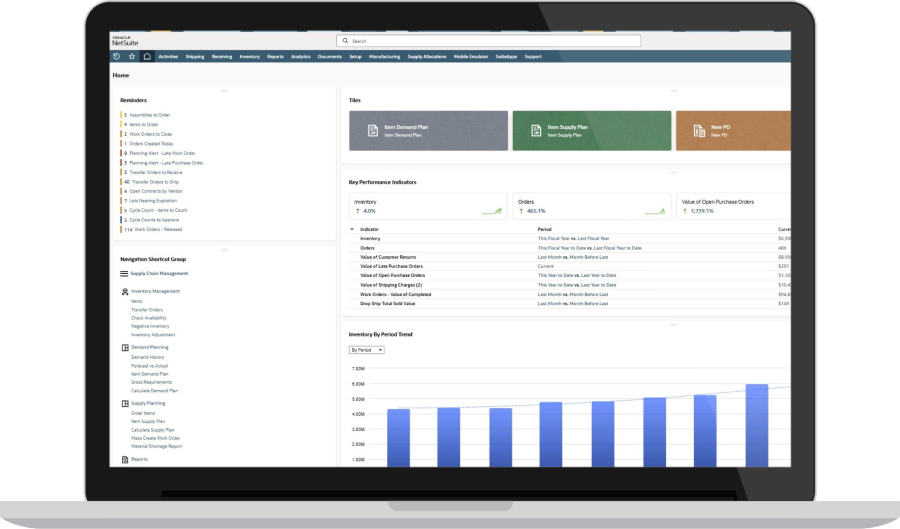
To succeed and take advantage of the latest trends, industrial machinery manufacturers must be able to manage and enhance the performance of their equipment at every stage of its lifecycle, from initial design through service and decommissioning. NetSuite ERP for Industrial Machinery provides manufacturers with an all-in-one cloud-based system that centralizes financials, production, and supply chain capabilities, facilitating improved performance and equipment quality while positioning manufacturers to scale with ease. Automated workflows cut production delays and errors; centralized analytics make it possible to implement predictive equipment maintenance; and real-time dashboards allow manufacturers to track equipment time and operating costs in real time to maximize asset productivity and minimize margin erosion.
Manage Your Supply Chain With NetSuite ERP
The industrial machinery manufacturing sector is undergoing a major transformation. The rise of powerful technologies like AI and cobots has the potential to make manufacturers more productive and efficient than ever, though these companies must also navigate the challenges of growing supply chain complexity and an ever-widening skills gap. By staying one step ahead of the latest trends and investing in the right technologies to support them, industrial machinery manufacturers can create sustainable growth for the long term.
Industrial Machinery Trends FAQs
What are the industrial manufacturing trends in 2026?
The industrial manufacturing sector is being shaped by numerous trends. Chief among them is the rise of AI and automation to drive production efficiencies, reshoring to build a more predictable supply chain, and deeper levels of collaboration between humans and robots on the assembly line.
What are the emerging technologies in industrial manufacturing?
The technologies shaping industrial manufacturing today include AI and AI agents, which are making manufacturing processes more autonomous and efficient, and automation that accelerates production while minimizing the risks caused by human error. Other technologies entering the mainstream include smart manufacturing, which allows businesses to take a more proactive approach to equipment maintenance, and additive manufacturing, which involves producing goods using advanced 3D printing methodologies.
What’s the outlook for industrial machinery?
The outlook for the industrial machinery manufacturing sector is positive, with analysts expecting steady growth in the years ahead. Backed by new technologies, upskilling for employees, and growing investment in onshore production, today’s manufacturers are in a strong position to scale their capacity while realizing cost, time, and performance efficiencies in their daily operations.