Using AI where it delivers proven benefits is becoming essential for businesses that want to stay competitive—including manufacturers. In many cases, AI is less about replacing workers than improving legacy business processes and helping people do their jobs with greater speed, accuracy, precision, and safety. For manufacturers, this shift is part of what's being called Industry 4.0, also known as the Fourth Industrial Revolution, or 4IR. Industry 4.0 is about real-time orchestration, connecting people, machines, data, and infrastructure. In fact, the European Commission is already making the case for Industry 5.0, a framework centered on human centricity, sustainability, and resilience.
Whether they view the shift through the lens of Industry 4.0 or 5.0, opportunities span manufacturing operations, including using agentic AI to align procurement with consumer demand and applying computer vision for defect detection. These use cases can help manufacturers improve productivity, customization, quality, and speed in ways that were difficult to achieve with traditional processes alone. This article explains what AI in manufacturing involves, why it matters, the benefits and challenges it brings, and 10 common use cases.
What Is AI in Manufacturing?
AI in manufacturing is the use of artificial intelligence technologies, such as machine learning, computer vision, predictive analytics, and generative AI, to help manufacturers improve how they design, produce, inspect, maintain, and deliver products. AI can let teams analyze large volumes of data, detect defects, forecast demand, optimize production schedules, predict equipment maintenance needs, and improve quality control. Rather than replacing people, AI often supports workers by helping them make faster, more accurate decisions and by automating repetitive or high-volume tasks across the manufacturing lifecycle.
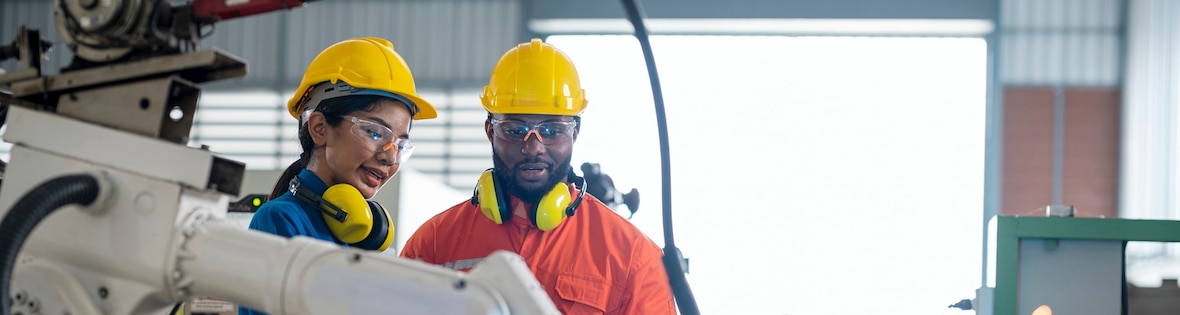
But AI's influence extends beyond data analysis. For example, by working autonomously or alongside human workers on the shop floor, vision-guided AI-driven robots and cobots can detect and report errors or defects in real time and autonomously recalibrate their operations accordingly. Unlike fully autonomous robots, cobots are designed for shared workspaces, but safeguarding requirements depend on the task, robot, payload, speed, and other factors.
As AI technology continues to improve, manufacturers can realize increased production throughput, supply-chain optimizations informed by demand sensing, and decreased costs.
Key Takeaways
- AI provides benefits for manufacturers, including increased efficiency, reduced costs, and faster innovation.
- Implementing AI benefits from careful planning, a solid data foundation, cross-functional alignment, and reskilling opportunities for employees.
- AI data analytics tools are not foolproof—they require human oversight.
AI in Manufacturing Explained
AI helps manufacturers manage their costs and boost productivity, quality, and output. It's also used to automate mundane and repetitive tasks, enabling employees to tend to more complex endeavors, and to safeguard staff from dangerous work, such as via the use of robotic arms that move hot metal along an assembly line, for example. And, by working in tandem with other AI-powered devices, AI systems can collect detailed data throughout an item's production cycle, catching errors and defects more consistently and faster than humans can.
Quality Magazine reported that 63% of manufacturing companies use AI for quality control, with applications expanding into real-time process optimization. The World Economic Forum often discusses three major categories where AI can be deployed: operational performance, workforce augmentation, and sustainability. AI also makes it possible for manufacturers to consider previously unattainable strategies, such as mass customization.
In addition to improving existing processes, decision-makers can use AI tools for forecasting future demand and implementing more accurate production schedules. As a result, manufacturers can curb waste of materials and valuable resources like energy or water and promote a more profitable and sustainable manufacturing process.
How Is AI Used in Manufacturing?
Manufacturers are increasingly turning to AI to gather and analyze real-time data to create a more connected and transparent view of the factory floor. They can also gain important insights into key productivity and performance benchmarks that inform next steps, such as output volume, downtime, and equipment efficiency. AI integration with other advanced technologies, including IoT devices, augmented reality, and ERP systems, provides additional sources of data, empowering managers and other decision-makers to fine-tune every step of the manufacturer's business process.
In addition, AI-powered tools can accomplish designated tasks with precision. Alongside 3-D modeling and digital tools, for example, AI can speed up the product design process and minimize waste when prototyping or testing new products. Once actual production begins, manufacturers can use AI to monitor equipment performance and predict when maintenance will be needed, reducing the risk of unexpected equipment breakdowns and costly production disruptions.
Why Does AI in Manufacturing Matter?
According to Markets and Markets, the value of AI in manufacturing is projected to reach approximately $155.04 billion by 2030. Grand View Research also forecasts strong growth, crediting escalating demand to manage progressively larger and more intricate data sets and the widespread use of big data, ML models, industrial robots, and IoT devices.
With a more nuanced understanding of how AI works and its limitations, manufacturers can develop detailed and well-informed implementation strategies that help them determine how, when, and where to implement the technology while generating a healthy ROI.
Benefits of AI in Manufacturing
Maximizing production throughput is one of the holy grails of manufacturing. When you consider the potential benefits that accrue from use of AI in manufacturing, virtually all of them—from improved asset utilization to accelerated product development cycles—have some role in the furtherance of that goal. By understanding the nuances of the benefits below, manufacturing leaders can better prioritize their AI investments and track associated business results.
- Improved asset utilization and reduced capital investment. An AI-powered predictive approach minimizes unplanned downtime, thus improving OEE metrics, lowers maintenance costs, optimizes spare parts inventory management, and extends equipment lifespans. Among all the possibilities for AI in manufacturing, investments in predictive maintenance and asset reliability are expected to yield the most relative ROI, according to analysts.
- Superior product quality. AI-driven quality control systems can generate some of the most easily measured improvements to a manufacturer's bottom line. By putting AI-powered quality control and defect detection technologies to work, manufacturers can experience significant reductions in scrap and rework costs, greatly improved defect detection accuracy, and significantly faster production due to the elimination of time-intensive manual inspection bottlenecks.
- Operational and financial alignment across business functions. Customer and supply chain demand forecasts are essentially two sides of a coin—they look at the same data from different vantage points. Given the degree to which accurate demand forecasts are at the root of many operational and financial efficiencies, manufacturers that prioritize AI-powered demand forecasting should benefit from greatly improved forecast timing and accuracy while driving significant inventory optimizations that can minimize the financial impacts of stockouts or overstocks.
- Improved production scheduling and throughput optimization. A new generation of AI-based production scheduling solutions is helping manufacturers address the limitations of legacy manual and computational tools, especially in capacity planning. By analyzing production constraints, demand signals, asset availability, and labor requirements, these systems can help improve throughput, overall equipment effectiveness, asset utilization, labor productivity, and on-time delivery—often without additional capital investments. They can also help reduce energy costs, cycle times, and changeover times.
- Energy cost optimization and regulatory compliance automation. Energy is a major cost center for most manufacturers, so it also represents one of the biggest opportunities for AI-driven savings. Not only can production schedules across manufacturing facilities be calibrated to yield the best possible output for a given amount of energy consumption, those same schedules can be optimized to significantly reduce utility costs through demand response and peak-load shifting. AI can also help analyze and generate granular reports on energy use.
- Improved productivity and workforce augmentation. According to a McKinsey report, many manufacturers, faced with a younger, less experienced labor force, are struggling to increase productivity. AI-powered training and real-time support tools, including augmented reality, virtual reality, cobots, and generative AI copilots, can help here. They're able to reduce time to proficiency, improve worker productivity and satisfaction, create opportunities for workforce reskilling, improve safety, and increase operational throughput.
- Reduced costs resulting from fewer safety incidents. Protecting your most valuable resource, your people, from harm goes hand-in-hand with reducing workers compensation and incident-related costs. According to Liberty Mutual's Workplace Safety Index, the total cost of workplace injuries in 2025 amounted to $58.78 billion. Meanwhile, the three "central benefits" of leveraging data and AI to improve workplace safety, according to the US National Safety Council, are cost savings, enhanced performance, and time savings.
- Reduced workforce-related costs and improved warehouse efficiency. According to an Accenture report on Warehouse-Driven Value Automation, robots add a multiplier effect by working faster and with near-zero errors, resulting in better quality and consistency. When robots take on repetitive, energy-consuming, and mundane tasks, that contributes to a more sustainable and hazard-free working environment. Warehouse operational benefits include dramatically improved picking accuracy, significant inventory optimizations, and reductions to both logistics costs and procurement spending.
- Time and cost-efficient product development cycles. Between social media advertising and sites like Kickstarter, traditional manufacturers no longer have the luxury of resting on the laurels of their existing product lines. Design agility is an imperative for manufacturers to survive the onslaught of attempts to disrupt their businesses. Using AI technology, manufacturers can virtually iterate and test more new designs in far less time, and at far less cost. They can also use AI to quickly adjust designs in response to shifting regulations across multiple geographic jurisdictions.
- Improved end-to-end process efficiencies and production waste reduction. PPH (parts per hour) and OEE are two key performance indicators that manufacturers often use to capture, measure, and communicate their efficiencies as easily understood frameworks. While the value maximization measure of PPH effectively answers the question of "How fast are we running?" OEE, which is a measure of availability x performance x quality, considers "How much good output did we produce in comparison to what we could have produced at ideal speed with no losses?" By applying AI and machine learning to the deluge of sensor-generated factory floor information, manufacturers can, in near real time, optimize and automate many of their operations to the point that quality production efficiencies are significantly improved while at the same time dramatically reducing production waste and scrap. That's even more true when AI is informed by real-time supply chain and demand data.
- Recovery of warranty-related financial leakage. Annual warranty costs can run as high as 5% of product revenues. Meanwhile, companies that apply AI and ML to their warranty adjudication processes have captured up to 30% of those costs, and the net result over the long run can improve margins by as much as 5%, according to Deloitte, which states that automated warranty adjudication allows for broader and deeper claim analysis—with less time and effort—improving both efficiency and accuracy.
- Revenue uplift due to improved customer satisfaction and personalized offerings. The ability to customize can no longer be the exclusive domain of boutique manufacturers. Although it may require some retooling, manufacturers that leverage AI to master mass customization will benefit from improved customer loyalty and social media sentiment, reductions in production waste through alignment of production to real-time demand signals, and a revenue uplift, especially because of premium-priced personalizations.
Challenges of AI in Manufacturing
No technology is perfect. When adopting AI in manufacturing, businesses must carefully consider factors that can make, break, or otherwise affect the implementation's success. Six common challenges for manufacturers implementing AI are explored below.
- Data quality: AI is only as intelligent as the data that fuels it. Before implementing AI, manufacturers should audit their data for accuracy and make sure that the instruments they use to collect data—such as scales that weigh raw materials—are calibrated properly. As a result, the AI deployment will not only have a solid base of information to start with, but it will continue to analyze and learn from high-quality data going forward. But remember: Human oversight and quality control checks are still necessary to verify that accuracy.
- Data source limitations: The analysis of diverse data sets also matters. However, many companies struggle with fragmented, isolated data and may need to break down information silos before implementing AI to avoid misleading predictions and overlooked areas.
- High costs: The financial resources and effort required to build and implement AI can add up. To reduce their costs, many manufacturers turn to centralized cloud-based business platforms like NetSuite that include integrated AI tools as well as partner-offered add-ons, rather than developing AI models themselves. By outsourcing and centralizing the infrastructure with a third party, businesses minimize their technology investments and minimize the costs associated with aggregating siloed data.
- Lack of skilled workers: Some manufacturers struggle to maintain sufficient staff to successfully implement AI-driven operational improvements. By leaning on technology partners that can not only apply AI to manufacturing but periodically verify its effectiveness, companies can develop realistic strategies to make the most of both their data and their workforces.
- Technology complexity: AI can be difficult to understand, in terms of how it works, what it’s capable of and how a manufacturer can use it to improve operations. Adding to that complexity is the fact that AI often works alongside other sophisticated tools, such as IoT devices, smart devices, and even blockchains. To fully realize AI’s benefits, manufacturers may need to engage with outside consultants for planning, implementation, and ongoing training.
Use Cases for AI and Machine Learning in Manufacturing
AI can support manufacturers across the full production lifecycle, from planning and procurement to shop-floor operations, quality control, maintenance, warehousing, and workforce support. The following 10 use cases show where manufacturers are applying AI to improve efficiency, reduce waste, strengthen resilience, and help employees make faster, better-informed decisions. As with any advanced technology, the best results come when AI is applied to clearly defined business problems, supported by high-quality data, and governed with appropriate human oversight.
- Predictive maintenance & asset reliability. Once machines and other manufacturing equipment are enabled for the production and transmission of previously unconsidered diagnostic information, for example vibration, temperature, acoustic, and programmable logic controller data, AI can produce new maintenance predictions and recommendations at scale, forecasting failures with exceptional accuracy. AI can also help manufacturers strike a machine scheduling balance between production and prescriptive maintenance, maximizing equipment utilization while minimizing unplanned downtime. AI-assisted preventive maintenance not only reduces the likelihood of a premature equipment failure, it can also extend the life of a machine.
- Quality control and defect detection. Thanks to machine learning, AI-powered computer vision technologies can help deliver consistent product quality across multiple production phases in a wide variety of manufacturing applications, from automobiles to printed circuit boards and beyond. That's because it greatly outperforms manual inspection in terms of both speed and accuracy. For example, microscopic solder defects that are invisible to the human eye are now easily detected with the help of ML-based automated optical inspection. Downstream from where such defects are detected, higher overall production throughput and standards are achieved, scrap waste is minimized, customer satisfaction is improved, and costs associated with warranty claims are greatly reduced.
- Supply chain automation. Supply chain disruptions and inefficiencies, and the resulting stockouts, can cost manufacturers up to 10% of annual revenue, according to studies. AI enables real-time demand sensing, multi-echelon inventory optimization, risk-event detection, and autonomous procurement actions. For example, after taking sales histories, macroeconomic signals, weather, and social sentiment into account, ML-based demand forecasts can drive supply chain optimizations that keep inventories actively aligned to demand. Meanwhile, agentic AI-powered natural language processing can analyze supplier contracts, constantly monitor for noncompliance, and help teams rebalance sourcing across approved vendors to maintain optimal inventory levels.
- Demand forecasting. Traditional demand forecasting largely relies on historical sales data and often assumes that future demand patterns will simply be a continuation of what has taken place before. In contrast, AI-powered systems can ingest, weight, and correlate dozens of variables, such as weather patterns, geopolitical conflicts, competitor tactics, social media sentiment, search trend data, and real-time point-of-sale data. As forecasts begin to reflect shifts in demand over shorter windows of time, other areas of the business, including procurement, supply chain, inventory, mass customization, production, and promotion, can be more easily aligned to better optimize KPIs, such as COGS, carrying costs, asset utilization, working capital, EBITDA, and ultimately net profit.
- Asset and operations performance. Manual schedulers and legacy materials requirements planning (MRP) systems can produce suboptimal plans, resulting in idle capacity, excess overtime costs, and missed delivery commitments. AI-powered advanced production scheduling (APS) can align production schedules to shifting demand in real time, while reinforcement learning agents can support dynamic job-shop scheduling. Now manufacturers can address unanticipated equipment disruptions, rush orders, and material shortages.
- Energy management and sustainability performance. Optimal energy management is now an even higher priority given rising prices and the shifting compliance landscape when it comes to American and European sustainability regulations. AI-driven dashboards can keep vigil over a manufacturer’s energy estate, looking out for anomalies and waste while monitoring autonomous optimizations of energy flows across HVAC, lighting, and production machinery. For example, AI agents can correlate machinery consumption to peak-demand charges and dynamically adjust load scheduling to optimize costs.
- Workforce training, productivity, and augmentation. AI in manufacturing extends beyond the production line to workforce training and support. AI-driven simulations, augmented and virtual reality, and generative AI copilots can accelerate onboarding, improve skills development, and provide real-time guidance for complex tasks. Collaborative robots can also boost productivity by assisting with repetitive, physically demanding, or potentially hazardous work.
- Safety management, monitoring, and compliance. AI offers more safety applications than just powering robots to do risky work. Thanks to AI, there are numerous opportunities to protect workers from harm, with more on the way. According to the US National Safety Council, recent advances in natural language processing, image and video processing, and big data predictive and prescriptive analytics are key to enabling wide visibility across industrial facilities, concise views of thousands of reports, and the ability to make faster decisions. Additionally, it’s getting much easier to demonstrate that your organization is complying with relevant safety regulations. For example, AI-powered computer vision can check for personal protection equipment compliance. Meanwhile AI-based wearables can monitor biometrics for conditions known to increase the likelihood of injury from fatigue, stress, and heat strain and issue real-time safety alerts when necessary.
- Warehouse and logistics efficiency. The warehouse represents one of the ripest opportunities for AI-powered optimizations. AI-enabled warehouse management systems, autonomous mobile robots, and inventories that are automatically restocked according to ML-based replenishment algorithms with dynamic safety-stock recalculation are transforming the traditional warehouse into a dynamic, self-optimizing differentiator. For example, the warehouse of the future will rely on demand-sensing integrations that connect point-of-sale data to factory production scheduling and computer vision-guided robotic picking, packing, and even assembly for complex parts.
- Procurement cost and supplier optimization. Inconsistent sourcing decisions, poor visibility into supplier risks, and reactive procurement processes can easily result in avoidable excess raw material costs and supply disruptions that negatively influence COGS, production scheduling, and manufacturing throughput. With the help of AI’s real-time supplier risk analytics, manufacturers can shift from a reactive to a proactive posture by automating source optimizations and spend intelligence. For example, supplier risk analytics can include concentration risk, supplier financial health, and geopolitical exposure as factors in selection. AI can also autonomously check supplier performance for compliance with contractual obligations and alert on those that match potential patterns of breach, abuse, or fraud.
Introduce AI Into Your Manufacturing with NetSuite
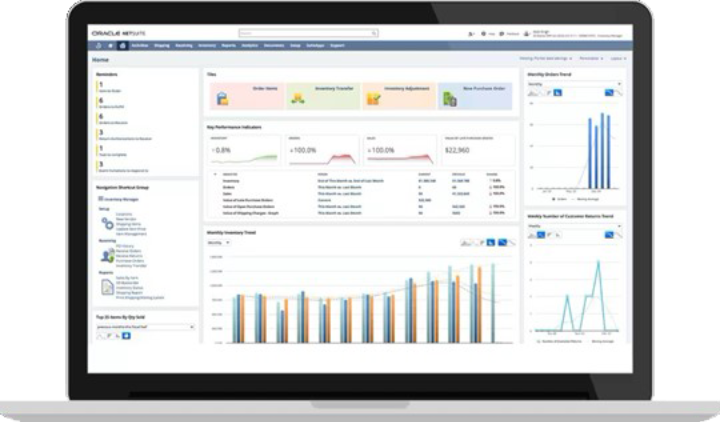
The effective implementation of AI into a manufacturing operation starts with access to high-quality data from every organizational level. NetSuite for Manufacturing is a comprehensive, cloud-based solution designed for modern manufacturers of all sizes. The software breaks down information silos, giving business leaders a centralized and integrated view of their organizations through robust capabilities in inventory management, real-time data analytics, business insights, and more. NetSuite also supports demand forecasting and production planning, allowing manufacturers to focus on growth and innovation, and drives strategic, informed decision-making.
Manufacturing Management with NetSuite
AI is a transformative shift that's reshaping industries around the world. It enhances manufacturers’ ability to analyze data, predict outcomes, and automate processes—all of which can enhance efficiency, reduce costs, and enable innovation at an unprecedented pace. AI’s applications in manufacturing are diverse and ever evolving, but they’re not without challenges. Therefore, decision-makers must carefully consider where, how and when their operations can best leverage the technology to maximize its benefits.
AI in Manufacturing FAQs
How can generative AI be used in manufacturing?
Generative AI is a subset of AI that can produce text, image, video, and audio content based on human prompts. In manufacturing, generative AI can optimize the design process by developing numerous design alternatives based on specified criteria. Generative AI copilots power support systems for factory workers, offering contextual feedback based on real-time operational data as well as troubleshooting assistance that ultimately leads to better job satisfaction and employee retention.
How could AI affect manufacturing jobs?
AI may automate some repetitive tasks while increasing demand for roles in robotics maintenance, data analysis, AI system oversight, process design, cybersecurity, and digital operations. Manufacturers should pair AI adoption with reskilling, clear governance, and human oversight so employees can use the technology safely and effectively.
How many manufacturing companies use AI?
According to the World Economic Forum, 89% of respondents across industries regard AI as essential and 68% of manufacturers have already started their AI journeys by fully implementing at least one AI use case in production. According to PwC, nearly 70% of the manufacturers it surveyed expect at least a three percentage point increase in operating profits by 2030, and over 40% anticipate a more substantial increase of five percentage points or more.