Maintaining healthy profit margins is crucial for ad agencies, but it’s not always a straightforward endeavor. Unlike product-focused businesses—such as retailers, which can easily calculate profit margins on individual products and categories—ad agencies and other service-based companies must be able to track, calculate, and optimize margins for a multitude of client accounts and projects with individualized billing structures.
With profit margins in the United States getting ever-narrower in today’s uncertain economy, major ad agency players like M&C Saatchi and WPP are rethinking their revenue forecasts for the coming year. Market conditions might shift over time, but one thing is certain: Ad agencies must find a way to maximize profit margins despite constant change if they want to stay in the black and achieve sustainable growth. This article examines how to calculate common profit margin ratios, explores industry benchmarks agencies can track to gauge their financial health, and offers tips on how to measurably improve profit margins.
What Are Ad Agency Profit Margins?
Ad agency profit margins are financial ratios that reveal how much profit an ad agency makes as a percentage of its revenue. Revenue refers to the total amount of money an agency earns by selling its services, be they content creation, digital marketing, or market research, after subtracting operational costs.
Profit margins provide agencies with a useful indication of their financial health. They show decision-makers where their company can operate more efficiently, how effectively it may weather challenging sales periods, and how well it’s performing relative to competitors. Just as important, agency leaders can use profit margin calculations to understand how much available money the agency has for investing in new projects and growth opportunities.
Key Takeaways
- Ad agency profit margins represent an important financial metric that tells agency leaders how successfully their business generates revenue and manages costs.
- The three key profit margin ratios for ad agencies to calculate are gross margin, operating margin, and net margin.
- To improve profit margin, ad agencies can optimize employee utilization, upsell existing clients, and expand process efficiencies through automation and integrated accounting software.
Ad Agency Profit Margins Explained
Ad agency leadership tracks profit margins to understand where and how to improve the company’s operations in order to boost profitability. For example, a low profit margin on a particular account might suggest that the agency should focus on upselling the client to generate additional revenue. By contrast, a period of high profit margins across the agency’s accounts might indicate that it’s time for the business to expand its operations while it has the capital to fund new projects.
Ad agency profit margins can be affected by external and internal factors. External factors that can drive profits up or down include competitors’ activity, market demand, and new industry trends. Internal factors include the agency’s pricing structure and rates, the efficiency of its operations, and its overhead costs.
Profit vs. Revenue: What’s the Difference? Which Should I Focus On?
Profit and revenue are both important metrics that measure an ad agency’s financial success. Revenue is the total amount of money the agency has earned from the sales of its services. It helps leaders comprehend the market demand for their agency’s services at any given moment. Many companies refer to revenue as their “top line,” because it’s the first entry on their monthly income statement. Unlike revenue, which doesn’t account for the cost of running a business, profit tells agency leaders how much money remains from overall sales after covering their expenses. Put another way, profit reveals how well an ad agency manages its costs and where it can improve its financial health.
Companies intent on financial sustainability are wise to make profit their long-term priority. After all, an ad agency can generate high revenue without being profitable, a common scenario for companies that are starting out, finding their financial footing, and offering clients favorable rates just to get their foot in the door. But unless it eventually builds and maintains healthy profit margins, that agency won’t be able to cover its operational costs or pay its employees, perhaps forcing it to shut its doors.
How to Calculate Ad Agency Profit Margins
Ad agency profit margins can be determined using three different ratios, each revealing useful glimpses into the business’s financial performance. By regularly calculating gross profit margin, operating margin, and net profit margin—and acting on the results—ad agencies can position themselves to work more efficiently, serve their clients more capably, and grow their profits over time.
Gross Profit Margin
Calculating gross profit margin tells ad agencies what percentage of their sales revenue can be converted into gross profit. In other words, it shows how efficiently the business can generate profit from the sale of its services. Agency decision-makers can use gross profit margin to determine how lucrative their accounts and projects are, then adjust their approach in cases where there’s room to generate additional revenue or reduce operating costs. The formula to calculate gross profit margin is as follows:
Gross profit margin = [Sales revenue – (Cost of sales / Sales revenue)] × 100
The first step in calculating gross profit margin is to calculate the agency’s gross profit, which is equal to its sales revenue minus its cost of sales. The cost of sales refers to costs that are directly associated with producing and delivering agency services, such as labor and travel costs. Note that the cost of sales excludes fixed business expenses that aren’t directly related to producing and selling an agency’s services, such as administrative costs and R&D expenditures. Once it has calculated its gross profit, the agency can calculate its gross profit margin by dividing this value by its sales revenue. This result is multiplied by 100 to express gross profit margin as a percentage.
Operating Margin
Operating margin measures the profitability of an ad agency’s core operations after accounting for its operating expenses and cost of sales. In practice, this metric tells agencies how much operating income they generate for every dollar of sales revenue that comes in. Be aware that an agency’s operating margin excludes costs that aren’t linked to the company’s daily operations, such as taxes and interest payments on loans. Here’s the formula for figuring operating margin:
Operating margin = (Operating income / Net sales revenue) × 100
To calculate operating margin, agencies first need to calculate their operating income. Operating income is equal to the profit a business has generated from its net sales minus its cost of sales and operating expenses. For an ad agency, the cost of sales includes the direct costs of providing services to clients—office space rental, supplies for its employees, technology investments—as well as overhead expenses, such as accounting and insurance costs. With operating income in hand, the agency can now calculate its operating margin by dividing its operating income by its net sales revenue. Once again, the result is multiplied by 100 to express operating margin as a percentage value rather than a dollar amount. This makes it easier for agencies to compare their financial health to industry benchmarks and to competitors of different sizes.
Net Profit Margin
Net profit margin is the truest measure of an ad agency’s profitability because it accounts for all company costs, from operating expenses to interest and taxes to preferred stock dividends. Net profit margin is a vital metric that not only helps agencies assess their financial health in the present but also improves their forecasting and ability to make well-informed financial decisions that will maximize their profit-making capabilities in the future. The formula for net profit margin is:
Net profit margin = [(Revenue – Net of all gains, losses, and expenses) / Revenue] × 100
To calculate net profit margin, agencies must first determine their net income, which is equal to their revenue minus the sum of all their gains, losses, and expenses, including taxes. “Gains” refers to income from noncore activities, such as selling an old business asset for profit; “losses” refers to noncore reductions in income, such as fees to cover a legal settlement ; and “expenses” are the cost of an agency’s core business operations. Once net income has been determined, the agency can calculate its net profit margin as a percentage by dividing this value by its revenue and multiplying the result by 100.
How Much Profit Should an Ad Agency Earn?
Different ad agencies will have different financial goals based on their size, market position, and client mix. No matter the objectives, calculating and comparing an agency’s gross, operating, and net profit margins to industry benchmarks provides a helpful indicator of its financial well-being and profitability relative to the competition.
When it comes to gross margin, an ad agency should aim for 50% or higher. This means that at least half its revenue will be available to cover operating expenses and overhead costs or reinvest in the business to drive new growth initiatives or service innovations. A gross profit margin below 50% would suggest that the agency must find ways to spend less time and money on project delivery—for instance, by rescoping projects or minimizing its reliance on expensive contractors. Agencies can also boost their gross margin by charging more for their services, though this approach risks turning clients away if the competition can deliver similar services at a lower rate.
Operating margin reflects what’s left after covering all the costs of running the agency—salaries, rent, software, other overhead—but before interest and taxes. An operating margin above 15% is generally considered healthy, while high-performing agencies typically hit between 20% and 30% or higher. This metric is especially useful for understanding how efficiently an agency manages its day-to-day operations. A strong gross margin paired with a weak operating margin often signals bloated overhead: too many people on the bench, expensive office space, or underutilized tools and subscriptions.
The advertising industry standard for net profit margins ranges from 15% to 35%, with many agencies targeting a value of 25%. This range varies by agency size, however. For example, small agencies often have high operating costs, especially those with relatively large teams compared to their size and client roster. By contrast, large agencies tend to have highly optimized working practices to help maximize profits on every client account project. Net profit margin can also vary based on the type of service an agency delivers. For example, high-value consulting agencies often enjoy higher profit margins than agencies that deliver more commoditized services, such as programmatic or pay-per-click marketing.
7 Tips for Maximizing Ad Agency Profitability
Many forces can impact an ad agency’s profitability. These include external factors, such as heightened competition and new market trends, and internal factors, such as the agency’s pricing strategies and ability to offer differentiated or innovative services. By following the seven strategies outlined below, and regularly calculating their profit margins to track progress, agencies can get incrementally closer to their profitability targets and improve their financial health year after year:
- Log all billable hours: Labor costs are one of an ad agency’s higher expenses, which is why making the most of each employee’s time is a top priority. By logging and reviewing employees’ billable hours each month, agency decision-makers and team leaders can see how efficiently their teams are working and course-correct when labor costs grow disproportionately high relative to a project’s scope. These corrections might involve reorganizing teams, rethinking inefficient working processes, or automating simple tasks, such as media monitoring and data analysis, so employees can focus instead on higher value work.
- Lower overhead costs: Overhead, one of a business’s indirect costs, refers to agency expenses that don’t contribute directly to the provision of its services. These expenses, which include employee salaries, office rent, insurance, and more, can account for roughly 30% of agency spend. Thankfully, overhead costs are easier to control than external factors. A best practice for ad agencies is to track monthly overhead costs—advertising budgets, accounting fees, office equipment, rent—and cut wherever possible to minimize the impact of these expenses on profitability.
- Assess your pricing strategy: The right pricing strategy can spell the difference between a low or a healthy profit margin. Some ad agencies charge their clients an hourly rate for their services; others charge flat rates for individual projects; still others work on a monthly retainer. An emerging trend among ad agencies is to offer value-based pricing, whereby clients pay for projects based on their perceived value of an agency’s services. Value-based pricing lends itself well to profit optimization because it tells agencies which clients are willing to pay for their deliverables. This allows agencies to work backward and scope projects in a way that will help them achieve their desired margin on individual projects and accounts.
- Wrangle scope creep: Scope creep occurs when a project wasn’t planned accurately, an agency incurs unexpected project expenses, or a client makes additional requests throughout the course of a project that eat into an agency’s profit margin. Agencies that charge billable hours can simply make their clients pay for these additional costs. But those that charge a flat rate or offer value-based pricing must be especially attentive when scoping out projects, taking care to implement tight controls so that scope creep doesn’t get out of hand. Some agencies manage to turn scope creep into new revenue opportunities by creating and charging their clients for add-ons and ad hoc services to address changes in project scope.
- Focus on client retention: Long-term client relationships hold the key to generating consistent revenue. Agencies that build and nurture lasting relationships avoid the high acquisition costs of finding and on-boarding new clients. Ad agencies can also improve their profit margins by focusing on high-value customers that have been with them for years and that continue to increase their spend as the relationship expands. In doing so, agencies can deepen these partnerships and achieve higher profits over time.
- Consider new revenue streams: Where possible, ad agencies should diversify their revenue streams to unlock growth, make themselves more resilient to economic or market shifts, and attain financial stability. Common practices include partnering with other agencies to deliver joint services, expanding into new markets, and developing new and differentiated services to sell to their clients. On that note, upselling existing clients with bundled and complementary services is one of the easiest—and most effective—ways to generate new revenue without spending time and money on new client acquisition.
- Alleviate inefficiencies with templates, automation, and software: Process optimization is a path to efficiency gains, time saved, and costs avoided. Smoother operations free ad agency employees to focus more on profitable work, which, in turn, boosts a company’s margins. Agencies are increasingly implementing automation software to accelerate repetitive tasks and lower labor costs. That said, billing and accounting software presents an added business expense, so agencies must make sure the cost reductions they achieve with these tools will be greater than their initial investment or their subscription fees, in the case of software-as-a-service cloud-based technologies.
How NetSuite Helps Track and Manage Agency Margins
To grow and maintain healthy profit margins, ad agencies must be able to track cash flow and profitability with the utmost precision. NetSuite Accounting Software for Advertising & Marketing Agencies combines project management, financials, and other core processes within a single cloud system, giving agencies the visibility and control they need to achieve this goal. NetSuite’s AI-powered software automatically posts fixed-fee projects, commission revenue, media costs, retainer drawdowns, and other core financial data. Instead of spending days preparing manual reports, agency accounting teams can produce auditable numbers in hours, helping decision-makers adjust project scope, staffing, and media allocations quickly to maximize profits and minimize costs. Using NetSuite’s live-data dashboards, agency leaders can also track key metrics, such as employee utilization, job burn, and media markups, so they can course-correct before overruns hit their P&L.
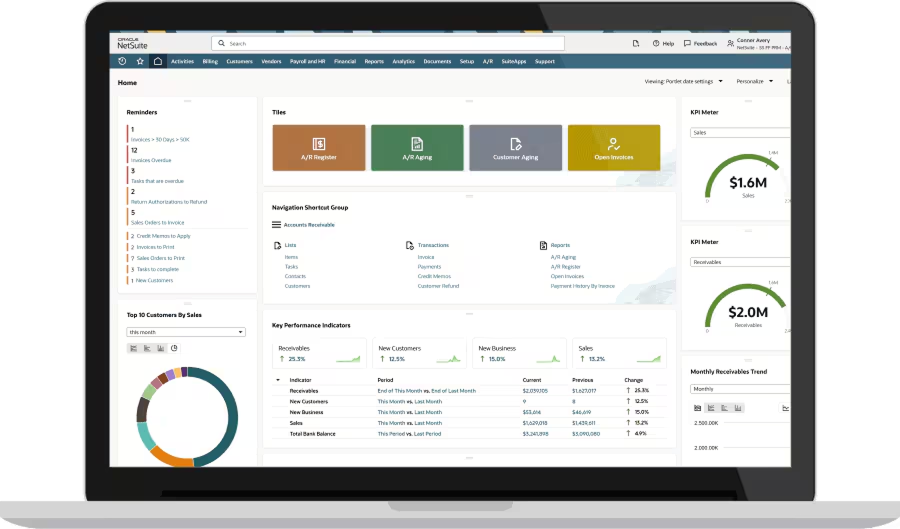
Manage Accounts Receivable With NetSuite
Profit margins aren’t just numbers on a spreadsheet—they’re the clearest signal of whether an agency is built to last. In a market where even the biggest players are trimming forecasts and tightening belts, agencies that thrive will know exactly where their money goes, which clients and projects actually pay off, and where inefficiency is quietly eating into their bottom line. The math isn’t complicated; the discipline is. To compete, ad agencies must diligently track margins, benchmark against industry trends, and treat every point of improvement as money back in their pocket.
Ad Agency Profit Margins FAQs
What is a healthy profit margin for an ad agency?
Healthy profit margins for an ad agency depend on whether it’s examining its gross profit margin or net profit margin. A good rule of thumb for agencies is to aim for a gross profit margin of at least 50% and a net profit margin of 15% or more.
What are common mistakes in profit margin calculation?
Common errors when calculating profit margins include misallocating expenses, underestimating indirect business costs (including rent and utilities), and forgetting to update business costs as needed to account for inflation and rising labor rates. Another common mistake is using gross profit instead of net income when calculating the business’s net profit margin, which risks giving the business an overinflated view of its financial health.