For decades, the fashion manufacturing industry has relied on forecasts and bulk runs that often created overstock and markdowns. On-demand production offers an alternative to the traditional “make now, sell later” mindset through a responsive, order-driven approach. This technique, along with a host of integrated methodologies and technologies, is redefining how apparel brands produce clothing, manage their costs, and protect their margins.
What Is On-Demand Apparel Manufacturing?
On-demand apparel manufacturing is the process of creating a garment only after a customer has placed an order.
Also referred to as “made to order,” on-demand production is a rapidly growing segment of the clothing business. It comes in response to customer demand for customized garments, a growing emphasis on sustainability-minded manufacturing, and evolving technologies that incorporate AI.
Key Takeaways
- The rise of on-demand clothing manufacturing is driven by consumer expectations about customization and sustainability.
- The on-demand process begins when a customer places an order.
- On-demand offers manufacturers numerous benefits, including accelerated time to market and a reduction in material and financial waste.
- On-demand draws on several methodologies, such as lean and just-in-time (JIT) manufacturing.
On-Demand Apparel Manufacturing Explained
On-demand apparel manufacturing operates as a digitally connected workflow that triggers design, sourcing, and production only after an order is placed. It exemplifies what’s known as the “pull system,” in which a product enters the market following direct demand from consumers. In the apparel industry, on-demand production gives buyers control over the appearance of their clothes Under the on-demand production model choices include fabrics, colors, and detailing, while garments are custom-sized for a perfect fit.
The pull model inverts the traditional push dynamic, in which clothing is mass-produced based on demand forecasting and then shipped out to the market. The push method is typically suitable for large-scale production of products with long shelf lives. However, in the apparel industry, it can harm a company’s bottom line through unused raw materials and fabric scraps, unsold clothing, high carrying costs, and other forms of material and financial waste.
The on-demand production process enables businesses to respond quickly to market trends and helps shrink manufacturers’ environmental footprint. McKinsey research shows that it allows most clothing manufacturers to reduce their carbon emissions by more than 60%. It also paves the way for resource-efficient, on-demand garment microfactories to proliferate independently of traditional manufacturing centers. Indeed, these small-scale production facilities are forecast to reach $6.2 billion by 2033, nearly three times their 2024 value, according to Dataintelo.
The Rise of On-Demand Manufacturing in the Apparel Industry
On-demand manufacturing is gaining traction as consumers grow accustomed to customizing nearly every aspect of their lives from coffee orders to skincare formulas, even if that personalization means paying as much as 50% more, per Deloitte. In the apparel industry, this appetite for individuality has turned personalization into a substantial business opportunity, with the market for custom apparel projected to increase from $678.4 million in 2024 to $1.26 billion by 2032, according to Credence Research.
At the same time, sustainability concerns have become hard to ignore. On-demand manufacturing directly addresses one of fashion’s biggest problems: waste. By producing garments only as they’re ordered, brands can cut down on overproduction, unsold inventory, and fabric waste, while shrinking their carbon footprints through smaller batch runs and reduced shipping and warehousing needs.
The rise of made-to-order clothing manufacturing also aligns with the principles of slow fashion, emphasizing quality over quantity and allowing brands to adopt more ethical labor practices. Slower, more deliberate production cycles also make it easier for companies to source sustainable materials and maintain supply chain transparency.
Still, on-demand manufacturing wouldn’t be possible without parallel advances in technology. Recent developments in AI, digital and 3D printing, and computer-assisted design (CAD) have all been instrumental in driving the growth of on-demand apparel manufacturing. They’re also lowering the barriers to entry for independent designers and startups.
How Does On-Demand Apparel Manufacturing Work?
On-demand manufacturing blends digital technology, flexible production methods, and integrated logistics to deliver customized garments quickly and efficiently. The following covers the steps involved:
- The customer places an order: On-demand production begins when a customer has placed an order, typically through an apparel brand’s website or app. These platforms typically provide visuals, detailed descriptions, and, sometimes, augmented reality tools to help customers virtually “try on” their choices. Shoppers can select from options for fabric, color, size, fit, and design details. They may also be able to add personal touches, such as monograms or unique patterns.
- The manufacturer processes the order: After the customer places and pays for the order, the brand’s ordering system passes the relevant product details to the manufacturer, usually via an integrated digital workflow. The manufacturer’s system verifies the order, confirms material availability, and adds the job to the production queue. In advanced systems, AI will analyze the order data for potential complications, such as formatting conflicts, and suggest alternatives if needed.
- The order goes to production: Most clothing manufacturers have automated at least part of their manufacturing processes. For example, pattern-cutting is commonly handled by digital or laser-guided machines. New printing technologies, such as direct-to-garment (DTG) or dye sublimation, may be used to decorate fabric with specific designs or patterns. Many companies still employ sewing professionals, though some are also automating that process with smart sewing machines, which combine programmable stitching, sensors, and AI to decrease the amount of manual work.
- The order is finished and checked for quality: After the garment is sewn, it moves into finishing. This stage may include adding final detailing, such as embroidery, trimming threads, pressing, and folding. Once completed, the garment is inspected to make sure it matches the customer’s order and meets brand standards. Trained staff, along with AI-enabled systems, check for defects, color accuracy, fit, and personalization accuracy.
- The order is shipped: After the garment passes quality control, it’s packaged, often with personalized touches like a thank-you note or specialty wrapping. Then it’s shipped directly to the customer, reinforcing the speed and efficiency of on-demand apparel fulfillment by bypassing the need for warehouses or traditional distribution chains.
Benefits of On-Demand Apparel Manufacturing
Manufacturing clothes on demand is a textbook example of a win-win situation: Consumers get exactly what they want, and brands can respond quickly to trends without the costs and risks associated with overproduction. Almost every facet of the business reaps the benefits:
- Accelerates time to market: Fabricating clothes as they’re ordered eliminates several time-consuming steps that occur in the traditional fashion model, including exhaustive forecasting and bulk production. This gives manufacturers the agility to move quickly from concept to final product, making it possible to ride trends as they’re happening.
- Reduces waste: In 2023, clothing manufacturers produced an estimated 2.5 billion to 5 billion items of excess stock—worth between $70 billion and $140 billion in sales according to the Business of Fashion and McKinsey’s “State of Fashion 2025” report. Waste on that scale hurts the bottom line and may hurt the environment. On-demand apparel manufacturing, backed by technology-driven precision cutting, significantly alleviates that problem.
- Optimizes inventory: The goal of on-demand manufacturing is not to eliminate but to manage inventory more efficiently. By matching production more closely to actual demand, companies can align stock levels with sales while improving cash flow.
- Prevents overstock: As a related advantage, by making only the clothes that customers have already ordered—and paid for—manufacturers avoid unwanted slow-moving inventory to cut down on waste, markdowns, and storage costs.
- Increases reach: On-demand manufacturing removes the logistical and geographical barriers that limit markets by bypassing the established supply chain. Using online portals and direct shipping, brands can sell to a global audience. They can also appeal to a broader customer base by serving niche markets and catering to regional customers.
- Enables customization: Advanced technology makes it possible for brands to offer myriad versions of the same clothing pattern. In addition to designating their size, customers can choose fabrics, colors, detailing, and other options to personalize their selections.
Challenges of On-Demand Apparel Manufacturing
On-demand manufacturing forces companies to rethink traditional logistics, inventory strategies, and production workflows. However, any apparel manufacturer considering on-demand production should be aware of the following challenges:
- Balancing costs: Despite the cost savings afforded by on-demand manufacturing, sometimes companies can overlook the reality that their per-garment cost will increase. According to one analysis, on-demand production costs can be up to 31% higher than those for traditional ready-to-wear manufacturing, and transport costs may be seven times higher. To thrive, companies must balance the operational costs of producing a custom garment with the pricing power of customization and the efficiency gains derived from less waste and faster turnover.
- Overcoming implementation obstacles: Implementing on-demand
manufacturing requires a highly flexible, digital production system and the integration
of new processes into existing structures. On the systems side, connecting order
management systems, CAD design software, manufacturing execution systems
(MES), supply chain management, and other tools can present technical
challenges. However, this integration is necessary for a seamless data flow.
In operations, re-engineering production processes, workflows, and layout of the production floor requires extensive employee training, which can be expensive and time-consuming. Other hurdles include the need for new inspection protocols and quality-assurance systems, as well as reevaluating material sourcing and supplier relationships.
- Maintaining consistent quality: Automation enhances consistency, but it doesn’t guarantee it. To begin with, equipment requires ongoing maintenance and calibration to maintain accuracy. Garment consistency can also be hampered by variability in raw material, such as different dye lots. And although the ability to customize so many elements of a garment is a selling point, each specification increases the possibility of a production error.
- Managing complicated logistics: On-demand manufacturing eases some traditional logistical burdens, but it also introduces new ones. One challenge is synchronizing order intake with decentralized production and direct-to-consumer delivery. Coordinating across microfactories and fulfillment partners—often using multicarrier shipping networks—can compromise lead times and raise costs.
Methodologies That Power On-Demand Manufacturing in the Apparel Industry
Although on-demand apparel manufacturing appears to represent a single process, it actually results from a combination of several distinct methodologies. Together, these components foster continuous adaptation: an environment in which rapid prototyping, small-batch production, and real-time data exchange are central to operations.
-
Lean manufacturing:
The term “lean” is the overarching philosophy of efficiency and waste reduction. It strives to remove waste across all aspects of production, such as excess inventory, unnecessary movement, overproduction, or defect. Lean manufacturing is built on the principle of continuous improvement (aka Kaizen) and encompasses the entire production system. -
Just-in-time (JIT) production:
First developed by automakers in post-World War II Japan, JIT manufacturing is a lean strategy that aims to minimize inventory and reduce waste by producing goods exactly when they are needed. It relies on precisely timed production schedules and efficient supply chain management to accomplish that. JIT primarily benefits the manufacturer as a cost-cutting strategy that also improves cash flow, whereas on-demand production focuses more on serving customers. -
Digital prototyping:
Digital prototyping gives designers and manufacturers specialized 3D apparel design and simulation software that develops and refines a garment’s design, details, and fit virtually, all before production begins. This approach obviates the need to create multiple physical samples, which saves money and minimizes waste. It also shortens the design-to-production cycle, which means customers receive their customized orders faster. -
Agile supply chain management:
Agile supply chain management involves building and managing supply networks that can quickly respond to changing market conditions, customer demands, and unforeseen disruptions. This is accomplished through real-time data-sharing among partners, decentralized decision-making, and the ability to adjust sourcing and production as needed. Such agility helps businesses meet customer expectations for faster, more personalized, reliable delivery.
Technologies That Drive On-Demand Manufacturing in the Apparel Industry
The technologies driving on-demand manufacturing in the apparel industry are rooted in digital innovation, providing real-time data, automation, and advanced fabrication capabilities. They include 3D knitting, digital cutting, and AI. The following provides a deeper look at each of these.
-
3D knitting:
3D knitting technology removes the traditional steps of creating, cutting, and assembling fabric by shaping yarn into complete garments. In contrast to customary circular weaving, 3D knitting intertwines yarns at perpendicular angles, making stronger garments and using fewer materials. It’s a sustainable alternative that consumes less yarn and generates minimal waste. -
Direct-to-garment (DTG) printing:
DTG printing is a specialized inkjet technology that prints designs directly onto the fabric of a garment. The process involves applying water-based inks directly onto the fabric surface of T-shirts, hoodies, and other garments. DTG allows for the creation of detailed, vibrant images and complex graphics without the involvement of screens or stencils. -
Digital cutting:
Digital cutting uses computer-controlled blades or lasers to cut fabrics, patterns, or materials directly and accurately from digital designs. It minimizes fabric waste, allows for quick turnaround of customized designs, and enables brands to offer complex or intricate patterns that would otherwise be difficult or time-consuming to produce manually. -
AI and predictive analytics:
AI and predictive analytics work together to make on-demand apparel manufacturing more responsive and efficient. Predictive analytics applies machine learning and statistical modeling to analyze data, including customer preferences, purchasing trends, inventory levels, and production capacity. This analysis provides insights to better anticipate demand, plan production schedules, and optimize resources. AI builds on those forecasts, fueling personalization and real-time visibility into performance data. AI systems also monitor production in real time, identifying potential bottlenecks and suggesting adjustments to maintain efficiency, quality, and delivery speed. -
Integrated software:
Integrated software comes in many forms, whether a single ERP platform with embedded project lifecycle management (PLM), ERP, MES, and CRM modules or a unified ecosystem of separate systems. By connecting data and processes across functions in real time, businesses gain the level of coordination required for on-demand manufacturing. PLM manages product design data, material specifications, and version control; ERP handles financials, procurement, and inventory; CRM provides visibility into customer orders and preferences; and MES tracks production activity on the factory floor. Together, these systems allow designers, manufacturers, and suppliers to work from synchronized data, adjusting as they go, without disrupting production. They also automate scheduling, material planning, and supply chain coordination, making sure resources are available and orders are fulfilled efficiently.
Power Your Apparel Company With a Modern ERP
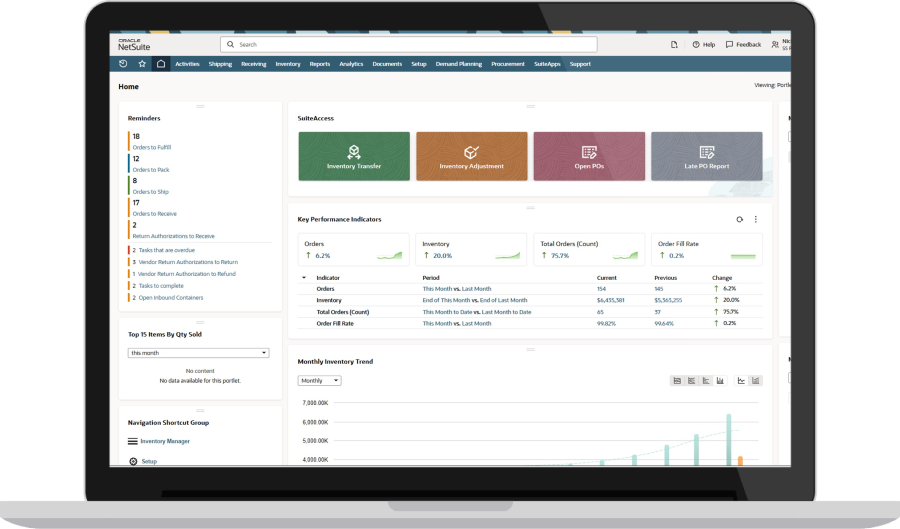
NetSuite Apparel ERP addresses the challenges of on-demand apparel manufacturing: seamless integration, real-time visibility, and the agility to manage customized orders. The cloud-based, fully integrated platform eliminates the issues of fragmented systems and processes by connecting every stage of the process from order capture and design through production, quality control, and shipping. It unites intelligent order management—which automates complex, multichannel workflows—with comprehensive inventory and supply chain management that improves material sourcing, tracks lead times, optimizes stock levels, and minimizes waste. In addition, built-in financial management capabilities provide real-time visibility into costs, margins, and revenue recognition, helping businesses stay profitable. Embedded AI and advanced analytics enhance demand forecasting, quality control, and proactive decision-making for insights that align production with shifting market trends and evolving customer preferences.
On-demand manufacturing is changing how apparel is designed, produced, and delivered. Aligning production with actual demand reduces waste, shortens lead times, and supports sustainability. The result is a more responsive and resource-efficient fashion industry that delivers exactly what consumers want, when they want it.
On-Demand Apparel Manufacturing FAQs
What is on-demand manufacturing?
On-demand manufacturing is a production process in which goods are made only after a customer places an order. It allows for a high degree of customization.
What is an on-demand warehouse?
An on-demand warehouse is a storage facility that provides inventory storage and fulfillment services tailored to real-time demand. In other words, businesses can access space and logistics support only when they need it, helping to cut costs.