
Consumers and business buyers are becoming increasingly specific when shopping for their needs and wants, making them more unlikely to accept less-than-exact matches. For this reason, manufacturers that follow the traditional path of anticipating customers preferences by forecasting and building “standard” products are now facing risks such as high production costs, capital tied up in packed warehouses of unsold inventory, and materials allocated to items that never sell. To minimize or eliminate these risks, many manufacturers are turning to on-demand production, a business model that calls for waiting until orders are placed before finished goods are produced.
Implementing the on-demand manufacturing approach requires a fundamental operational transformation that entails careful planning, dedicated digital tools, and specialized techniques. This article examines the essential technologies, strategic advantages, and implementation challenges of on-demand manufacturing.
What Is On-Demand Manufacturing?
On-demand manufacturers begin producing items only after a customer places an order, rather than building bulk quantities in advance and storing them as inventory. This approach allows manufacturers to align production processes with actual demand, not forecasted needs, which eliminates excess inventory and enables greater customization. Historically, on-demand manufacturing was difficult to achieve, but today’s manufacturers combine advanced manufacturing technologies and digital systems to more efficiently produce goods as they are ordered.
When executed properly, the on-demand process can improve the manufacturer’s cash flow, resource utilization, and customer satisfaction. If implemented poorly, on the other hand, it can create fulfillment delays that divert customers to faster competitors.
Key Takeaways
- On-demand manufacturers produce goods only after customers place orders.
- This approach minimizes the need to hold excess stock and gives consumers and business buyers more flexibility.
- On-demand manufacturers harness several technologies, such as 3D printing and computer numerical control (CNC) machining, to quickly and precisely produce custom goods.
- Manufacturing goods on demand comes with its own drawbacks, as small-batch production facilities may miss out on bulk discounts and struggle to scale customized production methods.
On-Demand Manufacturing Explained
Satisfying customers when fabricating and delivering goods on demand requires a tight timeline. Therefore, on-demand manufacturing processes tend to follow a distinct workflow that begins when a customer submits a request. After the customer provides specifications, digital systems automatically analyze the details and generate a price quote. As soon as the customer confirms the order, the system creates a detailed production plan that contains material requirements, scheduling, and quality control parameters, then forwards the order to the appropriate manufacturing operations.
This approach capitalizes on automation, replacing traditional production planning with a dynamic, order-driven process. Rather than maintaining standing factory lines for uniform products, manufacturers configure their operations to respond to each order as it arrives. To illustrate, consider a traditional eyewear manufacturer that constructs thousands of identical frames. These frames are stored in warehouses until they are purchased, with adjustments made to accommodate customers’ measurements just before delivery. By contrast, an on-demand manufacturer might perform a 3D face scan via its app, then design and manufacture custom-tailored eyeglasses and sunglasses for each individual customer, as Topology Eyewear in San Francisco does. Topology’s process involves milling acetate frames—using CNC machining—or laser-cutting stainless steel.
This kind of shift from traditional to on-demand manufacturing reduces inventory costs, but it does require manufacturers to prioritize flexibility and rapid response.
On-Demand Manufacturing vs. Traditional Manufacturing: Key Differences
Many manufacturers employ a hybrid combination of production methods: traditional for some goods and on demand for others. Understanding the differences between these methods is key to evaluating which approach best suits each product’s unique operations, goals, and customer base. The most important ways in which the two manufacturing approaches differ are:
- Time to market: On-demand manufacturing shortens a new product’s overall time to market by enabling rapid prototyping, quick design iterations, and immediate production once a design is finalized. Companies can then move from product conception to availability much faster than with traditional manufacturing, which usually involves lengthy tooling, production planning, large batch runs, and substantial inventory buildup before products are ready for market—unless a customer is ordering standard goods, in which case traditional manufacturers may already possess inventory that can be shipped immediately.
- Cost: Despite higher per-unit costs than traditional mass production, on-demand manufacturing often reduces or eliminates inventory carrying costs, minimizes the risk of holding unsold inventory, and cuts down on initial investments in tooling and storage. Traditional manufacturing achieves lower per-unit costs through large production runs, but requires significant up-front investment in equipment, materials, and inventory.
- Waste: By producing only what customers order, on-demand manufacturing minimizes waste by reducing both excess material from production processes (scrap) and dead stock. Traditional manufacturers can end up with too much inventory due to incorrect demand forecasts or dynamic market conditions. Or, worse, they could miss sales opportunities if they underestimate customer demand.
- Flexibility: On-demand production allows manufacturers to quickly adapt to changing customer preferences because their digital fabrication gear is designed to accommodate modifications. Traditional manufacturing is better suited for producing large quantities of standardized items, rather than customizable items.
- Technology: The systems that power on-demand manufacturing use scalable digital tools that can quickly adapt to different products and specifications as orders come in. These tools automate tasks throughout the order-to-cash cycle, including order tracking, delivery confirmation, and follow-up communications. Traditional manufacturing relies instead on conventional equipment designed to produce particular items in high volumes.
Technologies That Enable On-Demand Manufacturing
On-demand manufacturing technologies turn customer orders into high-quality goods quickly and effectively. When implementing an on-demand production model, manufacturers must match the right technologies to their operational needs. The main on-demand manufacturing technologies include:
- Additive manufacturing: More commonly known as 3D printing, additive manufacturing adds layers of material—plastic, ceramics, metal, and so on—on top of each other to create a product that matches exact specifications. Businesses often use this technique to build new prototypes or components quickly, such as those with complex patterns, or to test adjustments made to a product’s dimensions.
- Automation: Automation can enhance steps throughout the on-demand manufacturing process, from automatically uploading exact customer schematics to fabricating products to printing shipping labels for final delivery. On-demand manufacturers also use automated robots and calibration programs to adjust production machinery on the fly as customer requirements change.
- Artificial intelligence: AI algorithms can strengthen a business’s ordering process, giving customers more design options, real-time demos, and suggestions for features and specifications that fit the customers’ preferences and buying history. AI-powered software also can analyze design requirements and suggest the fastest, least costly, and most sustainable manufacturing process for each part. Companies can use AI to analyze historical data to improve forecast accuracy of supply chain needs and machinery performance, informing proactive strategies to optimize material inventory and reduce downtime. And AI-driven inspection systems can use computer vision to detect defects and ensure product quality in real time, reducing waste and recalls.
- CNC machining: This technology uses software to control the movement of machinery and tools that shape materials into precise components. It can enhance the accuracy, repeatability, and complexity of the parts produced by machines, making it ideal for creating hyper-customized products on demand. CNC machining can also increase productivity and extend operating hours because they can operate continuously with minimal human intervention. And they can improve workplace safety by automating tasks too dangerous for manual completion, such as cutting, milling, or drilling hard materials.
- Laser cutting: Lasers are used to cut, melt, or engrave raw materials—most commonly metal but also plastics, wood, and more. These tools are often more precise than traditional cutting methods and easier to program, so they’re ideal for producing highly customized or intricate designs. Their precision and flexibility result in faster turnaround times and less waste, especially for small batch, on-demand orders.
- Cloud-based software: With cloud software, manufacturers can transform their digital infrastructure by uniting order intake, production, quality control, and shipping in a single platform accessible by everyone in a team. This real-time, centralized system not only streamlines order fulfillment but also provides instant visibility into inventory, production status, and supply chain operations. Cloud solutions allow manufacturers to scale production up or down as needed, reduce IT costs, and integrate advanced technologies, such as Internet of Things (IoT) devices and AI.
Benefits of On-Demand Manufacturing
On-demand manufacturing businesses tend to be more innovative, flexible, and sustainable than manufacturers that use traditional techniques. This is especially true when manufacturing features are integrated into a larger enterprise resource planning (ERP) system that connects production to ordering, customer management, and fulfillment data. This holistic manufacturing approach brings several benefits to a business’s operational efficiency and bottom line, as well as the overall customer experience. Here are seven specific benefits of manufacturing on demand:
Shortens Production Cycles
On-demand manufacturing shortens production cycles by tapping into digital tools and more agile equipment to produce small runs of goods, rather than relying on forecasts and mass production as traditional manufacturers do. Using this approach, a company can move quickly from design to finished product before rapidly pivoting to fabricating different products or customizations. As a result, manufacturers benefit from faster time to market, greater flexibility in responding to changing customer needs, reduced risk of overproduction, and improved cash flow.
Enhances Product Customization
Manufacturing on demand lets customers choose a wider range of options when placing their orders. Modern software allows businesses to preset options and selection ranges for more diverse customer choices without expanding into unrealistic or tough-to-produce goods. For example, a traditional toy manufacturer may have a handful of basic models for dolls, painting or adding attachments after production to vary each product line. An on-demand manufacturer, however, can make customization part of the initial ordering process, empowering parents or children to design every detail within the established size/material range before sending the order details to a 3D printer.
UK-based MakieLab, for example, allows customers to digitally design their own 10-inch fashion dolls, which are then produced using 3D printing. Budsies, located in Florida, specializes in creating completely custom plush dolls based on customer drawings or specifications. Its on-demand process can make each doll unique—and it has shipped more than 200,000 of them.
Enables More Innovation
On-demand manufacturing empowers companies to take more creative risks by allowing design and engineering teams to use digital tools for adjustments and prototyping, speeding up the time to market for innovation. Rapid prototyping lets businesses add to or change existing offerings and then quickly test those changes. Because on-demand manufacturing accelerates the development cycle and reduces risk, it allows for quick iterations and refinements, so designers and engineers can experiment with complex or unconventional designs that might be impractical using traditional mass production methods. This is especially important in highly competitive or volatile industries, where new fads or tech advancements regularly disrupt the market, leaving slow-to-innovate competitors behind.
Lowers Production Waste
On-demand manufacturers limit their waste with finely tuned and specialized equipment that reduces scrap. Advanced machinery, including CNC equipment and laser cutters, can be optimized to meet specific customization ranges and calibrated within a small margin of error to create exact cuts and assemblies that yield minimal waste, even when details change from one batch to the next. Additionally, any unavoidable scrap, especially from 3D printers or injection molders, can be melted down and repurposed, further reducing waste.
Improves Inventory Control
For many companies, reduced inventory is the primary goal of on-demand manufacturing—remember, by producing only the goods that customers have ordered, there’s no need for large stock reserves and, therefore, no high storage costs. Manufacturers producing goods on demand can implement real-time inventory tracking courtesy of barcode scanners and automated checkpoints to monitor goods as they move through the order fulfillment process; they can also pinpoint bottlenecks or inefficiencies, a key obstacle to the fast turnaround that on-demand customers have come to expect.
Lowers Environmental Impact
If a business can reduce its surplus production, it will likely also reduce its energy and raw materials consumption—a major demand from environmentally conscious customers. According to PwC’s “2024 Voice of the Consumer” survey, customers across industries are willing to pay 9.7% above average price for sustainably produced or sourced goods, with a manufacturer’s waste reduction and recycling programs the greatest incentives for purchasing, mentioned by 40% of respondents. By demonstrating a commitment to sustainability, companies can protect the environment, lower their utility and material costs, and attract new customers.
Increases Flexibility
Companies that invest in the flexible production techniques and equipment required for on-demand manufacturing are better positioned to adapt to changes in the marketplace, such as emerging trends or sudden shifts in demand. By monitoring orders over time, on-demand manufacturers can identify popular customizations and introduce new products or features to seize unexpected opportunities, especially if those manufacturers sell directly to consumers. And when customer preferences shift away from popular offerings, on-demand manufacturers can instantly fine-tune their catalog without worrying about unsold inventory sitting in warehouses.
Drawbacks of On-Demand Manufacturing
On-demand manufacturing comes with several unique challenges, as producing goods to order involves additional precision and logistical considerations—as well as a different approach to applying resources. Below are five common impediments to on-demand manufacturing, with strategies for overcoming them:
Increases Cost
Small batch manufacturing often leads to higher costs in two major areas: procurement and production. Without the benefit of buying supplies in bulk, on-demand manufacturers often pay higher per-unit material costs. To reduce these costs, they can implement more sophisticated inventory management and forecasting tools to optimize order timing and quantities. For production, regular equipment adjustments for custom orders can slow down production output, increasing the share of fixed expenses (rent, administrative salaries, etc.) allocated to each unit’s costs. Investing in more efficient, automated equipment and streamlining production processes can reduce setup times, control utility costs, and minimize waste, thereby lowering the overall cost of goods sold.
Reduces Scalability for Large Orders
Producing goods after customers place orders can create bottlenecks during busy seasons or unexpected demand spikes, because each order may require a unique production run to match a customer’s exact specifications. Specialized equipment designed to produce the range of goods a manufacturer offers, especially machinery that can be adjusted automatically, allows businesses to quickly calibrate devices from one order to the next, shortening downtime and speeding up output. Some companies may also partner with external manufacturers or use distributed manufacturing networks for temporary capacity expansion during peak periods to help meet large orders without compromising lead times or quality.
Complicates Logistics
Manufacturing goods on demand increases logistical complexity because it hinges on real-time coordination of material sourcing, production, and delivery for each unique order, rather than relying on prebuilt inventory. Therefore, any supply chain slowdown or shortage can quickly lead to production delays and missed deadlines, opening the door to potential inroads by competitors with inventory reserves of comparable goods. The unpredictability and variety of orders further complicate scheduling and transportation, making it essential for companies to have agile and responsive logistics systems. By fostering diverse vendor relationships and investing in predictive analytics and advanced supply chain management and procurement systems, businesses can minimize these risks through forecasting and real-time visibility. These strategies can also help companies respond quickly to disruptions, such as extreme weather or sudden shifts in global trade policies, and keep orders moving smoothly.
Fosters Choice Paralysis
Offering diverse options can help businesses stand out in a competitive ecommerce market. But having too many choices can intimidate customers and overcomplicate the ordering process. According to the Baymard Institute, 18% of customers didn’t follow through with online orders because the process was “too long/complicated”—a top-five reason for cart abandonment. For manufacturers, an overly complex catalog may not only reduce sales but also complicate production and inventory management. Monitoring sales data and eliminating low-performing or low-margin goods can streamline both the ordering process and manufacturing operations. For example, consider a furniture manufacturer needing different machinery for customers’ different choices of wood. By limiting wood choices, the company could generate increased sales, lower costs thanks to a simplified manufacturing process, and offer a more consistent quality experience to customers.
How Do Companies Use On-Demand Manufacturing?
On-demand manufacturing has diverse applications, since nearly anything can be produced to order. But different industries reflect unique manufacturing priorities and, therefore, may implement different on-demand production tools and methods. Let’s dive into five major sectors that utilize this manufacturing model.
Healthcare
Between the drive to improve people’s health and the need to manage high costs, the healthcare industry has an insatiable thirst for innovation. On-demand manufacturing’s rapid prototyping provides a way to reduce the time to market for new medical devices while improvising the speed and quality of testing and clinical trials. This is especially true of complex products that require more precise and unique production specifications than available in traditional manufacturing. Medical companies also use on-demand manufacturing techniques, such as 3D printing, to create personalized items that directly satisfy a specific patient’s requirements, such as prosthetic limbs, perfectly crafted hearing aids, or even bioprinted organs and tissues.
Automotive
No one makes entire vehicles to a customer’s exact specifications, except within the boundaries of what traditional assembly line production can do. But the auto industry uses on-demand manufacturing techniques, such as 3D printing, CNC machining, and laser cutters, in at least two major ways. The first is to create low-volume metal and plastic parts that may be used only during a recall or for fine detailing; second, the auto aftermarket produces extensive customizations meant to enhance a particular car’s performance or aesthetics, which usually must be at least slightly different for every vehicle. Manufacturing on demand lets companies do this without maintaining a large and costly inventory. It’s also used to quickly update vehicle parts to meet new safety standards as regulations change.
Textiles and Apparel
As mentioned above, many modern consumers are concerned with sustainability, and textile and apparel buyers are a major force behind that trend. In fact, the sustainable fashion market was valued at $7.7 billion in 2023 and is expected to grow 23% annually into the next decade, according to a 2024 study. Nevertheless, textiles contribute more than 17 million tons of annual waste in the United States, according to the most recent EPA report. By adopting on-demand manufacturing, clothing companies can reduce their waste by only selling items customers want, in the sizes they need. This is especially true for boutique fashion and seasonal or trendy styles, as the demand for these items can fluctuate rapidly, leaving retail stores and warehouses filled with unsold stock.
Construction
Builders use on-demand manufacturing techniques, including laser cutters and injection molding, for components and tools fulfilling a project’s exact sizes and requirements. In some cases, these machines are available onsite, trimming component turnaround time down to hours or even minutes. Less commonly, companies use 3D printers to build entire structures and buildings, reducing the time, labor, safety risks, and waste involved.
Aerospace
The aerospace industry requires precise and lightweight components, and on-demand processes—such as additive manufacturing and CNC machining—can create detailed structures that balance strength and weight to meet customers’ demands. Meanwhile, engineers use these technologies to create objects with complex features or geometric patterns, often in the locations where they will be used, an important benefit for remote areas unable to access traditional supply chains—including space.
Future Outlook of On-Demand Manufacturing
With continual evolution regarding data capture and analytical capabilities, on-demand manufacturing is likely to become far more prevalent across industries. Research shows that many manufacturers believe flexible production models, such as manufacturing-as-a-service and pop-up microfactories, will be commonplace by 2030, driven by the need for greater agility and resilience.
The shift to building a wider range of goods on demand will be underpinned by those rapidly advancing technologies. 3D printing, for example, continues to become more cost-effective and scalable each year, able to produce more kinds of products with fewer materials and less waste than traditional methods. Likewise, AI-powered automation and simulations via digital twins are expected to streamline design, quoting, and production processes, boosting efficiency and quality along the way.
Even manufacturing supply chains are envisioned as evolving toward online markets capable of instantly connecting customers to any participant in a network of on-demand producers—creating a potentially disruptive model that could upend traditional manufacturing.
Future manufacturers must adapt their processes accordingly to best optimize resources for effective delivery of the precise goods customers want, when they want them. Monitoring market trends and investing in scalable systems today can help manufacturers stay ahead of the curve as on-demand manufacturing evolves.
NetSuite Is a Flexible, Modern ERP Solution for Manufacturers
NetSuite’s ERP for manufacturing delivers control over every aspect of their operations from order intake to quality control checks, for a smooth production process that ensures excellent customer experiences. NetSuite’s customizable and scalable cloud-based software features embedded AI capabilities throughout to support a manufacturer’s unique operations, even as business needs evolve and as the company grows. With built-in procurement and inventory management, manufacturers can be sure of the right supplies at the right volume for effective on-demand order fulfillment. In addition, NetSuite’s comprehensive manufacturing ERP integrates customer relationship management, planning and scheduling, and supply chain software to minimize delays, encouraging businesses to set—and meet—expectations for every order.
Gain Deeper Control Over Your Supply Chain With NetSuite
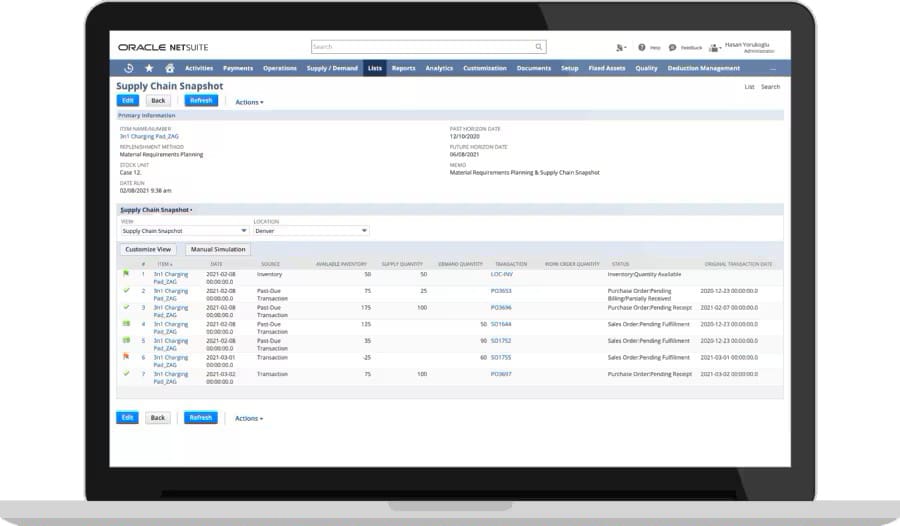
Traditional manufacturing methods normally require sizable up-front investments and long-term commitments to specific product lines and production methods. But as more customers demand flexibility from their manufacturers, companies are adopting on-demand manufacturing to offer more options without risking significant losses if demand shifts and inventory goes unsold. Successfully implementing on-demand techniques, however, requires carefully considering both business and customer needs, as well as deploying specific technologies and methods that foster quick order fulfillment. By properly implementing the on-demand manufacturing model, manufacturers can make their operations more sustainable and agile, ultimately becoming more capable of evolving at the same pace as their customers.
On-Demand Manufacturing FAQs
Why is on-demand manufacturing growing?
On-demand manufacturing has grown in recent years due to more accessible and affordable technology, including cloud-based manufacturing software, more precise and customizable machinery, and artificial intelligence. This increased availability allows more businesses, including small and midsize companies, to create flexible production processes that can quickly adapt to customers’ requests and create customizable, small-batch products on demand.
What’s a real-world example of on-demand manufacturing?
Some footwear manufacturers use on-demand manufacturing when producing custom sneakers. First, the customer designs shoes on the business’s website, which automatically forwards the criteria to the manufacturer. The manufacturer is then able to create the shoes using flexible machinery programmed to follow the customer’s exact specifications.
What is on-demand logistics?
On-demand logistics is an inventory strategy that distributes goods to different geographic regions with the goal of keeping goods close to customers. This strategy reduces shipping costs and helps businesses guarantee faster shipping times, though it typically requires extensive inventory reserves and higher carrying costs to maintain appropriate inventory levels at all locations.