
The insurance world runs on constant motion, with policies coming in, claims moving out, and rules that change often enough to keep every team on alert. On top of that, customers expect fast answers and a personal touch. It’s a tough balance, especially given tight margins and competitors quickly improving their own customer experience. Insurers are responding by replacing their scattered tools and spreadsheets with one connected enterprise resource planning (ERP) system designed to handle policy work, claims, finance, and customer data in one place.
What Is an ERP System in the Insurance Sector?
An ERP system in the insurance sector is a platform that centralizes finance, HR, CRM, supply chain management, and other core business functions in a single platform. Insurance ERPs serve as the authoritative system of record for policy data, agent information, claims history, commissions, and financial activity.
Key Takeaways
- Insurance ERP systems connect policy, claims, financial, and customer data in one integrated environment.
- These systems help insurers navigate mounting pressures, ranging from customers’ digital expectations to rising regulatory complexity.
- Reliable information flowing through shared systems helps teams process a higher volume of policies and claims.
- ERP technology adapts without requiring new systems or major rebuilds, giving leaders a dependable platform for long-term growth.
Insurance Enterprise Resource Planning Explained
In practice, an ERP solution coordinates how information moves across departments and automates daily workflows for finance, claims, HR, CRM, and other functions. When a policy is activated, for example, the system’s policy component records coverage details, the finance component posts premium activity, the customer record updates automatically, and analytics capture the event for future analysis. Work progresses without teams rekeying the same details into different systems.
Smooth, accurate workflows mean less operational drag from manual handoffs; processes also stay consistent across teams and regions. In addition, insurers with multi-entity operations or diverse product lines can use ERP technology to manage different regulatory environments, product rules, and reporting requirements without having to redesign their systems.
Why Do Insurance Companies Need ERP?
An ERP solution provides a level of efficiency that’s hard to ignore—and efficiency is what insurers are after. In PwC’s 2025 actuarial modernization survey, 94% of participants cited efficiency as a top driver for modernization, ahead of regulatory change. ERP systems build efficiency in the following ways:
- Operational improvement: Many carriers still run on aging technology that slows down daily work and forces staff to piece together information from scattered sources. An ERP system gives teams current, trustworthy data so leaders can make sound decisions.
- Competition: Insurance is now built around digital experiences, spanning quoting to billing to claims. Companies that want to keep up have to adjust quickly when the market changes. An ERP system gives them the stability and speed to do so.
- Better expense control: With an ERP system, routine work is performed automatically and information is easy to find. As a result, staff spend far less time typing data or digging for files. Entire chunks of manual labor shrink, with newfound savings show up quickly in financial accounting.
- Better service: Many insurance carriers offer similar products, so service becomes the deciding factor for consumers. An ERP system puts key client details at employees’ fingertips so they can answer questions quickly and keep claims moving. Better service is also good business. McKinsey analysis reveals that customer-experience leaders see double the revenue growth of their laggard counterparts.
- Growth: A flexible ERP system expands and contracts with the business. It supports new locations and offerings, team expansion, and shifting rules without requiring a full system overhaul every time the business shifts.
ERP Features and Capabilities for the Insurance Sector
ERP solutions provide insurers with one system to run the work that touches clients, policies, claims, suppliers, and finances. The following covers the key components typically found in an ERP solution:
-
Customer relationship management (CRM):
CRM systems consolidate essential client information in one place, so teams don’t have to search across multiple systems. For example, a client record would show the customer’s current policy and any open claims, so staff have a clear picture of the situation the moment they open it. Sales reps can also track their pipelines, support teams have immediate access to information necessary for accurate answers, and marketing can spot broader trends from aggregate data to help them shape outreach.
-
Regulations and compliance:
Rules in the insurance world change often, and regulators expect accurate information the moment they ask for it. ERP systems capture activity as it happens and generate required reports without staff having to re-create everything by hand. In addition, security controls protect sensitive records, and the system alerts users when something looks out of place. As a result, compliance teams have a chance to identify problems before they turn into something serious.
-
Claims and policy handling:
Policies and claims move constantly, and ERP systems make sure that flow remains manageable. Issuing a new policy, updating an existing one, or closing it out all happen within one environment, so nothing can be lost between systems. Claims also run more smoothly when routine steps are automated. Clients can check claims online, upload missing documents, get status alerts, and see payout dates without requesting support.
-
Supplier management:
Insurers work with a large circle of partners, including repair shops, medical specialists, reinsurers, and technology vendors. ERP systems reduce the complexity of supplier management by creating one location from which to view contracts, service milestones, and overall partner history. This leads to faster, more accurate decisions that drive company strategies while also identifying the source of any delays.
-
Finance and accounting:
ERP finance tools give insurers a dependable way to execute payables, receivables, the general ledger, and cash activity. All of the work happens within one system that pulls everything together. Billing is smoother, premium revenue is recorded cleanly, and leadership teams get a better read on how money is moving through the organization.
-
Reporting and analytics:
ERP systems turn the massive amounts of data that insurance operations generate into clear, understandable summaries. Leaders can study long-term trends to better understand trends and changes for both the business and the industry. Analytics can also flag when something looks off for quick insights instead of waiting for a quarterly review. With all the information pulled together, decisions happen faster.
ERP Benefits for the Insurance Sector
Rolling out an ERP system reshapes everyday work for insurance teams, cutting down on routine work and giving staff the tools that make their jobs easier. Insurers typically gain the following benefits:
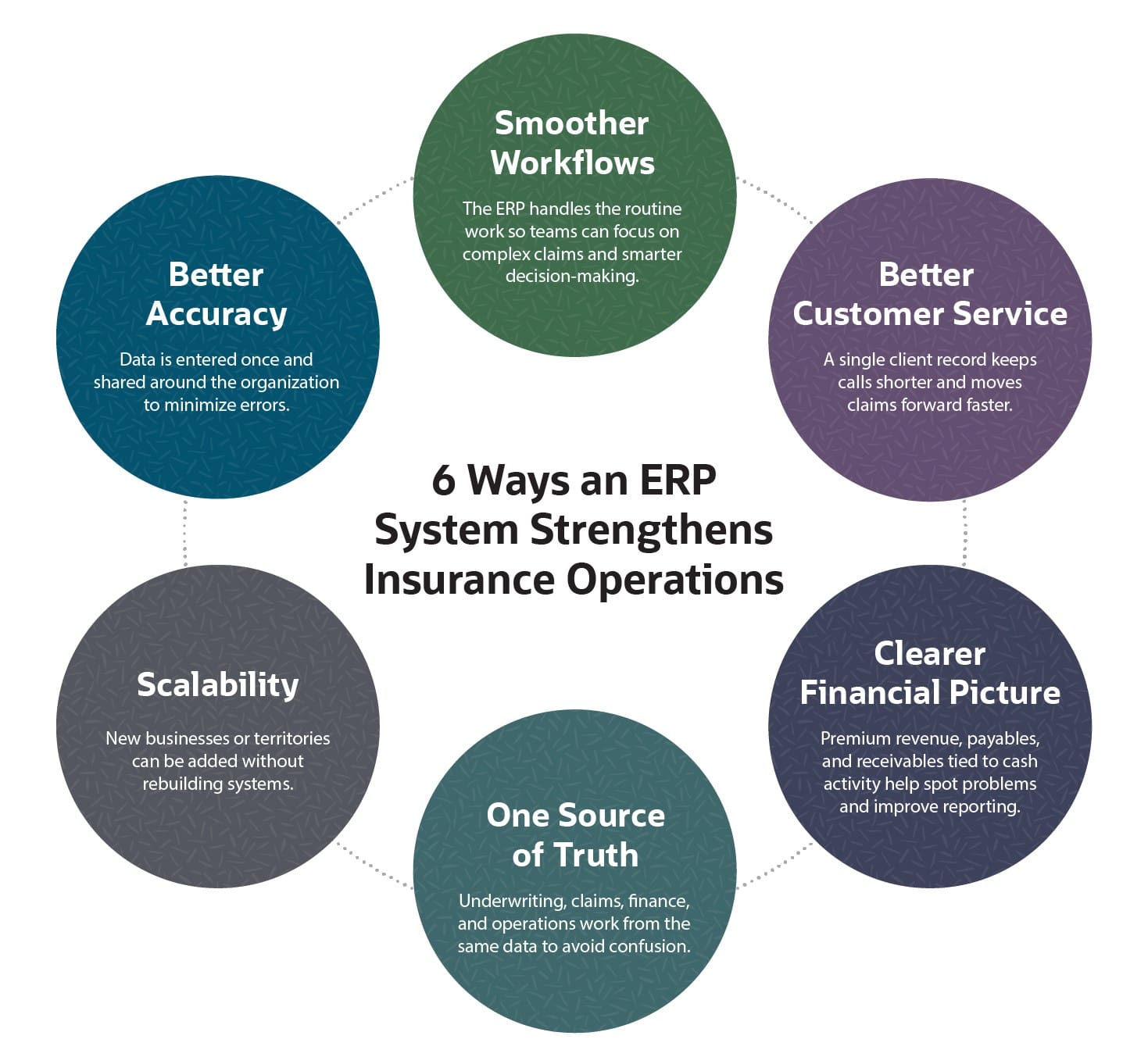
- Smoother workflows: Many insurance tasks still reside in spreadsheets or older systems that don’t work well together. An ERP system takes on what most would consider routine work (think: billing, policy updates, payroll steps, month-end prep), relieving staff from rekeying the same details over and over. Teams have the space to focus on work that needs their expertise, whether that’s sorting out an unusual claim or taking on a risk that needs a closer look.
- Better customer service and experience: When client details are contained in a single record, service teams can open a single client record file and immediately see policy information and claims. This clarity shortens calls and moves claims along more smoothly. Agents are also more confident about answering questions because they’re working from integrated information.
- Enhanced financial reporting: Finance teams gain a major advantage once premium revenue, payables, receivables, and other numbers live in the same system. Cash activity ties in as well, so the whole financial picture is visible without anyone having to chase down data. Leadership can learn about problems earlier and formulate plans with fewer unknowns. Reporting settles into a steady rhythm as well.
- Centralized data management: Insurance data can be found across underwriting, claims, finance, and operations. An ERP system pulls that information into one database, so everyone works from a common set of facts. Underwriters and claims adjusters see the same client history. Finance gets its numbers from a single set of records. When everything’s aligned, the result is less rework and fewer conflicting versions of the truth.
- Scalability: Adding new products or moving into new territories can often cause legacy systems to crack. A strong ERP system can adjust to that added complexity without forcing a rebuild. New lines of business or new territories can be folded into the existing architecture, and teams don’t need to learn a different tool every time the company grows.
- Increased accuracy: Mistakes pile up when staff manually pass around information. A premium entered incorrectly or a claim keyed into the wrong field creates hours of cleanup. With an ERP system, data is entered once and shared across the company without needing to be copied again. That consistency eliminates most of the back-and-forth corrections and headaches that stem from avoidable errors.
6 Ways an ERP System Strengthens Insurance Operations
Tips for a Successful ERP System Implementation
Implementing an ERP system in an insurance organization takes planning, patience, and steady communication. The following tips can help the rollout go smoothly:
- Know what the business needs: There are many types of ERP solutions. Before choosing a system, take the time to understand how work actually gets done. Review real workflows, listen to the people who use the current systems every day, and look for areas that slow down workflows. Take future plans into account, too; regional expansion, additional product lines, or regulatory shifts all influence what the ERP must support.
- Bring leaders in early: ERP projects move faster when leadership supports the effort from the beginning. Employees often cling to existing tools because they’re familiar, even if those tools create bottlenecks. When executives talk openly about why the change matters and they stay visible during the rollout, teams are more likely to embrace the shift.
- Pay close attention to data migration: Insurance data can stretch back for years, and old records aren’t always tidy. Review what the organization has and separate essential records from anything that’s outdated or no longer useful. Once data is migrated, the focus should be on thorough testing. Giving this phase sufficient time helps prevent surprises later.
- Prioritize training: Even a great system falls flat if people feel unsure about how to use it. That’s why change management is so important in a transition. Before go-live, make sure employees have opportunities to practice in a low-pressure setting and ask questions as they proceed. Ongoing support helps everyone feel more grounded as they learn the new system.
- Set a practical timeline: ERP projects involve configuration, testing, cleanup, and a long list of supporting tasks. A well-planned schedule includes buffer time for delays and unexpected surprises. A steady pace produces far better outcomes than a rushed launch that causes disruption.
- Keep listening: Early feedback after the ERP system goes live helps organizations fix issues and adjust processes and workflows quickly. Departments should have a simple way to raise concerns or request changes. Continuous adjustments build greater trust in the system.
Choose the Right ERP for Your Insurance Business
NetSuite ERP ties policy data, claims, commissions, and operations directly to financials, CRM, and analytics. SuiteAnalytics helps insurance leaders build custom dashboards to track key metrics, such as claims ratios, renewal rates, and cash flow, in real time. NetSuite OneWorld focuses on the complexities of operating across multiple states or countries. And the SuiteCloud platform and its marketplace of add-ons let insurers extend functionality without tearing apart core features. When it comes to implementation, NetSuite has a deep bench of partners that know insurance regulations inside and out.
ERP systems pull together all the elemented needed for smooth insurance company operations: policy data, claims, finances, and customer records. Getting a system up and running takes real planning and leadership buy-in, but the results are well worth it. When teams spend less time hunting for information and more time doing work that matters, business growth happens in a smoother, more efficient way.
ERP for the Insurance Sector FAQs
What are the three most common core ERP components?
ERP systems center on finance, operations, and human resources. Finance handles accounting, reporting, and compliance. Operations covers inventory, procurement, and production or service delivery. HR manages workforce data, payroll, and employee processes.
What are the four major phases of ERP implementation?
ERP projects typically move through planning, system design, deployment, and optimization. Planning establishes goals, timelines, and requirements. System design configures workflows and data structures. Deployment brings the system online. Finally, optimization refines performance once teams start using it.