Failure is commonplace in the consumer packaged goods (CPG) industry, where the majority of new product launches never gain traction. Yet, the pressure to innovate is intense. One key differentiator between CPG market leaders and companies whose products languish on shelves is their disciplined approach to product development. This article examines commonalities among successful products, the stages of product development, best practices, challenges, and future trends.
What Is CPG Product Innovation?
CPG product innovation is the process of creating new or improved everyday goods, such as food, beverages, personal care items, and household products. Innovation can be as modest as a new flavor or packaging format or as ambitious as the introduction of a new product category.
What separates successful innovation from expensive experimentation is the ability to balance consumer relevance with commercial viability. Companies that foster a culture of innovation tend to build more resilient portfolios than those that treat innovation as a series of one-off projects.
Key Takeaways
- Most new CPG products fail because development teams work in silos, move too slowly, or skip critical validation steps.
- A stage-gate framework combined with agile methods helps companies kill weak ideas early and direct resources toward products with real potential.
- Cross-functional collaboration, scalability assessment, and quality assurance baked in right from the start improve the odds of a successful launch.
CPG Product Development Explained
CPG product development takes an idea and turns it into a tangible item that moves through retail channels. The process begins with market research to determine viability and advances through formulation, packaging, regulatory compliance, and manufacturing scaleup. Development cycles for these frequently bought and quickly replaced products tend to be shorter and more iterative than for durable goods, which have average lifespans of three or more years.
Most CPG companies have traditionally developed products using a stage-gate framework, in which each step of the process ends with a yes/no decision on whether the initiative will continue to move forward. Early stages of product development dig into consumer insight and concept testing, while later stages tackle operational readiness, supply chain planning, and commercial execution. Along the way, teams pressure-test their assumptions and direct resources to the projects with the highest potential. Leading teams also blend this approach with agile development methods, which call for running smaller experiments, gathering feedback faster, and adjusting course as needed. This helps CPG companies keep pace with shifting consumer preferences without sacrificing financial discipline, though it requires tight, cross-functional collaboration among marketing, research and development, supply chain, and finance departments.
What Makes a Successful CPG Product?
Successful CPG products address unmet or shifting consumer needs, provide more perceived value than alternatives, and are easy to find. Developing these products requires intentional decisions about positioning, distribution, branding, availability, and pricing. Here’s what sets the best products apart:
- Strong value proposition: A clear value proposition explains who the product serves and why it beats the competition. Winning products tap into genuine consumer demand and balance functional benefits with emotional appeal.
- Smart distribution strategy: To reach the right shoppers, companies must align their channel strategy with consumer behavior. Products for mainstream buyers require broad retail distribution, whereas niche offerings may do better in specialty stores.
- High consumer trust: Consistent quality and transparent labeling are important factors in building trust. A single failure in either area can undo years of goodwill. Consumer reviews, third-party certifications, and brand reputation also contribute to perceptions of trustworthiness.
- Compelling branding and marketing: Products that stand out on crowded shelves—physical or digital—have a distinctive visual identity that reinforces consistent messaging. Packaging has to communicate benefits within the few seconds shoppers spend scanning their options.
- High availability: Products won’t sell if shoppers can’t find them on store shelves or in online search results. Through demand forecasting and collaboration with retail partners, companies can make sure items stay in stock across channels without overbuilding inventory.
- Competitive pricing: Pricing must reflect perceived value, competitive positioning, and cost structure. Companies that test different price points before a broad rollout will be better positioned to protect their brand equity and avoid leaving money on the table.
The 7 Stages of the CPG Product Development Lifecycle
CPG product development follows a structured sequence that culminates in a commercial launch. Terminology and stage definitions vary across organizations, but most follow a similar progression. Here are the steps that make up a typical framework.
-
Market Research
Market research grounds development decisions in evidence. It involves uncovering insights about consumer needs and usage patterns through interviews, focus groups, and surveys, and engages in category analysis to identify market opportunities and competitive dynamics. Researchers also rely on business intelligence software to integrate data from point-of-sale systems, loyalty programs, ecommerce platforms, and social listening tools to spot trends that traditional methods might miss.
-
Idea Screening
Idea screening narrows a broad list of concepts to those worthy of investment. Teams evaluate each idea’s strategic fit, technical feasibility, market appeal, and financial potential using standardized scoring criteria. From there, consumer concept testing validates whether target shoppers understand the idea’s value proposition before engineering resources are committed to the effort.
-
Product Design and Prototyping
Product design translates validated concepts into specifications for formulation, packaging, and user experience. For food and beverage products, for example, this entails recipe development, sensory testing, and iterative refinement based on consumer feedback. Personal care and household products require stability testing, efficacy validation, and safety assessments.
-
Product Roadmap
Product roadmaps sequence development activities with clear milestones, resource requirements, and decision points. They merge inputs from R&D, marketing, sales, operations, and finance to create a shared view of what needs to happen and when. Roadmaps also connect individual initiatives to broader portfolio strategy while accounting for capacity constraints. Demand planning helps teams forecast resource needs and align development timelines with commercial readiness.
-
Product Development
Product development scales the design from a lab or test kitchen to a manufacturing plant. Process engineering optimizes production consistency and confirms that materials and equipment can deliver at volume. If the company uses co-packers, partners are vetted at this stage. Material requirements planning coordinates procurement and production scheduling to hit launch timelines. Quality and regulatory teams confirm specifications and finalize labeling to meet compliance requirements.
-
Market Testing
Market testing validates the product under realistic conditions before broad rollout. Methods range from controlled store tests in limited geographies to digital A/B experiments that compare different pricing or messaging scenarios. Testing should measure packaging appeal, price sensitivity, promotional response, and whether consumers buy the product again, which is often a better predictor of long-term success than just the initial trial.
-
Product Launch
A successful rollout across channels and customer touchpoints requires commercial and operations teams to be in sync. Commercial planning matches trade terms and promotional strategies to retailer calendars, while operations readiness covers inventory build and contingency plans in the event of supply disruptions. A post-launch review analyzes metrics, such as distribution gains and sales velocity, so teams can adjust quickly if results fall short.
CPG Product Development Challenges
CPG development teams operate under tight constraints and constant uncertainty. Volatility in commodity, packaging, and labor costs squeezes margins, complicates pricing decisions, and renders long-term planning difficult. Supply chain complexity compounds these pressures; for all its advantages, global sourcing means juggling more suppliers, longer lead times, and more potential points of disruption. In addition, retailers hold significant power over shelf placement and expect evidence of sales velocity and category growth, quickly delisting products that don’t perform.
Organizational silos worsen these issues. When different teams use different data, work on different timelines, and optimize for different goals, development cycles take longer—which causes more problems because consumer preferences change fast. Products that test well during concept validation may arrive on shelves months later to find that trends have moved on.
With all that as a backdrop, perhaps it’s not surprising to learn that 76% of new product launches fail, according to Boston Consulting Group.
5 CPG Product Innovation Best Practices
High-performing CPG companies follow repeatable best practices that improve their odds of product innovation success while reducing waste and rework. The following approaches help address the financial, organizational, and logistical obstacles to effective product development:
- Encourage cross-functional collaboration: Silos slow everything down. Cross-functional teams that bring together marketing, R&D, finance, and supply chain representatives can move faster because they share data and work toward the same goals. Involving retailers and consumers early on helps keep development aligned with real needs.
- Leverage both internal and external data points: Internal data shows what’s selling and to whom. External data—social trends, category reports, competitive intelligence—reveals what consumers are starting to care about. Together, they help teams spot opportunities and make better decisions.
- Evaluate scalability potential: A concept that works in a test kitchen may not work at scale. Before investing heavily, companies should confirm they can manufacture at volume, source materials at the right cost, and justify the required marketing spend.
- Accelerate planning with technology: Portfolio and innovation management platforms provide visibility into the status of each initiative and its resource allocation. Manufacturing ERP systems connect product specifications, production schedules, and inventory management into automated workflows. AI-driven tools accelerate scenario planning, demand forecasting, supply chain optimization, and other critical processes.
- Prioritize quality assurance: Quality problems after launch damage brand reputation, trigger recalls, and strain retailer relationships. The goal is to catch issues before products reach consumers, which necessitates clear specifications and testing protocols from the start.
Building an Effective CPG Innovation Team
Successful CPG innovation depends on the right mix of skills, perspectives, and decision-making authority. Cross-functional teams that span marketing, R&D, supply chain, finance, and commercial operations move faster and make better decisions than siloed groups passing work through sequential handoffs. Team size should match the project; smaller initiatives need leaner teams, while major launches require more people at the table. Clear responsibilities prevent confusion, especially in larger groups. Product managers typically own the initiative and make trade-off decisions, R&D leads handle formulation and technical validation, and supply chain representatives flag potential manufacturing constraints.
Leadership support is also essential. Executives need to protect development resources from short-term pressures, remove obstacles like lengthy approval processes, and make it clear that innovation is a priority. When conflicts arise between functions, leaders should offer a clear path to resolution.
Future Trends in CPG Product Development
Several forces are reshaping how CPG companies develop products. As AI becomes an everyday tool, companies are using it to identify emerging trends and optimize supply chains. In manufacturing, AI-powered sensors and analytics can detect quality issues in real time and identify inefficiencies in production lines. AI also helps R&D teams run virtual simulations to test product concepts before they invest in physical prototypes.
Meanwhile, sustainability expectations keep rising. Consumers want products with lower environmental impact, and retailers are holding suppliers accountable through scorecards and audits. Development teams now weigh recyclability, carbon footprint, ethical sourcing, and water usage alongside performance and cost. These more demanding consumers are also harder to reach through traditional channels. Direct-to-consumer platforms let brands test niche concepts with specific audiences and gather feedback quickly. They also generate first-party customer data that can pave the way for broader product development.
All of this puts a premium on speed. Consumer preferences shift faster than traditional development cycles can accommodate, so companies that move from insight to launch more quickly often gain a competitive advantage.
How ERP Software Helps CPG Product Development
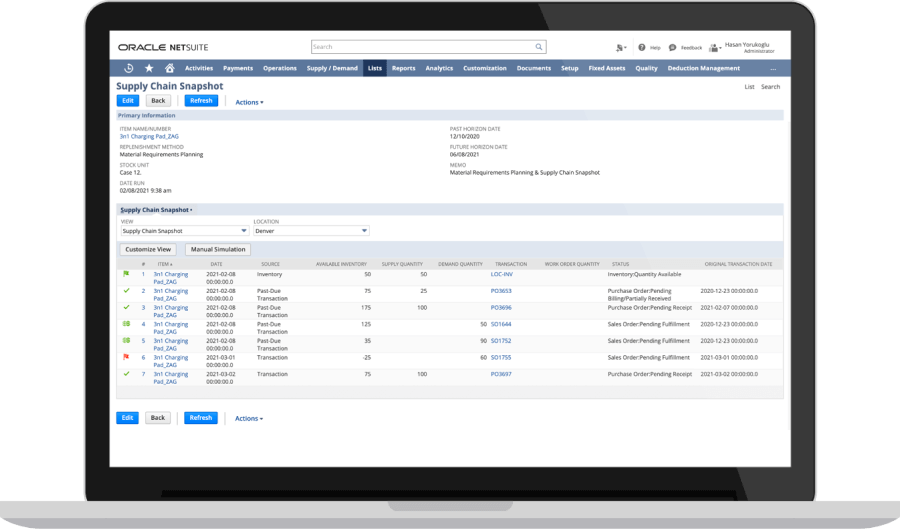
CPG companies frequently struggle with disconnected systems that wall off product data from financial and operational information. NetSuite ERP for Consumer Packaged Goods brings manufacturing, distribution, and financial management into a single cloud platform for a unified view of operations. The system supports demand planning and material requirements planning, which coordinates procurement and inventory. Business intelligence capabilities uncover data-driven insights that inform product development, with role-based dashboards providing visibility into business health. Additional features include order management, warehouse operations, procurement, and accounting. CPG teams gain margin visibility by SKU, customer, and channel, while expiration tracking and automated reorder signals keep fast-moving products in stock.
Manage the CPG Supply Chain With NetSuite
CPG product development requires disciplined execution across research, design, testing, and launch—with cross-functional alignment at every stage. Companies that develop strong value propositions and validate concepts with real consumers can position themselves to beat the industry’s high failure rate. As AI, sustainability requirements, and compressed timelines reshape development practices, the companies that adapt fastest are most likely to capture a disproportionate share of their markets.
CPG Product Development FAQs
What is CPG product development?
Consumer packaged goods (CPG) product development is the end-to-end process of discovering, designing, validating, and launching everyday goods for consumers. It covers market research, concept testing, formulation, packaging, manufacturing scaleup, and commercial launch.
What is CPG product management?
Consumer packaged goods (CPG) product management guides a product from concept through launch and ongoing optimization. Product managers balance consumer needs, commercial objectives, and technical constraints while coordinating cross-functional teams.
What are the 4 D’s of product development?
The 4 D’s are discover, define, develop, and deliver. “Discover” pinpoints opportunities and consumer insights; “define” establishes requirements and success criteria; “develop” creates and validates the product; and “deliver” brings it to market.