
Museums face a financial landscape unlike that of any other nonprofit sector. With earned income representing only one-third of revenue—and the rest coming from a patchwork of donations, grants, endowments, and sponsorships—museum finance teams must navigate complex fund restrictions, shifting philanthropic patterns, and rising operational costs. Add collection accounting rules that have no parallel in standard business practice and the need for specialized accounting expertise becomes clear.
Museums are increasingly turning to artificial intelligence to help manage these challenges. AI-assisted reconciliation, automated compliance monitoring, and intelligent cash flow forecasting are helping lean finance teams keep pace with rising operational demands—and preparing institutions for a future where agentic AI handles many tasks autonomously, freeing staff to focus on stewardship and strategic analysis.
This guide reviews the fundamentals of museum accounting, ranging from fund accounting and revenue recognition to the metrics, best practices, and technologies that help cultural institutions maintain their financial health and advance their missions.
What Is Museum Accounting?
Museum accounting refers to the specialized financial practices and reporting methods used by museums to track, manage, and report on their financial activities. It combines nonprofit fund-accounting principles with museum-specific practices tailored to the operational realities of managing collections, restricted donations, grants, and multiple revenue streams.
Unlike standard business accounting, which focuses on profit and loss, museum accounting organizes financial activity by the purpose of funds and in compliance with US Generally Accepted Accounting Principles’ (GAAP’s) ASC 958 standards for nonprofit entities. The standards aim to help museums demonstrate accountability to donors, grantors, boards, and the public, as well as to maintain the financial transparency required of tax-exempt organizations.
Key Takeaways
- Museums use fund accounting, classifying net assets as either having or not having donor restrictions and separately tracking each fund’s purpose and allowable uses.
- Under US accounting standards, museums may elect not to capitalize collections on the balance sheet, which can make two institutions of similar size appear vastly different financially.
- Different revenue streams—contributions, grants, memberships, admissions, and endowment income—must each follow different revenue recognition rules.
- Modern cloud-based ERP systems can simplify and automate many museum accounting practices and generate audit-ready reports.
- AI is poised to reshape museum accounting operations by allowing small teams to manage complexity that once required much larger staff.
Museum Accounting Explained
Museum accounting exists at the intersection of nonprofit financial management, cultural stewardship, and public accountability. It encompasses the financial processes required to track revenue, expenses, assets, and liabilities—but organizes this information around the specific purposes and restrictions that govern how museums can use their resources.
Museum accounting seeks to answer questions that for-profit businesses don’t face: Has grant money been spent according to the grantor’s stipulations? Are endowment distributions in compliance with state law? Does the board have accurate information about which programs generate surplus and which are subsidized? The answers are not merely about compliance; they also serve to shape strategic decisions about exhibitions, educational programs, and the institution’s long-term viability.
How Does Museum Accounting Differ from Standard Accounting? How Is It Unique?
The most fundamental difference between museum and standard accounting lies in purpose. For-profit businesses track revenue and expenses to demonstrate profit or loss for owners. Museums—like other nonprofits—use fund accounting, which organizes financial activity by the purpose of funds rather than by profit and loss. To meet their “purpose” requirements under US GAAP, museums must classify net assets into two categories: assets without donor restrictions and assets with donor restrictions. A donor who contributes $500,000 for acquiring 19th-century American paintings has placed a purpose restriction on those funds, and the museum’s financial reporting must demonstrate those funds were spent accordingly.
Collection accounting presents another stark contrast, rooted in stewardship rather than ownership. Under GAAP, museums may elect not to capitalize collections on the balance sheet—provided the collection is held for public exhibition and education, is protected and preserved, and any proceeds from items sold from the collection (deaccessioned items) are used to acquire new collection items. This has no parallel in standard business accounting, where assets are treated as resources owned and controlled for economic benefit. Revenue recognition adds further complexity: contributions are recognized when received or unconditionally pledged, grants may be conditional or unconditional with different recognition timing, membership fees are recognized ratably over the membership period, and earned revenue follows standard rules. Managing these differences simultaneously exceeds the complexity of typical business revenue accounting.
Core Components of Museum Accounting
Museum accounting rests on three interconnected components: funds, which organize financial activity by purpose; grants, which impose compliance obligations; and diverse revenue streams that each follow distinct recognition rules.
Funds
Rather than tracking all money in a single pool, museums maintain separate accounting for different categories of funds, based on donor intent and internal designations. Net assets without donor restrictions include unrestricted contributions, earned revenue from admissions and retail, and board-designated funds that the museum has internally earmarked for specific purposes but could, technically, redirect. Net assets with donor restrictions encompass gifts restricted for specific programs, time-restricted pledges, and endowment funds where donors have stipulated that principal must be maintained permanently or for a defined period. Software that automatically tags transactions to the correct fund category helps prevent the commingling of restricted and unrestricted resources—a compliance violation that can damage donor relationships and trigger negative audit findings.
Grants
Grant management is one of museum accounting’s most demanding functions. Unlike a standard business transaction, a grant typically requires the museum to track expenditures at a granular level, matching costs to specific grant budget line items. The museum must demonstrate that funds were spent in accordance with the grantor’s stated purposes, produce detailed financial reports on a schedule set by the grantor, and maintain a clear audit trail for every dollar received and spent. Museums that receive federal funding above $1 million per fiscal year face an additional layer of accountability: the Single Audit requirement under 2 CFR Part 200 (commonly called the Uniform Guidance). This audit examines not just financial statements but also mandatory compliance with specific grant requirements—a level of scrutiny that demands strong internal controls and detailed recordkeeping.
AI can ease this burden. Grant-compliance agents—a form of agentic AI—can monitor expenditures in real time, compare spending against approved budget categories, flag potential violations before they become audit findings, and even draft the periodic reports grantors require. For museums juggling multiple grants with different reporting requirements and schedules, this kind of continuous monitoring represents a significant shift from the traditional approach of assembling compliance documentation at reporting deadlines.
Revenue Streams
Museums generate revenue from a broad set of sources, each requiring careful accounting treatment:
- Earned revenue includes admissions, membership fees, gift shop sales, facility rentals, and special event revenue. These transactions generally follow standard revenue recognition principles under ASC 606, though membership fees are typically recognized ratably over the membership period, rather than when received.
- Contributed revenue encompasses donations, sponsorships, and grants. Donations are recognized when received or unconditionally pledged, but restricted gifts must be tracked separately. Sponsorships require careful analysis to determine which portion represents a pure contribution as opposed to an exchange element (such as advertising benefits) that should be recognized differently.
- Endowment distributions are governed by state law—mostly the Uniform Prudent Management of Institutional Funds Act (UPMIFA), which has been adopted by all 50 US states—and the museum’s own spending policies. Most institutions maintain spending rates between 4% and 5% of endowment value. UPMIFA allows spending from “underwater” endowments (where fair value has fallen below the original gift amount) if the governing board determines it prudent.
Key Metrics for Museum Accounting
Tracking the right metrics helps museum finance teams monitor financial well-being, communicate with stakeholders, and make educated decisions. The following metrics, organized by category, provide a framework for complete financial oversight.
Revenue Metrics
- Total revenue: Overall income from all sources—the top-line view of the museum’s financial scale.
- Earned revenue: Sales from admission tickets, memberships, gift shop operations, and events. It demonstrates the museum’s ability to generate self-sustaining income.
- Contributed revenue: Donations, grants, and sponsorships that represent philanthropic and governmental support.
- Revenue mix ratio: The percentages of earned, contributed, and investment income. There is no general rule about what constitutes a good revenue mix. Instead, it’s crucial that museum finance directors understand their institution’s own ratio and the risks and vulnerabilities it implies.
- Average revenue per visitor: Total earned revenue divided by attendance. This metric helps museums assess their pricing strategy and visitor spending patterns.
Expense Metrics
- Total operating expenses: The full cost of running the museum. It’s the baseline for a museum’s efficiency calculations.
- Program vs. administrative costs: The percentage of spending devoted to mission-related activities versus overhead. This is closely watched by donors and watchdog organizations, who look for the highest-possible allocation to mission.
- Cost per visitor: Total operating expenses divided by attendance, a key indicator of operational efficiency.
- Exhibition cost per project: The fully loaded cost of mounting each exhibition. It lets museums compare projects and helps determine future budgets.
- Staffing costs as a percentage of total expenses: Personnel is the largest expense category for most museums, usually constituting between 50% and 65% of all expenses. Tracking this ratio helps finance directors figure out if the museum is overstaffed or understaffed relative to its revenue base.
Profitability and Sustainability
- Operating surplus/deficit: Revenue minus expenses. It shows how well the museum is “living within its means.”
- Operating margin: Operating surplus or deficit as a percentage of total revenue. This allows museum leaders to compare their institution with others of different sizes.
- Break-even point: The revenue level required to cover all operating expenses. This is often used in scenario planning.
- Dependency ratio: Contributed revenue divided by total revenue. It shows the museum’s reliance on contributions and its vulnerability to shifting philanthropic trends.
Liquidity and Financial Health
- Current ratio: Current assets divided by current liabilities. Current ratio is an indicator of any organization’s ability to cover its short-term obligations.
- Cash on hand (months of reserves): The number of months the museum could operate using only existing cash. Cash on hand is considered a critical indicator of financial resilience.
- Debt-to-asset ratio: Total liabilities divided by total assets. It shows the extent of a museum’s debt leverage.
- Working capital: Current assets minus current liabilities. This is the money available to fund day-to-day operations.
Fundraising Efficiency
- Fundraising cost ratio: The cost to raise one dollar, expressed as total fundraising expenses divided by total contributed revenue. It measures the operating efficiency of a museum’s fundraising efforts: 10 cents per dollar is considered efficient, 20 cents adequate, but 35 cents usually raises concerns from donors and watchdog organizations.
- Donor retention rate: The percentage of donors who give again, calculated as the number of donors who gave in both the current and prior periods divided by the total number of donors in the prior period. It’s a key indicator of the strength of an institution’s relationship with its donors.
- Contributed revenue retention rate: Applies the same calculation as donor retention rate but to dollars instead of donor counts. It reveals whether retained donors are raising or lowering their contributions.
- Average donation size: Total contributions divided by number of donors. This reveals changes in giving patterns when tracked over time.
- Grant success rate: The percentage of grant applications that result in awards. It measures the effectiveness of the museum’s development team.
Attendance and Engagement Metrics
- Total visitors/attendance growth: Total visitors is the fundamental measure of a museum’s public engagement and reach. Attendance growth, calculated as current period visitors minus prior period visitors divided by prior period visitors and expressed as a percentage, helps assess whether that engagement is growing or receding.
- Membership growth rate: The percentage increase (or decrease) in members for the current period versus the prior period.
- Membership retention rate: The percentage of current-period members who were also members during the prior period.
- Revenue per visitor: Total earned revenue divided by total number of visitors. This is a combined metric that captures both attendance revenue and additional individual spending, such as in a gift shop or food concession.
- Program participation rates: Attendance at educational programs, tours, and events, presented as a percentage of total visitors.
Collection and Asset Management
- Collection value: This metric forms the basis for the next two—but it isn’t usually a single number. For museums that elect to capitalize their collections, this is the capitalized book value recorded on the balance sheet—usually recorded at historical cost or, for donated items, fair value at the date of the gift. Museums that don’t capitalize their collections still need an appraised or fair market value to use for management decisions and insurance purposes. This can differ dramatically from book value, particularly for collections acquired decades ago. Finally, there is replacement value, which insurers may use as the basis for coverage and which can differ significantly from both book value and fair market value.
- Conservation and maintenance costs: The ongoing investment required to preserve collection items. When expressed as a percentage of total expenses, this helps finance directors understand whether conservation is receiving adequate funding, which is important to the question of collection stewardship.
- Insurance costs for collections: Premiums for coverage that protects irreplaceable cultural assets. The ratio of insurance costs to collection value helps determine whether a museum is underinsured—a common concern for smaller institutions.
Capital and Endowment Metrics
- Endowment size and growth: The total value of endowment funds and their year-over-year change. Total value includes new gifts to the endowment as well as investment returns, so this metric is not necessarily an indicator of investment performance.
- Endowment spending rate: The percentage of endowment value distributed annually. It’s usually between 4% and 5%, a range that balances current needs with long-term principal preservation.
- Capital campaign progress: Tracking pledges and receipts against campaign goals. Because not all pledges are fulfilled, this is primarily a risk-management metric that tells museums if they need to increase collection efforts.
- Return on investments: Measures the investment performance of a museum’s endowment and reserve fund.
Efficiency and Productivity
- Revenue per employee: Total revenue divided by full-time equivalent (FTE) staff. It measures organizational productivity. Institutions with volatile contributions may prefer earned revenue per employee as a more stable productivity metric.
- Visitors per staff member: Attendance divided by FTEs. It indicates staffing efficiency relative to public engagement.
- Space utilization: A set of ratios that reflects what portion of a facility is being used to directly support the mission and how intensively that space is being used. It includes the ratio of exhibition space to total facility square footage, revenue per square foot, and visitors per square foot.
Accounting Best Practices for Museums
Because of their financial and operational complexity, strong accounting practices are even more important for museums than for the average nonprofit organization. Good practices are vital for museums to maintain compliance, satisfy grantors and auditors, and give leadership the financial clarity to make mission-driven decisions. The following practices—organized by functional area—provide a framework for building and sustaining strong financial operations.
Accrual-basis Accounting
- Use accrual accounting rather than the cash-basis method. Accrual accounting recognizes revenue when earned and expenses when incurred, regardless of when cash changes hands. This is the only GAAP-compliant approach, because it provides a more accurate picture of a museum’s financial position and obligations.
Fund Accounting
- Separate funds by purpose—restricted, unrestricted, endowment—to maintain proper tracking and compliance. Implement accounting systems that automatically tag transactions to the appropriate fund classification and prevent spending from restricted accounts that would violate donor intent. ERP systems with built-in fund accounting capabilities can automate this tracking.
Clear Revenue Recognition
- Distinguish between earned revenue (tickets, shop sales, facility rentals) and contributed revenue (donations, grants) in your chart of accounts and reporting.
- Recognize grant revenue according to donor restrictions and grant conditions—conditional grants are recognized only when conditions are substantially met, while unconditional grants are recognized immediately.
Strong Internal Controls
- Segregate the three critical duties of authorization (approving transactions), recording (entering transactions into the accounting system), and custody (handling the actual assets, such as cash or checks). GAAP requires this so that no single individual controls an entire financial process.
- Implement approval workflows that route purchases through appropriate authorization based on dollar amount and fund source. This is especially important for compliance with fund restrictions.
- Conduct routine reconciliations to verify the accuracy of records and deter fraud.
- Perform periodic, independent internal audits to assess whether the system of internal controls is doing its job.
- Add continuous monitoring to internal controls via agentic workflow. AI agents can analyze transaction patterns in real time, highlighting suspicious activity before payments are processed. This kind of always-on surveillance supplements periodic audits with ongoing vigilance.
Budgeting and Forecasting
- Prepare annual budgets aligned with strategic goals and program priorities.
- Monitor actual performance against budget monthly and investigate any material variances promptly.
- Update forecasts throughout the year as conditions change—shifting attendance patterns, unexpected gifts, or economic pressures may all require adjustments to spending plans.
- Deploy AI-powered forecasting tools to accelerate budgeting and forecasting. Especially for museums with volatile contributed revenue, these tools can model scenarios and flag emerging cash flow risks before they become crises.
Grant and Donor Compliance
- Track restricted funds with sufficient detail to demonstrate that expenditures comply with donor intent for all restricted gifts and grants.
- For each grant, maintain documentation that links individual expenditures to specific, approved budget categories—the level of detail grantors and auditors require to verify compliance.
- Prepare grant reports on schedule and retain supporting documentation for the periods required by each grantor (e.g., federal grants typically require records for at least three years after final closeout).
Collections Management Accounting
- Assuming your museum meets GAAP criteria for non-capitalization, make a deliberate, board-authorized election regarding collection capitalization and apply it consistently.
- Track acquisition, conservation, and insurance costs separately from operating expenses.
- Maintain detailed provenance and transaction records for all acquisitions and deaccessions.
- Maintain a complete and current collections management database as a financial control document.
- Conduct periodic physical inventories to verify that actual holdings match the collections database.
- Follow a documented, board-authorized policy that is consistent with GAAP requirements and applicable professional standards for all deaccessions.
Cash Flow Management
- Monitor liquidity unfailingly and maintain adequate reserves—many experts recommend three to six months of operating expenses in accessible funds.
- Plan for seasonal fluctuations in revenue, as museum attendance often varies significantly with time of year.
- Model cash flow scenarios to anticipate periods when short-term borrowing or spending reductions may be necessary.
Transparency and Reporting
- Provide clear, accurate financial statements to stakeholders, board members, and donors.
- Follow nonprofit reporting standards under GAAP, including the Statement of Financial Position, Statement of Activities, Statement of Cash Flows, and (if applicable) Statement of Functional Expenses.
- Remember that Form 990 is a public document—readers beyond the IRS will evaluate its contents.
Cost Allocation
- Allocate shared costs—such as staff time, facilities, and administrative overhead—appropriately across programs, fundraising, and management functions.
- Document allocation methodologies and apply them consistently. Proper cost allocation supports accurate program costing, grant reporting, and Form 990 functional expense disclosures.
Regular Financial Review
- Conduct monthly or quarterly financial reviews that compare actual results to budget, analyze key metrics, and identify emerging issues.
- Present summary reports to leadership and the board on a consistent schedule. These reviews should go beyond numbers to explain the story behind variances and recommend corrective actions when needed.
- Use generative AI to provide narrative insights—for example, by automatically clarifying what’s driving metric changes and highlighting anomalies that warrant attention.
Use of Technology
- Implement accounting software built for nonprofit organizations, with native support for fund accounting, grant tracking, and nonprofit-specific reporting.
- Where possible, integrate ticketing, membership, and donor management systems with the accounting platform to limit manual data entry and reconciliation. Cloud-based ERP systems offer real-time visibility and remote access that can be particularly valuable for organizations with multiple locations or traveling exhibitions.
Audit Readiness and Compliance
- Perform annual external audits as required by grantors, state law, or board policy. Prepare for Single Audits if federal expenditures exceed applicable thresholds.
- Stay current on nonprofit tax regulations, including Form 990 filing requirements, unrelated business income tax obligations, and state charitable registration requirements.
Risk Management
- Carry adequate insurance for collections, facilities, and general liability. Review coverage annually as collection values and operations change.
- Identify financial risks—such as overreliance on a single donor or grant, economic sensitivity of earned revenue, or endowment concentration—and develop mitigation strategies.
Documentation and Recordkeeping
- Maintain organized records for all transactions, paying particular attention to grants, donations, and collection acquisitions.
- Keep supporting documentation accessible for audit purposes and retain records according to legal requirements and grantor stipulations.
- Implement document management practices that allow authorized staff to locate records efficiently.
Museum Accounting Systems and Tools
Museums rely on a range of specialized systems to manage their unique financial requirements. The right technology mix depends on organizational size, complexity, and existing infrastructure, but most museums benefit from some combination of the following.
Accounting Software
Dedicated nonprofit accounting software provides the fund accounting structure, restriction tracking, and reporting formats that museums require. Look for systems that support multiple fund classifications, produce GAAP-compliant financial statements, and handle grant-budget tracking without customization.
ERP
ERP software integrates accounting with operational functions—procurement, inventory, project management, and human resources—in a unified system. ERPs can connect financial data with gift shop operations, facility management, and exhibition budgeting, providing a complete view of organizational performance. ERP systems usually include fund accounting capabilities and can scale as museums grow or add locations.
Payroll Software
Payroll systems handle wage calculations, tax withholding, benefits administration, and compliance with labor regulations. Museums with union contracts, hybrid or grant-funded positions, or workforces that mix full-time, part-time, seasonal, and contract staff may need specialized payroll capabilities that can handle multiple pay classifications and allocate labor costs across programs and funding sources. Integration between payroll and accounting or ERP systems cuts down on manual data entry and facilitates allocation of labor costs across programs and grants.
AI and Agentic AI
AI can help address some of museum finance teams’ thorniest pain points. AI-assisted reconciliation can match transactions across bank feeds, point-of-sale (POS) systems, and membership platforms—data sources that rarely align cleanly in cultural institutions with multiple revenue streams. These tools flag discrepancies, accelerate month-end closes, and replace the manual effort of tracing a single visitor’s ticket purchase, gift shop transaction, and membership renewal back to the general ledger.
Agentic AI—systems that autonomously execute multistep tasks—extends these capabilities further by handling various processes, such as chasing missing approvals on grant expenditures or preparing compliance-ready reports, with minimal human intervention. As these tools mature, they may help lean museum finance teams manage fund restrictions and audit demands more efficiently.
Donor Management System (CRM)
Customer relationship management systems track donor interactions and, therefore, can compile each donor’s giving history as well as report on the museum’s prospect cultivation and campaign performance. Integration between CRM and accounting systems allows contribution data to flow directly into the general ledger, slashing or eliminating duplicate entry and improving accuracy. Museums can use donor management data to segment donors, personalize communications, and analyze fundraising effectiveness.
Ticketing and Membership Software
Dedicated ticketing systems handle admissions, timed-entry management, and capacity control, while membership modules track new-member joins, renewals, and member benefits. Integration with accounting software automates revenue recognition and provides visibility into earned income patterns. Many systems combine ticketing, membership, and POS functions in a single system that connects with back-office accounting.
Grant Management Software
Specialized grant management tools track application deadlines, help manage budgets against award terms, schedule reporting milestones, and centralize documentation. For museums with multiple active grants, these systems reduce compliance risk and help development staff stay ahead of deadlines.
Collections Management Systems
Collections management systems track acquisition costs, insurance values, conservation expenditures, and deaccession proceeds. Integrating collections data with the accounting system creates complete records of collection-related financial transactions and supports documentation for audits, donor reporting, and insurance claims.
Benefits of Museum Accounting Software
Purpose-built museum and nonprofit accounting software delivers advantages that general-purpose systems cannot match:
- Fund compliance automation: Transactions are automatically tagged to the correct fund classification, with system-enforced restrictions that prevent inadvertent spending from donor-restricted accounts for unauthorized purposes.
- Grant tracking precision: Budget-to-actual comparisons are tracked at the grant level, with alerts for overspending and reports formatted to grantor specifications. This trims compliance risk and simplifies reporting.
- Audit readiness: Complete transaction trails, restriction documentation, and standardized reports make audit preparation faster and less disruptive.
- Real-time financial visibility: Leading systems provide up-to-date fund balances, cash positions, and budget status without waiting for the month-end close.
- Board-ready reporting: Prebuilt report templates and dashboards present financial information in formats appropriate for trustees, cutting short time previously devoted to reformatting data for governance presentations.
- System integration: Native or integrated ticketing, membership, donor, and POS systems shrink manual reconciliation and create a unified view of museum operations.
- Scalability: Museum accounting software served from the cloud can grow with the organization, adding users, modules, or entities without costly infrastructure upgrades.
Choosing the Best Accounting Software for Your Museum
Selecting accounting software starts with understanding how well each option handles the fundamentals of museum finance. Fund accounting capabilities matter most—the system should track restricted, unrestricted, and endowment funds with enough granularity to satisfy auditors and prevent accidental spending from donor-restricted accounts. Grant management is equally critical: Look for budget-to-actual tracking, compliance reporting, and documentation storage that can accommodate the requirements of your largest funders. Reporting flexibility determines whether finance staff can produce board reports, grant reports, and GAAP-compliant financial statements without relying on IT or exporting data to spreadsheets.
Integration and scalability shape long-term value. A system that connects with ticketing, membership, donor, and POS platforms—whether through prebuilt connectors or APIs—reduces manual reconciliation and creates a unified financial picture. Consider whether the software can grow with your institution as transaction volume, users, or organizational complexity increases. Finally, evaluate the vendor’s financial stability, its experience with nonprofits, the intuitiveness of the interface vis-à-vis staff with varying levels of expertise, and the total cost of ownership—including implementation, training, customization, and ongoing support—beyond the initial subscription fee.
Improve Accounting With NetSuite Museum Accounting Software
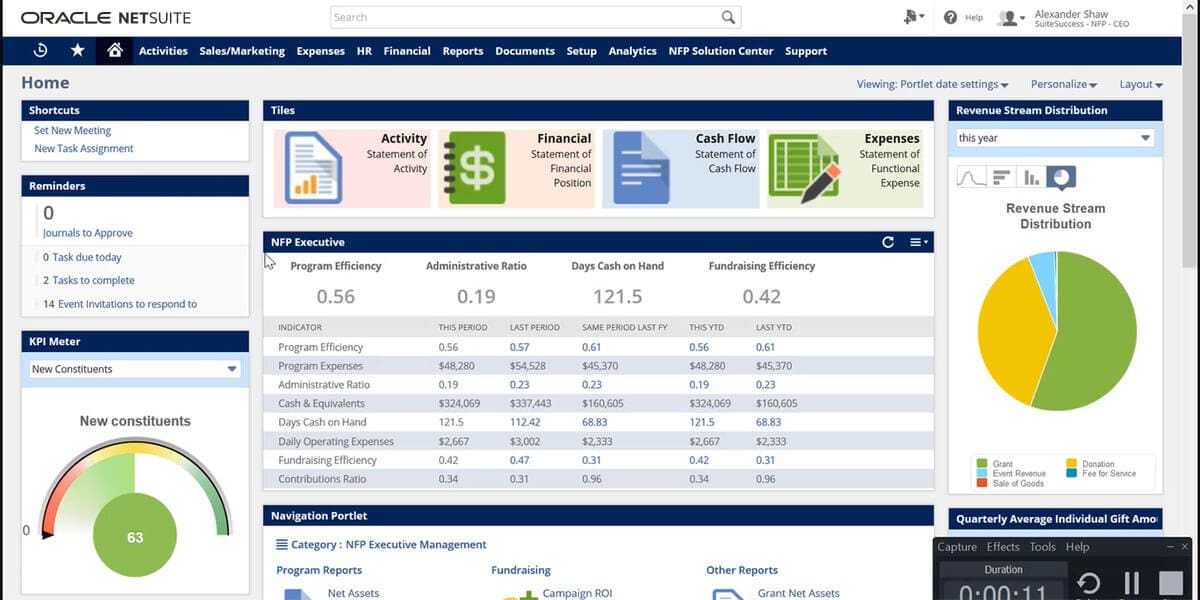
Museum finance teams juggle challenges that are simply out of scope for generic accounting software. NetSuite Museum Accounting Software addresses these challenges in a unified cloud platform that can tag every transaction to the correct fund, preventing improper spending from restricted accounts and simplifying audit preparation. GAAP-compliant fund accounting makes reporting on donor and grant restrictions straightforward—there need be no month-end scramble. In fact, automated reconciliations and real-time reporting accelerate closes, while cash flow monitoring helps finance directors better manage the seasonal swings and unpredictable attendance patterns that define museum finance. Meanwhile, NetSuite Museum ERP delivers live dashboards that attribute revenue and expenses by exhibition, program, or location—giving leadership the visibility to allocate resources strategically and build compelling narratives for donors and grantors.
Looking ahead, NetSuite has embedded AI capabilities directly into museum accounting workflows. AI-assisted reconciliation matches transactions across bank feeds, ticketing systems, and membership platforms. Anomaly detection flags unusual transactions before they become audit findings. Narrative insights explain what’s driving metric changes, turning financial reviews from data-gathering exercises into strategic conversations. And as agentic AI matures, museums can expect autonomous handling of tasks like chasing missing grant approvals or preparing compliance-ready reports—processes that currently consume significant staff time.
Museum accounting requires specialized knowledge that goes beyond that inherent in standard business accounting—greater even than what a typical nonprofit requires. From collection accounting to grant compliance and endowment management, museum finance professionals navigate complexity that demands both technical expertise and mission-aligned judgment. The right combination of policies, practices, and technology helps museums demonstrate accountability, maintain financial health, and devote maximum resources to their core purpose of preserving and sharing cultural heritage.
Museum Accounting FAQs
How are museum collections accounted for on the balance sheet?
Under US Generally Accepted Accounting Principles (ASC 958), museums may elect not to capitalize collections on the balance sheet if all three of the following criteria are met: The collection is held for public exhibition and education, is protected and preserved, and uses any proceeds from deaccessioned items to acquire new collection items. That means there would be no balance sheet entry. If a museum does choose to capitalize, collection items are recorded as assets at acquisition cost or fair value at the date of donation.
Do museums capitalize or expense art acquisitions?
Museums have a choice. Most elect not to capitalize collection items, provided they meet the criteria for non-capitalization outlined in accounting standards. When not capitalized, acquisitions are disclosed in financial statement notes rather than recorded as assets. Museums that capitalize may depreciate collection items, though many argue that this is inappropriate for items of cultural significance that may appreciate over time.
What is fund accounting in a museum context?
Fund accounting organizes a museum’s financial activity by the purpose of funds, rather than by profit and loss. Museums must classify net assets as either having donor restrictions (restricted by donors for specific purposes or time periods) or without donor restrictions (available for general use). This structure helps museums demonstrate that restricted funds are being used in accordance with donor intent and provides the transparency stakeholders expect from nonprofit organizations.