
Time tracking may seem like little more than an administrative HR function, but it can play a strategic role for many businesses. Time-tracking data is essential for understanding employee productivity, accurately paying workers on time, managing remote employees, identifying and addressing workforce inefficiencies, and—for service organizations—creating accurate invoices and maintaining customer trust.
Timesheet software can be a treasure trove of valuable data. But to realize the full benefits of the information collected by these systems, they must integrate with other sources of business data for a more comprehensive view of workforce operations. Integrating time-tracking tools with ERP platforms, payroll systems, or invoicing tools allows for real-time data sharing between or among these systems. This can yield a variety of benefits, from greater information transparency and unification of workflows to better decision-making and enhanced compliance.
What Is Time Tracking Integration?
Time tracking integration is the process of connecting time-tracking tools with other business software such as invoicing, project, payroll, or HR systems. Successful integration automates the exchange of data among different but related workflows. This lets organizations synchronize data about employee work hours, project timesheets, and related information that resides in the various software platforms.
Businesses that implement time tracking integrations reap many benefits, such as effectively eliminating the need for data re-entry, a significant reduction in errors, and increased efficiency. This free flow of information between time tracking and other systems can also provide businesses with real-time insights into resource allocation, client billing, and overall productivity. For companies that use time-tracking software, this kind of integration is central to improving operational workflows and making data-driven decisions.
Key Takeaways
- Integrating time-tracking tools with other key business software (payroll, project management, finance) automates data-sharing among the systems.
- Time tracking integration limits manual data entry and errors, increases real-time visibility, unifies workflows, supports collaboration, and improves payroll and invoicing processes.
- Such integrations also support detailed analyses of labor cost and performance throughout the company, helping to produce well-informed workforce-management decisions.
- Some use cases include tracking remote workers, improving compliance, and billing for professional services.
- Selecting a timesheet system that is natively integrated with an ERP platform eases the hassle of implementing integrations.
Time Tracking Integration Explained
Time-tracking software integration provides more benefits beyond reducing—or even eliminating—manual data entry; other workforce management benefits include better enforcement of scheduling policies, more timely payroll, reduced compliance risks, and greater visibility into employee performance. The automated exchange of data between time-tracking software and other business systems also underpins more strategic workforce optimization tasks, such as balancing head counts and forecasting labor demands. By analyzing time-tracking data and labor cost patterns across the company, leaders can make considered decisions about items such as compensation structures or staffing models.
Companies typically implement time tracking integration in a series of steps. They begin by working with key stakeholders from HR, payroll, IT, and operations teams to define the integration goals and determine compliance considerations. Among the data points that a time tracking integration can make available to payroll, project management, finance, or HR systems, for example, are employee clock-in and clock-out times, hours worked per employee, absences, leave requests, vacation usage, task and project allocation, attendance patterns, scheduling data, and productivity metrics, such as task completion times or output per hour.
Next, the company selects the time-tracking software that best matches its needs, with an eye toward compatibility with existing ERP or payroll systems. The company then configures and customizes it as necessary. The integration can be accomplished by selecting a business software suite with built-in time tracking tools or by using APIs to connect disparate systems.
Companies can set up payroll or attendance rules to automatically calculate regular hours, overtime, premiums, and other variable pay components as determined by actual time worked. Once those are established, the system can build workflows for handling exceptions, such as missed time-card entries, time-off requests, and time adjustments that require manual approval. After configuring those essentials, it’s time to migrate any existing data into the new system. Mapping data between the time-tracking system’s data fields and another system’s corresponding data fields supports a more accurate information transfer. Testing the systems in a sandbox environment before live deployment can confirm that all integration points work as intended under various scenarios, such as creating or approving a time sheet. Post-implementation, remember to monitor systems for data consistency, maintain detailed audit trails for all data transfers and modifications for compliance, and troubleshoot any issues that may arise.
Common Time Tracking Integration Features
Understanding common time tracking integration functionality is important to support a business’s plans for automating workflows, maintaining compliance with regulations, analyzing workforce data, and making strategic decisions. The right features can decrease manual work, improve operational efficiency, control labor costs, and provide more robust workforce management insights for day-to-day management and longer-term strategy.
Some common time tracking integration features and their benefits include:
- Real-time syncing: This capability instantly updates and shares time-tracking data across integrated systems. Real-time syncing reduces errors, helps prevent workers from receiving outdated information, and provides business decision-makers with visibility into current workforce activity.
- Permission controls: Companies can set individual access permissions to determine who can view, edit, approve, or export time-tracking data. Permission controls can help enforce business rules, protect sensitive information, limit unauthorized changes, and support data integrity and compliance.
- Reporting and data exports: Customized reports equip leaders and managers to monitor key performance indicators, analyze productivity, audit labor costs, and verify compliance. Exporting time and attendance data makes it easier to share information outside of the time-tracking tool and contributes to analytics performed in other systems, such as accounting or HR software.
- Project and task assignment: Assigning and logging work hours to specific projects or tasks creates a record of how, when, and where resources are used. This function helps companies manage budgets at a more granular level, track progress, allocate staff more effectively, measure project profitability, and identify productivity bottlenecks or inefficiencies.
- Invoicing and billing options: Integrating time tracking with other systems can automatically convert logged hours into electronic customer invoices or internal billings, reducing human error and resulting in more accurate billing with fewer human intervention points. This can help improve a business’s cash flow, client relationships, and financial accuracy.
- Notifications and alerts: Automatic reminders help employees and managers keep tabs on timesheet deadlines, scheduling changes, overtime thresholds, and exceptions. Timely notifications and alerts decrease the frequency of missing entries, help with compliance, and prompt employees to handle pending tasks in order to keep workforce management on track.
Benefits of Time Tracking Integration
Time tracking integration offers several advantages for companies, although each business will experience benefits differently based on organization size, industry, integration features, and how effectively the integration is implemented. Large, more complex businesses may gain greater value from unified workflows and compliance management, for example, whereas smaller companies may value increased accuracy the most. Understanding how integrated time tracking can benefit the business can create priorities in integration strategy to achieve the best ROI.
The following are six core benefits of integrating time-tracking tools with other business systems, along with tips on how to realize them:
- Improved visibility: Integrated time tracking provides business leaders in different departments with instant access to work hours, attendance records, project progress, and other data. This transparency allows for early identification of resource issues, proactive solutions to emerging productivity problems, and greater control over labor costs. To realize the full value of increased visibility, make sure dashboards and reporting tools are accessible to the right employees and monitor data flows regularly for accuracy.
- Unified workflows: Connecting time-tracking data with scheduling, payroll, and project management eliminates the need for manual data entry across systems to ease administrative logjams. Unified workflows can increase precision and simplify handoffs between teams. Integrated time tracking can also lead to faster and more accurate payroll and client invoicing processes. To make the most of this advantage, companies should analyze their existing processes to see where integration features might enable greater efficiency and automation.
- Enhanced decision-making: The integration of time-tracking software with other systems creates a foundation of accurate, up-to-date workforce data to support informed staffing, project management, budgeting, scheduling, and operational decisions. Companies can use advanced analytics for greater insights into labor costs, project profitability, and overtime trends to better allocate resources and control expenses. Regularly reviewing data and incorporating insights and reports into planning is key to sound decision-making.
- Increased collaboration: Integrated data can create a single source of truth across departments, promoting better communication and collaboration throughout the organization. Managers and leaders have access to the same data on work schedules, tasks, and progress updates, which can minimize misunderstandings, support cross-functional coordination, and help resolve any emerging concerns or workload imbalances. Encouraging the use of shared dashboards and self-service portals will help foster a culture of information-sharing and collaboration.
- Better accuracy: Automating the capture and sharing of time-tracking data can increase data accuracy on a number of fronts, such as fewer payroll mistakes, more accurate timesheets, and better project- and task-tracking. Knowing that time-tracking records are correct and integrated with payroll and HR systems fosters employee trust. Companies can maximize accuracy by encouraging frequent, real-time time tracking submissions, utilizing automated notifications and alerts, and performing periodic audits to flag errors.
- Maintains compliance: Time tracking integration can bolster regulatory compliance through the accurate documentation of hours worked, overtime, breaks, and paid leave. Companies can build in rules and audit trails to ensure labor law compliance while reducing the risk of litigation or fines for noncompliance. To maintain this benefit, however, businesses must update their system rules and policies as regulations change and regularly scan automated reports for compliance exceptions.
Time Tracking Integration Use Cases
The business uses for time tracking integration vary widely; some are likely to matter more to one business type than another, depending upon the nature of the business and its workforce management needs. The following use cases demonstrate the importance of selecting integrations that meet your specific business’s needs and goals:
-
Tracking Remote Workers
The continued prevalence of remote work can be beneficial for employees and employers—in the US, 28% of workers with remote-capable jobs worked exclusively remotely in 2025, and 51% worked in a hybrid fashion, according to Gallup. But keeping track of who is working on what can be a challenge.
Time tracking integration makes it possible for remote teams to log hours, activities, and locations, automatically syncing data in real time on multiple systems, such as payroll, project management, or analytics. By giving managers visibility into work as it is performed—even if employees are working across locations or time zones—time-tracking data can raise accountability and productivity. It also provides accurate billing and invoicing for billable work. Time tracking integration in a remote work environment can bolster trust among employees and managers, make it quicker and easier to run payroll, help prevent time theft (when employees misrepresent their hours and are paid for time they did not actually work), and arm leaders with insights that assist them in allocating their resources.
Best practices for integrated time tracking in remote or hybrid work situations include clearly communicating work and time tracking policies, automating tracking in ways that respect individual privacy, and standardizing processes to prevent inaccuracies. It’s also crucial to avoid overly intrusive monitoring, which can have a negative impact on employee engagement and morale.
-
Consultant and Agency Tracking
For consultants and agencies managing many clients or projects, integrated time tracking makes it possible to share data as billable hours, client codes, or project milestones with invoicing, CRM, and project management systems. With integration, users can tag their work hours by client and project, automate reporting, and sync activity logs for easier invoicing or billing, as well as profitability analyses. Time tracking integration also supports greater client transparency and exact compensation. However, teams must configure integrations carefully to maintain data accuracy and avoid billing issues. Frequent audits, regular data validation, and building workflows to support categorized time logging for invoicing are recommended for consultancy- and agency-tracking applications.
-
Ensuring Compliance Adherence
Integrating time tracking with payroll, ERP, or compliance systems helps any organization adhere to labor laws, monitor overtime, and maintain compliance documentation. But it can be particularly important in highly regulated industries, including accounting and finance, healthcare, and legal services. Integrated time tracking can automate reporting and audit-trail creation, curbing the occurrence of underpayment, overpayment, or regulatory violations. Some of the regulatory benefits of integrated time tracking include fewer manual errors, easier audits, and smoother compliance processes. Solid data synchronization and integration support for complex compliance rules (such as mandated breaks or overtime rules by jurisdiction) are critical, though. It’s also important to develop good user training programs, keep documentation current, and establish necessary data privacy practices.
Track Time Effortlessly With NetSuite
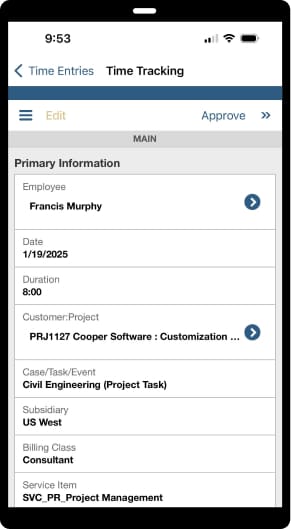
NetSuite timesheet management provides time tracking integration through a unified platform that connects timesheet data directly to core ERP, project management, HR, CRM, and payroll functions via APIs and built-in connectors. Employees can submit detailed hours via web or mobile device, assign working hours to multiple projects or tasks, and even use the system when offline and submit when back online. Real-time updates across the NetSuite ecosystem supports more accurate project costing, better resource allocation, advanced analytics and reporting, and faster invoicing and billing, along with automatic posting of logged time to the organization’s general ledger. NetSuite timesheet management’s suite of features and real-time data syncing reduce organizational errors, eliminate manual data entry labor, and improve decision making and resource planning.
Logging Hours With NetSuite Timesheet Management
Integrated time tracking can transform an administrative task into business value for organizations, their leaders, their employees, and their customers. By syncing time-tracking data with other business systems in real time, companies can decrease manual errors, improve operational efficiency, manage labor costs, simplify and improve invoicing and payroll processes, and perform workforce management analytics to inform day-to-day management and long-term strategy.