
How successfully a company hires, onboards, manages, and rewards its people is fundamental to success. These factors are too important to leave to chance, so the most successful firms use data to inform workforce management: They compare their attrition rates with national and industry-specific benchmarks. They hold managers responsible for keeping the lines of communication open with their reports. They actively manage their career development programs and look at total compensation metrics in context of the cost of replacing top performers.
What Is Employee Turnover?
Employee turnover refers to the total number of workers who leave a company over a certain time period. It includes those who exit voluntarily as well as employees who are fired or laid off—that is, involuntary turnover.
Turnover is different from attrition. When calculating attrition, reductions in force and terminations are not counted.
Key Takeaways
- Turnover measures separations—employees who leave a company—within a certain time period. Separations include everyone who is no longer with the company, regardless of the reason.
- Turnover is broken down into two types: voluntary, where people leave of their own volition, and involuntary, where people have been terminated or were part of a seasonal layoff or reduction in force.
- Employees who voluntarily leave their jobs are often seeking more money and better benefits, career progress, a more optimal work/life balance, or to escape an ineffective or toxic manager.
- Turnover is expensive: Gallup pegs the cost at between 40% to 200% of the salary of the employee being replaced.
Employee Turnover Explained
Turnover, especially the voluntary variety, impacts a company’s ability to achieve business objectives and is a key concern for executives. The reasons people leave vary, and companies can’t always stem the tide.
Shifts in demographics are one driver. More older Americans are working than ever before, setting businesses up to expect more retirements in the coming years. According to Pew Research, roughly one in five Americans ages 65 and up were employed in 2023—nearly double the level in 1988—with 62% working full time, up from 47% in 1987.
Meanwhile, millennials, who comprise 36% of the US workforce, according to 2024 US Department of Labor data, don’t stay at their jobs as long as previous generations did. A September 2024 US Bureau of Labor Statistics (BLS) report states that the median tenure of workers ages 55 to 64 was 9.6 years. That’s more than three times the tenure of workers ages 25 to 34 years, which was just 2.7 years.
Among workers ages 60 to 64, 52% had been employed for at least 10 years with their current employers, compared with just 21% of those ages 35 to 39, according to BLS data.
Then there’s the issue of supply and demand. In certain roles and geographies, there aren’t enough people with the right skills to fill open positions. Perennial shortages are found among medical professionals, scientists, mathematicians, skilled tradespeople, engineers, and many IT specialties. It’s widely agreed that many of these shortages will persist even with higher-than-normal unemployment rates.
And finally, people want more from their employers—and not just money. Recall that guaranteed lifetime employment is no longer on the table for most professions. Even baby boomers are looking for more than a steady paycheck and say working for a company with a purposeful mission is a top priority. According to a 2024 Gallup report, the primary ways businesses could have prevented employees from leaving were additional compensation/benefits (30%), more positive interpersonal interactions with managers (21%), organizational issues (13%), career advancement (11%), and improved staffing/workload/scheduling (9%). Today’s workforce also values flexibility and time off, as well as a clear career path complete with the training to advance steadily and remain marketable.
What Do Turnover Rates Tell Us About a Business?
Turnover rates must be viewed in context, as certain industries, such as hospitality and retail, traditionally have higher than average employee churn. A company can and should benchmark its turnover rate across similar businesses in its industry to get a sense of how well it’s retaining talent.
Consider a restaurant. Personnel managers face challenges including employing many first-time, part-time, seasonal, and student workers. Additionally, upward mobility for restaurant employees often occurs by taking positions at a new location. Yet even restaurants can develop solid “people plans” to lower turnover rates and improve team morale and cohesion, all of which lead to a better experience for guests.
Generally speaking, high turnover rates signal problems—with the company’s recruiting, its culture, its compensation and benefits structure, individual managers, training and career progression paths, and more.
What Are the Top Reasons for High or Low Employee Turnover?
Employees across industries commonly leave their jobs for the same reasons: inadequate compensation, limited growth opportunities, poor management, stress, and unsatisfying work environments. While some turnover stems from personal reasons or externalities beyond the business’s control, such as health events or family relocations, companies can look for warning signs and take actions in the following nine categories to minimize unexpected turnover.
-
Stress Levels
Employees with intense responsibilities, unclear roles, long shifts, and in otherwise high-pressure environments are ripe for burnout and turnover. Manageable workloads, clear expectations, regular check-ins, and staff autonomy can reduce burnout and increase performance.
-
Compensation and Benefits
Employees who believe they’re underpaid relative to their colleagues or market rates are likely to search for higher-paying jobs. Competitive pay scales, transparent salary structures, regular raises, and comprehensive and flexible benefits packages can help retain talent, even when competitors come calling.
-
Opportunities for Growth
Employees who don’t see a long-term path forward—opportunities are limited for promotions, building new skills, making more money, etc.—might look for jobs with more potential elsewhere. By investing in professional development, clear career paths, and internal mobility, businesses can retain employees and even tap into previously undiscovered skills.
-
Company Leadership
If leaders don’t clearly communicate the company’s direction, values, goals, and long-term stability, employees may lose confidence in the business. Strong, transparent leadership can help employees feel like trusted team members and part of the company’s success, giving them solid reasons to stay.
-
Managers
Aggressive, unsupportive, or incompetent managers can single-handedly drive top performers to competitors. Effective managers advocate for their teams, provide helpful feedback, and support a healthy work-life balance. Those on the front lines can also help HR and leadership understand why employees are leaving and what they can do to prevent it.
-
Employee Engagement
Employees who feel disconnected from the company culture or don’t share the same values will inevitably seek work elsewhere, where they are a better “fit.” Disengagement might show up as increased absences, deteriorating work quality, or indifference toward organizational priorities. On the other hand, engaged employees invest more energy in the company, take pride in their work, and are more loyal.
-
Work Satisfaction
Dissatisfaction can occur when workers feel underused or bored, viewing their time or potential as wasted or better served elsewhere. To help them feel more seen, businesses should try to align daily tasks with each employee’s skills and interests, and foster upskilling opportunities when possible. This personalized attention helps every team member find meaning in their jobs.
-
Office Culture
Toxic corporate culture, often marked by incivility, dishonesty, or lack of respect, is a strong predictor of turnover. Companies that foster a positive culture emphasizing open communication and mutual respect can help employees feel valued. This openness also gives workers a chance to voice concerns and suggest improvements rather than quit.
-
External Factors
Strong labor markets, new local employment opportunities, frequent recruiter outreach, increased marketing for new jobs in the industry, or life events can pull even satisfied employees away from a company. Managers should seek to understand their motives and use the feedback to help improve their own practices.
Types of Employee Turnover
Turnover accounts for all separations, both people who leave the company on their own accord and those who the business lets go. It also includes separations for external reasons, such as death or disability. Turnover is different from attrition in that it accounts for all departures from the company, whereas attrition considers only voluntary turnover. Furthermore, some HR teams may track inter-departmental transfers as internal turnover, excluding those figures from overall turnover metrics.
Common types of employee turnover include:
- Resignation: An employee leaves for a new job, career change, or personal reasons.
- Retirement: An employee reaches the end of their working life and leaves the company.
- Termination: An employee is let go due to poor performance, policy violations, or misconduct.
- Job abandonment: An employee stops showing up to work without formal notice or resignation.
- Layoffs or reductions in force (RIF): Employees are let go due to budget cuts, restructuring, or changing business needs. This type of turnover is often larger scale than other categories and can significantly increase turnover rates until restructuring is complete.
Turnover Types
| Turnover Types | ||
|---|---|---|
| Involuntary | Voluntary | |
| Desirable | Termination/abandonment | Retirements |
| Undesirable | RIFS | Quits |
Voluntary Turnover vs. Involuntary Turnover
Voluntary turnover counts employees who left the company by choice, often to take a new job at a different company, pursue educational opportunities, for personal reasons, or to retire. Involuntary turnover covers employees who are terminated for failing to meet performance standards and job expectations, have committed misconduct, or are part of a seasonal or company-wide layoff.
Desirable vs. Undesirable Turnover
Those who are terminated from their positions, not including unavoidable layoffs, fall into the category of desirable turnover because newer, more diligent and skilled employees can replace them. When it comes to voluntary turnover, the loss of people who left the company for new roles, not those who retired, is considered undesirable.
Cost of Turnover
The cost of replacing employees is a significant driver in a company’s initiatives to reduce involuntary and voluntary turnover. Costs include both the direct expenses of recruiting, hiring, and training, as well as harder-to-measure losses in productivity, morale, and institutional knowledge. These expenses become compounded when replacements don’t work out, restarting the entire cycle of recruiting and onboarding.
Gallup estimates that the cost of replacing an employee is around double the employee’s salary for leaders and managers, 80% for technical roles, and 40% for frontline employees. In practical terms, that means losing a manager with an $80,000 salary can cost an organization as much as $160,000 to replace them. A 100-person company where employees have an average salary of $50,000 and 20% turnover could wind up spending hundreds of thousands—if not millions—per year replacing workers.
Beyond the financial impact, turnover can create ripple effects that affect productivity long after the initial separation. New hires can take several months or years to reach full productivity, forcing team members to absorb additional responsibilities. This, in turn, can increase stress, the risk of burnout, and, ultimately, the likelihood of more turnover. Departing employees also take institutional knowledge with them, including undocumented processes, client relationships, and expertise that may take years to replace or rebuild.
Turnover by Industry
All this begs the question: What is a reasonable level of attrition?
Turnover, like most benchmarks, must be viewed in terms of industry. What’s high for one vertical industry may be completely typical for another. As of August 2025, retail and wholesale have the highest annual voluntary turnover rates at 26.7%, per HR research firm Mercer, more than double the national average (13%). Mercer says the most difficult jobs to keep filled are health care services, logistics, transportation equipment, and nonfinancial services.
Industries often calculate their turnover monthly; HR teams should look to industry sources and analysts for trends in their verticals. The Labor Department also tracks job openings and turnover data on an ongoing basis.
How to Calculate Employee Turnover
Calculating your turnover rate may seem straightforward, but there are a number of components that can skew results. Companies with human capital management (HCM) specialists should get those experts involved in analyzing attrition rates and causes. Others can access insights from analysts, including the Society for Human Resources Management (SHRM).
SHRM advises calculating employee turnover rate by dividing the number of separations during a month by the average number of employees on the payroll, multiplied by 100. Thus, to figure your employee turnover rate, you need to calculate:
Total headcount: This includes all employees on payroll and direct-hire temp workers, as well as those on a temporary layoff, leave of absence, or furlough. It should not include temporary workers or independent contractors on a separate agency’s payroll.
Average number of employees: From there, calculate the average number of employees per month by taking each month’s total and dividing by the number of months or the total headcount from each report if run more than once a month/number of reports used.
Total separations: The number of separations during a month includes both voluntary and involuntary terminations, but employees who are temporarily laid off, on furloughs, or on a leave of absence are not included.
That yields this formula:
Turnover Rate = # of Separations / Avg. # of Employees × 100
To calculate annual turnover rate (TR) or year-to-date turnover rate (YTD), add the monthly turnover rates together.
YTD Turnover Rate = January TR + February TR + March TR
Alternative Ways to Calculate Employee Turnover
Another, less detailed way to calculate turnover rate is to take the number of employees who left during a specific period and divide by the number of employees at the beginning of the period.
There are also ways to calculate different dimensions of turnover, for instance:
Involuntary turnover = (Number of Involuntary Employee Separations / Average Number of Total Employees) × 100
Voluntary turnover = (Number of Voluntary Employee Separations / Average Number of Total Employees) × 100
How Does the Bureau of Labor Statistics Calculate Turnover?
The BLS releases a “Job Openings and Labor Turnover” (JOLTs) report each month that classifies data by job openings, hires, and separations. Total separations include quits, layoffs, discharges, retirements, deaths, disabilities, and separations due to transfers to other locations of the same firm.
The quit rate serves as a measure of workers’ willingness or ability to leave jobs. For instance, the quit rate for August 2025 was 1.9%, while the layoffs/discharge rate was 1.1%. The total separation rate was 3.2%.
What Is a Healthy Employee Turnover Rate?
As discussed, turnover rates vary widely by industry and must be viewed within that context. HR teams can peg the national annual voluntary turnover average somewhere around 13% in 2025, down from 17.3% in 2023 and 13.5% in 2024, according to Mercer. From there, they need to plug in data from their human resources management systems, which ideally will be integrated with financial systems and thus able to provide insights into salaries and associated hard workforce costs.
Tracking overall turnover rates can help companies see if turnover is reaching levels that are problematic and allows them to dig into specifics. Are turnover rates consistent by age, gender, ethnicity, and tenure? How about by role, location, department, and manager? Is the workforce management team in the loop on trends that could indicate shortages in key roles?
Employee Turnover Prevention
Here’s the good news: Excess employee turnover is fixable. And the solution, often, starts with departmental managers.
Here are some best practices for HR teams.
Codify requirements for people managers: Don’t leave it to chance that front-line supervisors are checking in with their reports regularly or that they are discussing the factors that cause people to leave—including compensation, career path, and better work-life balance. Remember: What’s important to one high performer may not matter to another. It is absolutely crucial that managers uncover individual motivations and understand what will cause a person to not only continue to perform but become deeply engaged with executing the company’s vision.
Be proactive about communicating openings within the company: When it comes to career development, people who leave are often looking for paths to grow and develop new skills that they believe are unavailable within the company. By publicizing opportunities to move to new roles—and making sure there are no adverse effects for applying—HR can both minimize recruitment costs and aid with retention.
Analyze attrition data in detail: If one department is losing people at a higher rate than other groups, delve into why. It could be the nature of the roles within that team, or it could be that leaving employees want better communication and support from their managers, who they expect to treat them with professionalism.
Communicate, communicate, communicate: By increasing communication with employees via town halls and surveys, HR can highlight company vision as well as practical but important items like employee recognition programs, professional development opportunities, and new benefits.
Improve Tracking and Employee Turnover Reduction With HR Software
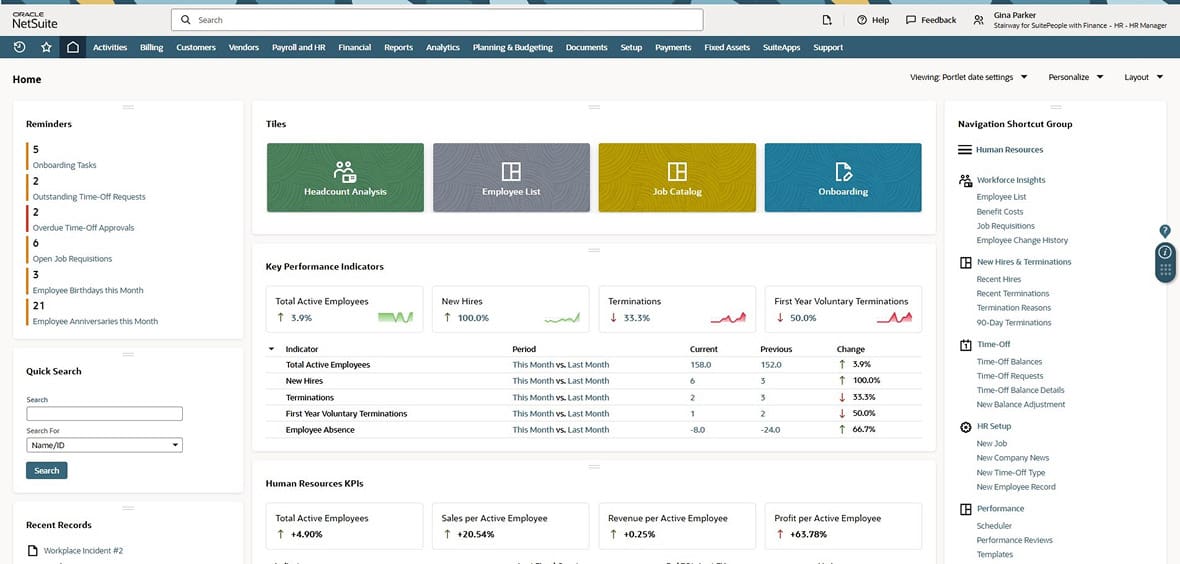
Full-featured human capital management software like NetSuite plays a crucial role in reducing employee turnover for several reasons. With NetSuite, analytics-powered findings can reduce attrition by highlighting problems and raising alerts to spark proactive changes. Unified data across groups can link KPIs and performance metrics with stated goals while also generating easy-to-read dashboards for management review. In addition, NetSuite simplifies logistical employee tasks such as onboarding and payroll management. All of these factors improve operations to ultimately lower turnover rates.
NetSuite’s HR Dashboard
Some employee turnover is both inevitable and beyond a business’s control, but businesses still hold the power to curb excessive turnover. By understanding why drivers such as compensation, management style, and growth opportunities drive employees to leave, leaders can take proactive steps to retain top talent and reduce hiring and training costs. Companies that treat turnover as a measurable, manageable performance metric, rather than an unavoidable cost of doing business, position themselves to build engaged and productive teams that support long-term stability and success.
Employee Turnover FAQ
Who is responsible for employee turnover?
While many factors converge to cause an employee to leave a job voluntarily or involuntarily, the former is most closely associated with the manager. Poor managers are a major reason employees leave—and good managers help design work environments that encourage people to stay. HR is responsible for tracking employee turnover and providing insight into trends, but in terms of people within the organization, a manager has the most power to prevent voluntary turnover.
Why should I care about employee retention?
Employee turnover can cost organizations millions every year. Turnover rates outside industry norms can signal major problems with culture, managers, compensation and benefits, and negatively impact customers.
What is the ROI of retention?
Besides avoiding the costs of replacing employees and the potential for lost sales, companies should realize that every facet of life is now subject to very public ratings. Just as a poor Yelp review can directly reduce a restaurant’s revenue, when employees slam a company on social media or career sites like Glassdoor, it will need to spend more to attract top talent.