
Retailers face growing pressure to reach more customers through more digital sales channels—all while maintaining accurate, efficient operations. The opportunity is enormous: In the US alone, ecommerce is projected to generate more than $1.3 trillion in 2025, climbing to $1.8 trillion by 2029. But competing in this environment requires coordinated processes and consistent, real-time data on all platforms. Marketplace integration offers a practical way to meet these demands.
What Is Marketplace Integration?
Marketplace integration is the process of connecting an online store and its back-end systems to third-party sales platforms. It maintains the consistency of product, inventory, pricing, and order data across disparate channels without requiring separate updates for each category.
Key Takeaways
- Integration centralizes marketplace data and automates processes, resulting in fewer errors, greater reach, and a better customer experience.
- Businesses can link their stores with marketplaces through third-party plug-ins, middleware, or APIs, whichever suits their specific needs and capabilities best.
- Integrations can connect systems to major marketplaces, such as Amazon and eBay, or to smaller, more specialized platforms.
Marketplace Integration Explained
Marketplace integration links an ecommerce company’s ERP, product information management, and warehouse management systems to the platforms where it sells products. This integration centralizes, transfers, and synchronizes data, which means that any change made in one system is reflected in real time throughout all connected channels. Sellers can monitor the consolidated performance and inventory data from a single dashboard, making it easier to track orders, manage returns, and handle customer inquiries. Businesses also gain access to richer analytics that support better-informed decisions about inventory planning, pricing strategies, and marketing campaigns.
Marketplace integration also automates critical tasks, thereby minimizing the manual work that often introduces operational errors. For example, the automatic generation of shipping labels smooths the flow of orders to fulfillment centers, and automated payment processing captures revenue faster. And because updates simultaneously apply to every channel and without the tedium of duplicated effort, adding new marketplaces becomes faster and less disruptive, which in turn helps increase sales.
Benefits of Marketplace Integrations
Marketplace integration transforms multichannel selling from a fragmented, time-intensive process into a streamlined system that supports growth. By automating data flow and improving visibility, retailers can expand their market reach yet maintain control over operations. More specifically, marketplace integration:
- Centralizes marketplace operations: Managing product listings, inventory, and orders from one platform reduces multichannel sales complexity. It eliminates the need to log into separate dashboards for each channel, making updates faster and preserving information consistency.
- Adds automation: Automation reduces the burden of ponderous manual tasks and supports data-driven decision-making. It optimizes inventory updates, order processing, and more while providing quick access to advanced insights.
- Reduces errors: By removing the need for manual data entry, marketplace integration minimizes the possibility of inventory discrepancies, incorrect pricing, and missed orders. Fewer mistakes mean lower costs and greater customer trust.
- Improves sales reach: Integration makes it easier to sell through new channels and adapt to emerging trends, such as social and voice commerce, without involving extra development work. Listing products on more platforms helps businesses expand their audiences and diversify revenue sources.
- Improves customer experience: Immediate inventory updates provide the latest availability information to customers, while automated processing improves order accuracy and delivery speed. This leads to more positive reviews and a better customer experience.
Types of Marketplace Integrations
Different integration approaches offer varied levels of speed and flexibility. Choosing the right method depends on a business’s size and complexity, plus the availability of technical resources. Three common marketplace integration options are:
- Third-party plug-ins: These prebuilt applications and software extensions allow quick connections between an ecommerce system and external sales platforms. They work well for small and midsize businesses seeking fast deployment, but these plug-ins may be limited when it comes to customization and scalability.
- Middleware: This software exchanges data and automates workflows between internal systems and multiple sales channels. Middleware improves flexibility and offers unified management, simplifying large multichannel operations.
- API integrations: Connecting directly to marketplaces via APIs gives businesses precise control over features and data flows. API integrations are well-suited to unique workflows, specialized functionality, or links with advanced ERP and analytics systems.
Why Do Marketplace Integrations Matter?
Multichannel sales increase revenue opportunities but also add operational complexity. Every marketplace has its own requirements for listings, inventory updates, and order management, which can quickly overwhelm traditional manual processes. Integrating multiple sales channels by means of a single back-end system addresses many of these challenges by automatically updating data everywhere in real time. This capability accelerates expansion into new channels and entry into new markets, making it easier for companies to act on growth opportunities.
Consolidated data gives managers access to accurate sales, stock, and order information—all in one place. This visibility supports timely responses to changes in demand, as well as more-informed pricing adjustments. Instant updates sideline overselling and missed orders, strengthening customer trust. And automation cuts down on administrative workloads, freeing teams to concentrate on strategy and growth.
What Are Some Examples of Marketplace Integrations?
Integrations can connect ecommerce systems to major marketplaces, such as Amazon, eBay, Etsy, and Walmart Marketplace. They can also link to regional or niche platforms that target specific industries or demographics, so sellers can tailor product listings to audience preferences. Each integration automates complex workflows—such as syncing product listings, updating stock levels, adjusting pricing, and routing orders—that would otherwise require manual coordination. For example, Amazon integrations can dynamically update pricing based on competitor activity, while Etsy integrations apply custom attributes specific to handmade or vintage goods for better product discoverability.
Beyond marketplaces, integrations may also extend to payment gateways, shipping providers, tax services, and marketing automation platforms to create a fully connected ecosystem. Middleware platforms and unified APIs allow retailers to manage multiple marketplace connections through a single dashboard, supporting expansion without creating IT complexity. Together, these attributes grant businesses a consistent, accurate presence across multiple sales channels.
Unify Your Customer Transactions With NetSuite
Selling through multiple marketplaces often involves fragmented systems, inconsistent product information, and error-prone manual processes—and all too often, the result is outdated stock levels that frustrate customers and undermine margins. IT teams wind up wasting valuable time reconciling and correcting data, while sales and operations struggle to gain timely, cross-channel performance visibility. This kind of disjointed approach hinders growth and hurts the customer experience. Enter NetSuite Commerce, which connects marketplaces with a retailer’s storefront, ERP, and other back-end systems to create a unified ecommerce platform. Product details, pricing, and order status are all automatically updated, cutting down on errors and accelerating fulfillment, while multichannel analytics provide a complete, accurate picture of performance. With NetSuite handling integration, automation, and data flow, businesses can focus on growth and customer satisfaction.
Centrally Manage Inventory With NetSuite Commerce
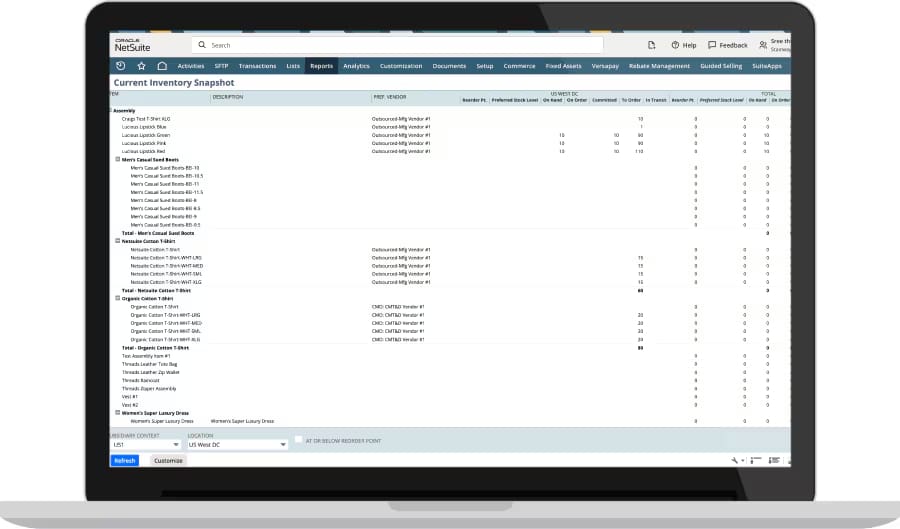
As competition intensifies in the growing ecommerce market, connected systems that synchronize data will become even more essential. Marketplace integration plays a vital role by simplifying operations, automating core processes, and improving accuracy. In doing so, it allows sellers to more easily expand their reach, stay adaptable, and deliver a consistent customer experience. Businesses that embrace scalable, flexible integrations will be well-positioned to innovate and succeed.
Marketplace Integration FAQs
What is the marketplace model?
The marketplace model is an approach to selling in which a business makes its products available through third-party platforms, such as Amazon, eBay, Etsy, or Walmart. Such marketplace operators provide the infrastructure and customer base, allowing sellers to manage their own inventory, pricing, and fulfillment.
What’s the difference between a marketplace model and a platform model?
The difference between a marketplace model and a platform model is that marketplaces act as intermediaries between third-party sellers and buyers, whereas platforms are owned channels. In the marketplace model, the operator provides the venue for others to sell products, while in the platform model, the business sells its own products or services directly to customers.