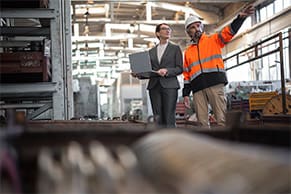
These days, it’s not uncommon for a new car to roll off an assembly line about once a minute. Hitting that pace requires figuring out where to position each workstation and how to sequence the work so that one task flows directly into the next without delay. Someone also has to think through the supply chain: what arrives when, from where, and what happens when something doesn’t show up. That’s the work of an industrial engineer. To optimize these workflows, they draw on tools ranging from tried-and-true process improvement methodologies to AI-powered analytics that identify patterns that would be difficult to spot otherwise.
What Is Industrial Engineering?
Industrial engineering is the discipline of optimizing how work flows through complex operational environments. With roots tracing back to the Industrial Revolution in the late 19th century, industrial engineers determine how to coordinate people, equipment, and processes with the least waste and fewest delays possible.
Their settings vary. Some industrial engineers are located on factory floors, reviewing sensor data and observing how work moves station to station. Others work in hospitals, analyzing why patients wait so long in the emergency department. Yet others can be found in distribution centers, figuring out how to arrange shelving so pickers walk shorter routes. What unites them all is systems thinking. Industrial engineers look at how different pieces fit together and where bottlenecks form. That perspective shapes the tools they choose.
Key Takeaways
- Industrial engineers optimize workflows across manufacturing, healthcare, logistics, and other sectors.
- Process improvement methodologies, such as Lean and Six Sigma, are still essential, but modern toolkits now extend to simulation, IoT, and machine learning.
- The most effective industrial engineers match tools to problems, rather than defaulting to familiar software.
- AI helps uncover insights from operational data at a scale and speed that manual analysis can’t match.
12 Essential Tools and Software for Industrial Engineers
The US Bureau of Labor Statistics projects 11% employment growth for industrial engineers through 2034, driven by a demand for professionals who can optimize production, manage supply chains, and bring expertise to automation initiatives. The tools they depend on fall into 12 broad categories, each addressing a different aspect of production, quality, or operations. Some are methodologies or frameworks for thinking about problems; others are software platforms or hardware systems. Many categories work best in combination.
-
Process Improvement Methodologies
Before any other industrial engineering tool can deliver value, the underlying processes they support must be sound. Process improvement methodologies give industrial engineers the frameworks to analyze, redesign, and sustain operations. Three dominate the field:
- Lean manufacturing: Lean focuses on eliminating waste by targeting activities that consume resources without adding value from the customer’s perspective. The eight categories of waste—transportation, inventory, motion, waiting, overproduction, overprocessing, defects, and underutilized talent—provide a checklist for analyzing any process. In practice, lean manufacturing underlies just-in-time delivery, pull-based replenishment, and visual management systems like kanban.
- Six Sigma: A data-driven approach to reducing process variation, Six Sigma strives to achieve fewer than 3.4 defects per million opportunities. That standard translates to near-perfect consistency in manufacturing. Six Sigma uses the DMAIC cycle (define, measure, analyze, improve, control) to structure problem-solving. It’s especially useful for tackling chronic quality problems and implementing statistical process control (SPC).
- Value stream mapping: This visual tool documents every step required to bring a product from raw material to delivery. By capturing both value-adding and non-value-adding activities, along with metrics like cycle time, changeover time, and inventory levels, value stream mapping reveals the biggest opportunities for improvement. Automating these workflows often translates directly into faster cycle times and improved on-time delivery.
-
Computer-aided Design (CAD)
CAD software supports a wide range of industrial engineering work, including the interpretation of supplier drawings to designing factory floor layouts. One of its highest-value applications is design-for-manufacturability review, where industrial engineers propose cost-saving alternatives to features that will be expensive to produce. A well-managed CAD library with version control also helps confirm that suppliers always work from current, approved files. Cloud-native CAD platforms are gaining traction because they connect design and manufacturing planning in one place, simplifying collaboration across departments and with external suppliers.
-
Modeling and Simulation Software
Industrial engineers use modeling and simulation software to create virtual versions of manufacturing systems and supply chains, and then test changes without having to disrupt real operations. This is especially useful when physical experiments would be too expensive or too disruptive. It’s also helpful for identifying bottlenecks and finding ways to reduce manufacturing lead time. Different simulation types serve different objectives. Discrete event simulation models production-line flow. Agent-based modeling captures how independent actors interact across a supply network. In supply chain analysis, simulation can factor in variable supplier lead times and show how delays propagate through assembly schedules. This is especially valuable for custom parts procurement, where lead times are often longer and less predictable.
-
ERP Systems and Supply Chain Management Software
ERP systems unite the data and workflows that run a manufacturing operation. These platforms serve as a central hub for production schedules, inventory levels, procurement activity, quality records, and financials. When production planning problems arise, such as schedule conflicts or capacity constraints, ERP systems provide the visibility needed to quickly diagnose root causes. Companies in this sector often look for industrial machinery ERP platforms tailored to their production environments, with built-in modules for materials requirements planning, shop floor control, and supplier management. Dedicated supply chain management platforms are also advantageous, offering specialized capabilities for demand forecasting and logistics optimization. Understanding how manufacturing supply chains behave under stress helps industrial engineers set appropriate safety stock levels and adjust production schedules when suppliers report delays.
-
Digital Prototyping
Industrial engineering teams use digital prototyping tools to validate product designs before building anything physical. While simulation software models production systems and supply chains, digital prototyping focuses on the product itself. Engineers can test the way a part performs under stress, whether components fit together correctly, or how an assembly responds to heat or vibration. Physical prototypes of custom components require specialized tooling, setup, and fabrication time, so shifting even one prototype cycle from physical to digital can compress development timelines significantly. The logical extension of digital prototyping is the digital twin, a continuously updated virtual model of a physical asset that reflects real-world conditions through sensor data and production system feeds.
-
Total Quality Management (TQM)
TQM is a management philosophy that embeds quality improvement into every function and process. Unlike inspection-based systems that catch defects after they occur, TQM incorporates quality from the start. To do so, industrial engineers draw on several TQM methods. Statistical process control uses control charts to monitor process parameters and flag when something trends outside acceptable limits. Failure mode and effects analysis helps teams anticipate what could go wrong so they can implement preventive controls. Gauge R&R studies verify that measurement systems are consistent and reliable. Error-proofing techniques make mistakes either impossible to commit or immediately obvious. Extending these principles to suppliers through capability assessments and process audits helps maintain quality across the entire production chain.
-
Predictive Maintenance
Predictive maintenance tools use sensor data and machine learning to forecast when equipment is likely to fail. These platforms pull inputs from vibration sensors, thermal monitors, and operational logs, then apply analytical models to detect early signs of wear or malfunction. Industrial engineers configure the systems by selecting the data streams to monitor, setting alert thresholds, and designing response protocols. The payoff extends beyond avoiding downtime: When predictive maintenance tools detect a component that is approaching failure, engineers can order replacements through normal procurement channels. Some systems trigger purchase orders automatically. Either way, organizations achieve greater control over equipment inventory management, reducing the need to stockpile expensive spare parts.
-
Augmented Reality (AR)
AR overlays digital information onto physical environments through headsets, smart glasses, or mobile devices. For industrial engineers, AR improves how workers perform complex tasks and how knowledge gets transferred. In assembly operations, for example, AR can project step-by-step instructions directly onto the work area, which helps cut down on errors and brings less-experienced operators up to speed faster. AR also supports safety by guiding workers through hazardous procedures with visual prompts and warnings within their lines of sight. It’s also a valuable tool for remote support, allowing onsite technicians to share what they see with offsite engineering experts who can offer real-time guidance; this also decreases response times and travel costs.
-
Internet of Things (IoT)
IoT refers to the networks of connected sensors and devices that collect and transmit data. In industrial settings, this is often called the Industrial Internet of Things (IIoT), and it serves as the data layer that powers many other industrial engineering tools. Sensors on equipment capture variables, such as temperature, vibration, and cycle times—information that engineers have historically viewed through other business systems. Predictive maintenance platforms use it to forecast equipment failures. SPC software uses it to signal when a process has drifted out of spec. The same principle extends to supply chain visibility. GPS trackers and IoT-enabled packaging send location and condition data to logistics platforms, helping teams spot delivery risks and adjust schedules before problems escalate. Sensor infrastructure also feeds supply chain analysis, providing industrial engineers with better data on lead time variability and supplier performance to inform sourcing decisions.
-
Project Management and Collaboration Software
New product introductions, continuous improvement projects, and supplier development initiatives all require coordination across multiple departments and, often, external partners. Project management platforms help teams plan timelines, assign tasks, and track progress. Collaboration tools centralize communication, especially when projects span engineering, procurement, and operations. For complex workflows like supplier qualification, where a new parts supplier must pass engineering review, process audits, and pilot production before final sign-off, these tools help stakeholders stay aligned.
-
Additive Manufacturing
Additive manufacturing, popularly known as 3D printing, produces parts by building up materials layer by layer from a digital design file. Unlike subtractive or formative manufacturing, it doesn’t require tooling, which makes it well suited to low-volume production and rapid design iteration. This flexibility is especially useful in discrete manufacturing environments, which produce distinct units rather than continuous batches. Industrial engineers employ additive manufacturing to produce rapid, functional prototypes in hours, rather than weeks. It’s also useful for printing custom fixtures, jigs, and inspection aids on demand. Some organizations use it to produce spare parts for legacy equipment, storing digital files instead of physical inventory. As printable materials have expanded to include metal alloys and high-performance polymers, additive manufacturing has become viable for certain end-use production parts, as well.
-
Artificial Intelligence (AI)
AI capabilities are now embedded across many of the tool categories that industrial engineers already use. Predictive maintenance platforms apply machine learning to sensor data. CAD software offers AI-powered design assistance. Quality inspection systems use computer vision to detect defects. ERP and supply chain platforms use AI to improve demand forecasts. Rather than being seen as a single tool, AI is better understood as a layer of capability that enhances existing systems.
Adoption is accelerating. For example, according to Rockwell Automation’s “2025 State of Smart Manufacturing Report,” 95% of CPG manufacturers have invested in or plan to invest in AI and machine learning within five years. Quality control is currently the leading application, with 50% of manufacturers planning to apply AI to support product quality. AI-powered computer vision systems, for example, inspect parts at production speed, detecting surface defects and dimensional deviations with a consistency that exceeds that of human inspectors. In precision machining, AI systems can learn the relationship between process parameters and part quality, helping engineers determine optimal settings. And, more broadly, industrial machinery automation increasingly relies on AI to coordinate robots, conveyors, and other equipment in real time.
Because AI touches so many systems, industrial engineers are often responsible for defining how these capabilities integrate with existing workflows. This includes identifying high-value use cases, preparing data infrastructure, and designing the human-in-the-loop processes that keep AI outputs actionable. For those tracking industrial machinery trends, AI capabilities are among the most significant developments shaping the profession.
Enhanced Decision-making and Real-Time Visibility With NetSuite ERP
Industrial engineers often work with data that is scattered across disconnected systems, making it hard to grasp the full picture. NetSuite ERP for Industrial Machinery collects production, inventory, supplier, and quality data in a single platform, giving engineers real-time visibility without the need for manual reconciliation. This cloud-based solution also integrates with the CAD, simulation, and project management tools that industrial engineers already depend on, so data flows easily among systems. Unified dashboards help teams spot problems early enough to make fast decisions, while built-in supply chain and demand planning tools support the cross-functional coordination that industrial engineering work demands. For engineers who collaborate daily with procurement, operations, and finance teams, working from the same data eliminates much of the usual back-and-forth.
Industrial engineering has been around for more than a century, but its toolkit today looks nothing like it used to. Stopwatches and time studies have given way to simulation software, IoT sensors, and AI-powered analytics. The 12 tool categories covered in this article form a capability set that effective industrial engineers draw from to address the problem at hand. As companies invest more heavily in smart manufacturing, industrial engineers who understand both the technical tools and the business context they serve will become increasingly invaluable.
Tools and Software for Industrial Engineers FAQs
What are the primary functions of industrial engineering?
Industrial engineers design and improve systems that integrate people, equipment, and processes. Their primary functions include process analysis, production planning, facilities layout, quality engineering, and supply chain design.
What software and systems do industrial engineers use?
The software industrial engineers use varies by specialty. An industrial engineer focused on production might spend most of their time using simulation and ERP systems, while one focused on quality might rely more on statistical analysis and machine-vision tools.
Do industrial engineers need to know how to program?
Programming proficiency is increasingly valuable, though not universally required. Python and SQL are the most widely used languages for tasks like data analysis and process automation.
How do industrial engineers choose the right tools for a project?
Tool selection depends on project objectives, data availability, organizational readiness, and cost. A simpler tool that gets used consistently will often outperform a sophisticated one that remains theoretical.