Sometimes a catalog part won’t do. Maybe the geometry is wrong or the material isn’t rated for the application. Or perhaps the tolerances of the use case are tighter than anything off the shelf can deliver. That’s when industrial machinery manufacturers turn to custom parts to assemble the products their engineering team envisions. These parts are crucial to meeting market demand, but maintaining a steady flow of custom inventory to keep production running is no simple feat.
Custom parts procurement requires more up-front coordination and carries more risk than standard purchasing. When it goes well, production stays on track and margins hold. When it doesn’t, the consequences manifest in delays, rework, and strained supplier relationships. This article breaks down the custom parts procurement process, the challenges, and the strategies that help manufacturers get it right.
What Is Custom Parts Procurement?
Custom parts procurement is the process of sourcing components built to unique specifications rather than purchasing them from a standard catalog. It encompasses everything from initial design documentation through supplier qualification, prototyping, and final delivery.
Unlike catalog purchasing, custom procurement requires close coordination of engineering, procurement, and supply teams before a single part gets made. Timelines are longer, and there’s no off-the-shelf fallback if something goes wrong. That raises the stakes for manufacturers in industrial machinery and other precision-driven industries.
Key Takeaways
- Custom parts are necessary when off-the-shelf components don’t meet a project’s dimensional, material, or performance requirements.
- Procuring custom parts is trickier than standard catalog procurement because it requires tighter coordination of engineering, procurement, and quality control.
- Common challenges include limited supplier alternatives, higher per-unit costs, and longer lead times.
- Clear specifications and documentation lessen the risk of receiving a part that doesn’t work as intended.
- Strategies, such as dual-sourcing, building timeline buffers, and maintaining safety stock, can also minimize risks related to procuring custom parts.
Custom Parts Procurement Explained
In discrete manufacturing environments, nearly every stage of the product lifecycle can generate demand for components that don’t exist in a catalog. When a design team needs a bracket that fits a particular assembly, a housing with nonstandard dimensions, or a fixture built to specific tolerances, custom procurement becomes the only path forward.
What separates custom parts procurement from standard purchasing is the coordination burden. Catalog items follow a predictable path: Identify need, select vendor, place order, receive goods. Custom parts require alignment among engineering, purchasing, quality, and operations departments at every stage. Specifications must be completed before quoting can begin. Supplier capability must match the part’s complexity. Prototypes must prove out fit and function before production ramps. And throughout, revision control and documentation discipline determine whether the part that arrives matches the part that was designed. It’s a challenge most manufacturers face. According to Fictiv’s “2025 State of Manufacturing & Supply Chain Report,” 91% of manufacturing leaders face barriers to product innovation and introduction, with nearly half struggling to source fast, high-quality solutions for low-volume builds.
The business case for getting this right is straightforward. Custom parts directly affect time to market and whether a company can improve on-time delivery. When components are delayed, prototyping slows, launch dates move, and engineering labor gets consumed without revenue to show for it. Custom parts also impact per-unit cost and margin, since bespoke components often have lower economies of scale, more expensive tooling, and greater inspection burden than standard parts. Quality costs add up, too. Incorrect parts and expedited rework are more common in custom procurement, contributing to hidden expenses that erode profitability. These stakes have only grown as industrial machinery trends push manufacturers toward tighter supply chains and faster launch cycles.
4 Stages of Custom Parts Manufacturing Procurement
A clear procurement strategy helps manufacturers manage all this complexity without losing time or budgetary resources to preventable mistakes. The process typically moves through four stages:
- Define specifications: Procuring custom parts starts in the hands of product designers and manufacturing engineers who translate the concept of what’s needed into complete technical documentation. Clear documentation reduces the chances of receiving a part that’s technically sound but functionally unusable. This means accurately capturing dimensions, tolerances, quality standards, and acceptance criteria, all of which are crucial to avoiding incorrect orders and rework later in the manufacturing cycle.
- Identify and evaluate suppliers: For custom work, a supplier functions as a production partner—one whose technical capabilities and documentation discipline can make or break the build. The core question at this stage is whether that partner can deliver the part on spec, on time, and at the right quality level. Answering it requires evaluating equipment, process expertise, inspection methods, and capacity.
- Prototype parts: This is the prove-it stage. Before committing to full production, make the vendor build samples to verify that the part works as designed. This stage catches fit and function issues early, when fixes are still cheap. This step is especially important for tight-tolerance components, where small variations in machining can affect both cost and lead time.
- Produce and deliver: Once the part is approved, it moves into volume production and shipment aligned with work orders. Cross-functional coordination becomes essential here. Procurement teams manage order releases, track deliveries against production schedules, and decide whether safety stock is needed for ongoing replenishment. Late design changes or incomplete quality checks can quickly cascade into schedule slips and inventory problems.
Why Is Custom Parts Procurement Challenging?
Understanding where custom parts procurement breaks down is the first step toward building a more resilient manufacturing process. When custom parts go wrong, the impact ripples across schedules, budgets, and supplier relationships, exacerbating production planning problems that dog even the most standardized procurement process. The challenges below represent the most common friction points in this specialized procurement discipline. They explain why procurement teams often spend more time, encounter more delays, and face higher stakes when sourcing bespoke components:
- Product complexity and specificity: Custom parts are engineered to exact requirements. Even small changes in tolerance, geometry, surface finish, or material can alter manufacturability and cost. These variables interact in ways that make it hard to predict final pricing or delivery dates until specs are locked in.
- Miscommunications and wrong orders: Custom parts depend on precise information transfer between buyer and supplier. When drawings are ambiguous or revision control breaks down, the part that arrives may not match what the design team intended. These errors are expensive to fix, resulting in waste and rework that can wreak havoc on budgets and schedules.
- Limited supplier alternatives: The more specialized the part, the smaller the pool of suppliers that can make it. That weakens negotiating leverage and increases dependency risk. If your only qualified supplier runs into capacity problems or equipment downtime, production stalls. Tariff shifts and supply chain disruptions make this concentration even riskier, since a single policy change can take a supplier out of the running.
- Higher unit costs: Custom parts cost more because they demand engineering time, setup effort, and intensive inspection that standard parts don’t require. Plus, suppliers that know they’re one of the few options available often price accordingly. Without clear cost allocation, teams may not realize which parts or suppliers are eroding margins until they’ve already taken a bite out of profitability.
- Longer production lead times: Custom work adds design validation, prototyping, and approval loops before stable production can begin. Unlike catalog parts whose lead times are measured in days, custom parts’ lead times are often measured in weeks or months, depending on material, tolerance, and process complexity. Even companies focused on reducing manufacturing lead time find custom parts hard to accelerate.
- Quality control issues: In custom work, inspection goes beyond basic dimensional checks. The part must perform correctly in the final assembly and hold up consistently across all production lots. The challenge is that custom parts often lack the historical data and standardized benchmarks that make quality control repeatable. This can lead to discrepancies slipping through that stall production and waste material.
7 Strategies for Addressing Common Custom Parts Procurement Challenges
The difference between a smooth custom parts program and a troubled one often comes down to discipline in a few key areas. The strategies below help manufacturing procurement teams establish that discipline. These practices can go a long way toward preventing surprises, tightening coordination, and catching problems early.
-
Assess Supplier Capacity and Capability
A supplier that looks good on paper may lack the capacity to deliver on schedule or the quality systems to catch defects before shipment. Before placing an order, validate that the supplier has the right equipment, process expertise, and inspection capability to suit your volumes and tolerances. Site visits, capability audits, and checking the first sample part before approving full-scale manufacturing provide a clearer picture of where a supplier is strong and where they may fall short.
-
Consider Dual-sourcing or Parallel-sourcing Strategies
For critical custom parts, qualify more than one source, where feasible, so that one supplier disruption doesn’t stop production. Dual-sourcing entails splitting orders between two active suppliers or keeping a qualified backup ready to step in. Parallel-sourcing has multiple suppliers produce the same part on an ongoing basis, often competing for volume based on quality, cost, and delivery performance. Despite adding up-front qualification costs, these approaches are especially valuable when geopolitical shifts, tariffs, or logistics problems threaten the global supply chain.
-
Add Ample Buffer Space to Project Timelines
One late custom part can derail a launch plan. Building a buffer into the schedule from the start gives production teams room to absorb delays without scrambling. That buffer should extend throughout the full cycle, from engineering handoffs through prototyping and supplier approvals. Place orders earlier than you think necessary, and make sure suppliers stay on top of revision control and inspection timing.
-
Prevent Budget Overruns by Monitoring Financial KPIs
Custom parts can erode margins in ways that are easy to overlook. Expedite fees, scrap, and rework add up fast when timelines slip or quality falters. Tracking key performance indicators, such as purchase price variance, on-time delivery rates, and cost-per-part trends, gives procurement and finance teams the visibility to intervene before overruns become entrenched.
-
Keep a Safety Stock of Critical Components
When a custom part is a bottleneck item, safety stock can protect uptime, especially if lead times are unpredictable or the part is difficult to replace. The trade-off is that working capital gets tied up in inventory, so this strategy works best for parts where stockout risk is high and replacement lead times are long. Reviewing supplier lead time history and delivery reliability can help determine how much buffer is enough, without overcommitting capital.
-
Communicate Acceptable Quality Criteria
Setting vague quality criteria invites disputes. Work with the supplier to define what “good” looks like before production begins. That means documenting the full range of quality criteria—dimensional tolerances, material specs, inspection methods—so the supplier knows exactly what will and won’t pass muster. When criteria are clear, disputes drop, inspections speed up, and fewer nonconforming parts make their way to the production floor.
-
Centralize Data in an ERP System
When procurement data lives in spreadsheets and email threads, mismatched revisions and incomplete quality records can hit production before anyone notices. An industrial machinery ERP system with a dedicated procurement module centralizes all the information teams need to coordinate, including purchase orders, revisions, quality documentation, and supplier performance. That consolidated visibility makes it easier to catch problems before they reach the shop floor.
Coordinate Complex Purchase Orders With NetSuite
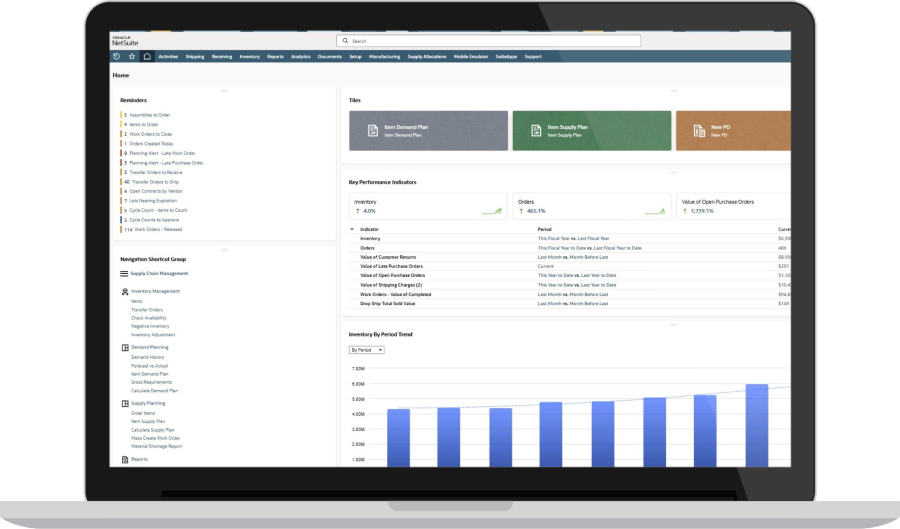
Manufacturers managing multiple custom-part programs need more than spreadsheets and email to stay coordinated. NetSuite ERP for Industrial Machinery connects procurement to engineering, inventory, and quality in a single system. That means purchase orders stay linked to the right specs, revisions don’t get lost, and supplier documentation is preserved for audits. When teams work from the same data, problems get caught earlier and supplier relationships get stronger. NetSuite ties procurement directly to financial reporting, so teams can track cost variance and margin impact without manual reconciliation. The platform also tracks supplier delivery and quality metrics, and AI-powered analytics uncover patterns in that data to help teams identify their best partners and make smarter sourcing decisions for future programs.
Supply Chain Management Made Easy With NetSuite ERP
Custom parts procurement demands more coordination, more lead time, and more attention to detail than catalog purchasing. That investment pays off when production runs smoothly and margins hold. More important, it’s what empowers industrial machinery manufacturers to build products their competitors can’t. Custom parts make it possible to make products that push past the limits of commodity inventory.
Custom Parts Procurement FAQs
How do you determine if a custom parts supplier is reliable?
Look for stable process capability for the material and geometry you need, as well as clear communication channels with named technical and commercial contacts. Ask for quality documentation and sample parts for validation to help vet supplier reliability.
What factors influence custom parts costs?
Part complexity, lead time, and order quantity are the main factors that influence custom parts costs. Tighter tolerances and exotic materials drive up machining and inspection effort, while low volumes and rush timelines add to per-unit cost.