
Production planning becomes visible only when it fails—when schedules slip, materials don’t arrive, or delivery commitments come under pressure. For industrial machinery manufacturers, the consequences can escalate quickly. Long lead times, complex bills of materials, and constrained supplier networks leave little room to recover. A single misalignment can cascade, interfering with months of planned work and putting customer relationships and revenue at risk.
This article examines the early warning signs of production planning problems, the root causes for them, practical ways to address each one, and the downstream consequences that emphasize the importance of getting planning right.
What Is Production Planning?
Production planning is the process manufacturers use to coordinate materials, equipment, labor, and schedules in order to meet customer demand. It involves forecasting which products will be needed and determining when and how to produce them.
For industrial machinery manufacturers, production planning encompasses more than these basics. Engineer-to-order environments require simultaneous coordination of design, procurement, and production processes that often span long, interdependent lead times. Effective planning depends on centralizing visibility for all these functions, enabling teams to adjust quickly as conditions change and to maintain on-time delivery.
Key Takeaways
- Production planning failures compound quickly in long-lead, complex manufacturing environments.
- Disconnected systems and poor visibility undermine even well-designed plans.
- Effective forecasting requires adaptive, scenario-based approaches.
- Disciplined scheduling and controlled job releases keep production flowing and prevent bottlenecks.
- Integrated ERP platforms connect planning, execution, and data to catch problems early.
Signs of Production Planning Problems
Before diagnosing root causes of production planning problems, it helps to recognize the symptoms. These warning signs often appear together, and, when they become chronic, indicate deeper structural issues in planning processes:
- Stockouts and overstock: Constant shortages point to inaccurate demand signals or breakdowns in inventory accuracy, halting production when critical components are missing. Conversely, excess inventory ties up capital and warehouse space, indicating overproduction or outdated forecasts. Stockouts and overstock often coexist in the same operation: too much of the wrong products, too little of the right ones.
- Inconsistent logistics: Recurring snafus with scheduling, transportation, or delivery indicate misalignment between production and fulfillment. When shipping dates slip or the need for expedited freight becomes routine, logistics is compensating for unstable plans. These problems rarely originate in transportation; more often, they reflect breakdowns upstream in production planning.
- Highly variable product quality: Quality inconsistencies often stem from unstable production conditions, where rushed schedules or skewed resources disrupt standard processes. When defect rates fluctuate under schedule pressure, it typically means planning is forcing trade-offs between speed and precision.
How to Fix 5 Common Causes of Production Planning Problems
Production planning breakdowns rarely come from a single source. Shortcomings in visibility, forecasting, scheduling, and resource coordination tend to feed each other, turning small glitches into systemic problems. Here are five common root causes—and ways to address them.
-
Transparency and Visibility Issues
One of the most persistent challenges in production planning is straightforward: Most manufacturers lack real-time visibility into what’s actually happening on the shop floor. Only 16% of manufacturing leaders report real-time work-in-process (WIP) monitoring throughout the entire production process. Without it, planning systems rely on stale or incomplete data, resulting in bottlenecks and unreliable decisions downstream.
At the crux of the issue is the IT/OT convergence gap—the disconnect between enterprise systems, such as ERP software and manufacturing execution systems (MES), and operational systems on the shop floor, such as machine sensors. Plans may reflect ideal conditions, but execution rarely does. Machines go down, setups take longer than expected, materials arrive late, and teams turn to informal workarounds that never make it back into production planning systems. The result is a fragmented operating model: ERP for transactions, MES for execution, machine sensors for real-time equipment status, and spreadsheets for day-to-day planning. These systems differ in timing, granularity, and accuracy, forcing planners to reconcile conflicting data manually while conditions continually shift.
How to fix it:
Closing the IT/OT gap requires connecting systems into a unified data architecture where ERP software, MES, and shop floor data feed into a single operational picture. Priorities include real-time shop floor data capture through Industrial Internet of Things sensors and integration with MES, along with role-based dashboards that provide actionable insights without the need for manual reporting. The goal is a continuously updated view that allows planners to respond as conditions change.
-
Inaccurate Demand Forecasts
Demand forecasting has undergone a fundamental stress test. Traditional statistical models, built on the assumption that demand patterns revert to historical norms, now operate in an environment where policy shocks and market shifts outpace the older models’ ability to adapt. The challenge isn’t simply volatility. The sources of variability have multiplied, with geopolitical disruptions, trade policy shifts, climate events, currency fluctuations, and customer-driven customization interacting in unpredictable ways. Demand shifts constantly, forcing planners to react faster than traditional models allow.
For industrial machinery manufacturers with long lead times, forecasting errors carry amplified consequences. A misread in the early planning stages can cascade through multimonth production cycles, spawning inventory imbalances and misallocated capacity, and putting additional strain on suppliers.
How to fix it:
Leading manufacturers are moving beyond single-point forecasts toward scenario-based models that allow teams to evaluate multiple possible demand outcomes. Just as critical is integrating trade policy changes, shipping data, and market indicators directly into planning workflows. Shortening planning cycles from monthly to weekly helps teams respond before small shifts escalate. Sales pipeline data that’s connected to production planning closes the gulf between what customers are signaling and what the operations team is preparing.
-
Mismanaged Schedules and Job Sequencing
Even accurate forecasts and strong visibility can’t overcome poor scheduling execution. Mismanaged schedules create disruptions across the shop floor. A common pattern is premature job release as an attempt to avoid the risk of starting late. But this floods WIP with too many active orders, creating congestion that slows production, extends wait times, and blurs priorities. With too many jobs in motion, workers often focus on the wrong tasks in their effort to simply keep things moving.
Another frequent failure is due-date myopia—in other words, prioritizing work strictly by delivery date rather than operational complexity. A job due later may carry more risk if it includes additional operations, outsourced steps, or subassemblies that require earlier initiation. When sequencing ignores this reality, high-risk work gets started too late, even if schedules appear to be on time on paper.
How to fix it:
Effective scheduling requires moving beyond static, due-date-driven plans toward constraint-aware execution. This means accounting for machine capacity, labor availability, material readiness, and setup requirements, together. Controlling WIP is equally critical. Releasing jobs at the right time, not necessarily at the earliest possible moment, keeps flow stable and prevents congestion on shared resources. Schedules should also adjust as conditions change. Modern planning systems support this through dynamic sequencing that accommodates real-time limitations.
-
Resource Shortages and Delays
Supply chain disruption has become the baseline operating condition in manufacturing. While lead times peaked at around 100 days in 2022 and have improved since, they remain significantly higher than pre-pandemic norms, leaving procurement and production in a constant state of readjustment.
In industrial machinery, resource restrictions carry substantial risk. With limited qualified suppliers and complex, long-lead components, even a single missing part can halt production of a high-value system. A delay affecting one casting or sensor, for instance, can lead to downstream congestion and missed delivery commitments. The challenge is no longer coping with simple shortages but dealing with persistent unpredictability of availability timing. Labor constrictions compound this pressure. Even when materials arrive on time, limited availability of skilled technicians can slow or stall execution. Together, material and workforce discrepancies create an environment where variability is the constant.
How to fix it:
Managing resource constraints requires accepting resilience as part of the production planning model itself. With that in mind, manufacturers should build variability assumptions directly into schedules. Tactical priorities include diversifying supplier bases for critical components, establishing strategic buffers for long-lead items, and strengthening supplier collaboration through shared forecasts and longer-term commitments. Many manufacturers are also improving visibility into sub-tier dependencies and labor availability to reveal potential disruptions before production is already in motion.
-
Inconsistent Quality Control
Quality control has traditionally been treated as an inspection step at the end of production, creating a fundamental problem: By the time a defect is identified, materials, labor, and capacity may have already been consumed, producing unusable output. The underlying issue is that quality is modeled as a validation step, not as a planning constraint. Rework probability and yield variability are often excluded from schedules, leading to plans that are overly optimistic. When defect rates increase because of schedule pressure, the impact on delivery timelines is rarely visible until orders are already at risk.
When products are high-value and customer-critical, the consequences are compounded. A single quality failure can trigger rework that consumes planned capacity and disrupts multiple jobs. When defects reach the customer, the cost extends beyond remediation to include service-level agreement penalties—not to mention long-term damage to relationships.
How to fix it:
Integrating quality into planning means treating it as an upstream factor. Leading manufacturers incorporate historical defect rates and yield variability directly into scheduling decisions, thus building realistic yield assumptions into production plans. Capturing quality signals earlier through in-line monitoring and statistical process controls reduces the likelihood of late-stage failures. Connecting quality systems with planning systems allows real-time performance data to contribute to scheduling adjustments, improving predictability and protecting delivery commitments.
What Are the Consequences of Poor Production Planning?
When planning fails, impacts are felt across operations, finances, and supplier and customer relationships, often in ways that aren’t immediately obvious. The most cited consequences include:
- Misused or unused resources: Poor planning leaves equipment idle and skilled workers waiting on materials that haven’t arrived. Capacity gets tied up on lower-priority jobs while urgent work stalls, burning throughput and wasting expensive labor and equipment.
- High inventory carrying costs: Planning that doesn’t match production to actual demand forces manufacturers to compensate by holding excess inventory. For manufacturers of complex equipment, where components can cost tens or hundreds of thousands of dollars, this ties up working capital and increases the risk of obsolescence.
- Inefficient workloads: Without clear priorities, production teams operate reactively, constantly shifting between tasks and expediting orders instead of following a stable sequence. The result is a “hurry up and wait” cycle where workers spend more time figuring out what to do next than actually doing it.
- Late deliveries and missed deadlines: When production plans break down, delays ripple through the schedule. For industrial machinery buyers, late delivery can stall capital projects and result in contractual penalties. Repeated misses damage credibility and cost future business.
- Poor quality standards: When production runs hot to meet compromised schedules, quality suffers. Processes are rushed, inspections hurried, and small issues slip through unchecked. What results is increased rework and defects that often surface only after delivery, when they’re far more costly to fix.
- Weakened supplier and customer relationships: Planning failures erode trust over time, shifting relationships from collaborative to reactive. Suppliers deprioritize unpredictable partners, while customers start treating delays as operational risk. In industrial machinery, where projects depend on reliable delivery, a pattern of misses can quietly remove a manufacturer from future consideration.
Catch Production Problems Before They Happen With NetSuite
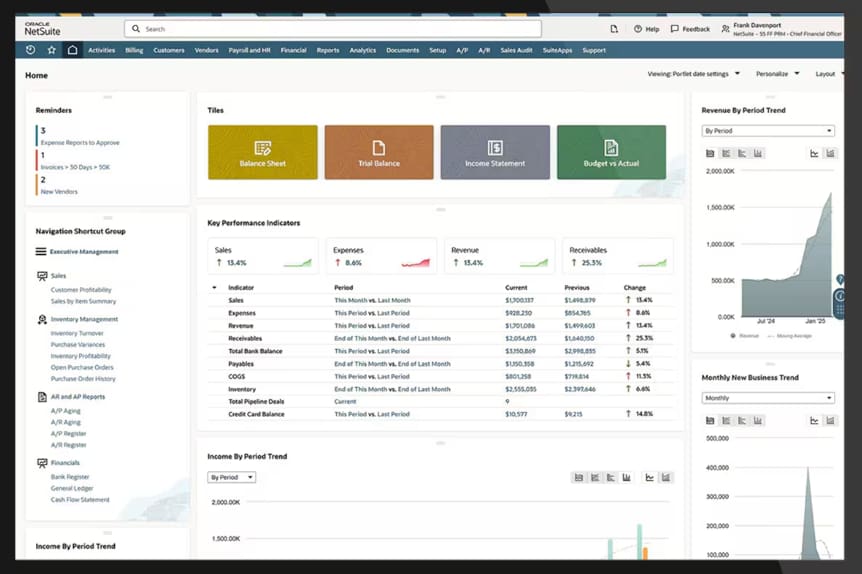
The challenges outlined in this article—visibility gaps, forecasting uncertainty, scheduling complexity, supply constraints, and quality integration—compound when planning systems, data sources, and organizational functions operate in silos. NetSuite ERP for Industrial Machinery addresses these integration lapses by connecting production, inventory, and supply chain data in real time. Planners gain visibility into work orders, material availability, and capacity without involving manual reconciliation. Demand planning supports scenario-based forecasting, and integrated execution aligns plans with shop floor conditions. For manufacturers managing long lead times, complex bills of materials, and engineer-to-order workflows, this unified approach replaces disconnected spreadsheets and point solutions with coordinated planning and execution. The result is more predictable schedules, tighter inventory control, and fewer surprises on the shop floor.
Strengthen Production Management With NetSuite
Production planning has never been simple, and today’s manufacturing environment—shaped by supply volatility, labor limitations, and rising customer expectations—raises the stakes further. For industrial machinery manufacturers, the cost of getting planning wrong compounds quickly across schedules, inventory, and customer commitments. Manufacturers that focus on fixing root causes build real operational advantage. When planning is aligned, operations flow; when it isn’t, disruption spreads. For leaders ready to shift from firefighting to foresight, the gains are tangible: stronger margins, more reliable delivery, and tighter control.
Production Planning Problems FAQs
What are some common issues in production planning and control?
Common production planning issues include inaccurate demand forecasts, limited shop floor visibility, resource and material shortages, constraint-blind scheduling, and quality control that’s disconnected from planning. These problems rarely occur in isolation. Poor visibility disrupts scheduling, increases reliance on expediting, and strains suppliers. Addressing root causes instead of symptoms is critical to stabilizing operations.
What are the five steps of production planning?
The five core steps of production planning are demand forecasting to estimate what’s needed, capacity and process planning to align resources with demand, material requirements planning to secure inputs, production scheduling to sequence work, and monitoring and adjustment to track performance and respond to change. In practice, these steps overlap and iterate rather than follow a strict sequence.