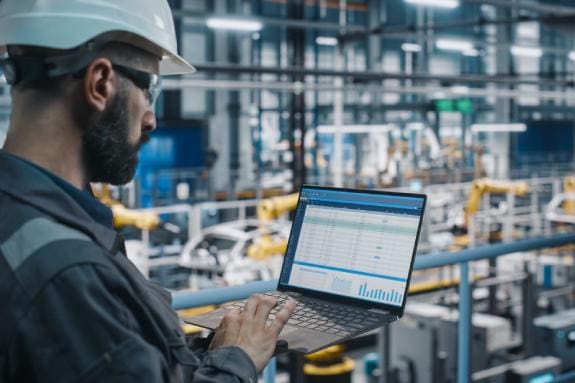
Research has shown that unplanned downtime costs the world’s largest companies 11% of their revenue. In fact, for manufacturers of complex, expensive products, such as automobiles and airplanes, the cost of a single lost hour of productivity can exceed $2 million.
Manufacturers are no strangers to collecting and analyzing data to improve productivity, avoid downtime, and reduce costs. Traditionally, data collection has been a labor-intensive manual process, as in a supervisor in a hard hat holding a clipboard near the assembly line. As a result, analyses tended to be retrospective, which made it difficult for manufacturers to quickly adapt to changes on the factory floor or in the marketplace.
As technology has advanced, though, so has manufacturing analytics. Use cases made possible by the adoption of cameras and sensors for data collection, as well as cloud-based platforms providing data aggregation and analysis, range from predictive maintenance and throughput optimization to supply chain and workforce management. These capabilities empower managers and executives to make data-driven decisions in real time to better address the needs of customers and shareholders, while remaining competitive in a volatile market.
What Is Manufacturing Analytics?
Manufacturing analytics is the use of real-time data and insights to help factories run smoothly through more informed decision-making. Analytics helps manufacturers improve productivity and cut costs by identifying production bottlenecks, predicting when equipment will fail, finding and mitigating the source of defects, and tracking a range of key performance indicators (KPIs) through purpose-built data visualization tools.
The key to successful manufacturing analytics is the ability to bring together data streams from operational technology (OT) and information technology (IT). The former consists of data drawn from a manufacturing plant and its equipment; the latter is typically information from business applications that manage finances, supply chain, personnel, and other functions. Analytics systems mine these widespread data sources to spot potential problems and recommend solutions before production runs become overwhelmed and must be halted.
Key Takeaways
- Manufacturers today are well positioned to leverage real-time data from the factory floor, as well as from business applications.
- Use cases for manufacturing analytics include demand forecasting, predictive maintenance, inventory management, and customer analysis.
- Robust analytics helps manufacturers improve productivity, reduce costs, and sharpen their competitive edge.
- To succeed, manufacturing analytics relies on a single source of truth, accessible from a unified, cloud-based data platform.
Manufacturing Analytics Explained
Collecting and analyzing operational data is nothing new for manufacturers. However, forward-thinking companies are transitioning from traditional methods of data collection, such as paper documents filled out on the factory floor, to automated aggregation made possible by Industrial Internet of Things devices. Along with improving efficiency and reducing errors, automated data collection removes the bias that can come from workers who, consciously or otherwise, fail to report critical information on their paper-based forms.
From there, AI models can further augment manufacturing analytics to help diagnose problems, predict a range of outcomes, and recommend next-best actions. None of this is possible, though, without a centralized and accessible repository of manufacturing data normalized to enable real-time analysis and produce data-driven insights. Without this degree of data integration, information remains in silos that are largely controlled by individual business units and only available for retrospective reporting.
The Advantages of Analytics in Manufacturing
Manufacturing analytics empowers companies to prevent equipment failures, predict customer demand, and keep floor and warehouse operations running smoothly. Companies that make enlightened operational and business decisions through collecting, cleansing, and analyzing data during every stage of production can expect to experience the following benefits:
- Optimized costs: Predictive analytics can help companies cut the cost of repairing equipment, maintaining excess inventory, processing product returns, and staffing the production line. In addition, companies can assess customer, market, and competitive data to help determine the best prices for their products.
- Increased productivity: One of the biggest benefits of adopting analytics at scale is eliminating manufacturing bottlenecks that hinder production. Companies that can repair equipment before it breaks, locate materials in the warehouse quickly, fix flaws before products get shipped, and adeautely staff the factory floor are less likely to experience the slowdowns or shutdowns that decrease productivity and profitability.
- Enhanced workplace safety: Analytics can contribute to a safer work environment by helping maintain the right staff (in both numbers and qualifications) for each shift or by identifying equipment that must be taken offline before it breaks. In addition, assessing employee data can help companies find gaps in skills or certifications that may contribute to safety risks and then implement appropriate training to fill those gaps.
- Stronger competitive edge: The ability to draw insights from customers’ order history, preferences, and interactions with the sales team helps manufacturers provide a level of personalized service that sets them apart. On a broader scale, studying market conditions allows companies to predict what products will be trending at what price point; with this information, they can ramp up production and go to market before their competitors .
12 Manufacturing Analytics Use Cases
Many aspects of researching, designing, developing, producing, and shipping manufactured goods can benefit from the application of manufacturing analytics. The key use cases described below can help companies anticipate demand, keep equipment running, manage inventory, reduce errors, optimize staffing levels, and meet the specific needs of customers.
-
Demand Forecasting
At its core, demand forecasting is about predicting what customers will want and the price they’ll be willing to pay for it. Sometimes, companies do this on a short timeline—for example, to determine whether to produce more goods on a Friday or a Monday. In other cases, demand forecasting looks weeks or months into the future. Whichever the case, using manufacturing analytics to identify expected demand, even in a general sense, helps businesses streamline management of inventory, labor, production, and shipping. This limits the effects and costs of overstocking raw materials and the need to store unsold goods, pay overtime to workers for additional shifts, or request a rush shipment from a supplier in the event of a stockout.
A range of data types assists the decision-making process behind demand forecasting. Analyzing consumer and competitor trends, for instance, can show where people are spending money and indicate how production plans may need to shift. Looking at marketing activity, meanwhile, offers a glimpse into how sales volume might change due to discounts or promotions, which may also influence future production.
-
Predictive Maintenance and Monitoring
Many manufacturers have adopted a preventive maintenance routine to safeguard the upkeep of equipment and avoid preventable failures. However, scheduled maintenance can sometimes be unnecessary maintenance, as it doesn’t consider equipment’s actual condition. Parts may be replaced before they need to be—with machines taken offline unnecessarily as a result.
Predictive maintenance, meanwhile, aggregates data from strategically placed sensors and applies advanced analytics to monitor equipment in real time. Data on operational conditions, such as vibration, temperature, and pressure, can help predict when equipment is likely to fail. This lets manufacturers schedule maintenance based on equipment’s actual condition and performance. Along with reducing the cost and resource utilization of unnecessary maintenance, this can extend machine life.
Predictive maintenance is closely linked with continuous monitoring. The precise technology can vary, depending on the factors being monitored. Continually analyzing circuits in electrical motors, oil in compressors, or emissions in furnaces can all reveal different signs of wear and tear. Analyzing sensor data helps manufacturers determine the severity of issues that arise and develop plans for addressing them.
-
Warehouse Management
Effective warehouse management oversees the materials used to fulfill orders, how space is used, when workers are scheduled, and how a company communicates with suppliers and transportation companies. This is distinct from tasks such as ordering and sorting related to inventory management, which is covered below.
Seamlessly coordinating people, equipment, orders, and inventory requires visibility into how a warehouse operates. Many analytics KPIs come into play here, including order lead time, picking accuracy, and inventory turnover—the third KPI being especially important for food, medicine, or other products with a predetermined shelf life. For instance, studying this data can help warehouse managers determine if processes like batch picking (fulfilling multiple orders for the same product) or zone picking (fulfilling orders from the same area of the warehouse) will save time without compromising accuracy.
-
Production Planning
As the term implies, production planning describes how a manufacturer will create its products. It often involves forecasting demand, optimizing production workflows, assessing inventory and resource allocation, making a production schedule, and monitoring progress against the plan.
It’s important for product plans to account for hiccups, such as delayed shipments of raw materials, equipment breakdowns, shifts in customer demand, or a spike in returns. The better a manufacturer can anticipate a problem through analytics techniques such as predictive maintenance or error detection, the less likely the problem will cause a significant delay in production.
Production planning is closely linked with many key business functions, including finance, sales, supply chain management, inventory management, and human resources. This demonstrates the benefit of using a cloud-based ERP platform capable of aggregating data from disparate business applications and adding layers of analytics capabilities for accurate and up-to-date production plans.
-
Supply Chain Management
Turning raw materials into finished goods and shipping products to partners (and customers) is an interconnected process known as supply chain management. A supply chain consists of a physical flow of materials, parts, and finished goods, as well as an information flow of purchase orders and production plans. Getting it right means coordinating the people, businesses, resources, and technologies that must come together to create a product.
In manufacturing, data and analytics can support supply chain management in a few ways:
- Barcodes and RFID tags within a warehouse can track inventory and anticipate when to replenish materials before they run out.
- Companies can identify preferred suppliers based on the results of metrics, such as fulfillment time, defect rate, or pricing flexibility.
- Order management systems can sort and prioritize orders as they come in; this is especially helpful if manufacturers receive orders from many channels.
- Once orders ship, tracking sensors on a truck can monitor when a shipment will get to a customer, easing any concerns the customer might have about delays.
-
Error Detection
Like many steps in the manufacturing process, manual inspections are time-consuming, prone to error, and subject to variability from one inspector to another. Companies often struggle to keep pace with the volume of production; inspecting a sampling of products may help address this issue, but it also can mean that some errors will still slip through the cracks—and make their way into customers’ hands.
Here, the combination of high-resolution cameras, sensors, and AI models enables real-time product inspections, allowing companies to immediately remove defective products from the line and halt production until issues are resolved. By analyzing additional production line data—such as equipment performance, product tolerances, and defect trends—manufacturers can perform root cause analysis and empower front-line managers to recommend targeted changes, be they equipment repairs or raw material adjustments, ultimately lowering the number of faulty products that reach customers.
-
Throughput Optimization
Productivity is key to profitability in manufacturing, as it allows businesses to stick to production plans, meet delivery timelines, and keep customers happy. Maintaining productivity means eliminating manufacturing bottlenecks that stem from misallocated labor, malfunctioning equipment, or inventory shortages.
Analyzing data from the factory floor helps detect these bottlenecks and generate solutions to increase production rates. On a broader level, management can gain insights into overall resource usage and identify opportunities to streamline operations. For example, manufacturing analytics might recommend scheduling product line changes to coincide with shift changes to help minimize disruptions caused by recalibrating equipment, switching operators, and other adjustments. Plant managers can also identify which pieces of equipment use the most energy to monitor potential resource drains across the manufacturing process.
-
Inventory Management
A subset of warehouse management, inventory management helps companies determine the type, schedule, and frequency of stock orders to meet production plans. Its ability to shorten production timelines and reduce costs makes it a key segment of manufacturing analytics, one poised to experience a compound annual growth rate (CAGR) globally in excess of 9% over the next several years. Accurate inventory management means that a manufacturer can fulfill open orders, optimize warehouse space, decrease spending on unused stock, and (for public companies) track inventory in compliance with both Securities and Exchange Commission rules and the Sarbanes-Oxley Act. Inaccuracy, on the other hand, means manufacturers will waste resources storing surplus stock, or will need to rush orders of items that are out of stock—and pay the premium associated with next-day shipping.
Manufacturers can improve inventory management by studying a range of metrics furnished by manufacturing analytics. The customer and competitor data that underpins demand forecasting, for example, also sheds light on what materials must be in stock to fulfill current and future orders. Analyzing external data is also vital. Information about raw material shortages, shipping delays, and even weather forecasts can help manufacturers anticipate shortages in time to come up with actionable solutions, such as ordering from a supplier in a less volatile geographic area.
-
Warranty Analysis
Historically, manufacturers have taken a one-size-fits-all approach to product warranties. These types of warranties can be easy to support, especially if they cover a predetermined length of time from purchase date. However, they may not account for nuanced differences among products, or components that might be susceptible to additional wear and tear, such as the motor in a dishwasher.
By analyzing data from the field, manufacturers can determine which products or components show signs of failure, then use that data to calculate failure estimations. This provides a guideline for rewriting warranties so they strike a balance between covering necessary fixes without costing the company too much. Beyond this, analyzing warranty data also helps companies make well-informed decisions regarding changes to current and future product lines to avoid failures. This manufacturing analytics market segment is expected to see a CAGR of more than 15% by the end of the decade as companies look to better manage costs, improve service delivery timelines, and manage warranties more proactively.
-
Workforce Management
Workforce management balances forecasting, staffing, and scheduling to ensure balanced availability of employees with appropriate skills. It’s an essential function for manufacturers: Front-line equipment operators, warehouse pickers, maintenance technicians, drivers, and supervisors need to be onsite throughout production.
Looking at workforce management data alongside demand forecasting and production planning data helps manufacturers predict necessary staffing levels to accommodate a holiday rush, a new product launch, or a big order due in a month. This preparation helps limit production delays and minimizes the need to pay overtime to staff who must be called in at the last minute. These factors have a downstream impact; customer satisfaction increases because orders are fulfilled on time, while employee satisfaction improves from more predictable schedules.
Beyond the production line, monitoring employee performance can help a company make data-driven decisions on where to devote resources for training, recruitment, safety, and even absence management policies.
-
Product Development
R&D is essential for maintaining a competitive advantage, but the iterative modeling, design, and development process is costly and time-consuming, especially given the sunk cost of creating prototypes that won’t be sold. Fortunately, much of the product development process can now be automated using advanced modeling techniques. A digital twin, for example, is a digital representation of a product or process that can be applied to a broad range of real-world testing conditions. This makes it possible to predict performance while using far fewer resources than would be needed to create a physical product, which is especially valuable for products used under harsh conditions or components used in complex processes.
In addition, incorporating generative AI tools into product design lets R&D teams create many design alternatives, based on the constraints, goals, and other limiting factors contained in a prompt for the AI model. This can help teams narrow their options quickly and focus their attention (and resources) on a small number of prototypes. Finally, data that’s leveraged in other manufacturing analytics use cases can offer guidance for R&D teams. For example, demand forecasting can tell companies where the market’s headed and offer insights into which products can meet customer needs. Warranty analytics, meanwhile, can highlight where components are failing and show R&D teams where to focus their efforts to improve existing products.
-
Customer Analysis
Companies in all industries benefit from knowing who their customers are and what they want. Manufacturing is no exception. Examining data on order history, patterns of product usage, and post-sales interactions helps companies forecast what customers will need and provide tailored offers that may include bulk discounts or personalized recommendations. What’s more, AI models can segment customers—those who buy frequently, those who buy in bulk, and so on—so sales teams can see which customers bring the most value and, therefore, might deserve some extra attention.
Customer feedback is another valuable source of data, even if the information isn’t always positive. In manufacturing, the ability to analyze product reviews and return rates in real time can flag flaws within a production batch. Along with allowing for corrections to production processes, this means firms can identify other impacted customers before flawed products impact their operations. No one likes to recall products, but doing it promptly helps manufacturers minimize the impact and keep their customer relationships intact.
Put Your Manufacturing Data to Work With NetSuite
NetSuite for Manufacturing brings together previously disparate data sources originating in order management, production planning, supply chain management, and quality management to give manufacturers an enterprise-wide view of development, production, and shipping. When data is available on a single, cloud-based ERP platform, employees on the factory floor and in the executive suite both gain access to the important details needed streamlining operations, reducing costs, improving safety, and meeting customer needs.
Manufacturing is a data-driven industry. The right analytics tools can provide visibility into what’s happening throughout the company and offer recommendations for small improvements that can have a big impact on productivity and profitability. Forward-thinking manufacturers are using analytics to forecast demand, manage inventory, optimize throughput, reduce errors, and more. Armed with the resulting insights, companies are able to run their businesses productively and profitably, anticipate and proactively address challenges, and stay a step ahead of their competition.
Manufacturing Analytics FAQs
How does data analytics improve manufacturing?
Data analytics improves the efficiency of manufacturing processes. For example, companies are better able to predict equipment lifecycle and repair milestones, raw material restocking, or production schedule modification. This reduces downtime for both equipment and personnel, which increases a manufacturer’s productivity and profitability.
How is data analytics used in manufacturing?
Manufacturers use data analytics to gain visibility into the end-to-end production lifecycle. Use cases include forecasting demand, managing suppliers, predicting errors, updating warranties, and monitoring how customers use finished products. The subsequent insights help companies eliminate bottlenecks, improve product design, cut down on waste, and otherwise streamline the manufacturing process.
What is an example of manufacturing analytics?
An example of manufacturing analytics is using a predictive model to assess a production plan and determining appropriate staffing levels. This allows a company to have the right number of workers with the right skills available for effective order fulfillment in a given time frame. Along with refining operations, this reduces labor costs because a manufacturer is less likely to incur extra costs from using overtime staff.