
For SaaS businesses, collecting cash is the easy part—the real challenge for finance teams lies in determining exactly when to recognize that cash as revenue. In an industry defined by up-front payments for long-term service delivery, miscalculating this timing can lead to distorted financial health, compliance failures, and a loss of investor trust.
Since the introduction of the US Generally Accepted Accounting Principles (GAAP) ASC 606 and International Financial Reporting Standards (IFRS) 15, navigating these complexities requires a deep understanding of how specific performance obligations and contract levers impact the bottom line. This article explains the core principles of SaaS revenue recognition, unique industry challenges, common real-world scenarios, and how automation is transforming workflows.
What Is Revenue Recognition?
Revenue recognition is an accounting principle that requires businesses to record revenue as it’s earned, not when payment is received. Revenue is typically earned when a company satisfies its performance obligations by delivering a product or service to a customer.
Governed by uniform standards in the United States and internationally, revenue recognition often involves evaluating customer contracts, defining performance obligations, and recognizing revenue on an ongoing basis as those obligations are satisfied. This process helps produce consistent, transparent financial reporting.
Key Takeaways
- SaaS revenue is recognized as services are delivered, not when cash is collected.
- ASC 606 and IFRS 15 provide a standardized five-step framework for global compliance.
- Accurate recognition provides the transparency needed to scale and build investor trust.
- Contract modifications and usage-based fees create complex shifts in deferred revenue schedules.
- Automation can handle the heavy lifting behind keeping your recognition schedules consistent, even as contracts change.
Revenue Recognition for SaaS Explained
Unlike businesses that earn revenue at the point of sale, SaaS companies largely use a subscription model, collecting payment up front for services delivered over time—whether monthly, yearly, or over multiple years. Because this cash is collected before services are fully delivered, it can’t be recognized immediately as revenue and must instead be recognized over time, in line with defined performance obligations. This process is governed by formal accounting standards—GAAP ASC 606 in the United States and IFRS 15 internationally—which were developed in tandem and share closely aligned core principles. Together, they provide a standardized five-step framework for revenue from customer contracts (detailed in a later section).
In practice, revenue is recognized as contractual commitments are met and control of the service transfers to the customer. For example, if a customer prepays $12,000 for a one-year subscription, the SaaS company would generally recognize $1,000 in revenue each month, with the remaining balance recorded as deferred revenue. Increasingly, finance teams are automating this procedure with AI-powered tools that support SaaS accounting by handling contract analysis and revenue schedules with high precision. In fact, the intelligent revenue recognition software market is expected to reach $11.7 billion by 2032, according to 360iResearch.
Why Is it Important for SaaS Companies to Get Revenue Recognition Right?
Proper revenue recognition serves as the bedrock of a SaaS company’s financial reporting, providing a standardized, credible look at the true health of the business. Getting it right allows investors to accurately compare performance and trust the integrity of the financial story. Strong revenue recognition:
- Reflects accurate financial statements: Precise revenue recognition guarantees that financial statements reflect actual operating performance rather than the fluctuations of billing or cash cycles. By matching revenue to service delivery, SaaS companies provide the reliable data needed for accurate long-term planning and a clear-eyed view of their recurring revenue health.
- Improves investor confidence: Standardizing how revenue is recognized establishes stakeholder trust by providing transparent views of comparable performances. When results are consistent, investors can more accurately evaluate growth trends, margins, and future obligations, curbing the uncertainty that often surrounds financial disclosures in high-growth markets.
- Maintains regulatory compliance: Adhering to ASC 606 and IFRS 15 keeps SaaS companies compliant while simplifying reporting in global markets. Since these frameworks are closely aligned, following them reduces audit risk and protects businesses from the severe repercussions of noncompliance, such as hefty fines or reputational damage among investors.
The Five Steps of Revenue Recognition
ASC 606 and IFRS 15 use a shared five-step framework that all SaaS businesses must follow to make sure revenue is recognized as value transfers to the customer. If done correctly, this standardized process allows financial reports to reflect the impact of customer agreements accurately, yet sustain comparability industrywide.
-
Identify the Contract With the Customer
For SaaS companies, a contract is in place the moment an arrangement creates enforceable rights and obligations—whether via a formal enterprise signature or by a user accepting online terms during registration or a mid-term subscription change. To satisfy standards requirements, the contract must have commercial substance, clearly defined payment terms, and a determination at the outset that the customer can afford the price. This step verifies that revenue recognition begins only when both parties are committed to a transaction with a likely payout.
-
Identify the Performance Obligations in the Contract
Here, SaaS companies must identify all distinct performance obligations. For an obligation to be classified as distinct, the customer must be able to benefit from it on its own and the service must be separately identifiable within the contract. Though software access is typically the primary obligation, SaaS contracts often include additional performance obligations, such as onboarding, premium support, data migration, or API usage. Each component must be evaluated carefully.
-
Determine the Transaction Price
The third step is to determine the transaction price—that is, the total amount the company expects to receive from the customer. For simple, fixed-price subscriptions (like $100/month), this is straightforward. However, many enterprise SaaS contracts include variable pricing elements, such as usage-based fees, volume discounts, or service credits for outages or performance issues. When price may vary, SaaS companies must estimate what they’ll likely receive. However, accounting standards require companies to use constraint—meaning that they can recognize only those revenue amounts they’re highly confident they’ll actually collect. This conservative approach prevents companies from overstating revenue and then having to reverse it later if actual usage or credits differ from initial estimates.
-
Allocate the Transaction Price
When a contract contains multiple performance obligations—say, a software license bundled with data migration and training—the total price must be distributed across them. This allocation is based on the relative standalone selling price (SSP), or what each component would cost if sold individually. If an explicit SSP isn’t available, finance teams must estimate it, using market comparisons or cost-plus margins. This step is vital for enterprise SaaS bundles because it prevents revenue from being artificially front-loaded. By anchoring the allocation to realistic values, teams guarantee that revenue recognition accurately reflects the timing and value of each service delivered.
-
Recognize Revenue as Performance Obligations Are Satisfied
The final step occurs when revenue hits the profit and loss (P&L) statement as performance obligations are fulfilled. Since subscriptions provide continuous platform access, SaaS revenue is recognized ratably on a straight-line basis over the contract term, be it monthly, quarterly, or annually. Conversely, usage-based fees, such as API calls or seat expansions, are recognized as consumption occurs, and one-time services, such as specialized training, are recognized at a specific point in time upon delivery. This mix creates a dynamic revenue waterfall that must be updated as customers upgrade or churn.
Unique Challenges in SaaS Revenue Recognition
While revenue recognition is important for all businesses, the subscription-based nature of SaaS companies makes it far more complex than recognizing a one-time sale. Because value is delivered continuously, enterprise SaaS contracts are often living documents in constant flux, making contract volatility one of the most significant hurdles. Modifications, such as mid-term upgrades, module add-ons, seat expansions, and downgrades, force finance teams to perpetually reassess whether a change represents a brand-new contract or a modification to an existing one. These shifts often necessitate a complete reallocation of the contract value and a reset of deferred revenue schedules.
Variable considerations, such as usage-based fees, rebates, or service-level penalties, introduce another layer of estimation that demands significant professional judgment. Teams must estimate these amounts, despite constraining them to prevent future reversals. Bundled multi-element deals add further complexity, requiring teams to decouple software access from professional services, because they often follow different recognition paths. Free trials and freemium models contribute to the turmoil, as SaaS companies must clearly distinguish marketing expenses from actual performance obligations.
These complexities—compounded by stringent disclosure requirements and the added friction of multicurrency contracts as SaaS companies scale globally—often exceed the capacity of manually prepared spreadsheets. Transitioning toward automated, AI-powered finance systems or ERP solutions is becoming the standard for maintaining audit-ready revenue amidst constant subscription flux. In fact, 63% of finance teams have fully deployed, or actively use, AI in their workflows, according to a 2026 Deloitte survey.
SaaS Revenue Recognition Examples
Different SaaS pricing models directly dictate the timing and flow of revenue recognition. The following three real-world examples illustrate how these structures shift recognition from up-front cash collection to carefully timed schedules.
Subscription Model
The subscription model is the engine of the SaaS industry, with customers paying recurring fees monthly, quarterly, or annually for ongoing access to software. Similar to accrual-based accounting, revenue is recognized not when cash is collected up front, but over the period the service is actually delivered.
Consider an enterprise customer signing an annual $36,000 contract for a human resources information system platform in January. While the SaaS provider might invoice the full amount on day one, it earns the right to recognize $3,000 only by the end of the first month, under accounting standards. The remaining $33,000 is recorded as deferred revenue—a liability on the balance sheet representing the obligation to provide future platform access. As each month passes, the provider moves $3,000 from the balance sheet to the P&L statement until the deferred balance hits zero at year-end. This logic holds even for monthly plans.
Multiyear Contract
Multiyear agreements—often, two- or three-year contracts that are frequently discounted—are common in enterprise SaaS, offering stability for the provider and predictability for the buyer. However, these long-term commitments significantly inflate deferred revenue balances, requiring meticulous tracking as performance obligations are satisfied over the course of several years. Whether the contract is prepaid in full or invoiced annually, revenue must be recognized proportionally over the entire service term.
Suppose a client signs a three-year, $108,000 agreement for a specialized ERP system. If the customer prepays the full amount, the SaaS company records the $108,000 as deferred revenue, recognizing $3,000 monthly for 36 months. Even with annual billing of $36,000, the recognition remains a steady $3,000 per month. If in year two the client adds a new global subsidiary module, finance teams must reassess the remaining obligations to reallocate the contract value accordingly.
Usage-based Pricing
Usage-based pricing shifts revenue recognition from a steady drip to a variable flow. Under this model, revenue is recognized only as consumption occurs, regardless of whether the metric is API calls, data storage, number of seats, or transaction volume.
Take the example of a cloud infrastructure provider charging a client $0.05 per gigabyte of data processed. If the client processes 100,000 GB in March, the provider recognizes $5,000 for that month. This creates a variable recognition schedule that demands real-time usage tracking and precise reporting. Because consumption often fluctuates, finance teams must frequently estimate accrued revenue midperiod and perform true-up adjustments once actual usage is confirmed, making certain that the P&L statement accurately reflects the value delivered, rather than just the amount invoiced.
Manage Complex Revenue Streams With NetSuite ERP
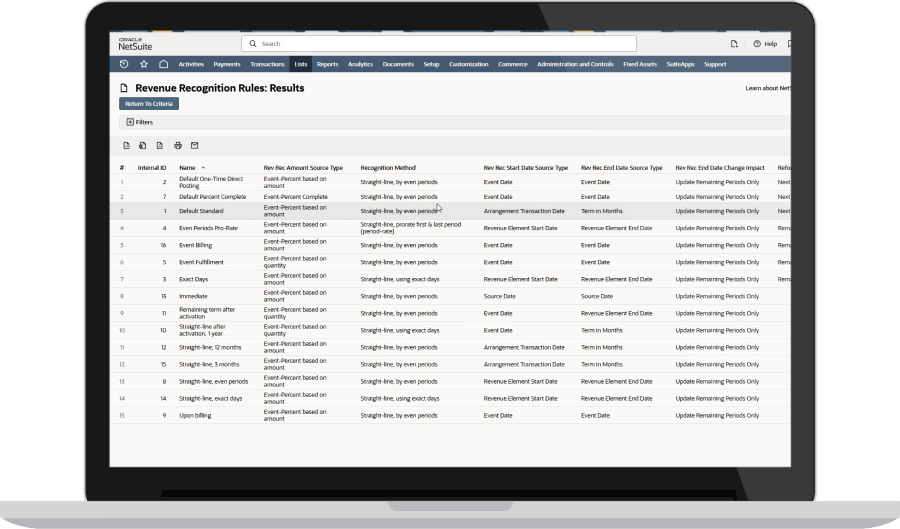
As SaaS revenue models evolve, manual spreadsheets often struggle to manage the complexities of modern accounting. NetSuite Revenue Recognition operationalizes these challenges by automating revenue scheduling, allocation, and reporting. Embedded within NetSuite ERP for SaaS, Subscription, and Technology Companies, NetSuite Revenue Recognitions allows SaaS companies to create specific recognition rules for every performance obligation and link them directly to line items in customer contracts. It also automatically recognizes revenue based on predefined milestones in compliance with ASC 606 and IFRS 15. By centralizing contract data and simplifying exception management, NetSuite helps SaaS companies report profits accurately and avoid bottom line volatility, transforming revenue recognition from a month-end burden into a strategic asset for accurate forecasting.
Recognize Revenue Accurately With NetSuite ERP
At its core, revenue recognition is about telling the true story of your SaaS business. Though navigating through the five-step framework and complex contract shifts can feel like a compliance hurdle, getting it right is what builds real investor confidence and sustainable growth. Swapping manual spreadsheets and static workarounds for a centralized, automated system is also important for simplifying audits and turning financial data into a strategic asset. With the right technology in place, SaaS providers can make sure that as their revenue streams evolve, their financial integrity remains solid.
Revenue Recognition for SaaS FAQs
What are the criteria for revenue recognition in SaaS?
SaaS revenue recognition requires a signed contract, identified performance obligations, a clear transaction price, and a defined allocation of that price. Revenue is recognized only as the customer receives and uses services.
What triggers revenue recognition?
Revenue recognition is triggered by the transfer of services to the customer. This occurs either over time, as a subscription is provided, or upon reaching specific contract milestones and performance obligations.