
Nonprofits rely on donations, and some come with strings attached. Restricted funds require that donor intent be tracked for the life of the gift and through every expense charged against it. The mechanics aren’t complicated—what’s challenging is maintaining discipline across dozens of grants, each with different restrictions, timelines, and reporting requirements, and simultaneously keeping a lean team audit-ready. This article reviews the mechanics of restricted fund accounting, highlights where things can go wrong—such as misclassified funds, poor monitoring, or misallocated expenses—and offers ways to avoid the pitfalls with better processes and AI-assisted tools.
What Are Restricted Funds?
Restricted funds are contributions that come with donor-imposed stipulations on how, when, or where the money can be used. The nonprofit takes legal custody of the assets, but discretion over their use is set by the donor.
Restricted funds come with specific caveats against how they can be used, and, unlike unrestricted contributions or for-profit revenue, they can’t be redirected regardless of how pressing an operational need might be. Misusing restricted funds, even unintentionally, can create legal liability and reputational damage. Restrictions typically fall into three categories:
- Purpose restrictions require the funds to be used for a specific program or project—a grant for youth literacy, for example.
- Time restrictions prevent use until a specified date or period has passed, such as after the opening of a new library.
-
Perpetuity restrictions, common with endowments, require the principal to remain intact indefinitely, with only investment income available for spending, as with many scholarship programs.
Key Takeaways
- Restricted funds are contributions with donor-imposed stipulations on how, when, or where the money can be used.
- Restricted fund accounting protects donor intent, clarifies what’s actually available for operations, and keeps public filings accurate.
- Accounting for restricted funds follows three steps: Analyze the contribution, record it in the correct net asset class, and release the funds when the restriction is satisfied.
- Common restricted fund mistakes, such as poor monitoring, misclassification, and incorrect revenue recognition, are preventable.
- Purpose-built nonprofit accounting software increases team productivity and accuracy and generates compliant financial reports.
Restricted Funds Explained
The phrase “restricted funds” is often used loosely in conversations about nonprofit versus for-profit accounting among finance staff, program managers, and board members, often with differing connotations. To be clear, here are the official accounting definitions of restricted funds and related terms. These classifications apply to cash contributions as well as in-kind donations.
Restricted vs. Unrestricted Funds
The core distinction between a restricted and an unrestricted fund is straightforward: Did the donor impose stipulations on how the money can be used? Unrestricted funds have no stipulations and can be deployed at the organization’s discretion. US GAAP calls these funds “net assets without donor restrictions.” They can be used to pay for overhead, absorb timing gaps, and respond to any and all needs. On the other hand, restricted funds carry requirements set by an external party, and those terms are legally enforceable. GAAP refers to these as “net assets with donor restrictions.” A nonprofit might have millions in restricted grants in the bank but struggle to cover payroll because the restricted funds simply can’t be redirected. Experienced nonprofit CFOs monitor the ratio of restricted to unrestricted net assets closely—total net assets can look healthy on paper despite net assets without donor restrictions actually being dangerously thin.
Permanently Restricted Funds vs. Temporarily Restricted Funds
These terms are no longer official GAAP classifications, as the Financial Accounting Standards Board’s ASU 2016-14 “Presentation of Financial Statements of Not-for-Profit Entities” consolidated them into a single “with donor restrictions” category. However, the concepts can be useful, especially as related to endowments. Temporarily restricted funds carry restrictions that will eventually expire, either at a specified time or when the organization fulfills the purpose for which the funds were given. Permanently restricted funds carry restrictions that never expire, such as an endowment where the donor requires the principal to be maintained in perpetuity. Nonprofits can disaggregate donor-restricted net assets between perpetual and spendable amounts in the footnote disclosures that accompany financial statements, and many find this helpful for internal management analyses.
Board-designated Funds
Board-designated funds may sound like a restricted category, but for accounting purposes they’re not. This distinction matters for liquidity planning as board-designated funds can serve as a financial cushion in ways that donor-restricted funds can’t. Board-designated funds are unrestricted funds that the organization’s governing board has chosen to set aside for a specific purpose, such as a capital reserve or a strategic initiative. They signal financial discipline and demonstrate good long-term planning—qualities that sophisticated donors and grantors look for when evaluating a nonprofit. However, board designations are just internal decisions that can be rescinded with a vote to release those funds for general use, if needed. That can never happen with donor-restricted funds. As a result, board-designated funds are classified as “net assets without donor restrictions” under GAAP.
Deferred Revenue
Donor restrictions and deferred revenue are two different concepts. “Restricted” describes how money can be used; “deferred” describes when revenue is recognized. A donation can be restricted or unrestricted based on donor’s intent—that’s one stipulation. Separately, it can be recognized as revenue immediately or deferred, depending on whether it’s unconditional or conditional.
Restricted contributions are further classified as conditional or unconditional, as defined by ASU 2018-08 “Not-for-Profit Entities (Topic 958).” Conditional restricted contributions give rise to deferred revenue because the donor can take the money back if the organization doesn’t meet specific requirements. Until those conditions are met, the nonprofit records a liability on the balance sheet representing money received before the organization has earned or become entitled to it. For example, a foundation awards $100,000 to a literacy program, but the grant requires the nonprofit to return unused funds if it doesn’t serve 500 students by year-end. The nonprofit records a $100,000 deferred revenue liability—not revenue—until the student count is met. Once the threshold is reached, the contribution is recognized as restricted revenue.
Unconditional restricted contributions, by contrast, are recognized as revenue when received, no deferral needed—they’re just classified as restricted until the funds are spent as intended.
Why Is Accounting for Restricted Funds Important?
Simply put, restricted fund accounting protects donor intent. When a donor imposes restrictions on a gift, the nonprofit is legally bound to honor those terms. Violations can trigger enforcement actions by state attorneys general, invite IRS scrutiny, and damage donor relationships. Restricted funds also affect what’s actually available for operations. GAAP requires qualitative and quantitative liquidity disclosures in the notes to financial statements precisely because restricted cash in the bank may be unavailable for commitments like payroll or rent. Restricted fund accounting essentially provides the guardrails that prevent nonprofit leadership from mistaking restricted balances for general liquidity.
Proper fund accounting also prevents distorted reporting, so that leadership has an accurate picture of operating performance. Since multiyear restricted grants get recognized separately from unrestricted funds, each period’s results reflect what’s actually available to run the organization. Finally, nonprofit reporting is public-facing, making careful accounting especially important. IRS Form 990 requires separate reporting of net assets with and without donor restrictions. Tax-exempt organizations must make annual returns available for public inspection, and the IRS publishes many filed returns online. This makes classification errors transparent to donors, watchdogs, and board members.
Accounting for Restricted Funds
Accounting for restricted funds follows a three-step process: Analyze, record, and release.
Step 1: Analyze
Every donation should be analyzed to determine how it’s classified. That analysis follows a sequence. First, determine whether the incoming funds are a contribution, such as a cash donation, or an exchange transaction where the nonprofit provides goods or services of comparable value. Second, if it’s a contribution, determine whether it’s conditional or unconditional based on whether the donor can take the money back if certain requirements aren’t met. Third, classify the contribution as with or without donor restrictions per the donor’s instructions.
Step 2: Record
Based on that analysis, record the transaction on the Statement of Financial Position (balance sheet) and the Statement of Activities (income statement). Categorize each donation as follows:
|
Unrestricted |
Restricted |
|
|---|---|---|
|
Unconditional |
|
|
|
Conditional |
|
|
Step 3: Release
Once the nonprofit has used the funds as the donor intended, the restriction is considered satisfied. At that point, the funds are released from restriction through a reclassification entry—moving them from net assets with donor restrictions to net assets without donor restrictions. For purpose restrictions, release typically happens when qualifying expenses are incurred. For time restrictions, release happens when the specified period passes. For capital gifts restricted to acquiring property or equipment, release comes when the asset is placed in service.
Restricted Funds Journal Entry Example
The following example illustrates the journal entries recorded during the life of a restricted fund, using the three steps described previously.
In January 2026, a nonprofit received a $100,000 foundation grant to expand its senior wellness program, offering free health screenings and nutrition counseling to older adults. The grant covers a two-year period (2026–2027). By June 2026, the organization has incurred $40,000 in qualifying expenses for part-time nursing staff, screening supplies, and educational materials.
Step 1: Analyze
- Is the grant a contribution or an exchange transaction? Contribution—the funder donated cash and isn’t receiving goods or services of comparable value.
- Is the grant conditional or unconditional? Unconditional—there’s no matching requirement, no performance milestones, and no right of return.
- Is the grant restricted or unrestricted? Restricted—the donor specified that the funds must be used for the senior wellness program.
Based on this analysis, the grant is categorized as an “unconditional and restricted” contribution, so revenue is recognized immediately, and the cash is recorded as net assets with donor restrictions.
Step 2: Record
In January 2026, the nonprofit recognizes the full $100,000 as restricted revenue in the period received, even though the grant covers two years:
|
Account |
Debit |
Credit |
|---|---|---|
|
Cash |
$100,000 |
|
|
Contribution Revenue—With Donor Restrictions |
$100,000 |
To record receipt of the restricted contribution.
By June 2026, the organization has incurred and paid $40,000 in qualifying program expenses:
|
Account |
Debit |
Credit |
|---|---|---|
|
Program Expenses—Senior Wellness |
$40,000 |
|
|
Cash |
$40,000 |
To reflect payment for nurses and other program expenses.
Step 3: Release
When the $40,000 in qualifying expenses is incurred, the restriction is satisfied. The funds are released through a reclassification entry:
|
Account |
Debit |
Credit |
|---|---|---|
|
Net Assets Released from Restrictions—With Donor Restrictions |
$40,000 |
|
|
Net Assets Released from Restrictions—Without Donor Restrictions |
$40,000 |
To move the satisfied portion from restricted to unrestricted net assets.
The release amount matches the qualifying expenditure. The remaining $60,000 stays in net assets with donor restrictions until spent on the program. Because this grant is unconditional, meaning that the nonprofit is already entitled to the funds, the $60,000 is a net asset (equity), not a liability.
Restricted Funds Reporting Requirements
Under ASU 2016-14, the three core nonprofit financial statements (the Statement of Financial Position, Statement of Activities, and Statement of Cash Flows) must use the two-class net asset presentation: with and without donor restrictions. ASU 2016-14 also specifies what to disclose in the notes, including the nature and amounts of donor restrictions, how those restrictions affect resource availability, and the composition of board-designated funds.
Nonprofits with endowments have additional disclosures, particularly for underwater endowments where fair value has fallen below the original gift amount. They must disclose the shortfall and their policy for spending (or not) from underwater funds. Organizations receiving federal awards face additional tracking and reporting requirements under the federal Uniform Guidance. Those spending $1 million or more in federal awards annually are subject to Single Audit requirements that examine both an organization’s financial statements and its adherence to the terms and conditions of its federal funding.
Financial Statements for Restricted Funds
The previous section covers what nonprofits need to disclose with regard to their restricted funds. Let’s take a look at where that information appears on an organization’s financial statements and what each statement reveals about restricted funds:
- The Statement of Financial Position presents assets, liabilities, and net assets at a point in time. The critical distinction is the split between “net assets with donor restrictions” and “net assets without donor restrictions.” This statement shows readers how much of the organization’s equity is encumbered. Footnotes break down significant restrictions by type, including purpose-restricted, time-restricted, and perpetual endowment corpus.
- The Statement of Activities shows revenue, expenses, and changes in net assets for a fiscal period. This statement is often presented in a two-column format, with separate columns for activity “with donor restrictions” and activity “without donor restrictions.” Restricted contributions appear as revenue in the restricted column. Releases are shown as a decrease in restricted net assets and a corresponding increase in unrestricted net assets. Readers can track whether the nonprofit is receiving new restricted funds faster than it’s spending them.
- The Statement of Cash Flows presents cash inflows and outflows from operating, investing, and financing activities over a period of time. Restricted contributions limited to long-term purposes, such as endowment gifts and capital campaign proceeds, are typically classified as financing activities rather than operating activities. This affects how readers interpret operating cash flow.
- IRS Form 990 follows GAAP presentation. Part X, Lines 27 and 28, captures net assets with and without donor restrictions. Schedule D captures endowment activity.
Handling 5 Common Accounting Mistakes for Restricted Funds
Even well-run nonprofits make mistakes with restricted fund accounting. Here are five of the most common pitfalls and how to avoid them.
-
Poor Monitoring
Without regular reconciliation, accountants can lose sight of which balances are time-restricted, purpose-restricted, or unavailable for general use. Unspent funds that should have been returned go unnoticed. Compliance violations bubble up during an audit. Release entries get missed or delayed, distorting the financial statements. Strict and timely adherence to well-documented accounting policies and procedures can address these issues. Maintain a monthly restricted-funds schedule that tracks each fund by source, purpose, beginning balance, additions, releases, and ending balance. Reconcile it to the general ledger at month-end or use AI-powered monitoring to flag anomalies continuously, catching fund balances approaching deadlines without corresponding activity before period-end review. Report summarized information to leadership and the board at least quarterly. Assign a staff member to be responsible for monitoring each significant restricted fund.
-
Misclassifying Fund Restrictions
Misclassification happens when teams confuse a restriction with a condition, a board designation with a restriction, or a contribution with an exchange transaction. The result is misstated financial statements and audit problems. Misclassification can also limit flexibility unnecessarily. For example, treating board-designated or unrestricted funds as if they were donor-restricted ties up resources that management could otherwise redeploy. For each new funding agreement, ask three questions in order: Is it a contribution or an exchange? Is it conditional or unconditional? Is it restricted or unrestricted? Document the rationale in the accounting records. Keep the original donor agreement or gift letter on file should questions arise later. And remember to train staff on the distinctions.
-
Combining Restricted and Unrestricted Funds
Combining donor-restricted and unrestricted funds in reports is one of the more serious errors a nonprofit can make. It can happen if accounting software doesn’t support fund accounting, if reports only show totals without breaking out net asset classes, or if finance purposely runs combined reports without a restricted/unrestricted breakdown because it just seems easier. The consequences are significant, especially if the organization can’t demonstrate compliance with donor restrictions or if auditors issue findings. In severe cases, state attorneys general take action or donors sue. This is true even when commingling is purely administrative and the organization intends to honor all restrictions. To avoid this, use accounting software that supports proper fund accounting and build a reporting package that shows leadership both an operating view centered on unrestricted activity and a roll-forward of restricted balances.
-
Premature Revenue Recognition
This error usually stems from treating conditional contributions as unconditional. Conditional donations have both a barrier and a right of return and should be recorded as refundable advances until conditions are substantially met. Booking cash straight to contribution revenue overstates current-period revenue and net assets. To avoid this, review every grant agreement for milestones, performance barriers, or repayment language before recording revenue. This is an area where AI can help by automatically scanning grant documents for conditional language and alerting finance when milestone completion data suggests a release is warranted. If the wording is ambiguous, GAAP guidance supports presuming it’s conditional. Then put internal controls in place to trigger revenue recognition when conditions are met. A grant calendar that flags milestone deadlines, sign-off from program staff confirming completion, and monthly reviews comparing grant requirements against actual progress can all help.
-
Misallocating Expenses to the Wrong Project
Proper expense coding is tricky for any organization, but restricted-fund projects raise the stakes. An expense doesn’t fulfill a donor restriction and trigger a release if it’s misattributed to another funding source. Worse yet, these errors tend to come up during audits or funder reviews. Start with a chart of accounts that supports tracking by fund or project. AI-assisted expense allocation can help here, suggesting fund codes based on transaction patterns and flagging potential miscoding before it reaches the ledger. Track staff time by project to support payroll charges and use a documented allocation method for shared costs, such as rent or IT. Reconcile grant budgets against actual coding each month. Release entries should be tied back to the same documentation that supports grant expenses.
Manage Restricted Funds With Accounting Software
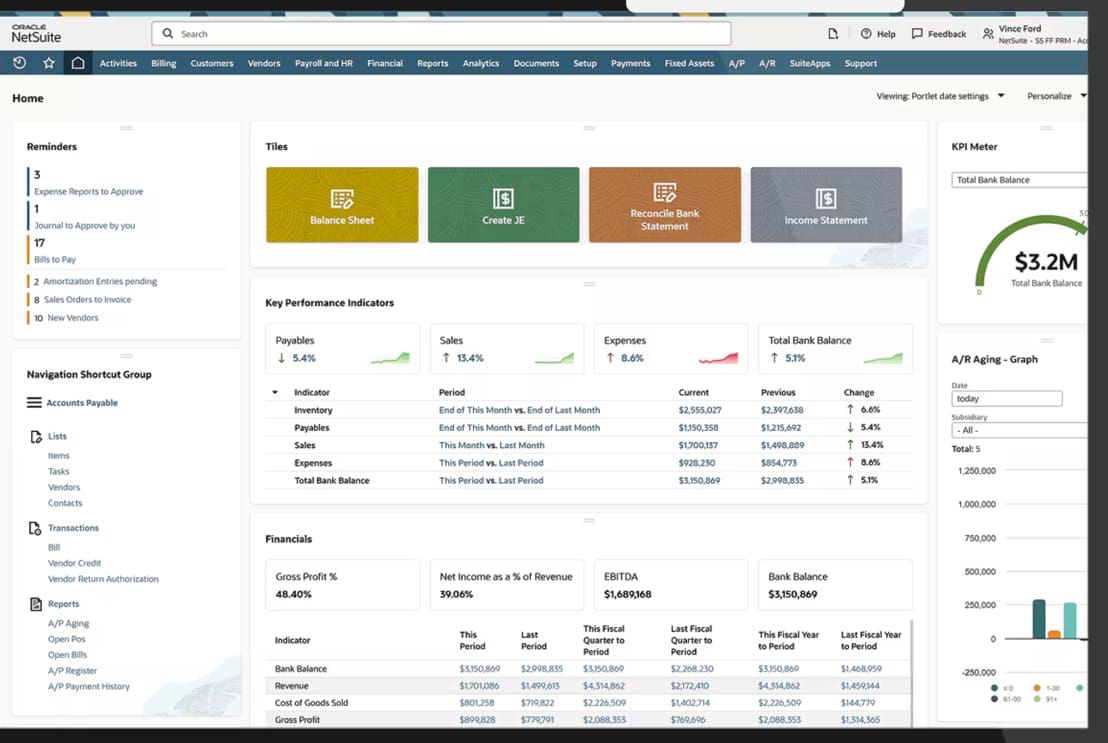
Managing restricted funds with general-purpose accounting software invites errors. NetSuite ERP for Nonprofits includes fund accounting software with multidimensional account coding, so organizations can track restricted and unrestricted activities separately from the start. AI-powered features automate routine tasks, such as invoice capture and expense allocation, removing the manual steps where errors typically occur. Built-in controls add another layer: Restricted funds can be configured so only allowable expenses post against them, and automated alerts flag exceptions before they become audit findings. Continuous monitoring agents track fund balances and flag anomalies—such as expiring restrictions without corresponding releases—throughout the month, rather than at period-end. Preconfigured reports generate the restricted-fund disclosures required under GAAP, and detailed audit trails document every release from restriction.
Simplify Nonprofit Accounting With NetSuite
Restricted funds come with legal obligations, reporting requirements, and operational complexity that unrestricted funds escape. The accounting treatment itself is manageable—the harder part is getting the rest of the organization to understand why the distinctions matter. The mistakes that trip up nonprofits most often—poor monitoring, misclassification, commingling, premature recognition, and expense misallocation—are preventable with the right systems, controls, and organizational alignment in place. For nonprofits managing multiple restricted funds, purpose-built accounting software makes compliance easier and frees finance teams to focus instead on supporting the mission.
Restricted Funds FAQs
Are restricted funds assets or liabilities?
Restricted funds are assets. The restriction affects how the asset is classified within net assets, specifically as “with donor restrictions,” but this doesn’t make it a liability. One exception: Conditional contributions not yet recognized as revenue are recorded as refundable advances, which are liabilities until the conditions are met.
Who can restrict funds?
Only donors can impose restrictions that create net assets with donor restrictions under GAAP.
What is an example of a restricted fund?
If a donor gives $100,000 to a university and specifies that the funds must be used for scholarships for first-generation students, that’s a restricted fund. The university records the gift as revenue with donor restrictions and releases the corresponding amount when it awards qualifying scholarships.