
Marketing teams are under pressure to do more with less: Launch more campaigns, reach more segments, and move faster than ever. Marketing operations (MOps) makes that possible by establishing the systems, processes, and automation that teams need to scale execution efficiently. It also generates the dashboards and measurement frameworks that prove what’s working—and what isn’t. This article explores how MOps works and the best practices that separate high-performing marketing teams from all the rest.
What Is Marketing Operations?
Marketing operations refers to the people, processes, and technologies that help marketing teams run campaigns effectively and measure results. In short, MOps serves as the back office for the marketing function. MOps professionals manage the tools and workflows that keep marketing initiatives on track, and their core duty is to provide the structure and transparency that creative and demand-generation teams rely on. They’re also responsible for delivering the data and analytics that connect marketing activities to business outcomes.
Key Takeaways
- Marketing operations transforms marketing from a support function into a strategic discipline that demonstrably fuels revenue.
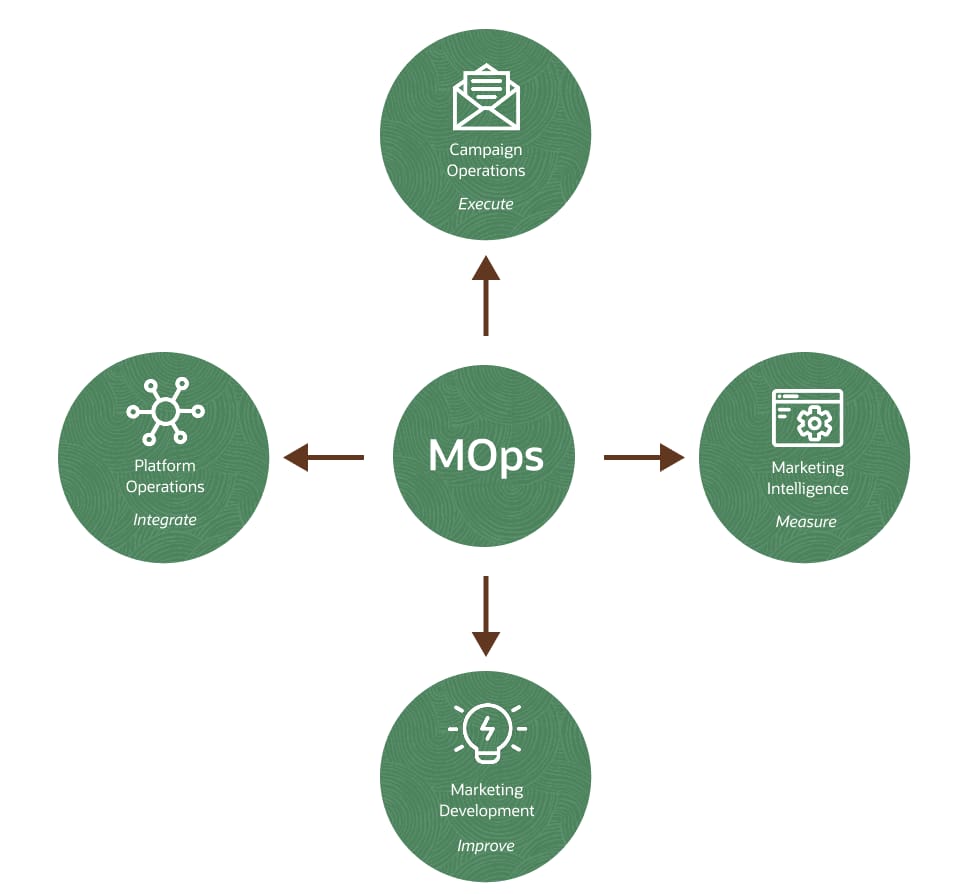
- MOps runs four key functions: campaign operations, platform operations, marketing development, and marketing intelligence.
- Marketing organizations that invest in MOps gain the infrastructure to execute consistently and substantiate marketing’s impact to the business.
Marketing Operations Explained
Marketing operations used to be a back-office support function. Now, it’s closer to the center of how marketing actually works. MOps teams run the technology stack, build the dashboards, set up the automation, and create the governance rules that keep campaigns from going off the rails. While the rest of marketing focuses on messaging and creative efforts, MOps focuses on making sure everything actually runs—and that teams can measure what happened. When a campaign launches, MOps coordinates handoffs among creative, demand generation, and sales teams; keeps data clean; and makes sure systems talk to each other.
This shift tracks with a bigger change in how marketing is being held accountable. Airtable’s “2024 Marketing Trends Report” found that 88% of marketing leaders are now directly responsible for hitting a revenue number, up from 79% the year before. MOps sits at the center of that because it can show what’s working and what isn’t. Just as important: MOps gives marketing a way to talk to finance and sales in terms everyone understands, with an emphasis on contribution to pipeline and revenue, not just clicks and impressions.
Why Does Marketing Operations Matter?
MOps overcomes a long-standing marketing obstacle. As reported in The CMO Survey for 2025, 64% of marketing leaders say demonstrating the impact of marketing actions on financial outcomes is one of their biggest challenges. MOps writes the playbook and provides the data insights that help marketing become more demonstrably accountable to business objectives. It gives marketing leaders the visibility to forecast results, allocate budgets confidently, and prove ROI to executives, resulting in:
- Enhanced efficiency and performance: MOps automates repetitive tasks and standardizes campaign builds, freeing teams from administrative burdens. This translates into more time redirected toward strategizing and creative execution.
- Improved marketing alignment: MOps establishes shared definitions, standardized taxonomies, and unified reporting to keep campaigns and channels strategically aligned.
- Performance consistency: MOps develops measurement systems that identify what works, so marketing teams can lean into the best tactics and report successful outcomes to the business.
The 4 Key Functions of Marketing Operations
MOps balances strategic governance with day-to-day execution across the four key functions outlined below. Together, they define how work gets done, how systems are managed, how insights are generated, and how the marketing discipline evolves.
-
Campaign Operations
Campaign operations turns marketing plans into deliverables. This function translates briefs into build requirements, manages scheduling and approvals, and executes the emails, landing pages, and lead-nurturing programs that reach prospects and customers. A well-run campaign operations function reduces rework and failed sends, and sets the foundation for accurate performance measurement through consistent naming conventions and tracking protocols.
-
Platform Operations
Platform operations governs the marketing technology (martech) infrastructure that enables marketing execution. With the martech landscape now exceeding 14,000 products, according to a report by Martech Tribe, managing this complexity has become a discipline in itself. When something breaks, the consequences ripple quickly, resulting in lost leads, failed campaigns, and unreliable reporting. Platform operations keeps systems running reliably and securely while maintaining the data integrations that connect them.
-
Marketing Development
Marketing development focuses on improving how marketing teams work. This pillar builds better processes, establishes agile practices, and trains teams to execute more effectively. In fact, the “2025 State of Agile Marketing Report” found that 96% of marketers applying agile ways of working report a positive experience. Organizations often underinvest here, but this pillar is what propels MOps from keeping the lights on to driving business transformation.
-
Marketing Intelligence
The intelligence function converts data into actionable insights through marketing reporting, performance measurement, attribution modeling, and forecasting. And this is smart business: A recent Demand Gen report indicates that 86% of B2B practitioners say measurement and attribution is a growing priority for their business. Marketing intelligence helps CMOs confirm impact to executives and reallocate investments toward higher-performing initiatives, thereby optimizing marketing spend.
Four Key Functions of Marketing Operations
Common Marketing Operations Project Management Approaches
Choosing the right project management approach helps MOps teams balance competing demands—strategic initiatives that require focused execution alongside the steady stream of operational requests that never stops. The wrong fit can leave teams either too rigid to respond to urgent needs or too reactive to make progress on larger projects. Marketing operations teams typically adopt one of the following three project management methodologies, depending on the work involved:
- Scrum: Teams work in sprints, which are fixed time periods dedicated to completing specific deliverables. Typical sprints span two to four weeks. Scrum works well for large, longer-term initiatives, such as platform migration or reporting system overhauls.
- Kanban: This continuous-flow approach visualizes work on a board featuring columns that track tasks at each stage, including “To Do,” “In Progress,” and “Done.” Kanban is well suited to ongoing workstreams, such as creative requests or operational support tickets.
- Hybrid: This method blends scrum’s iterative cycles with kanban’s continuous flow. A common pattern uses Scrum sprints for strategic projects, while choosing kanban to manage work on inbound requests and routine operational tasks.
7 Marketing Operations Best Practices
Strong marketing operations doesn’t happen by accident. These seven practices help MOps teams build a reliable foundation for operational efficiency, yet stay agile enough to adapt as business needs change:
- Keep documentation up to date and easy to find: Maintain shared process documentation, templates, and playbooks. Without them, marketing efforts become inconsistent and automation becomes impossible.
- Make sure your success metrics align with goals: Use measurable outcomes linked to business goals, rather than vanity metrics like impressions. This includes solid marketing operational metrics and key performance indicators, such as cost per lead, customer acquisition cost, pipeline contribution, and customer lifetime value.
- Leave room for project flexibility: Overly complex workflows create bottlenecks and get ignored. Keep processes simple enough to follow consistently, and reserve flex slots in sprints for urgent campaigns.
- Consider cross-department collaboration: MOps works best when sales and finance see the same numbers marketing does. Regular check-ins and shared dashboards allow everyone to work with the same information.
- Adopt an attitude of continuous improvement: Treat every campaign as a learning opportunity. Build regular retrospectives into the workflow to identify what’s working and what needs to change. Use MOps data to back up those decisions.
- Leverage technology for manual tasks: Every hour spent on repetitive administrative work is an hour not spent on strategy. Marketing automation, CRM, and AI tools can handle routine marketing tasks so your team can focus on higher-value work.
- Rationalize your tech stack: More tools don’t necessarily translate to better marketing. Audit regularly, consolidate where you can, and require a business case before adding anything new. Tool sprawl creates complexity and fragments your data.
ERP Software That Improves Agency Operations
Marketing operations teams often struggle to connect campaign performance to financial outcomes. NetSuite ERP for Advertising & Marketing Agencies merges project costing, billing, and resource planning into a single platform. Its integration with NetSuite CRM’s marketing automation capability gives MOps leaders clearer visibility into campaign profitability and strengthens accountability across the business. Because it unifies finance, sales, and operations data, NetSuite eliminates the silos that slow down decision-making and lead to conflicting reports. And real-time dashboards give marketing teams the confidence to forecast revenue and allocate resources effectively.
Marketing Automation Made Easy With NetSuite

Marketing operations transforms the creative art of marketing into a true business discipline. Organizations that invest in MOps establish the infrastructure to execute campaigns consistently, measure business results accurately, and ultimately stay accountable to the business. As marketing demands grow more complex every day, that operational excellence can become a significant competitive advantage.
Marketing Operations FAQs
What’s the difference between marketing operations and marketing?
Marketing is responsible for the strategic and creative work that reaches customers. Marketing operations runs the systems and processes that render that creative work efficient and measurable.
What are the four pillars of marketing operations?
The four pillars of marketing operations are campaign operations, platform operations, marketing development, and marketing intelligence. Together, they cover execution, technology management, process improvement, and performance measurement.