
A hailstorm dents the hood of a parked car. Braving the elements, the owner takes pictures and files a claim from their driveway. Artificial intelligence (AI) assesses the damage and approves a repair estimate the same day.
That kind of speed and service is the whole point of digital transformation in insurance. It’s a long way from the paper files, fax machines, and mismatched computer systems the industry has run on for decades. Getting there means rebuilding how insurers work, from generating the first quote to issuing the final claim payment.
What Is Insurance Digital Transformation?
Insurance digital transformation is the use of technology to rethink how an insurer prices risk, serves customers, and makes decisions throughout the business. It goes way beyond simply digitizing paper files by drawing on new data sources, such as telematics, sensor feeds, and real-time market signals.
Key Takeaways
- Digital transformation in insurance deploys new technologies to rebuild the manual, siloed processes that have been a mainstay of traditional insurance operations.
- The industry is moving from AI that assists staff to agentic systems that run entire claims and underwriting tasks, with people reviewing the outcomes.
- A foundation of clean, connected data is needed to support faster claims, sharper underwriting, lower administrative costs, and stronger retention.
Digital Transformation in the Insurance Industry Explained
Even the best digital technology will barely improve an insurer’s productivity if it merely digitizes rigid existing processes. The hard part of transformation is untangling decades of legacy workflows that define who touches a file, in what order, and why. Such procedures, written into core systems from the 1970s and 1980s that many carriers still run on, continue to split the work across departments—policy data in one place, claims in another, finance in a third, and none of it talking to each other. Swapping in new technology without rethinking the workflow barely moves the needle; the processes still happen in silos, just on a screen instead of paper.
Real transformation reorganizes the business around data and automation. Picture the path a policy travels. Someone shops and buys, an underwriter prices the risk, a claim eventually comes in, and the policy gets serviced along the way. At every one of those stops, integrated, AI-powered technologies are now able to take over the grunt work by providing instant online quotes, generating risk scores, processing mobile claims, and updating bills in accordance with policy changes. As a result, underwriters and adjusters will gain more time to use their expertise on tricky judgment calls or messy edge cases.
Why Is Digital Transformation Important for Insurance Agencies?
Insurance industry challenges involving speed and scalability have been bubbling up for years. Now, they’re colliding with customers who expect insurance to feel like every other app on their phone. For insurers at this inflection point, digital transformation can help prevent them from falling behind because of these pressing issues:
- Manual processing increases lead times: Paper and email are slow by nature, and the drag gets worse with every handoff between departments. As a result, claims drag on for weeks and quotes take days to generate.
- Legacy systems lack flexibility and scalability: Old core platforms are so rigid that changing one part can break another. That makes it difficult to launch new products or even add capacity during busy periods, like hurricane season.
- Data silos limit critical insights: Most insurance data is stuck in systems that were never meant to share. Even simple questions like “Which customers lose us money?” take weeks of manual digging to answer.
- Customers expect a modern experience: Forty-seven percent of all insurance purchases happen digitally, according to JD Power, and buyers compare those experiences to the slickest apps they use, not to other carriers. And when routine tasks feel clunky, they remember it. Poor digital experiences make it harder to retain customers.
Digital Transformation Benefits for Insurance Agencies
The up-front work of transformation can be daunting. But once digital technology is up and running, it should create a more responsive business that customers want to stay with. The following benefits play a major role:
- Faster claims processing: AI-assisted intake and damage assessment can shorten the time needed to address a straightforward claim from weeks to minutes. The resulting faster payouts are one of the best ways to keep customers happy. A nice byproduct is that AI-powered claims processing frees adjusters to handle harder cases.
- Enhanced customer insights: A single view of each customer, drawn from policies, claims, and payments, makes it easy to spot who’s likely to leave and who’s worth more over time. Siloed systems could never figure out those things.
- Better customer experience: A policyholder can file a claim or adjust coverage directly from their app, then watch a live tracker show exactly where things stand. That’s the type of information that used to require customers to make multiple phone calls.
- More accurate underwriting: AI models are trained on far more data than a person could ever review by hand, which sharpens risk prediction. And they work fast, so accuracy isn’t forfeited to speed.
- Lower administrative costs: Automating high-volume, rule-based tasks trims operational costs that would otherwise scale almost linearly with every new policy or claim.
The Technologies Shaping Digital Transformation in Insurance
Digital transformation is frequently talked about as if it’s a single purchase, but no one tool delivers it. It takes a full stack of technologies working together, including these:
- Cloud computing: The cloud swaps the up-front cost of on-premises servers for flexible capacity that scales up or down as needs change. Cloud ERP is often the foundation that brings policy, claims, and financial data together in one platform.
- Artificial intelligence: Machine learning (ML) models score risk, extract information from claims documents, and spot fraud patterns. Natural language processing extracts meaning from unstructured text, such as medical records and adjusters’ notes.
- Generative AI: These tools can draft correspondence, summarize lengthy files into the few paragraphs an underwriter needs, and converse naturally with policyholders to gather first-notice-of-loss details.
- Workflow automation: Business process automation tools orchestrate entire multistep workflows.
- Internet of Things and telematics: Connected cars, homes, and wearables stream live data on how people drive and live, powering usage-based insurance. They also support the shift to loss prevention.
- Advanced analytics: Advanced analytics tools answer the questions plain-vanilla reports can’t, such as which policies are about to lapse or which neighborhoods face rising flood risk.
How Is Digital Transformation Changing the Insurance Industry?
After digital transformation, decisions that once waited on a person shuffling paper can happen immediately, in systems the whole business can see. That resets the tempo of the entire operation. Insurers can respond quickly to market shifts, so they’re heading off problems instead of cleaning them up. Here’s what that looks like across the business.
Customer Experience
For years, customers heard from their insurer exactly four times: when they bought, when they paid, at renewal time, and if they filed a claim. With unified customer data, insurers can be useful between those transactions. They can catch and alert customers to a missed payment before coverage lapses, or offer help the moment something goes wrong. That doesn’t mean automating everything, though. The best setups stay hybrid, handling routine tasks like paying a bill or checking a claim’s status through self-service but keeping real people on hand for more stressful and complicated issues, such as filing a major loss or working through a coverage dispute.
Underwriting
Underwriting used to be capped by how many files one person could work through in a day. Now, AI pulls the data together, creates a first-pass risk score, and clears the easy applications so underwriters can spend their time on the gray areas and the big-ticket risks. Live inputs, such as credit records, driving history, and in-vehicle sensor data, make sure those customer scores remain up to date from application to renewal. That’s vital for fast-changing risks, including cyber and climate, where the old actuarial tables can’t keep up because there’s either too little loss history to model or the past no longer predicts the future.
Claims Management
Claims processing has changed more than any other part of insurance. Work that once took weeks of paperwork can now be wrapped up in minutes for a straightforward auto, travel, or property claim. AI document review handles the messy stuff, such as police reports, medical records, handwritten notes, or photos of a crumpled bumper, that traditional automation struggled with. On a straightforward claim, an agentic AI system can run the whole sequence—checking photos against weather data, confirming coverage dates, requesting a missing invoice, scoring fraud risk—then either settle it or route it to a human with a complete case summary. The complicated or high-dollar claims still go to a human. But the human now gets a head start, because the file has already been analyzed and reported on by AI software.
Sales Operations
The ground is shifting fast for how customers first reach an insurer, as digital technologies take the simplest deals off the sales force’s plate. Instead of working with a human agent on a manual quote, standard personal lines—such as auto, renters, and basic homeowners—and small commercial policies can be quoted and bound online in minutes. Sometimes, an AI agent gathers the details and binds a simple policy. Customers can also pick up flight coverage when they buy a plane ticket or product damage coverage when buying a phone. Human agents remain in the loop for more complex risks, such as large commercial accounts, high-value properties, or fully underwritten life policies, for which someone must weigh the nuances and earn the customer’s trust.
Billing and Payments
Billing has long relied on separate, bolted-on tools for invoices, payments, and refunds. This leads to scenarios in which one household might get a paper bill for the car and a text alert for the home policy. Digital transformation pulls that information into integrated systems that can accept payments via cards, ACH, digital wallets, and text-to-pay, while also keeping the general ledger in sync. Cleaner billing usually means more people will pay on time, too.
Policy Administration
Policy administration systems keep track of who has what coverage, at what price, and under what terms, which makes them an insurer’s most rigid and highest-stakes technology. A mistake here has legal and financial ramifications. Therefore, a “rip-and-replace” of a policy administration system is a risky, multiyear, high-cost project that insurers generally take on only when the old core is truly at its end of life. In the meantime, they frequently take the lower-risk route of wrapping the old core in APIs that let modern apps and portals read and update policy data on the fly. That opens the door to faster product launches and self-service changes without the pain of rebuilding the engine all at once.
Risk Management
Risk management used to entail a periodic look in the rearview mirror—usually an annual assessment based on historical loss data. Today, real-time inputs from sensors, telematics, and satellite imagery let insurers watch exposure change as it happens. ML can model how a single event, such as a wildfire or a wave of cyberattacks, might hit many policies at once—the kind of potential correlated loss that’s easy to miss when risks are judged one policy at a time. This forward-looking view helps carriers price policies and estimate needed reserves with more precision, so a carrier can hold enough to stay solvent without tying up more capital than necessary. It also turns risk data into a way to warn customers before something goes wrong, by, for example, catching a water leak or a risky driving pattern early enough to alert the customer before a small problem becomes a claim.
Operations Management
AI and workflow automation are having the most direct impact in back-office operations management, where they can take over high-volume grunt work like renewals, document processing, and compliance reports. They cut costs and increase accuracy while leaving a complete, time-stamped trail of every action—so an auditor can trace exactly what happened without piecing it together from manual notes. With this work completed, operations staff can focus on cases that call for nuanced judgment.
Examples of Digital Transformation Success in the Insurance Industry
Digital transformation likely doesn’t look the same at any two carriers. For some, it means rewiring the back office so a routine task runs in seconds instead of half an hour; for others, it means reinventing the product itself. The two examples below sit at opposite ends of that range—one is an auto insurer overhauling how it handles claims, the other a life insurer rethinking what a policy even is.
Assessing vehicle damage used to mean an adjuster reviewing claims by hand. But a large US auto insurer now lets customers photograph damage in its app and then runs those images through AI-powered estimating software to categorize the damage and generate a repair estimate in a fraction of the time. Straightforward claims move quickly, while complex or disputed ones still are routed to a human adjuster. But now, the adjuster starts with a file that the system has already sized up. Claims is the highest-volume, highest-stakes moment in auto insurance, so speeding it up generates benefits in terms of cost and customer satisfaction alike.
Traditional life insurance is close to a set-it-and-forget-it product. A customer answers some health questions, takes a medical exam, signs a policy, and then rarely hears from the insurer again—except that a national US life insurer has reinvented that model through wearables, which enable it to write policies with the potential to change continually. The company lets policyholders share data from devices that measure their activities and vital health data, giving them the opportunity to earn premium discounts and rewards for healthy habits. Instead of pricing a life once, the insurer stays engaged, nudging customers toward habits that lengthen their lives—and, along the way, reduce claims.
3 Insurance Digital Transformation Best Practices
Some insurers may invest in transformation but end up with disconnected pilots that never scale. The ones that get real value are more disciplined about which projects they tackle first, and in what sequence—a key tenet of these best practices:
- Integrate and centralize your data sources: Pulling together siloed data requires connecting the systems that run policy administration, claims, billing, and CRM, often through an ERP integration process that also ties them to financials. From there, companies should treat data quality as an ongoing discipline to maintain foundational strength.
- Identify and automate repetitive processes: The smartest place to start is usually on high-volume, well-defined tasks, such as claims data extraction or renewal processing. These processes carry low risk because AI tools can work inside existing systems, so those systems need not be replaced.
- Consider a phased approach to digital transformation: Roll out changes in stages tied to real outcomes, instead of betting on one giant overhaul. Only after cleaning up the data and automating simple tasks should AI enter the picture.
Modernize Your Agency’s Operations With NetSuite ERP
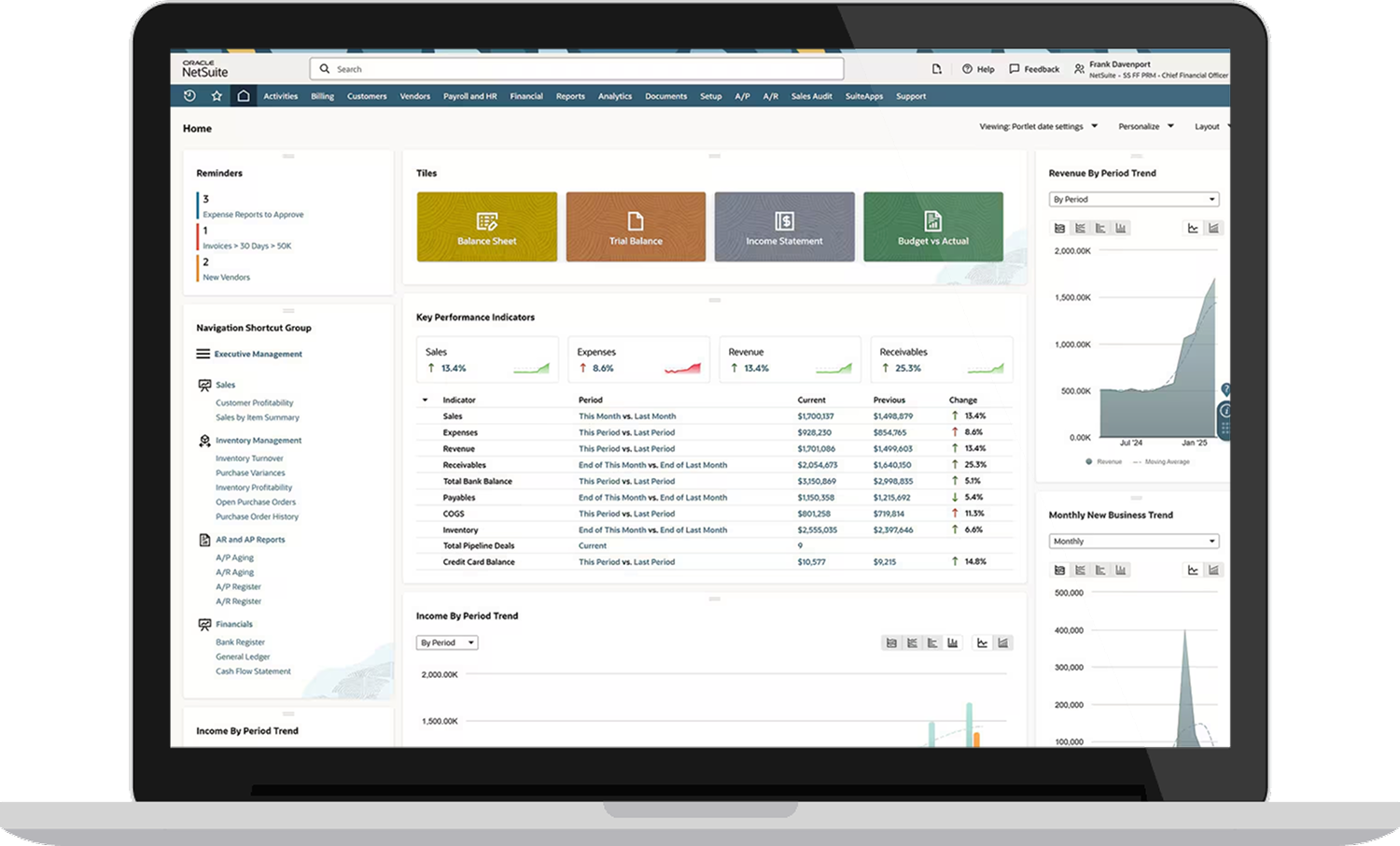
The problems of disconnected legacy systems, siloed data, and manual processes are hard to solve one tool at a time. NetSuite Insurance ERP offers carriers, brokers, and agencies a cloud-native system that brings policy, claims, commissions, and financial data together with CRM and analytics. AI-powered dashboards display and analyze premium trends, claims ratios, and cash flow, while anomaly detection spots irregular claims and payments before they post. Agentic workflows monitor for claims and payment exceptions, then route each one to the right person for review, using the same controls and audit trail as the rest of the system. On the financial side, AI reads and captures invoices, drafts reports and reconciliations, and helps close the books faster with less manual work. Built-in controls and audit trails support compliance with industry standards throughout many jurisdictions, entities, and currencies.
Unify Claims and Financial Data With NetSuite
Digital transformation creates an opportunity for insurers to rebuild decades-old processes by focusing on data and automation to clear out the repetitive work, get the data in order, and free people for the work that actually calls for human judgment.
Insurance Digital Transformation FAQs
How does digital transformation improve customer experience in insurance?
Digital transformation improves customer experience in insurance by reducing the time and effort that routine tasks require, such as getting a quote or filing a claim. It also provides real-time status updates and supports personalized service.
What are the latest digital transformation trends in the insurance sector?
The latest digital transformation trends in the insurance sector include generative AI that is graduating from pilots to production, agentic AI that can run multistep tasks with little supervision, and AI chat agents that assist in selling policies.