Consider this scenario: A CNC machine goes down, but its service history is strewn across spreadsheets, a legacy computerized maintenance management system (CMMS), and several employees’ email inboxes. Nobody knows when the bearings were last replaced or whether the right spare parts are in stock. Suddenly, what should’ve been a planned repair is an expensive emergency. Worse yet, the production line grinds to a halt.
Situations like this are common in industrial machinery operations. Many organizations struggle to connect the dots among asset data, maintenance execution, and financial planning. Equipment lifecycle management can help. Understanding what it is, why it matters, typical challenges, and strategies for implementing it can help manufacturers build more reliable and cost-effective operations at a time when margins are tight and skilled labor is scarce.
What Is the Equipment Lifecycle?
The equipment lifecycle refers to the full span of an asset’s useful existence from its initial planning and acquisition all the way through its installation, operation, maintenance, and retirement. Think of it as a framework for understanding how decisions made at each manufacturing stage impact an asset’s long-term performance and cost.
Viewing assets from a lifecycle perspective has other benefits, too, namely, it reframes equipment management as a proactive process based on planned maintenance and smarter replacement timing, rather than just reactive problem-solving. Tracking equipment through each stage—design, installation, operation, maintenance, and retirement—builds a data foundation that supports better decisions. Choices made during design and installation—say, equipment standardization and complete asset documentation—reduce complexity down the line. Operational data collected during maintenance supports more accurate decisions about when to service equipment to prevent failures. And when it comes time for retirement decisions, a complete history of performance and repairs (including costs) can make it easier to justify replacement or further investment.
Key Takeaways
- Unplanned downtime costs manufacturers millions, and siloed systems make it worse.
- Equipment lifecycle management connects maintenance, inventory, and finance within a unified operating model to fuel data-driven decision-making.
- Better lifecycle management contributes to not just equipment reliability but also capital planning, compliance, and sustainability.
- Many organizations have preventive maintenance programs on paper but struggle to execute them consistently.
- The biggest equipment lifecycle challenges are coordination issues—fragmented data, poor cost visibility, and reactive firefighting.
Equipment Lifecycle Management Explained
Equipment lifecycle management involves more than scheduling maintenance or responding to failures. It also covers procurement decisions, inventory planning, financial tracking, and end-of-life disposition.
For midmarket manufacturers, lifecycle management manifests as a cross-functional operating model, rather than simply as a maintenance-focused activity. The 2024 updates to the ISO 55000 series of asset management standards reflect this shift by treating data quality and financial alignment as core requirements for certification. Operations, maintenance, finance, and IT all have roles to play in lifecycle management, and they all benefit when asset information flows freely among them.
Technological advancements like smart manufacturing and AI are accelerating this shift, but those technologies require clean, centralized data to deliver their benefits. For discrete manufacturers with fleets of complex equipment, spreadsheets and siloed systems quickly become bottlenecks.
The 4 Major Stages of the Equipment Lifecycle
Every piece of manufacturing equipment moves through four major stages of its useful life. Decisions and data quality that mark each phase will influence outcomes in the ones that follow:
The Industrial Equipment Lifecycle
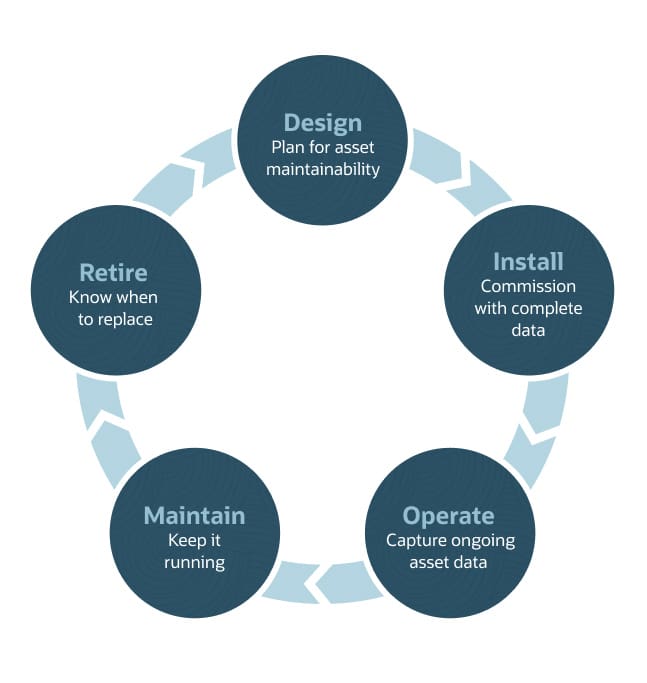
- Design: This stage covers specification, selection, standardization, and planning for maintainability before the asset is purchased or built. Choices made here determine future maintenance costs, parts requirements, and replacement timing.
- Installation and operation: The goal is to commission the asset with complete lifecycle data, including asset ID, location, serial number, bill of materials, work instructions, spare parts links, warranty terms, and operating thresholds.
- Maintenance: This phase includes preventive routines, condition monitoring, predictive maintenance programs, and reactive repairs. The challenge for most organizations is not whether they believe in the value of planned maintenance, but whether they can execute it consistently.
- Retirement: This phase involves more than pulling the plug. It includes formal replacement criteria, depreciation tracking, compliance handling, end-of-life processes, and capturing lessons learned for the next buying cycle. A complete asset history makes decisions at this stage defensible to leadership and finance.
Why Does Equipment Lifecycle Management Matter?
The appeal of lifecycle management lies in its ability to improve asset reliability, inventory management, labor productivity, compliance, and capital planning—all at once. Here’s how:
- Reduces total cost of ownership (TCO): Without shared data, no one knows what a piece of equipment actually costs to own, so replacement decisions are based on gut instinct or postponed until something fails. Lifecycle management pulls acquisition costs, operating expenses, maintenance spending, and disposal costs into one view. When maintenance, operations, and finance see the same numbers, TCO becomes a reliable metric, rather than a rough estimate.
- Lowers downtime: Unplanned stoppages remain one of the stickiest problems in manufacturing, often costing tens of thousands of dollars or more per hour. Large production facilities can lose millions annually when equipment is out of service. Lifecycle management is a proactive process that leads to better asset monitoring, timely maintenance scheduling, and more spare parts on hand—all of which reduces downtime and supports continuous operations.
- Maximizes equipment life: Preventing failures and addressing small issues promptly helps manufacturers wring more value from their assets. Consistent maintenance, informed by complete asset history, can extend equipment life and delay capital expenditures. And equipment that stays operational longer means fewer production interruptions and more consistent lead times.
- Supports sustainability efforts: The 2024 ISO 55001 update put greater emphasis on environmental impact and lifecycle operations, making sustainability an important part of the compliance conversation. Extending equipment life delays the environmental costs of disposal and manufacturing replacements.
- Offers regulatory compliance: Many industries require documented maintenance records, calibration histories, and safety inspections for critical equipment. Equipment lifecycle management systems that centralize this information make audits easier by storing updated, complete records in one place.
- Increases ROI: Equipment that’s properly maintained runs longer, fails less often, and performs closer to its rated capacity. Assets that last longer and run more reliably deliver higher returns on the original capital investment, and the frequency of major capital outlays decreases.
- Enhances planning: Better lifecycle data changes when things happen, not just whether they happen. Replacement timing, outage windows, and parts ordering can be scheduled together, rather than managed separately. This is driving many manufacturers to review or upgrade their asset-management information systems.
Common Equipment Lifecycle Management Challenges
Small equipment lifecycle problems have a tendency to snowball quickly when departments operate in silos. A missed maintenance window becomes a breakdown, which leads to a production delay, which results in a missed shipment. Here’s where manufacturers often get stuck:
- Managing expenses: Many teams struggle to quantify the real financial impact of equipment problems. Unplanned downtime costs add up quickly. But without clear data, those expenses remain invisible. That makes it difficult to build a business case for equipment lifecycle management improvements or justify technology investments to leadership.
- Equipment tracking: When asset data is scattered across maintenance software, spreadsheets, purchasing tools, and finance systems, even simple questions like when a motor was last serviced can be hard to answer. This makes procurement more difficult, especially when sourcing custom or specialized parts.
- Dialing in maintenance schedules: Preventive maintenance programs may exist on paper, but many facilities still dedicate too little maintenance effort to planned work. Schedules are based on emergencies rather than asset criticality or equipment condition. And when maintenance is reactive, production schedules suffer, as well.
- Monitoring performance: Not all organizations consistently track asset-management performance metrics. But key metrics, such as mean time between failures or planned maintenance percentage, make it easier to identify trends and show improvement over time.
12 Best Practices for Efficient Equipment Lifecycle Management
The following practices work best when done systematically. Tip: Start with the highest-friction problem areas (such as fragmented asset data or reactive maintenance) and expand over time to include more advanced capabilities, such as predictive maintenance and AI-driven analytics.
-
Automate Manual Workflows
Storing asset data in spreadsheets and sending work requests via email slows everything down and invites errors. Automation handles the paperwork—logging work orders, updating records—so maintenance teams can focus on equipment maintenance and repairs.
-
Enable Predictive Maintenance
AI-driven predictive maintenance is generating a lot of buzz, but it’s best framed as the next level above preventive maintenance—not a silver bullet. Successful predictive maintenance programs don’t treat maintenance as a silo. They combine sensor data with ERP, procurement, maintenance history, production data, and field reporting to give AI the context it needs to quickly spot patterns and predict failures.
-
Enhance Inventory Tracking
Spare-parts management is a lifecycle issue because poor inventory visibility turns small failures into longer outages. Improving parts and inventory management is a good first step in cutting downtime costs. A single, real-time inventory view across locations—with the ability to identify component shortages before they affect production—helps prevent stockouts of critical parts. Automating procurement for basic replenishment further pares delays when parts are needed.
-
Reduce Equipment Variability
Equipment variability might seem to increase flexibility, but, over time, it drives up technician training demands, warehouse complexity, and sourcing headaches. Standardizing equipment families, controls, parts, and operating practices lessens that complexity. Interchangeable equipment and spare parts make maintenance easier and alleviate the burden of having to carry many part variants.
-
Prioritize Maintenance Schedules
An effective lifecycle program prioritizes schedules that are based not on calendar intervals but on asset criticality, failure consequences, operating duty, safety exposure, and replacement lead times. The aim is to perform the right work on the right asset at the right time with the right parts.
-
Centralize Equipment Asset Management
It’s difficult to make confident decisions when lifecycle data is scattered across systems. Centralizing asset, inventory, and workflow data builds the foundation for faster decisions and better coordination among teams. Without it, even good data goes unused.
-
Consider Preventive Maintenance
Predictive maintenance may get the hype, but it doesn’t work if basic preventive maintenance is inconsistent. The challenge isn’t convincing organizations that preventive maintenance matters—it’s finding ways to make it easier. One way to do that is to use CMMS or ERP systems with maintenance modules that can handle recurring tasks, meter-based triggers, mobile workflows, and complete maintenance records.
-
Track Equipment Usage and Performance
Not all organizations consistently track asset-management performance metrics, which makes it hard to know what’s working and what isn’t. KPIs worth tracking: mean time between failures, mean time to repair, planned maintenance percentage, downtime hours, downtime cost per hour, work order completion rate, inventory turns, and asset-level cost of ownership.
-
Standardize Lifecycle Procedures
Documented lifecycle procedures—covering everything from commissioning to retirement—make it easier to train new technicians and stay compliant. They also protect institutional knowledge: When an experienced tech leaves, the procedures stay.
-
Align Asset Management With Financial Planning
Better asset management isn’t just about fewer failures—it’s also about knowing when to replace equipment and building a business case that finance will approve. Centralized asset data leads to faster approvals by maintenance, operations, and finance.
-
Establish Decommission Criteria
Asset retirement decisions shouldn’t be based on gut feelings; they should be based on rules and data. Signs that it’s time to replace an asset: frequent breakdowns, repair costs that approach the price of a new machine, hard-to-find parts, or safety concerns.
-
Upgrade to an ERP System
ERP systems provide the backbone for equipment lifecycle management, but they’re not maintenance tools on their own. Companies often pair them with dedicated enterprise asset management (EAM), CMMS, or Industrial Internet of Things (IIoT) platforms to gain detailed maintenance scheduling, root cause analysis, and other functionalities. ERP systems also provide centralized data for more advanced smart manufacturing and AI-driven capabilities. According to a 2025 Rockwell Automation survey, 95% of manufacturers have invested in or plan to invest in AI/ML within five years—capabilities that require integrated data foundations to deliver value.
Centralize Equipment Tracking and Performance Monitoring With NetSuite
What does it actually cost to keep a piece of equipment running? Most organizations can’t answer that easily because asset data, inventory, maintenance records, and financials live in separate systems. NetSuite for Industrial Machinery unifies the business data that undergirds equipment lifecycle decisions. Unlike specialized maintenance platforms, NetSuite centralizes asset records, inventory data, work-order tracking, and financial reporting. This gives operations, maintenance, and finance a shared view of equipment performance and costs.
With full-lifecycle, fixed-assets management, real-time inventory visibility across locations, and embedded analytics that support natural language queries and AI-generated summaries, NetSuite provides the foundation for better lifecycle decisions. It also integrates with specialized EAM, CMMS, or IIoT tools for organizations that need advanced maintenance scheduling, real-time condition monitoring, or detailed root cause analysis.
Equipment will always fail. Parts will still wear out. The difference between those events being a minor disruption and a major production loss, however, often comes down to the systems and data that support the management and response. Organizations don’t need to overhaul everything at once to see the benefits. Small, consistent wins—consolidating asset data, automating a manual workflow—will compound over time into meaningful operational improvements.
Equipment Lifecycle Management FAQs
What is equipment lifecycle management?
Equipment lifecycle management is the practice of tracking and maintaining equipment from acquisition through retirement. Using an equipment lifecycle framework allows manufacturers to maximize the value of their assets, control costs, and manage risk over the equipment’s useful life.
What is an example of the equipment lifecycle?
Consider a CNC machine as an example. A company selects the CNC machine based on its capabilities and total cost of ownership, commissions it with complete asset data, manages it using preventive and predictive maintenance, and eventually retires it when failure frequency or repair costs cross agreed-upon thresholds, using the machine’s full history to justify the decision.