
“A small leak will sink a great ship.” For ISPs juggling thousands of accounts across multiple pricing models, Benjamin Franklin’s centuries-old warning may hit close to home. Billing errors, such as missed charges, incorrect usage calculations, and botched plan changes, may seem minor in isolation, but they compound quickly. Effective billing management helps ISPs plug those leaks before customers notice or they become larger financial problems.
What Is ISP Billing Management?
ISP billing management refers to the processes providers perform to accurately charge customers for their internet services. Steps include defining plans and pricing, measuring usage, issuing invoices, calculating taxes and fees, collecting payments, and reconciling accounts.
Key Takeaways
- ISPs with accurate billing management practices are more likely to be paid on time and without dispute.
- In turn, they can capture more revenue quickly and improve cash flow.
- ISPs typically offer three types of pricing plans: flat-rate, tiered, and usage-based.
- ISP billing systems that integrate billing, accounting, and customer data have become essential tools.
ISP Billing Management Explained
The global market for internet services is projected to be worth $1 trillion by 2030, up from $638.6 billion in 2024—a 56.6% increase representing a compound annual growth rate of 8.2%, according to Research and Markets. As subscriber bases expand and data consumption rises, billing complexity also grows.
ISP billing management depends on accurate data flowing between systems: Network infrastructure captures usage, rating engines apply pricing rules, and billing platforms generate invoices. ISPs must also be able to prorate charges for midcycle changes, such as new sign-ups, plan upgrades, or cancellations.
Suffice to say, the stakes are high. Billing errors and process gaps mess with accounting, contribute to revenue leakage, erode customer trust, and fuel churn at a time when switching providers has never been easier.
Common Types of ISP Billing Models
From businesses paying by the gigabyte to residential customers with unlimited plans, ISPs serve a diverse subscriber base with different billing needs. Most ISPs support multiple billing models simultaneously. Among the most common are:
- Flat-rate billing: This model establishes a fixed monthly charge for predetermined throughput speed and data, the latter of which is often unlimited (though some providers may impose fair usage policies, which set a monthly data cap or prioritize traffic once a certain usage threshold is reached). Flat-rate billing is typically offered to customers with predictable usage levels.
- Tiered pricing: Tiered, or layered, pricing is based on predefined levels of speed, data allowances, or both; customers choose the tier that best matches their usage and budget. For example, a basic plan might offer 100 Mbps with a 500 GB monthly cap, while an intermediate plan offers 500 Mbps with 1 TB, and a premium plan delivers 1 Gbps with unlimited data. Tiered pricing presents ISPs with opportunities to upsell customers to higher tiers.
- Usage-based billing: Pay-as-you-go pricing treats internet service as a utility, charging customers according to their actual data consumption (though, in some cases, customers receive an allowance for a specific amount of data at a fixed rate). Usage-based billing is geared to low volume users who don’t want to commit to a fixed monthly fee, as well as those whose data consumption varies considerably from month to month.
Key Features and Functions of ISP Billing
Effective ISP billing operations require coordination across several core functions. How well an ISP executes them—typically with the aid of modern software—impacts accuracy, efficiency, and customer satisfaction.
-
Billing automation:
The ISP billing cycle involves capturing usage data, applying rates, generating invoices, and collecting payment. Automating these steps reduces manual effort and errors and speeds up billing and subsequent revenue collection. Automation also handles routine tasks, like prorating charges for midcycle plan changes and following up on overdue accounts. -
Invoicing:
Invoice processing must account for each customer’s plan and data use, plus applicable fees and taxes. Invoices must then be delivered reliably via email, customer portal, or mail. Itemized invoices reduce confusion and disputes, while timely delivery keeps the billing cycle on track. -
Reporting and analytics:
Visibility into customer behavior, network usage, revenue streams, and payment trends helps ISPs spot problems early and capitalize on what’s working. Key metrics include collection rates, churn, average revenue per user, and accounts receivable aging. This data also supports compliance and timely financial reporting. -
Payment processing:
Customers expect to be able to choose from a variety of payment methods, such as credit and debit cards, ACH transfers, and third-party payment services. Security is also critical; measures like encryption and advanced authentication help protect both the customer’s and the ISP’s financial information, reducing fraud and maintaining compliance with regulatory standards. -
CRM and field-service support:
Billing touches the customer experience directly. Access to a customer’s complete account history through CRM integration helps field-service teams arrive prepared and able to resolve issues faster. In addition, self-service portals reduce the load on support teams by letting customers view and pay their bills and manage their accounts on their own.
Benefits of Software for ISP Billing
The functions described above can be done manually, but not at scale or without significant risk of error. ISP billing software automates the billing lifecycle, from defining plans and pricing to reconciling accounts. The benefits of using software for billing include:
- Increased accuracy: Manual billing tasks, such as calculating charges and applying taxes, are susceptible to mistakes. ISP billing software minimizes errors by automatically applying rates, processing subscription changes, and generating invoices based on actual usage data. Greater accuracy means fewer disputes and less revenue lost to corrections.
- Increased efficiency: The automation of invoicing, payment collection, and service provisioning simplifies operations, significantly reducing the time, labor, and associated costs required if they were handled manually. It also accelerates the ISP’s billing cycle, which speeds revenue collection and improves cash flow.
- Data unification: ISPs often have separate tools for billing, customer management, network monitoring, and support. An ISP billing system centralizes this data, bypassing the risks of duplicate entries and inconsistencies because everyone works with the same accurate information.
- Improved revenue assurance: Revenue is left on the table when an ISP fails to bill its customers accurately. ISP billing software helps prevent revenue leakage by automatically tracking plans, processing subscription renewals, and reconciling usage against invoices.
Accounting Software That Supports ISPs
Billing errors pack a double punch, hitting ISPs with both lost revenue and damaged customer trust. NetSuite ISP Accounting and Billing Management Software helps ISPs avoid both. NetSuite unites billing, accounting, and customer data on a single cloud platform that handles high-volume transaction processing and supports different billing models. It automatically generates and delivers accurate bills to customers on time. Real-time dashboards track key metrics—margins, average revenue per user, and churn, to name a few—and automated journal entries and reconciliations speed the monthly close. Built-in revenue recognition keeps ISPs compliant with ASC 606 and IFRS 15 standards, despite bundled subscriptions, usage fees, and one-time charges.
For complex subscription billing needs, NetSuite SuiteBilling supports flat-, tiered-, and consumption-based pricing, as well as promotions, volume discounts, and customer-specific rates. Change orders, proration, and automated renewals are built in, reducing revenue leakage and manual work.
NetSuite SuiteBilling
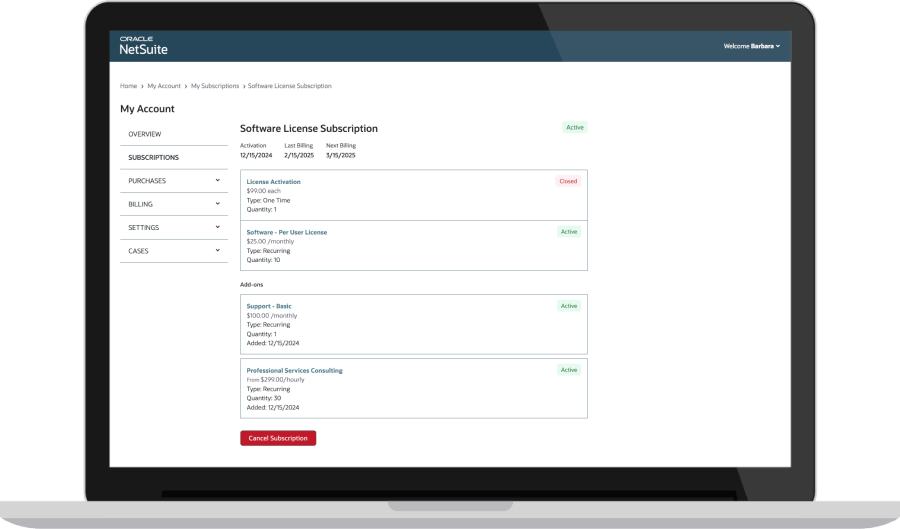
ISPs serve customers with vastly different needs, and billing has to keep up. Applying the right billing model to the right account, while handling invoicing, payment processing, and revenue tracking, requires tight coordination among teams and systems. When these functions work well together—best achieved through integrated software—the payoff is clear: accurate bills, faster collections, and customers with fewer reasons to jump ship.
ISP Billing Management FAQs
What are common causes of billing discrepancies?
Billing miscalculations, double billing, and failure to cancel service charges after a customer changes their service plan can cause customers to question their bills. These problems often occur due to outdated or inefficient billing processes, including delayed service-provisioning changes and poor systems integration.
What steps should be taken to handle disputed charges?
After a customer lodges a complaint, an ISP should document and attempt to resolve it quickly. If the issue can’t be readily resolved, a more formal process should begin, with the customer notified in writing about the steps involved and when to expect a response. If the charge is upheld, the ISP should explain why and outline any options if the customer wants to pursue the matter further. If the charge is found to be incorrect, the ISP should issue a prompt refund or credit.
How does integrated software help improve accounting accuracy?
Integrated ISP billing software eliminates the need for manual data entry in separate systems, reducing billing errors and unreliable financial records. Automated journal entries, revenue recognition, and reconciliations keep billing aligned with accounting standards and simplify audits.