
Most businesses start with a default chart of accounts to organize their financial data. At first, it works fine—revenue is revenue, expenses are expenses, and closing the books is simple. But for SaaS companies, these generic templates quickly crack under the weight of multiplying subscription tiers and mounting deferred revenue. Before they know it, the finance team is spending days buried in spreadsheets just to reconcile their revenue numbers or show last quarter’s performance to potential investors.
Building a chart of accounts (COA) proactively to serve the realities of a subscription business avoids this trap. When the finance team understands what makes a SaaS COA different, they can design one from the ground up and make sure it remains accurate as the business grows.
What Is a SaaS Chart of Accounts (COA)?
A SaaS COA is an index of all financial accounts in a software company’s general ledger, structured around subscription-based revenue models. It categorizes every financial transaction—customer payments, vendor invoices, payroll, asset purchases—into numbered accounts that feed directly into the balance sheet and income statement. A COA also supports cash flow statement preparation.
While COAs are common in all industries, SaaS COAs require additional account structures to handle industry-specific accounting practices, such as deferred revenue, the distinction between recurring and nonrecurring income, and capitalized software development costs. A strong SaaS COA should meet compliance standards and follow US Generally Accepted Accounting Principles (GAAP), while providing investors and leadership with detailed account information. Analysts or accounting software can then use this information to evaluate performance through operational metrics, including monthly recurring revenue (MRR), customer acquisition cost, and customer lifetime value.
Key Takeaways
- A SaaS COA organizes all financial transactions into numbered accounts, with each account directly connected to the balance sheet and income statement.
- SaaS COAs use dedicated accounts to track deferred revenue and capitalize software development costs to meet compliance standards.
- Standard numbering conventions leave gaps between accounts to accommodate growth without having to restructure the COA or losing consistency across accounting periods.
- Annual reviews, consistent transaction coding, regulatory alignment, and accounting software help SaaS companies maintain and update their COAs as needs change.
SaaS Chart of Accounts Explained
The COA acts as the connective tissue between a SaaS business’s daily transactions and its high-level financial analysis. Accountants record every sale, expense, and asset movement in the general ledger, using the account codes defined in the COA. Those entries then roll up into financial statements and management reports, giving teams a baseline for spotting trends and comparing performance. With the SaaS industry expected to grow at a 12% compound annual growth rate through 2030, according to Grandview Research, SaaS companies will have to track their increasing transactions and accounting complexities carefully to avoid misclassified data and compliance issues.
Why Is the Chart of Accounts Important?
SaaS companies use their COAs to generate reliable financial statements, track key performance indicators to inform internal improvements, and present clear data to investors and stakeholders. Without this concise organization of account information, analysts struggle to distinguish among different revenue streams, such as recurring subscriptions or one-time implementation fees, making financial performance analysis less reliable. Finance teams also use the COA when planning future strategies and adjusting operations; by categorizing expenses by department or function, staff can track resource allocation and see whether spending supports the company’s growth plans.
What’s Unique About the Chart of Accounts for a SaaS Company?
SaaS companies follow unique accounting requirements stemming from their reliance on subscriptions and ongoing revenue. The Financial Accounting Standards Board’s rules, specifically ASC 606, require SaaS companies to recognize payments received before performance obligations are satisfied—called deferred revenue or contract liabilities—as liabilities on the balance sheet, only recognizing revenue as the provider delivers services over the contract term. SaaS COAs also separate recurring revenue from nonrecurring income streams, such as professional services or setup fees. This distinction directly affects common investor metrics, including annual recurring revenue (ARR). SaaS businesses also carry far less physical inventory than traditional companies but face substantial software development costs, some of which may be capitalized under ASC 350-40 rather than expensed immediately.
Designing a Chart of Accounts Structure for a SaaS Company
A SaaS business’s COA should reflect its financial reporting needs. To match the depth and structure of the business’s financial statements, most COAs start with balance sheet categories and then move on to income statement accounts.
When designing a COA, the first step is choosing a numbering convention. The first digit of each account number identifies its category; this keeps reporting and staff training consistent across accounting periods. Next, teams lay out the COA’s five main categories in order: assets, liabilities, shareholders’ equity, revenue, and expenses. Each category receives a dedicated number range that includes specific subcategories for each starting digit. Many SaaS companies add ranges for other income and expenses to separate core business functions from non-operating items in the general ledger.
A standard numbering scheme for SaaS companies follows this structure:
- 1000-1999: Assets include current assets, such as cash, accounts receivable (AR), and prepaid expenses, as well as noncurrent assets, such as equipment and capitalized software.
- 2000-2999: Liabilities encompass both current liabilities, such as accounts payable, accrued expenses, and deferred revenue/contract liabilities from prepaid subscriptions, and long-term liabilities, such as notes payable and deferred tax obligations.
- 3000-3999: Equity represents the owners’ residual interest in the company, including common stock, preferred stock, retained earnings, and paid-in capital.
- 4000-4999: Revenue includes both recurring subscription revenue, often segmented by tier or product, and nonrecurring revenue from professional services and usage-based fees.
- 5000-5999: Cost of revenue (also called cost of sales or cost of goods sold) includes the direct expenses required to deliver services, such as cloud hosting, infrastructure, third-party software licenses, payment processing, and direct customer support.
- 6000-6999: Operating expenses are the business’s indirect expenses (sales, marketing, R&D, general and administrative costs).
- 7000-7999: Other income includes noncore revenue streams, such as interest income or foreign exchange gains.
- 8000-8999: Other expenses mirror the 7000 range but capture non-operating costs, such as interest expense or foreign exchange losses.
Within that core structure, most COAs create gaps between account numbers (4100, 4200, 4300, rather than 4001, 4002, 4003) to leave room for new accounts as the company adds new line items. For example, if general AR starts at 1200, the company may begin listing prepaid expenses at 1300, keeping 1201-1299 open for AR accounts from various services, product lines, markets, or acquisitions.
For reporting flexibility, some SaaS COAs include “parent” accounts that summarize an entire category of “child” accounts. For example, a parent account like “6000—Sales & Marketing” might roll up child accounts for multiple expenses: paid advertising, content marketing, trade shows, and marketing technology. Finance teams use this structure to summarize financial figures for investors without losing the detail they need for operational decisions. Over time, accountants often add even more granular subcategories under existing child accounts—paid advertising may split into search ads, social media ads, video ads, and sponsored content, for example—without losing historical comparability.
Common Accounts in a SaaS COA
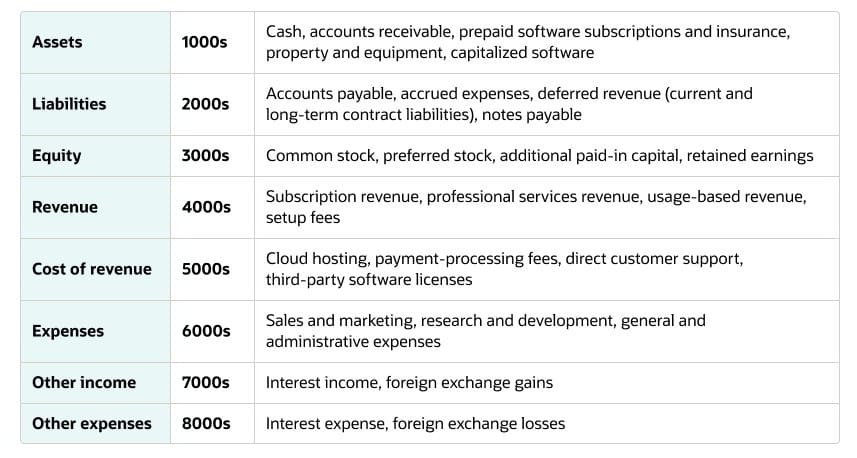
Sample Chart of Accounts Structure for a SaaS Company
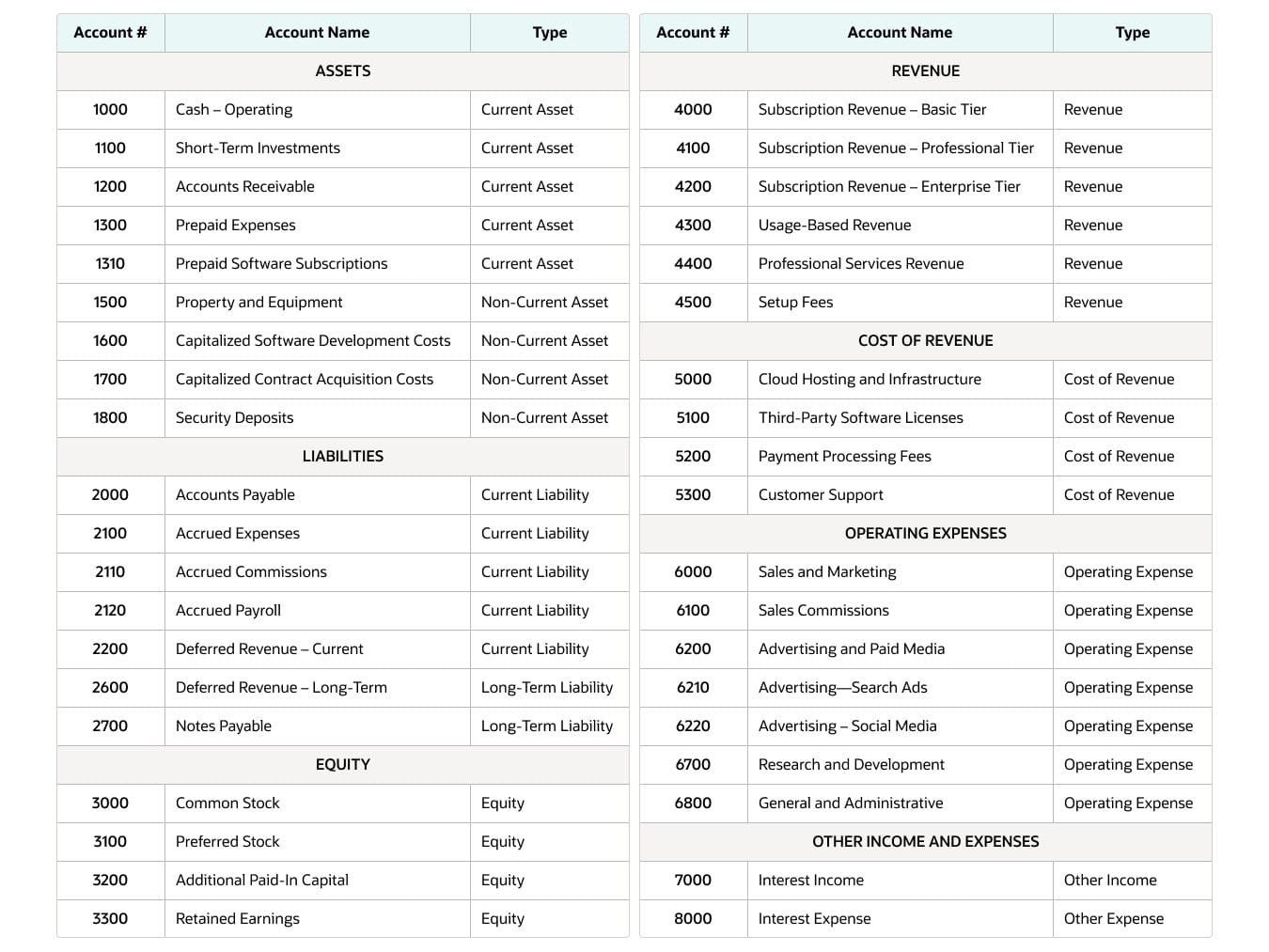
The following table is a template for SaaS companies building or refining their COA. Be sure to add important accounts or delete irrelevant lines to suit the company’s size, product complexity, and reporting requirements. And remember: COAs aren’t set in stone. Leave gaps for future growth, and regularly reevaluate the COA to make sure it reflects current financials.
Sample SaaS Chart of Accounts
5 SaaS COA Best Practices
Building a SaaS-specific COA is a solid first step—but as the business’s financials change, the COA should evolve, too. Keeping an up-to-date COA requires finance staff to monitor how the business changes over time, creating new accounts as the business expands into new markets, adds new revenue streams or business models, acquires companies, or responds to new accounting rules. The following five best practices help financial teams design and maintain an effective chart of accounts over time:
- Design scalability into your COA: Include room for growth in the initial design. Use a numbering system with gaps between accounts (1100, 1200, 1300) so new accounts can be added easily. Leave plenty of space for future product lines, geographic expansion, and acquisitions within available number ranges and parent-child hierarchies. A 10-person startup’s COA should still function when the company reaches 500 employees, albeit with more accounts within the same structure.
- Make sure your COA adheres to relevant regulatory standards: Publicly traded SaaS companies must comply with GAAP standards (or International Financial Reporting Standards for international operations), such as ASC 606 for revenue recognition and ASC 350-40 for software capitalization. However, many private companies also choose to follow these standards to maintain consistent reports for investors, prepare for potential audits or fundraising, and support scalable accounting practices. Following these standards helps companies recognize revenue correctly, capitalize qualifying software development costs, and maintain the level of detail auditors and analysts demand.
- Regularly review your COA: Schedule at least one annual COA review, commonly conducted at fiscal year-end, to assess the current structure and consider any changes. Rapid growth, new products, mergers and acquisitions, or changes in pricing/subscription models may require new accounts or structural adjustments. Major midyear changes can muddy period-over-period comparison, so most companies make structural updates between fiscal years.
- Record transactions consistently: Inconsistent coding compromises data quality and leads to unreliable analyses. Establish clear guidelines for how accountants should categorize common transactions, such as how to recognize revenue for each service type. After rules are finalized, document these decisions in standardized policy manuals, and update guidelines when questions arise, rather than relying on one-off judgments that vary by transaction.
- Leverage tools and templates: Cloud-based accounting software designed for the SaaS industry can automate deferred revenue schedules, align financial data with regulatory standards, integrate with billing systems, and generate reports targeted at specific investor expectations. These systems often use SaaS-focused COA templates to reduce setup time and avoid structural mistakes that arise when applying unique account structures to generic templates. Businesses with existing COAs should choose accounting software that can accommodate their financial structure without forcing compromises that undermine reporting capabilities. As the company scales, integrated ERP systems centralize financial data to align information with a unified COA.
Simplify Financial Records With Accounting Software
Manually managing a SaaS-specific COA with spreadsheets and disconnected software can lead to misclassified transactions and reporting delays that compound as transaction volume grows. NetSuite ERP for SaaS, Subscription, and Technology Companies integrates financial, operational, customer, and billing data into a single cloud-based solution. The software automates revenue recognition, multi-entity consolidation, and account reconciliation—with real-time reporting that supports ASC 606 compliance. With NetSuite, finance teams can configure the COA to match SaaS-specific accounting structures and generate investor-ready reports that combine operational metrics, such as MRR and ARR, with GAAP-compliant financial statements. Built-in controls and integrated, role-based dashboards help maintain consistent transaction coding companywide and minimize redundant data entry to keep the general ledger up to date as the business scales.
A chart of accounts built for SaaS businesses gives finance teams a solid base for accurate reporting and reliable metrics that inform business decisions. SaaS COA structures comprise five main categories—assets, liabilities, equity, revenue, and expenses—based on industry-specific requirements, including deferred revenue or capitalized software development costs. This targeted approach allows SaaS companies to generate detailed financial statements without sacrificing flexibility as they grow.
Chart of Accounts for SaaS Companies FAQs
How often should a SaaS company review its chart of accounts?
SaaS companies commonly review their chart of accounts (COA) once per year, often at fiscal year-end, to assess whether the structure needs to be adjusted to reflect evolving reporting needs. Companies undergoing significant changes or growth periods, such as new product launches or acquisitions, may review their COAs more frequently, perhaps every six months or quarterly.
How should deferred revenue be handled in the COA for a SaaS business?
Deferred revenue represents payments received from customers before performance obligations are satisfied. SaaS companies should record these payments on their chart of accounts (COA) as contract liabilities on the balance sheet, recognizing them as revenue on the income statement over the contract term. Most companies create two separate deferred revenue accounts: current (services to be delivered within 12 months) and long-term (services beyond 12 months).
What’s the best way to track recurring income in a SaaS COA?
A SaaS chart of accounts (COA) usually tracks recurring income as a dedicated revenue account for every subscription tier or product line, such as “Subscription Revenue—Basic Plan” and “Subscription Revenue—Enterprise Plan.” This segmentation supports accurate calculations by product or tier, providing detailed revenue breakdowns to internal stakeholders and potential investors.