
Managed service providers (MSPs) have partnered with businesses for decades to help them work more efficiently, lower their IT costs, and focus on growth. Demand for their services, which include network monitoring, cybersecurity, cloud management, and data backup and recovery, has exploded, with annual recurring revenue for MSPs rising 11% between 2023 and 2024. Yet, despite this success, MSPs must stay one step ahead of the latest trends shaping customer requirements to remain agile, adapt strategically, and stand out from their competitors. With tightening margins, talent shortages, and global markets in a state of uncertainty, it has never been more important for MSPs to adapt their services, billing mechanisms, and technology to mitigate these challenges and strengthen their offerings.
This article delves into the biggest trends driving customer behavior and MSP market dynamics today and lays out steps MSPs can take to turn these trends into new business opportunities and growth.
The Top 10 MSP Trends to Watch This Year
Quality of service, reliability, and compliance. These are three of the primary factors behind a company’s choice of MSP today, as evidenced by rising demand for such MSP services as cybersecurity, disaster recovery, and AI-powered automation. Here are the top 10 trends MSPs have their eyes on, all of which ladder up to the ability to deliver high-quality, reliable, and compliant services to their customers.
-
AI and Automation Remain Top of Mind
IT operations often include high-volume, repetitive, and rule-based tasks that aren’t only time-consuming but also prone to human error, especially when done manually. To overcome these issues, MSPs are automating IT operations—ticketing, equipment monitoring and maintenance, data analysis, and reporting, to name a few. Many MSPs are also implementing AI to further accelerate these processes and drive faster decision-making. Additional use cases for AI among MSPs include detecting and mitigating cybersecurity threats and cost-optimization, with 38% of MSPs adopting AI to cut their operating costs. Looking ahead, MSPs will increasingly use advanced generative AI tools to automatically draft emails and customer communications and to synthesize insights from large volumes of business data using simple, conversational prompts.
-
The Need for Cybersecurity Services Grows
Cybersecurity is a fast-growing requirement among MSP customers, and this demand will likely continue to rise as attackers grow bolder and adopt more advanced tactics. In addition to defending businesses’ IT networks and on-premises infrastructure from attacks, MSPs are protecting and managing their employees’ devices, as well as their growing network of cloud and edge computing services. Companies have also begun relying on MSPs to handle their data sovereignty, regulatory compliance, and governance, especially companies that use AI-powered services as part of their IT workflows. In response to this need, some MSPs have built a compliance-as-a-service (CaaS) offering that automates and centralizes regulatory compliance processes. CaaS is an attractive differentiator for MSP customers and prospects in highly regulated industries, such as financial services and healthcare.
-
Remote Work Enablement Is Still a Priority
Remote work is still going strong. According to the US Bureau of Labor Statistics, more than 25% of employees between the ages of 25 and 54 worked either remotely or in a hybrid capacity as of February 2026. This trend has brought convenience for workers but has caused significant security challenges for companies that manage a dispersed network of employees working in public locations and using nonsecure devices to perform their daily tasks. According to industry data, more than half of MSPs say remote work solutions are a primary growth driver for their business. To that end, businesses need help from MSPs to secure their IT networks and employee devices, no matter their location. MSPs often complement these protections with added security measures, such as multifactor authentication, and cybersecurity awareness training for their customers’ remote workforces.
-
Cloud Architecture Becomes More Complex
For years, MSPs have been helping businesses migrate from traditional IT infrastructure to public, private, and hybrid cloud solutions, and, more recently, to multicloud environments. Though cloud computing is no longer a novelty, the rising complexity of companies’ cloud architectures is increasingly difficult for their IT teams to manage. This presents MSPs with an opportunity to step in and develop, implement, and refine customers’ cloud strategies. Performance optimization, cost management, integration with legacy systems, and data privacy all represent opportunities for MSPs to support customers on their cloud journey.
-
Talent Shortages Continue
Finding talented and motivated employees is one of the biggest problems plaguing MSPs. More than half of MSPs say hiring is a primary hurdle to their success, citing cloud and cybersecurity roles as particularly difficult to fill. Indeed, the Information Systems Audit and Control Association reports that 75% of businesses in the tech industry find it difficult to find and retain top talent, singling out cybersecurity professionals as being in short supply. To address this talent management issue, MSPs can offer competitive compensation and training options for new hires, leverage AI and automation to make their teams more efficient, and outsource or partner with other providers that can support them with the required expertise.
-
Domain Expertise Is in Demand
Domain expertise is a major differentiator for MSPs looking to attract and retain customers in specific industries. In fact, specialized MSPs enjoy 30% higher profit margins than their competitors because they can justify premium pricing in exchange for their deep industry expertise. This makes sense. Businesses want to feel that MSPs understand and can respond to their unique challenges, rather than taking a one-size-fits-all approach to service delivery. That goes double for companies in regulated fields governed by sector-specific bodies or regulations—the Consumer Financial Protection Bureau in financial services and the Health Insurance Portability and Accountability Act in healthcare, for example. To meet demand for industry-specific experience, leading MSPs are developing their domain expertise through training and investments in technology solutions tailored to customers’ specific requirements.
-
Value-based Pricing Models Catch On
Traditional MSP pricing models—charging per user, per device, or flat monthly fee—are giving way to value-based approaches whereby MSPs price their services on the basis of tangible business outcomes, such as improved uptime, measurable performance gains, or demonstrable ROI. This shift benefits both parties: Customers pay for results, rather than activity, and MSPs can differentiate on value, rather than competing on price alone. Delivering on these promises requires MSPs to track their own operations more rigorously, which is why many now use real-time analytics dashboards to monitor system performance and uptime.
-
Edge Computing Becomes Crucial for Some Sectors
Edge computing brings processing closer to where data is generated—employees’ mobile devices, Internet of Things sensors, decentralized servers—rather than routing everything through a central cloud. The result is lower latency, expedited decision-making, and the ability to act on data in real time. For MSPs, this creates opportunities to help clients deploy and manage edge infrastructure. According to ResearchAndMarkets’s “Edge Integration Services Market Report 2025,” the industrial sector is the largest adopter, driven by the need for ultra-reliable infrastructure in smart factories and latency-sensitive automation. Financial services, healthcare, and transportation are also investing heavily, along with emerging use cases, such as autonomous vehicles and smart cities.
-
Client Partnerships Deepen
The traditional role of an MSP was that of an outsourcer, providing customers with expertise they didn’t have in-house due to a lack of experience or resources. The level of collaboration between MSPs and their customers is deepening, with KPMG reporting that 80% of businesses want MSPs to assume the role of strategic partner to help teams achieve their business objectives. Achieving this shift might mean working together on business and IT strategies, promoting change management initiatives, or setting realistic success metrics that reflect the MSP’s experience with its other customers.
-
Data Overload Spurs Demand for Analytics Expertise
One of the most common reasons businesses hire MSPs is to help them overcome legacy data issues and modernize their IT systems. To deliver, MSPs are investing in the technologies that can manage large volumes of structured and unstructured data to uncover valuable insights. Business intelligence dashboards for business service analysis, for example, allow MSPs to view performance metrics, cybersecurity logs, end user behavior, and more, in a user-friendly graphic format. Crucially, MSPs can draw on this information to help customers set clear, realistic objectives for their IT projects that align with broader business goals.
A Forward-thinking PSA Helps MSPs Stay on Top of Trends
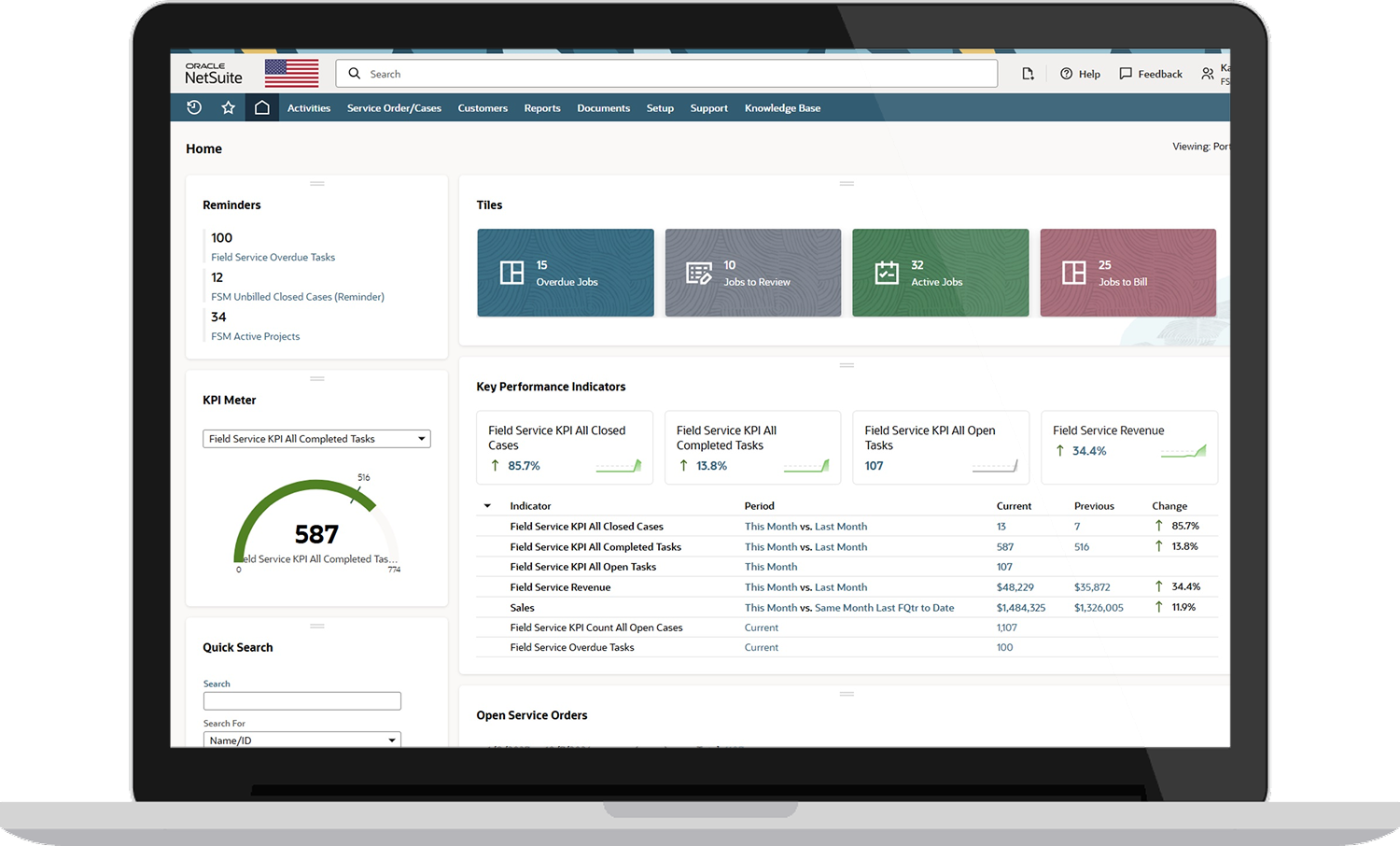
MSPs that want to capitalize on the trends shaping their industry’s and customers’ needs can’t afford to work with fragmented financial and operational data. NetSuite MSP Professional Services Automation software centralizes MSP activities, tracks service level agreements, and connects data from critical systems, such as accounting, inventory, billing, and revenue. This provides MSPs with actionable intelligence that improves end-to-end visibility, accelerates their billing cycles, and allows them to identify and grow their most profitable services. NetSuite’s automated workflows cut time, cost, and the risk of human error from labor-intensive tasks, such as contract and inventory management, and its support for multicurrency and multitax operations makes it easy for MSPs to expand their offerings and expand into new markets.
Simplify Reporting and Analytics With NetSuite PSA
MSPs are embracing new ways of working, new ways of partnering with customers, and new technologies to level-up their services and achieve better, data-driven decision-making for their customers. At the same time, they’re growing more proactive in the way they handle key customer priorities, such as cybersecurity, disaster recovery, and remote workforce management. By combining innovation with a focus on quality and reliability, MSPs can keep up with the latest industry trends and position themselves—and their customers—for growth.
Managed Service Provider Trends FAQs
What are the key trends in MSP industry?
Customers want reliability, security, and compliance—and managed service providers (MSPs) are evolving to deliver. Top priorities include AI and automation, stronger cybersecurity, and improved disaster recovery and data governance.
Is the MSP market growing?
The managed service provider (MSP) market is growing at a significant pace. According to one study, the global MSP market will experience a 15.5% compound annual growth between 2025 and 2033.
Which managed services are in high demand in 2026?
Managed service provider (MSP) services in high demand include cybersecurity, disaster recovery, and the rollout of process automation and AI to improve customers’ operational efficiency. Other high-demand services among MSP customers at this time include advanced data analytics, remote workforce management, and cloud-based IT infrastructure.