
Marketing and advertising agencies’ ability to sustain long-term client relationships depends not only on proven creative and executional strengths, but also on billing practices that foster mutual trust and success. Fair compensation and low risk for both parties require transparent billing processes, clearly defined fees and terms, and open communication. Effective billing begins with acknowledging that a one-size-fits-all approach is generally ineffective, and that each project or client engagement calls for a tailored approach.
What Are Common Advertising Agency Billing Models?
Selecting the right billing model for each project or engagement is a critical piece of the business development process for marketing and advertising agencies and a key driver of profitability. That determination rests on factors that include assessing project scope, accommodating the client’s billing preferences and requirements, and safeguarding the value of an agency’s work along with its cash flows. Both parties typically negotiate a billing model that provides predictability, flexibility, and protection. From hourly to hybrid billing, here’s a look at some of the most common models used in the industry.
-
Hourly billing:
Hourly billing allows agencies to charge clients on the basis of actual time spent on specific tasks or projects. Agencies may charge a single, blended hourly rate for all team members or tiered rates based on employees’ roles or level of expertise. Contracts or attached rate cards should clearly define the rates and minimum billing increments. Though this billing method offers transparency for clients, it can make total project costs harder to estimate for budgeting purposes, unless a monthly cap or not-to-exceed clause is included. Agencies often use hourly billing for time-and-materials contracts, consulting engagements, on-demand and one-off work, short-term projects, and tasks that fall outside a project’s statement of work (SOW). -
Monthly retainers:
Monthly retainers are fixed, recurring fees that agencies charge for ongoing access to their marketing and advertising services. The agency and client define the scope of services and terms in an SOW. Retainers may cover a minimum number of hours or specific deliverables, such as monthly content, strategic consulting, media management, SEO, or design services. Agencies calculate retainer fees based on the estimated time, resources, and minimum levels of work required. Monthly retainers provide predictability: Agencies gain recurring revenue streams from consistent work, and clients benefit from continuity of service and costs. -
Fixed project fees:
Under a fixed project fee model, agencies charge an agreed-upon price that covers a project’s defined scope, deliverables, and timeline, as outlined in an SOW. Fees are based on the estimated time and resources required to complete a project, the project’s complexity, and the client’s budget and are typically billed in milestone installments. The price remains locked-in regardless of how long the project takes, giving clients budgeting certainty. To protect the agency from cost overruns and secure compensation for work outside the original scope or when requirements change, inclusion of a change-order process is desirable. Fixed-fee compensation is the most commonly used model for both project- and retainer-based client relationships, according to a 2024 survey by the American Association of Advertising Agencies. -
Performance-based billing:
Performance-based billing ties an agency’s fees, in part or in whole, to specific measurable results. The agency and client agree on the metrics—lead generation, impressions, click-through rates, sales conversions, returns on ad spend—along with the measurement tools and attribution models that determine compensation. Agencies often charge an up-front fee or retainer to supplement the performance-based payments, which can be structured in tiers to reward superior results. Advertisers are increasingly focused on more accountable agency compensation. In fact, according to a 2024 report by the World Federation of Advertisers, 74% of advertisers surveyed said they want to better align agency compensation with business performance. -
Hybrid models:
Hybrid billing allows agencies to combine two or more billing methods for a single project or across an overall client engagement. This approach tailors pricing to different types of work, providing flexibility for both agencies and their clients. Hybrid billing can also help agencies avoid absorbing unexpected or out-of-scope costs. Common examples include fixed project fees paired with hourly or time-and-expense billing for out-of-scope work; monthly retainers combined with separate fees for third-party vendor costs and markups; and base fees coupled with performance-based payments.
Agency Billing Models: How They Work, Plus Pros and Cons
| Model | How It Works | Pros | Cons |
|---|---|---|---|
| Hourly |
Charges for actual time spent Rates blended or tiered by role Rates and minimum increments defined in contracts |
Transparent Good for time-and-materials, consulting, or short-term projects |
Harder to predict total costs Requires careful tracking |
| Monthly retainers |
Fixed recurring fees for ongoing services Scope and deliverables defined in a statement of work |
Predictable revenue Continuity for clients |
May undercompensate if work exceeds estimates |
| Fixed project fees |
Agreed-upon price for defined scope and timeline Billed in milestones Change orders protect against scope changes |
Budget certainty Protects agency from scope creep |
Less flexible Agency bears risk if project takes longer than expected |
| Performance-based |
Fees tied to measurable results (leads, clicks, conversions), often with an up-front retainer |
Aligns incentives Rewards strong performance |
Outside factors could affect results Revenue can be unpredictable |
| Hybrid |
Combines two or more billing methods (for example, fixed fee plus hourly rates for out-of-scope work) |
Flexible Protects agency against unexpected costs |
Can be complex Requires clear communication |
8 Billing Best Practices for Marketing and Advertising Agencies
Marketing and advertising agencies can improve billing by clearly defining terms and processes and increasing convenience at each step of the contract-to-cash cycle. Modernized invoicing and payment systems, combined with consistent reinforcement of expectations, help reduce friction and payment delays. The following eight billing best practices help agencies support a healthier cash flow position and strengthen client retention.
-
Send Detailed Contracts
Well-written contracts prevent client confusion or disputes. Clear contract language should define the scope of work, fee structures, billing and payment terms, and the change-order process. It also should outline any performance-based metrics and incentives, along with standardized terms and conditions. Detailed contracts set client expectations, prevent “scope creep,” facilitate timely payments, and provide legal safeguards.
-
Provide Multiple Ways to Pay
Multiple payment options offer convenience and promote faster, on-time payments. Flexible payment schedules and methods, including ACH transfers, credit cards, checks, and third-party payment processors, contribute to satisfied client needs and improved cash flow and retention. Where allowable, agencies can transparently factor credit card or payment processing fees into project costs or pass them on to clients. Agencies also can incentivize lower-fee payment methods.
-
Set Consistent Expectations
Agencies should establish clear billing expectations and consistently communicate them to clients, starting during contract negotiations, to encourage on-time payments. Contracts should clearly define fees and other compensation, payment terms and schedules, and late payment fees. Invoices should state the billing period; a summary of work performed with itemized charges; taxes and fees; payment terms, including net terms; due dates; payment instructions and links; late payment terms; and billing contacts able to address client questions. Automated payment reminders should reiterate invoice details and upcoming due dates, with follow-up past-due notices sent when required.
-
Keep an Eye on Cash Flow
Steady cash flow is essential to an agency’s financial health. Client payment timing can affect liquidity and an agency’s ability to cover day-to-day operating expenses, including employee salaries, internal costs, and pass-through vendor expenses tied to client work. Regular monitoring of client payments improves forecasting and budgeting, allowing agencies to address potential shortfalls before they become problematic.
-
Break Down Invoices for Big Projects
Invoicing clients at defined project intervals—perhaps tied to monthly billing periods, deliverables, or project milestones—can protect an agency’s work to date and provide predictable cash flow as a project progresses. Smaller, phased payments tie compensation to work completed throughout a project’s lifecycle, providing a financial safeguard against the specter of lump-sum, end-of-project billing—which is no fun for agencies or clients.
-
Discourage Late Payments
Late payments can disrupt cash flow, strain an agency’s finances, and potentially delay or halt projects underway. In some cases, agencies may ultimately go unpaid. To minimize late payments, agencies should clearly define payment terms, due dates, and late-payment fees in contracts, reinforce them in invoices and payment reminders, and actively track receivables. Discounts can incentivize clients to make early payments. When payments do fall behind, agencies should reach out to clients to understand the reasons and attempt resolution before pursuing collections.
-
Automate Invoice Scheduling
Automated billing systems typically include invoice scheduling, which generates and electronically sends invoices faster and more accurately than manual methods. Invoices are scheduled at predetermined times to correspond with clients’ contract terms, such as milestone-based or recurring monthly payments. Automated invoice scheduling saves both time and administrative costs and preserves predictability for clients.
-
Upgrade Your Accounting Software
If an agency is running on entry-level accounting software or a patchwork of spreadsheets, it’s probably losing money without realizing it. Basic systems weren’t built for the way agencies bill—retainers, project work, hourly overages, and pass-through costs, sometimes all for the same client. Modern agency-focused accounting software connects time tracking, expense management, and invoicing in one place, so hours and costs flow directly into billing queues, instead of sitting in spreadsheets waiting for manual entry. The real payoff is visibility: Agencies can track budget burn in real time, catch scope creep before it kills margins, and see which clients are actually profitable.
Easier Billing for Your Agency With NetSuite Accounting Software
NetSuite Accounting Software for Advertising & Marketing Agencies provides financial visibility into projects and overall client engagements by combining an agency’s project tracking, billing, and payment processing on one platform. The industry-specific accounting software is an add-on component to NetSuite’s cloud-based, ERP platform. It tracks each project’s timeline, expenses, and media buys, and applies billing rules, payment terms, and due dates to generate invoices that match contract terms. The software accommodates multiple project types and billing models, providing flexibility to agencies. The tracking capabilities help agencies monitor work-in-progress analytics and project profitability, while making sure records adhere to financial reporting standards and tax rules.
Cash Flow Visibility
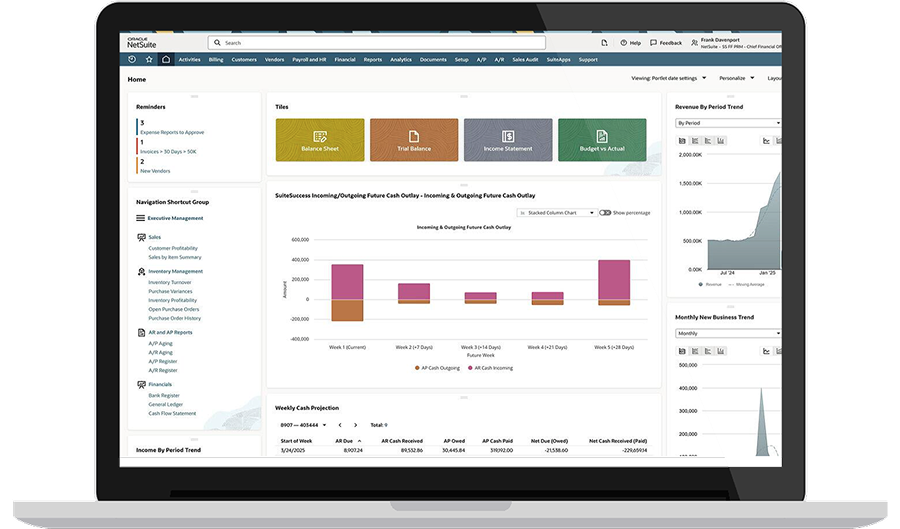
Successful marketing and advertising agencies require flexible billing and payment structures tailored to each project or account and backed by clearly defined and consistently reinforced contract terms. Integrated accounting software automates project tracking and the end-to-end billing process, providing stronger controls to cut down on errors, improve cash flow predictability, and protect margins.
Advertising Agency Billing Practices FAQs
What percentage do advertising agencies charge?
Advertising agencies do not charge a fixed percentage of media as their commission. The fees vary based on the level of client spending, the type of media purchased, and whether media planning or other related services are included.
How do you calculate agency fees?
Agencies calculate fees based on factors that include a project’s complexity and scope; the time, resources, and level of expertise needed to complete the project; desired profit margins; the project’s value to the client; and the importance of the client relationship.