Think about a guest’s entire journey with a hotel, from that first online search to check-in, and even months later, telling friends about their trip or planning a return visit. When hotel managers and owners truly understand guest needs and focus on meeting each of these moments, they can create memorable experiences that turn first-time visitors into loyal customers who drive real business growth. While modern hospitality demands strong coordination among company departments, personalized service delivery and strategic use of technology are the difference-makers when catering to guest expectations along the hotel guest cycle.
What Is the Hotel Guest Cycle?
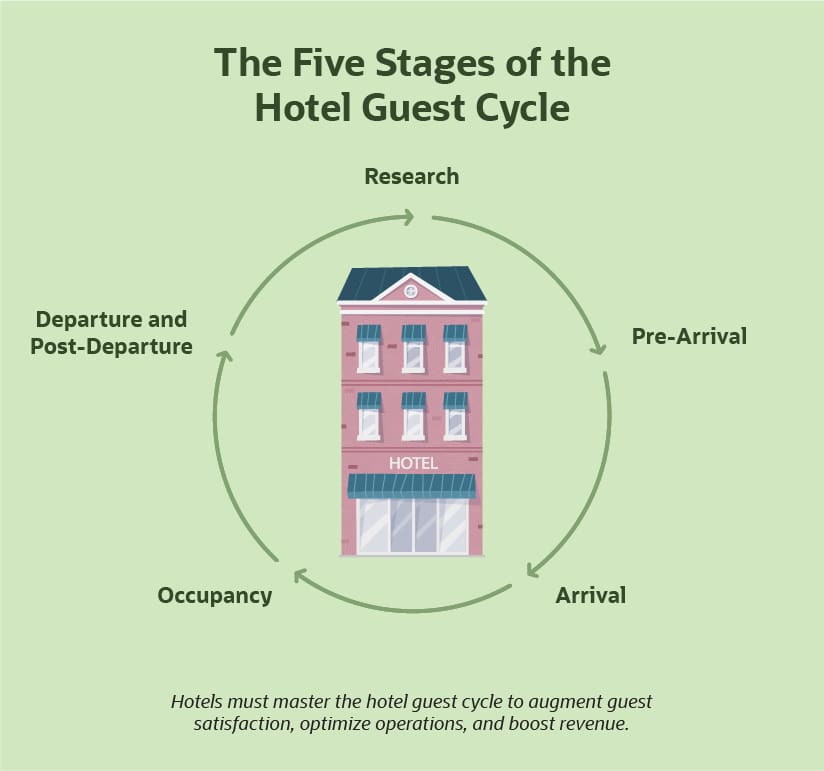
The hotel guest cycle refers to all the interactions between a guest and hotel property throughout the entire customer journey. It’s a five-stage systematic framework that tracks guest engagement from initial awareness through post-departure engagement and provides a structure to deliver consistent, high-quality experiences.
Key Takeaways
- Each phase of the hotel guest cycle requires specific strategies and coordinated efforts on the part of the property.
- Through improved service consistency and personalized experiences, effective guest cycle management affects customer satisfaction and revenue generation.
- Property management systems and guest communication platforms allow for smooth operations and data-driven decision-making.
- Common challenges include managing overbookings, maintaining service consistency, providing employee training, and limiting delays during check-in and checkout processes.
- Among the best practices for optimizing each stage of the guest journey are proactive communication, prompt response times, personalization, and strategic technology implementations.
Hotel Guest Cycle Explained
The hotel guest cycle gives hotels a roadmap for making every guest interaction better. By understanding this natural progression, properties can stay one step ahead of what guests need while coordinating teams to deliver consistently stellar experiences that earn repeat bookings and positive reviews. By examining each stage through both operational and guest perspectives, hotels can identify opportunities for improvement and lay out targeted strategies.
Why Is the Hotel Guest Cycle Important?
Managing the guest cycle strategically establishes a competitive advantage through superior service. Properties that excel at each stage create sustainable business models built on loyalty, positive reviews, and increased revenue per available room. For instance, the Global Review Index for 2025—a composite measure of hotel guest satisfaction—climbed to 86.9% worldwide, setting a new record and continuing an upward trend from the previous two years. Of note: Analysts say that improved staff responsiveness and post-stay engagement contributed most to the increase. Mastering the hotel guest cycle is important because of how it delivers the following benefits:
- Boosts customer satisfaction and experience: Each touchpoint along the guest cycle journey shapes guest perceptions and influences the likelihood of their returning or recommending the property. Hotels that consistently exceed expectations throughout the cycle develop emotional connections that transcend price comparisons and create brand advocates.
- Identifies areas for improvement: Systematic analyses of each cycle stage can reveal operational bottlenecks, service gaps, and missed opportunities. Properties can then allocate their resources more effectively.
- Coordinates services: Seamless collaboration among front office, housekeeping, guest services, and other teams is a hallmark of guest cycle expertise. The framework leads to integrated operations that translate into consistent service delivery and prevents miscommunications that generate guest dissatisfaction.
- Builds brand loyalty and reputation: Exceptional experiences throughout the cycle result in positive reviews, repeat bookings, and word-of-mouth referrals. Properties that master the guest journey enjoy sustainable competitive advantages. In fact, some of the world’s leading hotel loyalty programs reached massive scale in 2025: Marriott Bonvoy at 203 million members, Hilton Honors at 190 million, and IHG One Rewards at 130 million.
The Five Stages of the Hotel Guest Cycle
The hotel guest cycle breaks down into five connected phases that help hotel teams make smarter decisions about where to focus their time and resources. Understanding each stage means hotels can deliver targeted improvements that boost satisfaction and improve operations, resulting in greater revenue opportunities.
-
Research
The research phase begins when a potential guest first considers travel plans and ends with their booking decision. Modern travelers consult multiple sources and compare numerous properties. In the end, they expect seamless digital experiences. Hotels must keep a sharp online presence and provide accurate information and compelling visual content. Simply put, properties that provide transparent pricing and easy navigation are more effective at converting browsing into booking.
-
Pre-Arrival
Pre-arrival communications set expectations and heighten anticipation for the upcoming stay. This stage includes confirmation messages, pre-stay surveys, and proactive outreach about special requests or available upgrades. Hotels leverage this opportunity to gather guest data and address any potential concerns before guests arrive. When done well, pre-arrival engagement lowers check-in friction and facilitates personalized service delivery from the moment guests arrive.
-
Arrival
The arrival experience is the key to a lasting first impression, which is why smooth check-in processes and warm welcomes are vital. Front-office teams must coordinate with housekeeping departments to make sure rooms are ready, as well as manage guest expectations regarding availability and preferences. Properties using mobile check-in and digital room keys value guest convenience. Proper training positions staff to adequately recognize loyalty program members and handle special requests.
-
Occupancy
During occupancy, guests interact with multiple departments and services, informing their opinions about the property’s value and quality. Housekeeping must uphold room standards, guest services must respond to requests in a timely fashion, and recreational facilities must provide amenities that differentiate the property. Hotels should also monitor guest satisfaction through real-time feedback systems and make it possible for staff to address any issues proactively. Additionally, revenue management teams can identify upsell opportunities while making sure service delivery exceeds expectations.
-
Departure and Post-Departure
Departure processes shape final impressions, so easy checkout and accurate billing are a must. Post-departure engagement allows properties to stay connected with guests through thank-you messages, loyalty program updates, and targeted offers for future stays. Hotels that excel at this stage convert one-time guests into repeat customers and brand advocates.
Challenges in Managing the Hotel Guest Cycle
Managing the hotel guest cycle requires the coordination of multiple departments and touchpoints. It’s no wonder, then, that properties regularly face operational challenges that disrupt guest satisfaction and, ultimately, revenue performance. Understanding the following obstacles facilitates proactive solutions that can result in a competitive advantage:
- Overbooking and double bookings: Hotels balance maximizing occupancy with fulfilling every guest reservation. Despite the use of automation and real-time inventory tools, system lags, human error, and aggressive revenue tactics can result in risky overbooking or double bookings—a frequent source of guest dissatisfaction. While quick recovery—rebooking, upgrades, or compensation—is essential, it doesn’t address the root cause. Hotels need to take preventive measures, such as integrating property management systems with channel managers for real-time updates, conducting regular staff training on reservation tools, and establishing clear protocols for handling booking conflicts.
- Service consistency among locations: Multiproperty brands, especially, struggle to provide uniform guest experiences. It’s essential for properties to standardize operating procedures and invest in centralized training programs. Conducting regular compliance audits is also recommended. Shared digital platforms for feedback help identify service gaps quickly. Leadership should encourage cross-property collaboration and staff rotation to spread best practices and establish unified service standards.
- Employee training and retention: High turnover rates and insufficient onboarding can threaten service continuity. Hotels address this through structured onboarding programs, ongoing skill development, and clear advancement pathways. Competitive compensation, recognition initiatives, and a positive workplace culture can all contribute to retention of valuable team members. Of course, regular feedback and on-the-job mentoring also do their part to keep staff prepared for evolving guest needs.
- Delays at check-in and checkout: Peak arrival and departure times often prompt bottlenecks that damage first and last impressions. Hotels should implement mobile check-in, self-service kiosks, and predictive staffing models based on arrival data. Pre-arrival communication and streamlined workflows reduce wait times. Also, granting staff the authority to resolve issues quickly will minimize delays and guest frustration.
Best Practices for a Successful Hotel Guest Cycle
Developing a service culture that addresses both routine operations and unexpected challenges typically results in greater guest satisfaction and loyalty, which, in turn, translates into more revenue. Here are some proven methods to accomplish these goals:
- Communicate effectively: Proactive communication via email, SMS/text, mobile apps, and social media keeps guests informed before, during, and after their stay. Clear updates about reservations, arrival procedures, and amenities quell uncertainty. Personalized pre-arrival messages tailored to guest preferences build rapport and set expectations for a smooth and enjoyable stay.
- Respond to queries promptly: Quick, thoughtful responses to guest inquiries demonstrate professionalism and care. Combining AI-powered chatbots that offer immediate acknowledgment with skilled human follow-up balances efficiency and personalization. To make sure all communication reflects genuine warmth and competence, train staff in empathy, active listening, and problem-solving.
- Encourage direct bookings: Direct booking channels eliminate third-party commissions and provide valuable guest data for personalization. Direct bookings can be encouraged with best-rate guarantees, loyalty points, room upgrades, and exclusive amenities. Clear website messaging about these benefits and a simplified reservation process are important, as well.
- Personalize services: Guest data that’s been gathered makes it easy to customize services throughout the stay—from greeting repeat guests by name to anticipating room preferences. CRM and property management systems support sophisticated personalization based on historical data, such as special occasions and in-stay behavior. These thoughtful touches forge memorable experiences that differentiate properties in competitive markets.
- Uphold consistent service: Maintaining standards for all shifts and departments requires detailed procedures, ongoing training, and regular audits. Property management systems enforce consistency through automated workflows and standardized processes. Real-time feedback identifies service gaps early. Hoteliers must foster accountability and continual improvement so that every team member delivers the brand promise.
- Encourage friendliness: Authentic warmth transforms routine transactions into memorable interactions. Leadership sets the tone through employee recognition programs and empowerment initiatives; motivated staff members who feel valued more naturally provide exceptional service. Practicing this kind of genuine hospitality forms emotional connections that increase guest loyalty and result in positive reviews.
- Implement and integrate technology: Modern technology simplifies operations and enriches guest experiences. Integrated property management systems, communication platforms, ERP software, and CRM tools provide staff with complete guest visibility and facilitate real-time coordination. Automation reduces manual tasks and errors, while predictive analytics supports proactive service delivery. Technology integration makes personalization possible at scale and helps properties adapt quickly to changing guest expectations; it also eliminates data silos.
How Does Technology Help Improve the Hotel Guest Cycle?
Every aspect of the hotel guest cycle is transformed by technology. Modern ERP systems integrate reservations, guest preferences, finance, inventory, and operational data into a unified platform that strengthens efficiency—and, perhaps more important, service quality. Mobile applications are especially powerful in that they offer guests self-service options from booking through checkout, while providing hotels with valuable behavioral data.
And what digital transformation would be complete without AI? In the hotel world, AI can, among other things, bolster revenue management through dynamic pricing and demand forecasting. Chatbots, meanwhile, handle routine inquiries on the fly. What’s more, hotels leveraging integrated technology stacks can be sure of seamless experiences across all touchpoints. The strategic deployment of technology frees staff to focus on high-value interactions that result in delighted guests.
Manage Your Hotel Guest Cycle With the Right ERP
NetSuite Hospitality ERP embraces the entire guest cycle by unifying financial management, reservations, inventory control, and guest data into a single solution accessible to all departments, at all properties. Real-time visibility makes possible proactive decision-making, while automation cuts down on the number of manual tasks and associated errors. Hoteliers gain comprehensive insights into guest behavior, operational efficiency, and financial performance through integrated analytics and reporting. And when deployment is cloud-based, scalability and accessibility are easily achieved without burdensome IT infrastructure costs.
Mastering the hotel guest cycle is the foundation upon which lasting reputations are built. From initial research through post-departure engagement, each stage presents opportunities for hotels to transform routine transactions into unforgettable moments. But success requires more than operational excellence—it demands a true understanding of the emotional journey travelers take in order to respond with intelligence and authenticity at every touchpoint. Properties that integrate thoughtful service and an empowered staff—along with the strategic use of technology—will enjoy a sustainable competitive advantage.
Hotel Guest Cycle FAQs
What are common hotel guest cycle problems?
Common challenges of the hotel guest cycle include communication breakdowns between departments, inconsistent service delivery, technology integration issues, and difficulty personalizing experiences at scale. Hotels also struggle with capturing and effectively acting on guest feedback, as well as managing the complexity of multichannel distribution and loyalty programs.
What’s the role of the hotel staff in the guest cycle?
Staff members serve as the primary interface between hotels and guests. Their responsibilities include anticipating needs, resolving issues, personalizing service delivery, and gathering feedback that drives continuous improvement. Well-trained staff can turn standard transactions into relationship-building opportunities.
What are the stages of the hotel guest journey?
The hotel guest journey consists of five stages: research, pre-arrival, arrival, occupancy, and departure/post-departure. Each stage presents unique opportunities to exceed guest expectations and build lasting relationships.